Skip to content
Bevel & Bone

HUB 04 · Reviews

MAC MTH-80 Review

The knife a lot of cooks quietly consider the best all-rounder made. Here's what the spec sheet says, and who it's for.

By Stephen V.Updated How we choose
#ad

We earn a commission when you buy through our Amazon links, at no extra cost to you. It never changes a ranking, and we say so when the cheaper knife is the better buy. How this works.

The MAC MTH-80 has a strange reputation: it's the knife serious cooks recommend to each other but that almost nobody outside the hobby has heard of. It isn't beautiful, it isn't cheap, and it isn't marketed hard. It just cuts extraordinarily well and holds that edge — which is the whole job.

What the spec sheet tells you

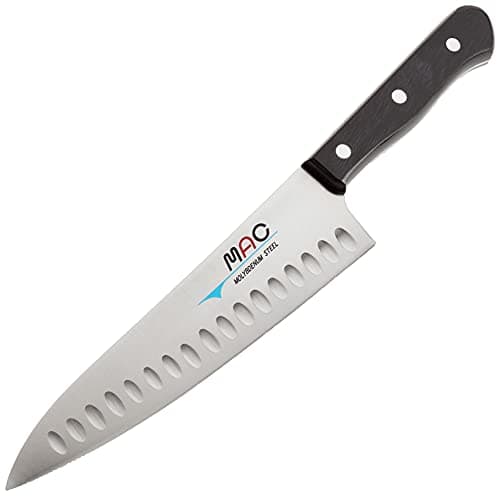
The MTH-80 pairs a high-carbon molybdenum-vanadium steel (a hard, Japanese-style blade around HRC 59–61) with an unusually thin blade and a keen ~15°-per-side edge. That combination is the point: the hardness holds the edge far longer than a German knife, and the thin geometrymeans it falls through produce with almost no wedging. The dimpled "hollow" edge adds small air pockets so starchy foods release instead of sticking. It sits between German toughness and full-Japanese fragility — harder than a Wüsthof, more forgiving than a Damascus gyuto.

Who it's for

The MTH-80 is our top overall pick for a cook who is ready to spend a little more than a Victorinox and will treat a knife with normal care. It's the "buy once" answer for most enthusiastic home cooks — the reason it leads our best chef knives ranking. It is notthe pick if you're rough with knives (the harder steel chips where soft German steel just rolls) or if you want the lightest possible blade — see the "don't buy this if" note below.

Value

It costs several times a Victorinox and looks almost as plain, so the value case is entirely about performance-per-dollar over years, not shelf appeal. Against premium Japanese knives twice its price (Shun, Miyabi), it gives up finish and beauty but very little cutting ability — which is exactly why we rate it so highly and why the pricier Japanese options are more about the object than the cut.

In detail

The knife, in detail

01
Mac Mac Mth-80 Professional Hollow Edge 8" Chef's Knife

The best overall, if budget allows

Mac Mth-80 Professional Hollow Edge 8" Chef's Knife

8 in / 20 cmMolybdenum-vanadium~HRC 59–61~15° edgeDimpled
8.4/10

The knife a lot of cooks quietly consider the best all-rounder made. Thin, sharp, and it stays that way.

Edge retention
9
Out-of-box edge
9
Handling
9
Build
8
Value
7

Pros

  • The blade is unusually thin, so it falls through produce with almost no wedging
  • Harder Japanese-style steel than the German knives — holds its edge markedly longer
  • The dimples (granton edge) genuinely reduce sticking on starchy vegetables
  • Takes and holds a very acute edge

Cons

  • No full bolster; the pinch grip sits right at the blade — some find it exposed
  • Harder steel is a little less forgiving of lateral abuse than soft German steel
  • Costs several times a Victorinox and looks almost as plain

Don't buy this if…

you're rough with your knives — you pry, twist, or hit bone. Harder, thinner steel chips where soft German steel just rolls. Buy the Wüsthof or the Victorinox and treat it like a hatchet if you must.

$114.95View on Amazon

Price as of Jul 18, 2026. Prices change — Amazon's is the one that counts.

#ad · we may earn a commission from this link to Mac Mth-80 Professional Hollow Edge 8" Chef's Knife

Questions

Frequently asked

Is the MAC MTH-80 worth the money?

For a cook who will use and maintain it, yes — it cuts like knives twice its price and holds an edge far longer than a German knife at a similar cost. If you're rough with knives or only cook occasionally, a cheaper Victorinox is the smarter buy.

What angle is the MAC MTH-80 sharpened to?

Around 15° per side — a keen, Japanese-style edge that suits its harder steel. Maintain it at that angle; see our sharpening angle guide.

Can the MAC MTH-80 chip?

Yes — its harder, thinner edge is less forgiving than soft German steel. Keep it off bone, don't twist or pry, use a wood or plastic board, and it will stay intact for years.

Keep reading

Receipts

Sources

We do not run a test kitchen, and we do not pretend to. Specs are the manufacturer's published figures, attributed as such; where we could not verify something, we say so on the page rather than quietly leaving it out. Read our full method.