

Skip to content
Bevel & Bone

HUB 02 · Sharpening

Best Honing Steels

The daily-maintenance tool that keeps a knife feeling new — five rods ranked, plus why hard blades need ceramic.

By Stephen V.Updated Published How we choose
#ad

We earn a commission when you buy through our Amazon links, at no extra cost to you. It never changes a ranking, and we say so when the cheaper knife is the better buy. How this works.

A honing steel does not sharpen a knife — it realigns an edge that has rolled over microscopically, which keeps a sharp knife feeling sharp between actual sharpenings. It's cheap, fast, and the daily habit that does the most to keep an edge. (If your knife is genuinely dull, you need a stone, not a steel — see sharpening vs honing.)

Our top pick is the Victorinox — a plain, fine-cut steel rod that does exactly what a hone should for very little money. But the most important choice here isn't the ranking; it's matching the rod to your knife's hardness, covered below.

The short answer

Quick picks

#ad · Live prices from the Amazon Product API, as of October 16, 2026. Where we have no verified live price we show none — we'd rather leave a gap than print a number that has rotted.

By the numbers

The specs, side by side

Every figure below is the manufacturer's published specification. Where a maker doesn't publish a value, the cell reads "—" rather than a number we made up.

Knife / ToolTypeLengthSurfaceHandle
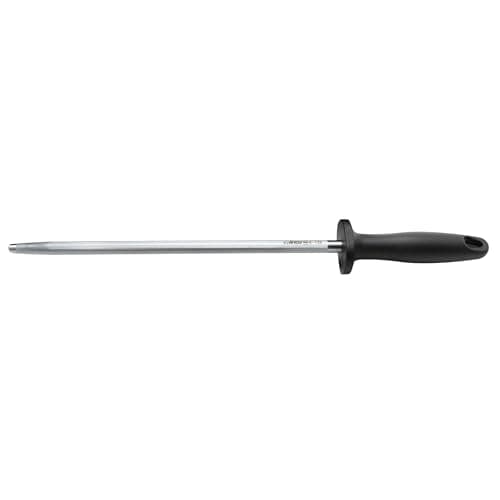
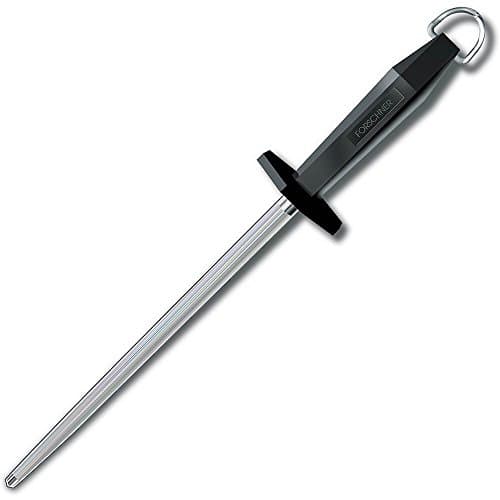
Victorinox 10" Fine Cut Honing Steel (40581)Fine-cut steel rod (round, 7/16 in diameter)10 in (25 cm) rodFine cut (#5)Black polyamide with finger guard and hanging ring
Wüsthof 10" Sharpening SteelFine-cut steel rod10 in (26 cm) rodFine cutTriple-riveted POM
Mercer Culinary 12" Ceramic Honing RodCeramic rod12 in rod (19.1 in overall)Fine, 1200 gritErgonomic nylon with hand guard
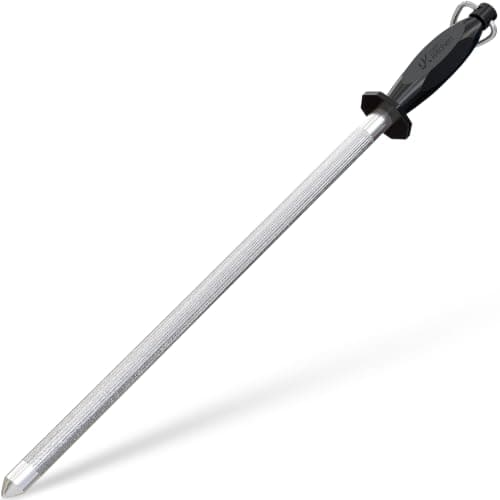
Winco 12" Sharpening SteelSteel rod12 in (30 cm) rodStandard cutPlastic with guard and ring
Utopia Kitchen 12" Honing SteelCarbon-steel rod12 in (30 cm) rodStandard cutPlastic with hanging ring

In detail

The picks, in full

01
Victorinox Victorinox 10" Fine Cut Honing Steel (40581)

The default honing steel

Victorinox 10" Fine Cut Honing Steel (40581)

Steel rod10 inFine cutPolyamide handleMagnetic tip
8.4/10

A no-nonsense fine-cut steel from the people who make the default chef's knife. Cheap and correct.

Realignment
8
Build
8
Ease of use
9
Versatility
7
Value
10

Pros

  • Fine cut realigns a rolled edge without stripping metal — exactly what a hone should do
  • 10 inches is long enough for an 8-inch chef's knife with room to spare
  • A finger guard between handle and rod, plus a hanging ring — a plain working-kitchen tool

Cons

  • A honing steel maintains an edge; it does not sharpen a dull one (people forget this constantly)
  • Steel rods won't touch very hard Japanese blades the way a ceramic rod will

Don't buy this if…

…your knives are hard Japanese steel (HRC 60+). A traditional steel rod barely bites on them — a fine ceramic rod is the right hone for hard blades.

$42.10View on Amazon

Price as of October 16, 2026. Prices change — Amazon's is the one that counts.

#ad · we may earn a commission from this link to Victorinox 10" Fine Cut Honing Steel (40581)

02
Wüsthof Wüsthof 10" Sharpening Steel

Matching a German knife set

Wüsthof 10" Sharpening Steel

Steel rod10 inFine cutPOM handleMade in Germany
8.0/10

The steel that matches the classic German knife. Well-made, well-balanced, and it'll last forever.

Realignment
8
Build
9
Ease of use
9
Versatility
7
Value
7

Pros

  • Beautifully balanced and built like the Wüsthof knives it's meant to accompany
  • Fine cut is gentle on an edge — daily honing without eating your blade
  • A genuine lifetime tool

Cons

  • You pay a German-brand premium for what a Victorinox rod does equally well
  • Same limitation as any steel rod: it won't bite on very hard blades

Don't buy this if…

…you just want the function. The Victorinox steel hones just as well for less; buy the Wüsthof if you want the matching set on your counter.

$65.00View on Amazon

Price as of October 16, 2026. Prices change — Amazon's is the one that counts.

#ad · we may earn a commission from this link to Wüsthof 10" Sharpening Steel

03
Mercer Culinary Mercer Culinary 12" Ceramic Honing Rod

Honing hard Japanese blades

Mercer Culinary 12" Ceramic Honing Rod

Ceramic rod12 in1200 gritNylon handleHand guard
8.0/10

The hone for hard Japanese knives. A fine ceramic rod actually bites where a steel rod slides off.

Realignment
8
Build
8
Ease of use
9
Versatility
9
Value
6

Pros

  • Mercer publishes a 1200-grit ceramic surface — abrasive enough to lightly refresh a hard edge, not just realign it
  • 12-inch rod suits long chef's and slicing knives
  • Nylon handle with a full hand guard and non-slip grip — the safest rod here to use with wet hands

Cons

  • The priciest rod in this roundup by some way, for a job a cheap steel rod does on soft German knives
  • Ceramic is brittle — drop it and it can crack or chip
  • Hand wash only; Mercer says don't put it in the dishwasher or leave it soaking

Don't buy this if…

…your knives are soft German steel and you already hone daily with a steel rod. The ceramic's advantage only shows up on hard blades; on soft steel a plain steel rod is fine — and a quarter of the price.

$68.69View on Amazon

Price as of October 16, 2026. Prices change — Amazon's is the one that counts.

#ad · we may earn a commission from this link to Mercer Culinary 12" Ceramic Honing Rod

04
Winco Winco 12" Sharpening Steel

Commercial-kitchen durability

Winco 12" Sharpening Steel

Steel rod12 inStandard cutPlastic handleNSF
7.6/10

The steel you see hanging in restaurant kitchens: cheap, tough, NSF, and utterly unglamorous.

Realignment
7
Build
8
Ease of use
8
Versatility
6
Value
9

Pros

  • NSF-certified commercial workhorse built to survive a busy line
  • Long rod and a big finger guard make it safe and quick to use
  • As cheap as honing steels get

Cons

  • Purely functional — no finesse and a coarser cut
  • Won't touch hard Japanese steel, like any traditional rod

Don't buy this if…

…you want the finest possible hone for a nice knife. This is a rugged, cheap line-cook's rod; for refinement choose the Victorinox fine steel or a ceramic rod.

$17.53View on Amazon

$19.9812% off

Price as of October 16, 2026. Prices change — Amazon's is the one that counts.

#ad · we may earn a commission from this link to Winco 12" Sharpening Steel

05
Utopia Kitchen Utopia Kitchen 12" Honing Steel

Spending as little as possible

Utopia Kitchen 12" Honing Steel

Steel rod12 inCarbon steelPlastic handleHanging ring
7.2/10

The cheapest honing rod worth owning. It does the one job a hone has to do, and nothing else.

Realignment
7
Build
6
Ease of use
8
Versatility
6
Value
9

Pros

  • Costs almost nothing and realigns a soft-steel edge perfectly well
  • Long 12-inch rod handles any home knife
  • A fine first hone to build the daily habit without spending

Cons

  • Plastic handle and basic build — it feels like what it costs
  • Coarser cut than a Victorinox or Wüsthof fine steel; use a light touch

Don't buy this if…

…you want a tool that lasts a lifetime or matches a nice knife set. This is the functional-minimum pick; the Victorinox is a small step up in refinement for a little more.

$10.90View on Amazon

$14.9927% off

Price as of October 16, 2026. Prices change — Amazon's is the one that counts.

#ad · we may earn a commission from this link to Utopia Kitchen 12" Honing Steel

The one rule: match the rod to the steel

This is the mistake people make. A traditional steel rod realigns soft German edges beautifully but barely bites on hard Japanese blades (HRC 60+). For those, you want a fine ceramic rod (like the Mercer), which is abrasive enough to lightly refresh a hard edge as it hones. So:

  • Soft German knives (~HRC 56): a fine steel rod (Victorinox, Wüsthof) is perfect and forgiving.
  • Hard Japanese knives (~HRC 60+): use a fine ceramic rod. A steel rod slides off and does little; see best Japanese chef knives for which knives this applies to.

Honing technique in one paragraph

Hold the rod vertical, tip on a cloth on the counter. Set the knife at roughly its edge angle (~15–20°), and draw it down and across the rod from heel to tip, alternating sides, five or six light strokes each. Light pressure — you're aligning, not grinding. Do it every few uses. When honing stops bringing the edge back, it's time to actually sharpen on a stone.

The forged German option, in depth

The one rod on this list that is built like a knife rather than a tool is worth a closer look if you own forged German blades — our Wüsthof honing steel review covers the length, the surface and whether the matching-set premium is real.

Where to go next

The reason to own a rod at all is that it removes almost no steel. How many times can a knife be sharpened works through why that makes honing the maintenance that keeps a knife off the stone for months.

How we picked

We do not run a test kitchen

We compiled each product's published specifications — steel, hardness, edge geometry, weight — normalized them into the matrix above, and scored each one against a published rubric. The scores are judgments from those specs and the value math — they are not measurements we took, because we do not have a test kitchen and we're not going to pretend we do. Units we claim to have tested: 0.

Questions

Frequently asked

Does a honing steel sharpen a knife?

No — it realigns an edge that has rolled, keeping a sharp knife sharp. It removes little or no metal. To restore a genuinely dull edge you need a whetstone. See sharpening vs honing.

What honing rod do I need for a Japanese knife?

A fine ceramic rod. Traditional steel rods barely bite on hard Japanese steel (HRC 60+); a ceramic rod like the Mercer lightly sharpens as it hones, which is what hard blades need.

What happened to the Messermeister ceramic rod?

Amazon no longer lists it — the Messermeister 12-inch ceramic rod, its ultra-fine 2200-grit sibling and the 4-sided diamond rod all read "currently unavailable," so we replaced it here with the Mercer Culinary 12-inch ceramic rod, which publishes the same fine 1200-grit ceramic surface in the same length. Our old Messermeister review stays up for reference.

How often should I hone my knife?

Frequently — every few uses or before a big prep session. It takes ten seconds and means you'll need to sharpen on a stone far less often.

Keep reading

Receipts

Sources

We do not run a test kitchen, and we do not pretend to. Specs are the manufacturer's published figures, attributed as such; where we could not verify something, we say so on the page rather than quietly leaving it out. Read our full method.