Skip to content
Bevel & Bone

HUB 04 · Reviews

Tojiro DP Gyuto Review

The cheapest honest way into a real VG-10 Japanese knife. It punches absurdly far above its price.

By Stephen V.Updated How we choose
#ad

We earn a commission when you buy through our Amazon links, at no extra cost to you. It never changes a ranking, and we say so when the cheaper knife is the better buy. How this works.

The Tojiro DP is the knife that breaks the "you get what you pay for" rule. It puts a genuine VG-10 cutting core — the same class of steel used in knives three times the price — into a plain, no-frills package that costs about what a mid-range German knife does. For a first Japanese knife, nothing else is close on value.

What the spec sheet tells you

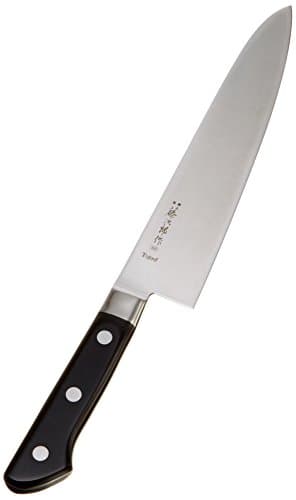
A VG-10 core(Takefu's well-regarded Japanese stainless) hardened to about HRC 60, clad in two outer layers of softer stainless for a three-layer blade, ground to a keen ~15° edge. The hardness is the story: it holds an edge markedly longer than any German knife here, and the thin, flat-ish profile suits precise push-cutting. What you don't pay for is finish — the Western handle is basic and a little blocky. You're buying the steel, not the fit and polish, and the steel guideexplains why that's a smart trade.

Who it's for

The cook ready to graduate from a soft-steel beginner knife to something that holds an edge — but who doesn't want to spend $150+ to do it. It's the value pick in our best Japanese chef knives list and the top knife in best chef knives under $100. It is not for a household that abuses knives: VG-10 rewards good habits and punishes bad ones — twist it through bone or freeze and the hard edge can chip.

Value

This is the single best value in the category and one of the highest-scoring knives on the whole site, precisely because our value math rewards cutting performance per dollar and the Tojiro maxes it. If you want the biggest jump in edge retention for the least money, this is the knife — pair it with a good stone to keep that hard edge keen.

In detail

The knife, in detail

01
Tojiro Tojiro DP Gyuto 210 mm Chef's Knife

The best value in a Japanese knife

Tojiro DP Gyuto 210 mm Chef's Knife

8.3 in / 210 mmVG-10 core~HRC 60~15° edge3-layer clad
8.2/10

The cheapest honest way into a real VG-10 Japanese knife. It punches absurdly far above its price.

Edge retention
8
Out-of-box edge
8
Handling
8
Build
7
Value
10

Pros

  • A genuine VG-10 cutting core at a price the German knives can't touch — this is the value story of the category
  • Harder than any German blade here, so it holds a keen edge far longer
  • Thin, flat-ish profile suits push-cutting and precise work

Cons

  • The Western handle is basic and a little blocky — you're paying for the steel, not the fit and finish
  • Harder steel chips if you twist it through bone or freeze; treat it with respect
  • Reactive-ish edge on the very hard core wants drying after acidic food

Don't buy this if…

this is the only knife in a household that abuses knives. VG-10 rewards good habits and punishes bad ones — a Victorinox is the more forgiving choice for a shared kitchen.

$74.82View on Amazon

Price as of Jul 18, 2026. Prices change — Amazon's is the one that counts.

#ad · we may earn a commission from this link to Tojiro DP Gyuto 210 mm Chef's Knife

Questions

Frequently asked

Is the Tojiro DP a good first Japanese knife?

It's the classic first Japanese knife — a genuine VG-10 core at German-knife money. It holds an edge far longer than a soft German blade, as long as you treat it with a little care (no bone, no twisting, a wood or plastic board).

What is VG-10 steel?

A high-carbon Japanese stainless made by Takefu, hardened to about HRC 60–61. It takes and holds a very keen edge while resisting rust. See our knife steel guide.

Does the Tojiro DP need special sharpening?

Not special, but proper: keep it at its ~15° edge on a whetstone. Its hard steel rewards a fine finishing grit. Our sharpening how-to covers the technique.

Keep reading

Receipts

Sources

We do not run a test kitchen, and we do not pretend to. Specs are the manufacturer's published figures, attributed as such; where we could not verify something, we say so on the page rather than quietly leaving it out. Read our full method.