The MAC Chef Series HB-85 is the pick if you can stretch to it. At ~4.9 oz with a 2.0 mm blade at ~HRC 60 behind a ~15° edge, it requires less force to cut than anything else on this site — and force is the thing that hurts. If the budget is tighter or a soft, grippy handle matters more to you than the blade, the Mercer Millennia at a fraction of the price is the right answer instead. Both are better choices here than any heavy forged German knife, however good it is.
How this list is ranked: by how little a knife asks of a painful hand — cutting effort first, then weight, then how securely the handle sits without being squeezed — not by overall score. A Wüsthof Classic scores highly and is deliberately absent, because 9.0 oz and a full bolster are the wrong answer to this question.
One honest caveat before the picks: we are not clinicians and this is not medical advice. These are equipment judgements from published specifications — weight, blade thickness, hardness, edge angle and handle material. If you have significant hand pain or loss of grip, an occupational therapist can assess your specific hand far better than a spec sheet can.
Why sharpness matters more than any ergonomic feature
The single biggest lever on how much force a cut takes is not the handle. It is how thin and how keen the blade is. A thick, dull blade has to wedge food apart, and the only way to make that happen is to push harder and grip tighter — which is exactly the loading that hurts an arthritic hand and the reason knives slip.
That gives you two things to buy for, and they compound. A thin blade behind a low edge angle separates food instead of splitting it: ~15° per side on a 2.0 mm spine (the MAC) takes dramatically less effort than ~20° per side on a thicker German grind. Blade geometry is the full explanation. And harder steel keeps that edge longer, which means the knife stays low-effort for months instead of weeks — knife hardness explained covers the HRC scale and the trade-off.
The corollary is uncomfortable but important: if you are going to let a knife go dull, no knife on this page will help you. Honing takes ten seconds and restores most of the lost cutting ease — how to hone a knife and how often to sharpen are the two pages to read after this one. If gripping a honing rod is itself the problem, a guided sharpening system or a local sharpening service is the better route than a stone — is professional knife sharpening worth it runs the numbers.
What to look for
- Light weight — under about 6 oz. Every ounce is carried by your hand and wrist for the whole prep session. The MAC HB-85 is ~4.9 oz and the Mercer Millennia ~5.6 oz; a forged Wüsthof Classic is ~9.0 oz and a forged Mercer Genesis ~8.5 oz. That is nearly double, and you feel it in twenty minutes.
- A thin blade and a low edge angle. ~15° per side cuts with noticeably less push than ~20°. Thin spines matter as much as the bevel.
- A textured, slightly soft handle. Santoprene, Fibrox TPE and textured polypropylene all let you hold a knife securely without clamping down on it. Smooth polished wood and smooth steel both have to be gripped harder to feel safe, which is the thing you are trying to avoid.
- A finger guard or a defined bolster step.Something that stops your hand sliding forward onto the blade if your grip slackens. The Millennia's molded guard is the clearest example here.
- A handle you can hold in a full fist.The classic pinch grip is the most controlled way to hold a chef's knife and also the most demanding on finger joints. A bolsterless or short-bolster knife lets you choke back into a comfortable full grip instead — how to hold a chef knife shows both, and knife bolster explained covers why a full bolster gets in the way.
- Length: 8 to 8.5 inches, not shorter. It is tempting to size down, but a longer blade lets you cut with one smooth draw rather than several sawing strokes — fewer repetitions for the same work. Chef knife sizes explained has the full reasoning.
The short answer
Quick picks
#ad · Live prices from the Amazon Product API, as of October 11, 2026. Where we have no verified live price we show none — we'd rather leave a gap than print a number that has rotted.
By the numbers
The specs, side by side
Every figure below is the manufacturer's published specification. Where a maker doesn't publish a value, the cell reads "—" rather than a number we made up.
In detail
The picks, in full
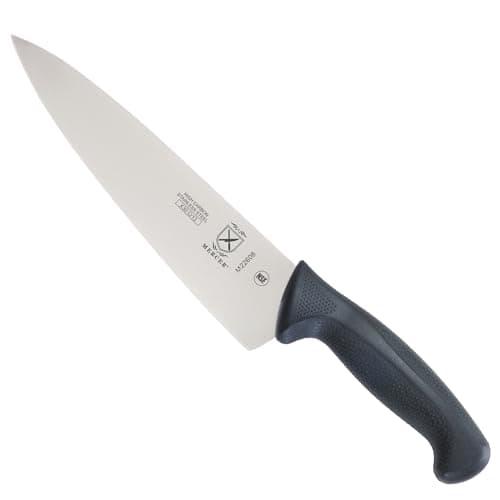
The lightest, cheapest way into a MAC
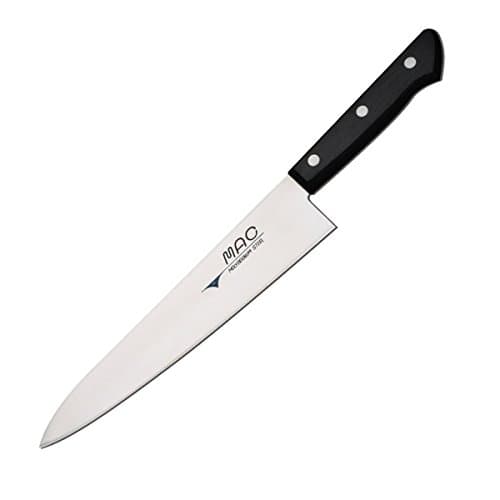
MAC Chef Series 8.5" Chef's Knife (HB-85)
8.5 in / 21.5 cmMolybdenum-vanadium~HRC 60~15° edge4.9 oz
MAC's entry-level gyuto: the same hard, thin Japanese steel as the famous MTH-80 in a lighter, plainer, cheaper package.
- Edge retention
- 8
- Out-of-box edge
- 8
- Handling
- 9
- Build
- 7
- Value
- 8
Pros
- +MAC calls it the lightest chef's knife it makes — at under 5 oz it is nimble in a way no German knife is
- +A 2.0 mm spine with the gyuto's gradual taper: it slides through produce rather than wedging
- +The same molybdenum-vanadium steel family and ~HRC 60 as MAC's pricier lines, at the lowest MAC price on Amazon
- +Western riveted handle with a small steel bolster — nothing about the grip needs learning
Cons
- −No dimples (granton edge), so starchy slices stick to the blade more than on the MTH-80
- −The half-bolster and thinner handle feel spare next to a forged German knife of the same price
- −Hard, thin steel is less forgiving of twisting and bone contact than a soft stamped blade
Don't buy this if…
…you want heft. This is a feather; if a heavy, forward-balanced knife is what feels 'right' in your hand, the Tojiro DP or a German blade will suit you better.
The cheapest knife worth owning
Mercer Culinary Millennia 8" Chef's Knife
8 in / 20 cmJapanese steel~HRC 56StampedSantoprene
The culinary-school standby: a cheap, light, NSF stamped knife that culinary students are told to buy.
- Edge retention
- 5
- Out-of-box edge
- 6
- Handling
- 8
- Build
- 6
- Value
- 10
Pros
- +About the cheapest chef knife any professional will actually endorse
- +Light and grippy; the textured handle has a finger guard beginners appreciate
- +NSF-certified — the reason it's on culinary-school supply lists
Cons
- −Soft steel and a rougher factory edge than the Victorinox
- −Fit and finish are exactly what the price suggests
Don't buy this if…
…you can stretch to the Victorinox Fibrox. It's a small step up in money for a real step up in edge and finish — the Millennia is the pick only when every dollar counts.
Your first good chef knife
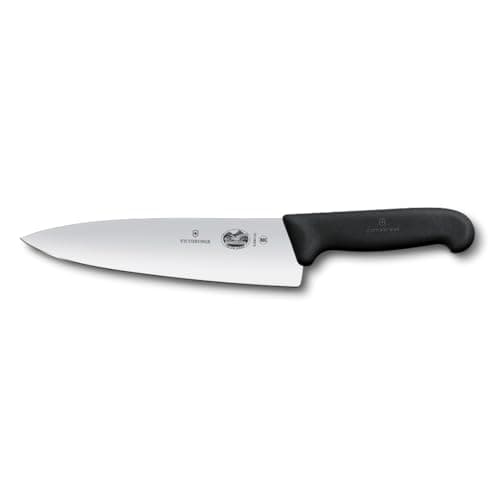
Victorinox Fibrox Pro 8" Chef's Knife
8 in / 20 cmX50CrMoV15~HRC 55–56StampedFibrox handle
The default answer to "what's a good first chef knife." Cheap, light, holds a usable edge, and a joy to sharpen.
- Edge retention
- 6
- Out-of-box edge
- 8
- Handling
- 8
- Build
- 7
- Value
- 10
Pros
- +Costs a fraction of a forged German knife and out-cuts most of them out of the box
- +Soft-ish steel takes a screaming edge on a stone in minutes — the easiest knife here to learn to sharpen on
- +Light and nimble; the textured Fibrox handle grips even with wet hands
- +NSF-certified and dishwasher-tolerant (though you still shouldn't)
Cons
- −Softer steel means you hone often and sharpen more frequently than a hard Japanese blade
- −Stamped blade lacks the heft and bolster some cooks want for control
- −It is a tool, not an heirloom — nothing about it is beautiful
Don't buy this if…
…you want a knife that keeps its edge for months between sharpenings. This trades edge retention for being cheap and easy to re-sharpen — a great trade for a beginner, a poor one if you refuse to touch a stone.
Commercial kitchens and sanitation-first cooks
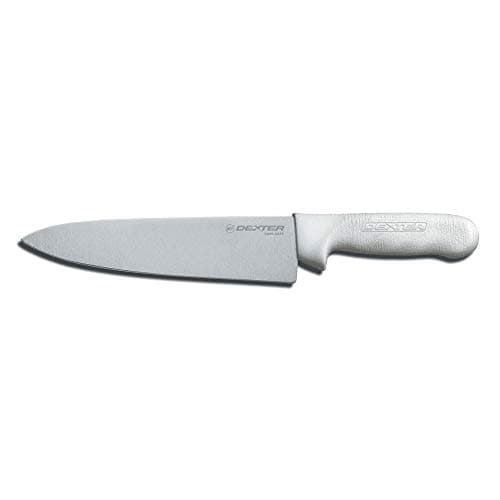
Dexter-Russell Sani-Safe 8" Chef's Knife
8 in / 20 cmDEXSTEEL stainlessStampedSealed polypropylene handleNSF certified
Foodservice equipment, not cutlery. NSF-certified, sealed at the handle, made in Massachusetts, and priced to be replaced without a second thought.
- Edge retention
- 5
- Out-of-box edge
- 7
- Handling
- 8
- Build
- 7
- Value
- 9
Pros
- +NSF-certified with a sealed blade-to-handle joint — no rivet gaps or bolster crevice for food to hide in
- +The textured polypropylene handle keeps its grip wet or greasy, which is the entire point in a working kitchen
- +Soft-ish stainless comes straight back on a honing rod, so a cook can fix the edge mid-shift instead of finding a stone
- +Made in Southbridge, Massachusetts and priced like a consumable
Cons
- −Dexter publishes no HRC, no bevel angle and no weight for this knife, so three of our spec columns sit empty
- −Edge retention is ordinary — this is a hone-every-shift knife, not a hold-it-for-months one
- −Utilitarian to a fault: a white plastic handle and a stamped blade will never be the knife you show anyone
Don't buy this if…
…you want one knife you'll still admire in twenty years. This is designed to be sanitized, resharpened and eventually thrown away. The Wüsthof or the MAC is the knife you keep.
The picks, and who each suits
- MAC Chef Series HB-85 (8.5") — the lowest-effort cut on the site. ~4.9 oz, a 2.0 mm stamped blade, high-carbon chrome-moly-vanadium at ~HRC 60, ~15° per side. It falls through produce with almost no downward pressure and holds that edge far longer than a soft German blade. The handle is riveted Pakkawood — well shaped but smooth and hard, so it is the weakest part of the knife for this use. Costs several times the Millennia.
- Mercer Culinary Millennia 8" — the grip-first pick, and the cheapest knife here. ~5.6 oz with a textured Santoprene handle and a molded finger guard, in Japanese stainless at ~HRC 56. The handle is the most secure on this page without asking for any squeeze at all. The trade is edge: at ~HRC 56 behind ~20° it dulls faster than the MAC, so it needs honing more often to stay low-effort.
- Victorinox Fibrox Pro 8"— the balanced default. ~6.6 oz, X50CrMoV15 at ~HRC 55–56, and the textured Fibrox handle that grips with wet or greasy hands. Heavier than the first two, but it is the easiest knife here to bring back to screaming sharp on a stone or at a sharpening service, which matters more over years than the extra ounce and a half.
- Dexter-Russell Sani-Safe 8"— for the largest, most textured handle. Sealed blade-to-handle joint and a textured polypropylene grip designed for commercial kitchens, made in Massachusetts and priced to be replaced. Dexter publishes no Rockwell figure, no bevel angle and no weight for this knife, so three cells in the matrix read "—" rather than carry an invented number.
What we deliberately left off
Heavy forged German knives.The Wüsthof Classic and the forged Mercer Genesis are both excellent and both roughly twice the weight of the MAC. Weight is sometimes sold as "letting the knife do the work", which is true for chopping through a squash and false for ninety per cent of prep, where you are simply holding it up.
The Global G-2. It is light (~5.8 oz) and often recommended for ergonomics, and we are leaving it off on purpose: the one-piece dimpled stainless handle is hard, cold and slippery with wet or oily hands, and it is the most polarizing handle in our lightweight ranking. If grip security is a concern, a seamless metal handle is the wrong bet, whatever it weighs.
Very short blades. A 6-inch knife feels more manageable and makes you work harder, because you need more strokes per onion. Size down only if an 8-inch blade is genuinely unwieldy — and then consider a santoku, which is shorter but tall and thin, in our santoku ranking.
The rest of the kitchen matters as much as the knife
Four changes cost little and reduce hand load more than any upgrade from one of these knives to another:
- A heavier, non-slip board. A board that slides makes you grip harder to compensate. A thick wooden board or a rubber-footed one solves it — wood vs plastic cutting board compares the two.
- Board height. A board set too high makes you push down with your shoulder and wrist instead of your body weight. Lower is usually better.
- A nakiri for vegetables. A tall, flat, thin blade cuts straight down with the board stopping the stroke, which removes the rocking motion that aggravates wrists. See is a nakiri worth it and best knives for cutting vegetables.
- Storage you can reach one-handed. Digging a knife out of a crowded drawer is both a grip problem and a safety problem — magnetic strip vs block weighs the options, and knife safety basics covers the rest.
If a standard handle is simply too thin to hold, note that adapted wide-grip and angled cutlery exists specifically for reduced hand function. We do not stock it and we are not going to pretend otherwise — it is worth asking an occupational therapist about alongside anything on this page.
Where to go next
Two neighboring lists overlap this one on purpose and answer slightly different questions: best chef knives for small hands ranks for hand size and handle girth, and best lightweight chef knives ranks on weight alone. If what you actually want is the cheapest competent knife in this shape, the under-$50 list includes three of these four.
How we picked
We do not run a test kitchen
We compiled each product's published specifications — steel, hardness, edge geometry, weight — normalized them into the matrix above, and scored each one against a published rubric. The scores are judgments from those specs and the value math — they are not measurements we took, because we do not have a test kitchen and we're not going to pretend we do. Units we claim to have tested: 0.
Questions
Frequently asked
What kitchen knife is best for arthritic hands?+
A light, thin, sharp knife with a textured handle. Our pick is the MAC HB-85 — ~4.9 oz, a 2.0 mm blade at ~HRC 60 behind a ~15° edge, which needs the least force of anything we rank. If a soft grippy handle matters more, the Mercer Millennia is the cheaper answer.
Does a sharper knife really help with hand pain?+
It is the biggest single factor. A dull blade has to wedge food apart, which means more downward force and a tighter grip. Honing before each session takes ten seconds and restores most of the lost cutting ease.
Should I buy a shorter knife if my hands hurt?+
Usually not. A shorter blade means more strokes for the same work. An 8 to 8.5 inch blade lets you cut in one smooth draw. Size down only if an 8-inch knife feels genuinely unwieldy.
Are heavy forged knives better because the weight does the work?+
Only when chopping through something hard, like a squash. For most prep you are simply holding the weight up, and a 9 oz forged knife tires a painful hand far faster than a 5 oz one.
What else reduces hand strain in the kitchen?+
A heavy non-slip cutting board, a lower work surface, a tall thin nakiri for vegetables so you cut straight down instead of rocking, and storage you can reach one-handed. All four help more than swapping one good knife for another.
Receipts
Sources
We do not run a test kitchen, and we do not pretend to. Specs are the manufacturer's published figures, attributed as such; where we could not verify something, we say so on the page rather than quietly leaving it out. Read our full method.