Skip to content
Bevel & Bone

HUB 01 · Chef Knives

Best Chef Knives for Left-Handed Cooks

Most good chef knives are already ambidextrous — the trick is knowing which ones are not. Four genuinely symmetrical blades, ranked for left-handed fit.

By Stephen V.Updated How we choose
#ad

We earn a commission when you buy through our Amazon links, at no extra cost to you. It never changes a ranking, and we say so when the cheaper knife is the better buy. How this works.

Buy the Global G-2 if you want a knife with nothing handed about it at all — a seamless one-piece body, a dimpled grip that is identical on both sides, and an even bevel ground at roughly 15° per side. If you want the same certainty for a fraction of the money, the Victorinox Fibrox Pro's moulded handle and symmetric stamped blade do the job just as well. Four knives, ranked for left-handed fit, with live prices.

How this list is ranked: for left-handed fitness, not raw cutting score — so the order differs from our main ranking, where the MAC leads. The good news is bigger than the list: the great majority of Western chef knives are symmetrical double bevels with handles that do not care which hand holds them, so a left-hander is not paying a premium or shopping from a short list. What you do need is to recognise the three designs that are handed, and those are below.

The short answer

Quick picks

#ad · Live prices from the Amazon Product API, as of October 9, 2026. Where we have no verified live price we show none — we'd rather leave a gap than print a number that has rotted.

By the numbers

The specs, side by side

Every figure below is the manufacturer's published specification. Where a maker doesn't publish a value, the cell reads "—" rather than a number we made up.

Knife / ToolBladeSteelHardnessEdgeConstructionWeight
Global G-2 8" Chef's Knife8 in (20 cm)CROMOVA 18 stainless~HRC 56–58~15° per sideOne-piece steel, sand-filled hollow handle~5.8 oz (164 g)
Victorinox Fibrox Pro 8" Chef's Knife8 in (20 cm)X50CrMoV15 stainless~HRC 55–56~20° per sideStamped, full-length tang~6.6 oz (187 g)
Mac Mth-80 Professional Hollow Edge 8" Chef's Knife8 in (20 cm)Molybdenum-vanadium high-carbon~HRC 59–61~15° per sideThin stamped blade, Pakkawood handle~6.5 oz (184 g)
Wüsthof Classic 8" Chef's Knife8 in (20 cm)X50CrMoV15 stainless~HRC 5814° per side (Precision Edge Technology)Forged, full tang, full bolster~9.0 oz (255 g)

In detail

The picks, in full

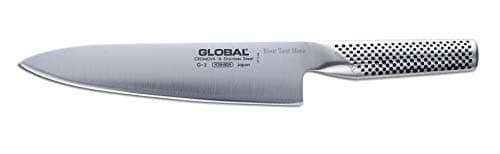
01
Global Global G-2 8" Chef's Knife

Cooks who want a light, seamless blade

Global G-2 8" Chef's Knife

8 in / 20 cmCROMOVA 18~HRC 56–58~15° edgeOne-piece
7.0/10

The one-piece stainless knife you either love or hate on feel alone. Light, distinctive, divisive.

Edge retention
7
Out-of-box edge
7
Handling
7
Build
8
Value
6

Pros

  • Seamless one-piece body has no rivets or bolster crevices to trap food — genuinely hygienic
  • Very light and nimble; the dimpled handle is grippier than it looks
  • Made in Japan with a harder-than-German edge

Cons

  • The dimpled all-metal handle is polarizing — some hands find it slippery when greasy
  • Light, blade-forward balance feels wrong to cooks raised on heavy German knives

Don't buy this if…

…you've never held one. The handle is the most love-it-or-hate-it thing in this list — try before you buy, or buy somewhere with easy returns.

$149.95View on Amazon

Price as of October 9, 2026. Prices change — Amazon's is the one that counts.

#ad · we may earn a commission from this link to Global G-2 8" Chef's Knife

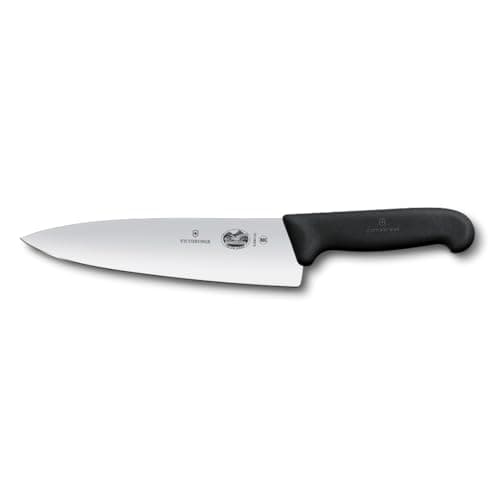
02
Victorinox Victorinox Fibrox Pro 8" Chef's Knife

Your first good chef knife

Victorinox Fibrox Pro 8" Chef's Knife

8 in / 20 cmX50CrMoV15~HRC 55–56StampedFibrox handle
7.8/10

The default answer to "what's a good first chef knife." Cheap, light, holds a usable edge, and a joy to sharpen.

Edge retention
6
Out-of-box edge
8
Handling
8
Build
7
Value
10

Pros

  • Costs a fraction of a forged German knife and out-cuts most of them out of the box
  • Soft-ish steel takes a screaming edge on a stone in minutes — the easiest knife here to learn to sharpen on
  • Light and nimble; the textured Fibrox handle grips even with wet hands
  • NSF-certified and dishwasher-tolerant (though you still shouldn't)

Cons

  • Softer steel means you hone often and sharpen more frequently than a hard Japanese blade
  • Stamped blade lacks the heft and bolster some cooks want for control
  • It is a tool, not an heirloom — nothing about it is beautiful

Don't buy this if…

…you want a knife that keeps its edge for months between sharpenings. This trades edge retention for being cheap and easy to re-sharpen — a great trade for a beginner, a poor one if you refuse to touch a stone.

$53.00View on Amazon

Price as of October 9, 2026. Prices change — Amazon's is the one that counts.

#ad · we may earn a commission from this link to Victorinox Fibrox Pro 8" Chef's Knife

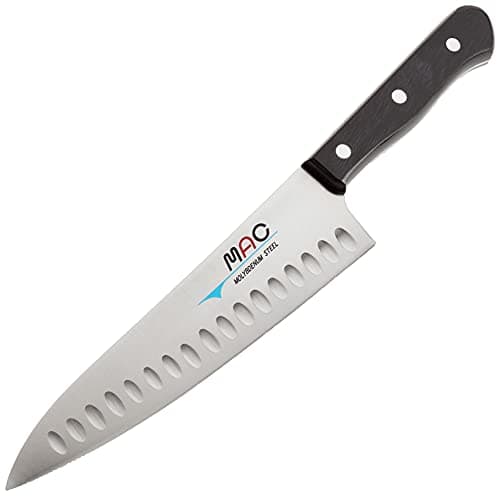
03
Mac Mac Mth-80 Professional Hollow Edge 8" Chef's Knife

The best overall, if budget allows

Mac Mth-80 Professional Hollow Edge 8" Chef's Knife

8 in / 20 cmMolybdenum-vanadium~HRC 59–61~15° edgeDimpled
8.4/10

The knife a lot of cooks quietly consider the best all-rounder made. Thin, sharp, and it stays that way.

Edge retention
9
Out-of-box edge
9
Handling
9
Build
8
Value
7

Pros

  • The blade is unusually thin, so it falls through produce with almost no wedging
  • Harder Japanese-style steel than the German knives — holds its edge markedly longer
  • The dimples (granton edge) genuinely reduce sticking on starchy vegetables
  • Takes and holds a very acute edge

Cons

  • No full bolster; the pinch grip sits right at the blade — some find it exposed
  • Harder steel is a little less forgiving of lateral abuse than soft German steel
  • Costs several times a Victorinox and looks almost as plain

Don't buy this if…

…you're rough with your knives — you pry, twist, or hit bone. Harder, thinner steel chips where soft German steel just rolls. Buy the Wüsthof or the Victorinox and treat it like a hatchet if you must.

$114.95View on Amazon

Price as of October 9, 2026. Prices change — Amazon's is the one that counts.

#ad · we may earn a commission from this link to Mac Mth-80 Professional Hollow Edge 8" Chef's Knife

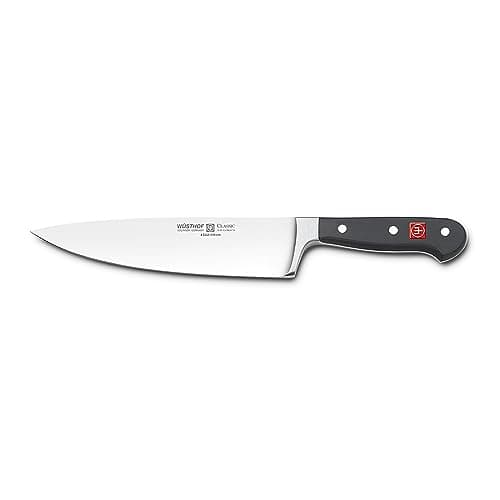
04
Wüsthof Wüsthof Classic 8" Chef's Knife

A do-everything German workhorse

Wüsthof Classic 8" Chef's Knife

8 in / 20 cmX50CrMoV15~HRC 5814° per sideForged
7.4/10

The archetypal German chef knife. Heavy, tough, forgiving, and it will outlive you if you hone it.

Edge retention
7
Out-of-box edge
7
Handling
7
Build
9
Value
7

Pros

  • Forged from a single billet with a full bolster and full tang — the reference for a durable German blade
  • Wüsthof's newer 14°-per-side edge is noticeably keener than the old 20° grind
  • Tough enough to shrug off the abuse a home cook actually inflicts
  • Triple-riveted POM handle is essentially indestructible

Cons

  • Heavy — a real workout over a long prep session
  • The full bolster eventually blocks the heel and complicates sharpening the whole edge
  • Full retail price is high; it's frequently the knife people overpay for

Don't buy this if…

…you want a light, nimble knife or you have smaller hands. This is a heavy German blade by design — the MAC or Tojiro will feel far more agile.

$170.00View on Amazon

Price as of October 9, 2026. Prices change — Amazon's is the one that counts.

#ad · we may earn a commission from this link to Wüsthof Classic 8" Chef's Knife

What actually makes a knife right-handed

Three things, and only three. Everything else is marketing.

  • A single-bevel edge. Traditional Japanese yanagiba, deba and usuba knives are ground on one face only, and a right-handed one steers hard for a left-handed user. These are made in dedicated left-handed versions — at a premium, and usually to order. Single bevel vs double bevel explains the difference properly. Every knife on this page is a double bevel.
  • An asymmetric double bevel.Some Japanese double-bevel knives are ground unevenly — more steel removed from the right face than the left — to steer slightly for a right-handed pinch grip. The effect is subtle in the kitchen and it is also the thing most often exaggerated. Published per-side angles are the signal to look for: a knife specified at "15° per side" or "14° per side" is even by definition, and all four here are.
  • A handed handle or a one-sided granton.A handle with a thumb scallop or a D-shaped Japanese wa handle fits one hand better than the other, and a few knives put hollow-ground dimples on only one face. Moulded synthetic handles, triple-riveted Western handles and seamless one-piece bodies are symmetrical. So are offset bread knives' cranked handles — which genuinely are handed, so check before you buy one.

The picks, and who each suits

  • Global G-2— for the left-hander who wants zero ambiguity. One piece of stainless, no rivets, no bolster, a sand-filled hollow handle and the same dimpled texture all the way round, ground at about 15° per side. It is also very light, which makes it the kindest knife here on a long prep session. The handle is the most polarising thing on this page — hold one first if you can.
  • Victorinox Fibrox Pro 8"— for almost everyone else. A symmetric stamped blade at about 20° per side and a moulded Fibrox handle with no handed feature anywhere on it. It is the cheapest knife here by a wide margin and the easiest to sharpen, which matters more than handedness for a left-hander learning on a stone.
  • MAC MTH-80— for the left-hander who wants the best cutter. A thin blade ground at about 15° per side, harder steel than the German knives, and a Pakkawood Western handle with no thumb scallop. Our top pick overall; third here only because it costs several times the Victorinox and demands more care.
  • Wüsthof Classic 8"— for the left-hander who wants heft and a knife to keep. Forged, full tang, full bolster, a triple-riveted symmetrical POM handle and a 14°-per-side edge. At about 9 oz it is the heaviest here; the full bolster also makes sharpening the heel harder, which is a left- and right-handed problem equally.

The one thing that really changes for a left-hander

Not the knife — the board. Right-handed knife technique as it is usually taught assumes you feed food from the left and slice to the right; left-handers mirror it. Everything in how to hold a chef's knife and knife skills for beginners works mirrored exactly as written, and the claw grip is identical. If a technique video feels wrong, flip the layout rather than the grip. The same goes for sharpening: the stone routine in how to sharpen a chef's knife mirrors cleanly on any even double bevel, which is one more reason to buy one.

Bread knives, shears and the real left-handed problems

Chef knives are the easy part. The genuinely handed tools in a kitchen are kitchen shears (the blade that sits on top determines which hand can see the cut line), offset bread knives with a cranked handle, peelers with a single-sided blade, and any serrated knife whose teeth are ground on one face. If you are kitting out a kitchen, check those four individually — our bread knife ranking notes which blades are offset, and knife edge types explained covers how serrations and grantons are ground.

Where to go next

If fit is what brought you here, hand size matters more than handedness for most people: small hands and large hands re-rank the field for grip and knuckle clearance. For the head-to-heads between the knives above, we have Global vs Victorinox, Global vs MAC, Wüsthof vs Global and Victorinox vs Wüsthof.

How we picked

We do not run a test kitchen

We compiled each product's published specifications — steel, hardness, edge geometry, weight — normalized them into the matrix above, and scored each one against a published rubric. The scores are judgments from those specs and the value math — they are not measurements we took, because we do not have a test kitchen and we're not going to pretend we do. Units we claim to have tested: 0.

Questions

Frequently asked

Are chef knives right-handed?

Almost all Western chef knives are not — they are symmetrical double bevels with handles that work in either hand. Handedness only really applies to traditional single-bevel Japanese knives, some asymmetric Japanese double bevels, handles with a thumb scallop or a D-shaped wa grip, and one-sided granton grinds.

What is the best chef knife for a left-handed cook?

The Global G-2 is the most unambiguously ambidextrous knife here: one seamless piece of steel, an identical grip all the way round, and an even edge at about 15° per side. The Victorinox Fibrox Pro is the same certainty at a fraction of the price.

Can a left-hander use a Japanese knife?

Yes — most modern Japanese kitchen knives (gyuto, santoku, nakiri) are double bevels and work fine in either hand. Avoid traditional single-bevel yanagiba, deba and usuba unless you buy the left-handed version, and check for a D-shaped wa handle, which is handed.

Do I need to sharpen a knife differently if I am left-handed?

No. On an even double bevel you mirror the standard routine — same angle, same number of strokes per side, same burr check. Only single-bevel knives need a different approach, and they need it regardless of your hand.

Keep reading

Receipts

Sources

We do not run a test kitchen, and we do not pretend to. Specs are the manufacturer's published figures, attributed as such; where we could not verify something, we say so on the page rather than quietly leaving it out. Read our full method.