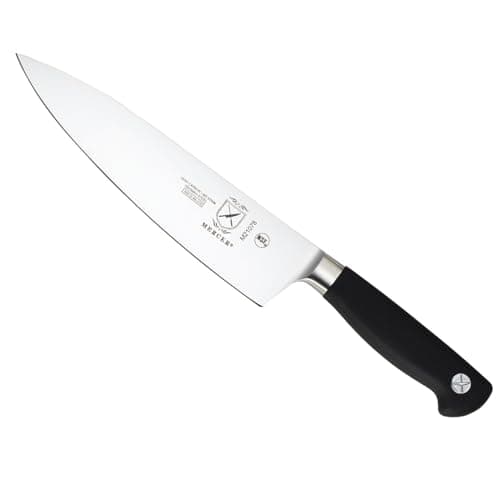
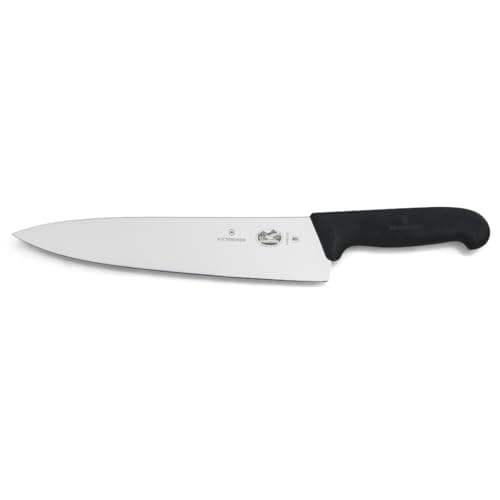
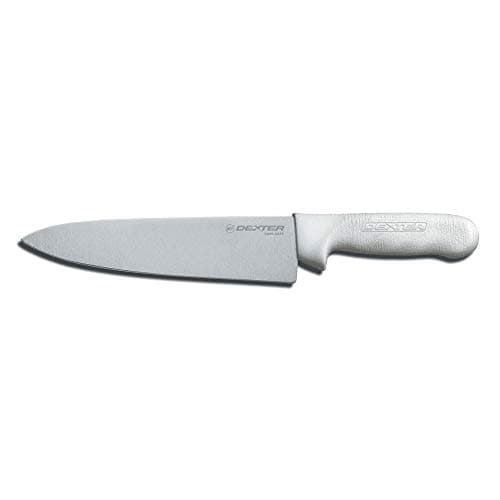
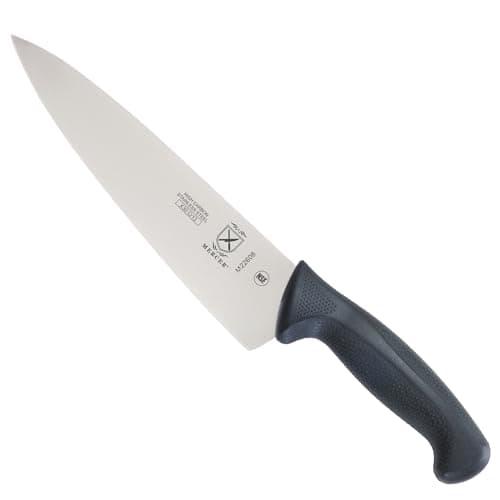
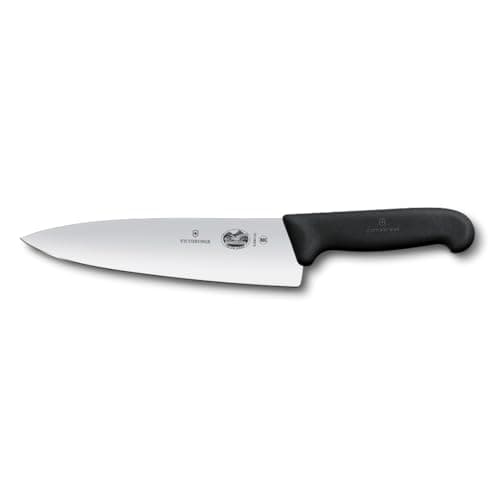
Here is the fact the knife industry would rather you did not lead with: an excellent chef's knife costs under $50. Not a compromise, not a "good enough for now" — a knife that cuts as well as blades costing four times as much, because a thin, sharp cheap knife out-cuts a dull expensive one every single time. These five are ranked by our overall score, with live prices.
The top pick, the Victorinox Fibrox Pro, is the near-universal answer to "what's a good first chef's knife" — light, keen, and the easiest blade in the category to learn to sharpen. Below it sit a genuinely forged Mercer, a longer Victorinox, an NSF foodservice workhorse and the cheapest knife any professional will endorse. Prices at this end of the market hover right around the $50 line, so the buy button always shows Amazon's current number, or "Check price" when we can't verify a live one — a knife that has nudged a dollar or two over is the market moving, not us rounding.
What under $50 actually gets you
Everything that decides how a knife cuts, and none of the things that do not. At this price you get good steel and geometry— soft German-style stainless that takes a screaming edge and is forgiving to sharpen — in a light, grippy, hard-wearing package. What you do not get is Damascus cladding, a hand-honed bevel, or a beautiful object. That is a great trade, because finish is the part of a knife's price that has nothing to do with the cut. The honest ceiling on cutting performance arrives far higher up the range; down here you are buying pure function, and function is most of what a knife is for.
Soft steel is a feature at this price
Every knife here uses soft German-class stainless around HRC 55–56, and for a budget or first knife that is exactly right. Soft steel dulls a little faster than a hard Japanese blade, but it rolls instead of chipping (so it survives real-world abuse), and it is the easiest steel to learn to sharpen — forgiving of a wobbly angle, fast to bring back on a stone. The catch is simply that you hone more often; the fix is a honing steel and the fifteen-second habit that keeps a soft edge feeling new.
Stamped or forged down here
Four of these are stamped and one — the Mercer Genesis — is genuinely forged, which is remarkable at the price. Forging buys heft and a bolster, not a better cut, so choose on feel: the stamped Victorinox and Mercer Millennia are light and nimble, the forged Genesis is heavier and more planted like a German workhorse. Neither is better in the abstract — a lighter blade suits fast, precise work, a heavier one suits cooks who like to feel the knife do the work.
The one upgrade to buy with the knife
Not a better knife — a stone. Learning to sharpen on a cheap, forgiving knife is the highest-leverage skill in the kitchen, and it is the whole reason we tell people to start with soft steel. A $45 knife you keep sharp beats a $190 one you neglect, so spend the money you saved here on a King combination stone and twenty minutes with how to sharpen a chef's knife. That, not the knife, is what separates a cook whose knives cut from one whose do not.
Where to go from here
If your budget stretches a little, the under-$100 tier adds a genuine VG-10 Japanese blade (the $75 Tojiro) and the full overall ranking shows where spending more does — and stops — buying a better cut. But make no mistake: nothing on those pages will out-cut a sharp knife from this one. If you are starting from zero, the beginners list re-ranks these same knives for a first-time buyer.