Yes, if you buy crusty bread more than occasionally — and the right one costs about as much as a takeout lunch. A serrated blade does something a straight edge physically cannot: it bites through a hard crust without compressing the soft interior underneath. If your bread comes pre-sliced and you never make a layer cake, you can skip it; for everyone else it is the best value in a knife drawer.
The honest three-question test
You need a bread knife if you answer yes to any one of these. Do you buy bread with a hard crust — sourdough, a baguette, ciabatta, anything from a bakery rather than a bag? Do you ever slice a cake or a soft roll horizontally? Do you crush tomatoes when you slice them?If all three are no — sandwich loaves only, no baking — a sharp chef's knife will do, and the money is better spent elsewhere. If any one is yes, read on.
What a serrated edge actually does
A straight edge cuts by pressing a thin wedge of steel through food. On a hard crust over a soft crumb that fails in a specific way: the crust resists, you push harder, and the moment the edge breaks through, the pressure you built up crushes the inside. You get a squashed slice with a torn top.
A serrated edge works differently. The points concentrate force on tiny contact areas, so they puncture the crust at much lower pressure, and the scalloped sections between them then saw through what is left. The whole cut happens with a back-and-forth motion and almost no downward force, which is why the crumb survives. The same mechanism is why a serrated blade handles tomato skin, melon rind and the crisp exterior of a roast chicken so much better than a straight edge. Knife edge types explained puts serrations next to the alternatives, and what is a bread knife used for covers the full job list.
Why you cannot just use a sharp chef's knife
You can, on a soft loaf. On a hard crust the chef's knife loses twice. First, as above, it compresses. Second, the crust blunts it — a hard, abrasive crust and a board strike at the end of every stroke roll a fine straight edge fast, which is why people who cut bread with a chef's knife complain their knife never stays sharp. Chef knife vs bread knife works through the comparison, and why does my knife get dull so fast explains the edge damage.
What to look for if you buy one
- Length: 9 to 10 inches. The blade has to clear the whole loaf in one pass, because every time you stop and restart you tear the crumb. A 10-inch blade handles a full sourdough boule; an 8-inch one does not.
- Wavy versus pointed serrations. Wide wavy scallops bite crust cleanly and are gentler on soft crumb. Deep pointed teeth are more aggressive and better on very hard crusts and frozen items. Both work; wavy is the safer default for bread specifically.
- Straight or offset handle. An offset (cranked) handle lifts your knuckles above the board, which matters for bagels, rolls and flat loaves sliced right down to the surface. For tall boules a straight handle is fine. Note that an offset handle is handed — check it suits your cutting hand.
- Do not pay for premium steel. This is the one knife category where it is genuinely wasted money, and the reason is in the next section.
Why we would not spend much, and what to buy instead
Serrations cannot be honed and are very difficult to resharpen at home — each scallop has to be worked individually with a tapered rod, which is why sharpening a serrated knife is the one job we usually recommend paying someone else to do, if you bother at all. That makes a bread knife closer to a consumable than an heirloom: it will cut well for years and then be replaced. Spending four times as much buys a nicer handle and a forged feel, not better bread. The three picks below are the ones we would actually buy.
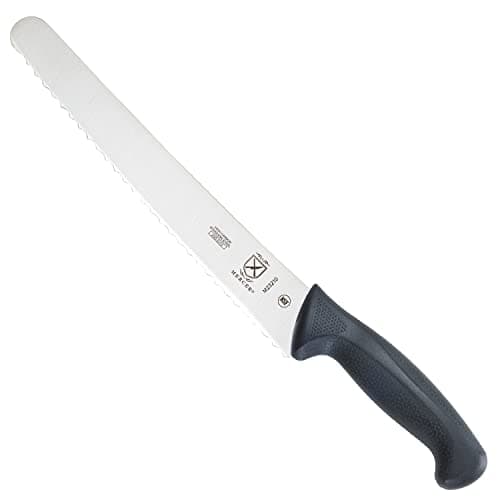
- Mercer Culinary Millennia 10" wavy edge — for almost everyone. A long 10-inch blade that clears a full boule in one or two strokes, wide wavy serrations that bite crust without crushing crumb, and a textured Santoprene handle with a finger guard. It costs so little that replacing it eventually is a non-event. Stamped and utilitarian, which is the point.
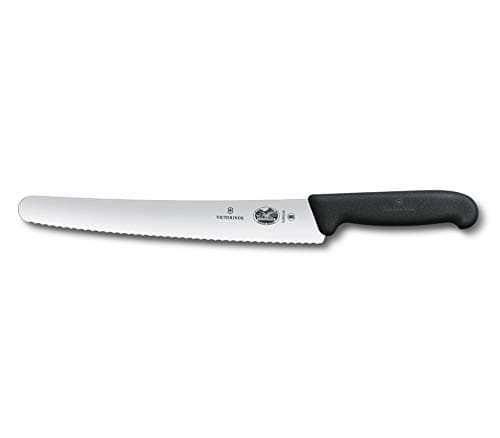
- Victorinox Fibrox Pro 10.25"— for the household that bakes often and wants to buy once. Deep pointed serrations handle hard crust and delicate cake alike, and the Fibrox handle is grippy wet or greasy, which is why it runs in bakeries and delis. Several times the Mercer's price for bread that comes out much the same; Victorinox offers a mail-in resharpening service.
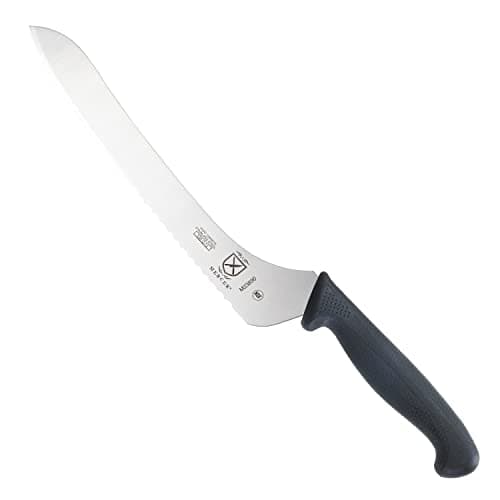
- Mercer Culinary Millennia 9" offset — for knuckle clearance. The cranked handle keeps your hand above the board, so you can slice a bagel, a roll or a low loaf flat without scraping skin. Same clean-cutting wavy serrations. A niche preference — many bakers prefer a straight handle, and the offset shape is handed.
What a bread knife is also good for
It earns its drawer space well beyond bread. Tomatoes (the serrations puncture skin instead of sliding off), melon and pineapple rind, squash skin, cake layers, frozen items you need to divide, and the crisp skin on a roast. Specific techniques are in how to slice bread, how to cut a tomato, how to cut a watermelon and how to cut a pineapple. For a roast, a long straight slicer is still the better tool — see what is a carving knife and how to carve a turkey.
Where it sits in a four-knife kitchen
Most home kitchens run on four blades: a chef's knife, a paring knife, a serrated bread knife and something long for slicing. The bread knife is third on that list for a reason — it does one thing nothing else can do, and it costs almost nothing. How many kitchen knives do you need makes the case in full, and knife set vs open stock explains why buying it individually beats getting it in a block. Our full ranking is at best bread knives.
Looking after it
Two rules. Keep it off the dishwasher rack — not because the machine harms serrations especially, but because a serrated edge you cannot resharpen is one you should not risk; see can you put knives in the dishwasher. And store it where the points are protected, in a block, on a strip or in a guard rather than loose in a drawer, per how to store kitchen knives. A bread board picks up crumbs and smells faster than any other surface in the kitchen, so how to get smells out of a cutting board is worth five minutes too.