Skip to content
Bevel & Bone

HUB 01 · Chef Knives

The Best Chef Knives for Small Hands

The right knife for a smaller hand isn't a smaller knife — it's a lighter, better-balanced one you can control all the way through a prep session.

By Stephen V.Updated How we choose
#ad

We earn a commission when you buy through our Amazon links, at no extra cost to you. It never changes a ranking, and we say so when the cheaper knife is the better buy. How this works.

If a chef's knife feels like too much knife, the fix is rarely a shorter blade — it's a lighter one with a handle that fits and balance that keeps the weight in your fingers, not out at the tip. Control and fatigue are what a smaller hand actually notices over a long prep, and every pick here is chosen for exactly that.

How this list is ranked: for fit and control in a smaller hand — weight, handle girth, balance and how tiring the knife is over a long session — not by raw overall score. A superb heavy knife that wears your hand out at the twenty-minute mark is the wrong knife here, however high it scores elsewhere.

The three things that decide fit

  • Weight. This is the big one. A lighter blade (the MAC, Global and Mercer here all sit well under a heavy German knife) is far less tiring to steer, and tiredness is what turns into imprecision and near-misses. Lighter almost always beats heavier for a smaller hand.
  • Handle girth and shape. A thick, boxy handle forces your grip open and kills control. Slimmer, contoured handles — and the textured Fibrox and Santoprene grips here — let smaller fingers wrap and pinch securely, wet or dry.
  • Balance.A knife that balances near the bolster feels light and agile; one that's tip-heavy feels like it's pulling away from you. The lighter, blade-forward Japanese knives here feel nimble precisely because there's so little mass to manage.

Length: don't automatically drop to a 6-inch

It's the obvious move, but a very short blade makes big produce harder and leaves your knuckles closer to the board. An 8-inch blade suits most smaller hands fine once the weight is right — the length lives on the board, not in your grip. If your hands really are small or your kitchen is tight, a 7-inch blade or a lighter santoku is the smarter step down than a stubby 6-inch; the full breakdown is in chef knife sizes explained.

The grip does half the work

A smaller hand benefits most from a proper pinch grip— thumb and forefinger on the blade itself, just ahead of the handle — which moves your control point onto the steel and makes even a full-size knife feel planted and precise. It's the single highest-leverage fix, and it's worth learning before you decide a knife is "too big"; how to hold a chef's knife walks through it.

The short answer

Quick picks

#ad · Live prices from the Amazon Product API, as of Jul 28, 2026. Where we have no verified live price we show none — we'd rather leave a gap than print a number that has rotted.

By the numbers

The specs, side by side

Every figure below is the manufacturer's published specification. Where a maker doesn't publish a value, the cell reads "—" rather than a number we made up.

Knife / ToolBladeSteelHardnessEdgeConstructionWeight
Mac Mth-80 Professional Hollow Edge 8" Chef's Knife8 in (20 cm)Molybdenum-vanadium high-carbon~HRC 59–61~15° per sideThin stamped blade, Pakkawood handle~6.5 oz (184 g)
Victorinox Fibrox Pro 8" Chef's Knife8 in (20 cm)X50CrMoV15 stainless~HRC 55–56~20° per sideStamped, full-length tang~6.6 oz (187 g)
Global G-2 8" Chef's Knife8 in (20 cm)CROMOVA 18 stainless~HRC 56–58~15° per sideOne-piece steel, sand-filled hollow handle~5.8 oz (164 g)
Mercer Culinary Millennia 8" Chef's Knife8 in (20 cm)Japanese stainless (X50CrMoV15 class)~HRC 56~20° per sideStamped, textured Santoprene handle~5.6 oz (159 g)
Miyabi Kaizen II 8" Chef's Knife8 in (20 cm)FC61 fine-carbide stainless~HRC 60~9.5–12° per side (Honbazuke)Forged, Micarta handle~7.9 oz (224 g)

In detail

The picks, in full

01
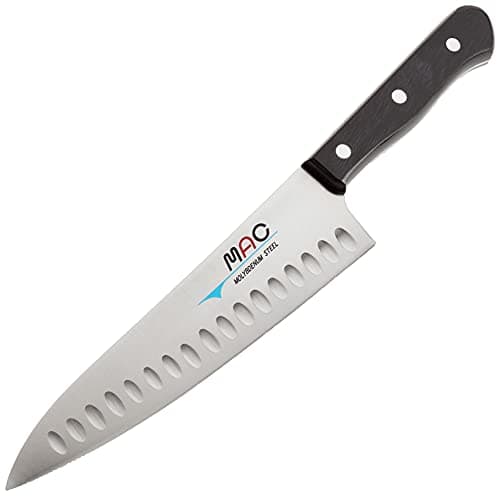
Mac Mac Mth-80 Professional Hollow Edge 8" Chef's Knife

The best overall, if budget allows

Mac Mth-80 Professional Hollow Edge 8" Chef's Knife

8 in / 20 cmMolybdenum-vanadium~HRC 59–61~15° edgeDimpled
8.4/10

The knife a lot of cooks quietly consider the best all-rounder made. Thin, sharp, and it stays that way.

Edge retention
9
Out-of-box edge
9
Handling
9
Build
8
Value
7

Pros

  • The blade is unusually thin, so it falls through produce with almost no wedging
  • Harder Japanese-style steel than the German knives — holds its edge markedly longer
  • The dimples (granton edge) genuinely reduce sticking on starchy vegetables
  • Takes and holds a very acute edge

Cons

  • No full bolster; the pinch grip sits right at the blade — some find it exposed
  • Harder steel is a little less forgiving of lateral abuse than soft German steel
  • Costs several times a Victorinox and looks almost as plain

Don't buy this if…

you're rough with your knives — you pry, twist, or hit bone. Harder, thinner steel chips where soft German steel just rolls. Buy the Wüsthof or the Victorinox and treat it like a hatchet if you must.

$114.95View on Amazon

Price as of Jul 28, 2026. Prices change — Amazon's is the one that counts.

#ad · we may earn a commission from this link to Mac Mth-80 Professional Hollow Edge 8" Chef's Knife

02
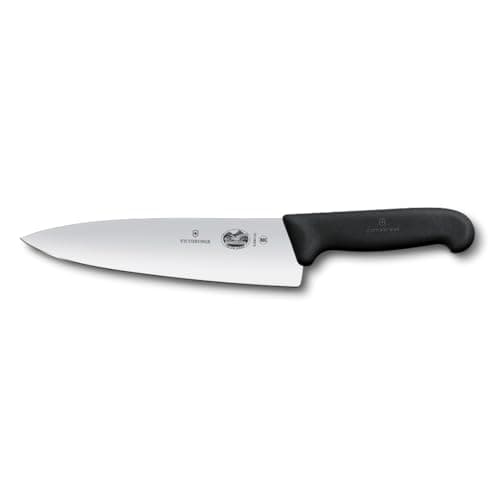
Victorinox Victorinox Fibrox Pro 8" Chef's Knife

Your first good chef knife

Victorinox Fibrox Pro 8" Chef's Knife

8 in / 20 cmX50CrMoV15~HRC 55–56StampedFibrox handle
7.8/10

The default answer to "what's a good first chef knife." Cheap, light, holds a usable edge, and a joy to sharpen.

Edge retention
6
Out-of-box edge
8
Handling
8
Build
7
Value
10

Pros

  • Costs a fraction of a forged German knife and out-cuts most of them out of the box
  • Soft-ish steel takes a screaming edge on a stone in minutes — the easiest knife here to learn to sharpen on
  • Light and nimble; the textured Fibrox handle grips even with wet hands
  • NSF-certified and dishwasher-tolerant (though you still shouldn't)

Cons

  • Softer steel means you hone often and sharpen more frequently than a hard Japanese blade
  • Stamped blade lacks the heft and bolster some cooks want for control
  • It is a tool, not an heirloom — nothing about it is beautiful

Don't buy this if…

you want a knife that keeps its edge for months between sharpenings. This trades edge retention for being cheap and easy to re-sharpen — a great trade for a beginner, a poor one if you refuse to touch a stone.

$47.98View on Amazon

Price as of Jul 28, 2026. Prices change — Amazon's is the one that counts.

#ad · we may earn a commission from this link to Victorinox Fibrox Pro 8" Chef's Knife

03
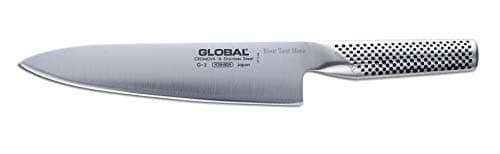
Global Global G-2 8" Chef's Knife

Cooks who want a light, seamless blade

Global G-2 8" Chef's Knife

8 in / 20 cmCROMOVA 18~HRC 56–58~15° edgeOne-piece
7.0/10

The one-piece stainless knife you either love or hate on feel alone. Light, distinctive, divisive.

Edge retention
7
Out-of-box edge
7
Handling
7
Build
8
Value
6

Pros

  • Seamless one-piece body has no rivets or bolster crevices to trap food — genuinely hygienic
  • Very light and nimble; the dimpled handle is grippier than it looks
  • Made in Japan with a harder-than-German edge

Cons

  • The dimpled all-metal handle is polarizing — some hands find it slippery when greasy
  • Light, blade-forward balance feels wrong to cooks raised on heavy German knives

Don't buy this if…

you've never held one. The handle is the most love-it-or-hate-it thing in this list — try before you buy, or buy somewhere with easy returns.

$149.95View on Amazon

Price as of Jul 28, 2026. Prices change — Amazon's is the one that counts.

#ad · we may earn a commission from this link to Global G-2 8" Chef's Knife

04
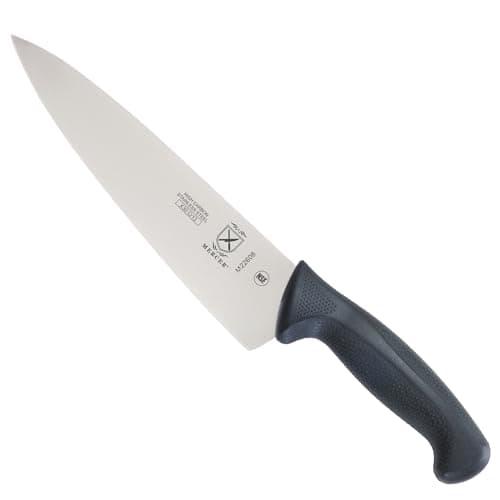
Mercer Culinary Mercer Culinary Millennia 8" Chef's Knife

The cheapest knife worth owning

Mercer Culinary Millennia 8" Chef's Knife

8 in / 20 cmJapanese steel~HRC 56StampedSantoprene
7.0/10

The culinary-school standby: a cheap, light, NSF stamped knife that culinary students are told to buy.

Edge retention
5
Out-of-box edge
6
Handling
8
Build
6
Value
10

Pros

  • About the cheapest chef knife any professional will actually endorse
  • Light and grippy; the textured handle has a finger guard beginners appreciate
  • NSF-certified — the reason it's on culinary-school supply lists

Cons

  • Soft steel and a rougher factory edge than the Victorinox
  • Fit and finish are exactly what the price suggests

Don't buy this if…

you can stretch to the Victorinox Fibrox. It's a small step up in money for a real step up in edge and finish — the Millennia is the pick only when every dollar counts.

$21.00View on Amazon

Price as of Jul 28, 2026. Prices change — Amazon's is the one that counts.

#ad · we may earn a commission from this link to Mercer Culinary Millennia 8" Chef's Knife

05
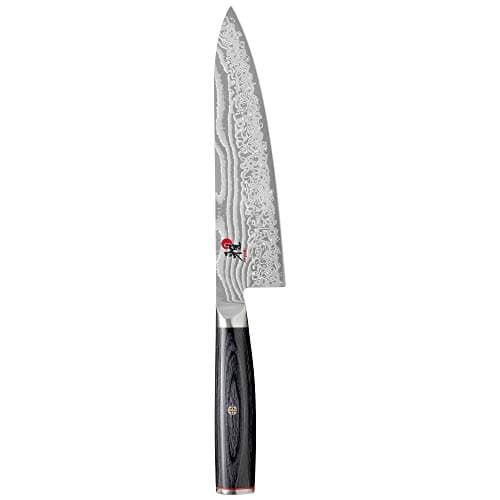
Miyabi Miyabi Kaizen II 8" Chef's Knife

The keenest factory edge here

Miyabi Kaizen II 8" Chef's Knife

8 in / 20 cmFC61 steel~HRC 60~9.5–12° edgeHonbazuke
8.4/10

Zwilling's Japanese line: a very hard, very acute edge with a hand-finished Honbazuke bevel.

Edge retention
9
Out-of-box edge
10
Handling
8
Build
9
Value
6

Pros

  • The hand-honed three-step Honbazuke edge is one of the most acute factory edges you can buy
  • Hard FC61 steel keeps that edge far longer than any German knife
  • Beautifully finished — this is a knife you look forward to using

Cons

  • A very acute, hard edge is the most chip-prone geometry in this roundup
  • Expensive, and the returns are diminishing versus a Tojiro if you don't sharpen well

Don't buy this if…

you can't yet sharpen a Japanese edge on a stone. A 10° edge this hard needs correct maintenance; without it you'll chip it and won't be able to fix it. Start on the Tojiro or Victorinox.

$189.95View on Amazon

Price as of Jul 28, 2026. Prices change — Amazon's is the one that counts.

#ad · we may earn a commission from this link to Miyabi Kaizen II 8" Chef's Knife

How to test fit before you commit

Feel is personal and impossible to fully judge from specs, so buy from somewhere with easy returns and check three things the day it arrives:

  • Pinch it, don't fist it.Grip the blade in a pinch and hold it out. If your wrist is already working to keep the tip up, it's too heavy or too tip-heavy for you — send it back.
  • Do a real minute of chopping. Mince a small pile of parsley or dice an onion. Fatigue and hot-spots show up in a minute of use, never in a showroom heft.
  • Watch your knuckles. With a proper claw on the guiding hand, the flat of the blade should ride your knuckles comfortably. If a short blade puts your fingertips near the edge, a slightly longer blade is actually safer.

Keeping a light knife sharp matters even more than usual: a dull blade makes you push harder, and pushing harder is where a smaller hand loses control. Hone often and learn a whetstone — a sharp light knife is safer and less tiring than a dull heavy one. And if none of these fit, the wider field is in best chef knives, all of it scored on the same rubric.

How we picked

We do not run a test kitchen

We compiled each product's published specifications — steel, hardness, edge geometry, weight — normalized them into the matrix above, and scored each one against a published rubric. The scores are judgments from those specs and the value math — they are notmeasurements we took, because we do not have a test kitchen and we're not going to pretend we do. Units we claim to have tested: 0.

Questions

Frequently asked

What size chef's knife is best for small hands?

An 8-inch blade suits most smaller hands well, provided it's a light one — the length sits on the cutting board, not in your grip, so weight matters far more than length. If your hands are genuinely small or your kitchen is tight, a 7-inch blade or a light santoku is a better step down than a very short 6-inch knife.

Is a santoku better for small hands than a chef's knife?

Often, yes. A santoku is typically shorter (around 7 inches), lighter and flatter, which many smaller hands find easier to control with an up-and-down chopping motion. The trade-off is less reach and a less pointed tip. See our chef knife vs santoku comparison to decide.

Are lighter knives better for small hands?

Generally yes. A lighter blade is less tiring to steer over a long prep session, and fatigue is what erodes precision and safety for a smaller hand. A heavy German knife can still work with a good pinch grip, but a lighter Japanese-style blade is the easier place to start.

Keep reading