Yes. After a chef's knife it is the second knife to own, and a good one costs about as much as a pizza. The reason is specific rather than general: a paring knife is the only kitchen knife designed to be used in your hand, off the board, and there are three everyday jobs where that is the whole point. If you only ever cut on a board and buy your fruit pre-prepared, you can skip it — but almost nobody actually cooks that way.
The three-question test
You need one if any of these is a yes. Do you peel, core or hull anything by hand — apples, potatoes, strawberries, a tomato you want skinned? Do you ever need to cut something small and precisely — deveining a shrimp, segmenting a citrus, scoring a bread roll, trimming fat from a chop? Do you cut anything held in the air, away from a board? If all three are no, your chef's knife covers you. If one is a yes, a paring knife is the cheapest meaningful upgrade available to you.
What a short blade actually does
A chef's knife works because it is long: the length lets you draw a cut through food in one pass with the board taking the force. Every one of those properties is wrong for in-hand work. A long blade held in the air has leverage you cannot control, the tip is far from your fingertips, and the part of the edge nearest your hand — the heel — is the part you cannot see.
A 3.5–4 inch blade inverts all three. The whole edge sits inside your field of view and within an inch or two of your thumb, so you can steer it with the same precision you steer a pencil. That is why peeling with a paring knife works and peeling with a chef's knife is how people cut their thumbs. What is a paring knife used for runs the full job list, and chef knife vs paring knife puts the two side by side.
There is a safety argument too, and it runs the other way from intuition. Small knives are not inherently safer — they are used in the hand, pointed toward the body, which is exactly the geometry that causes thumb and palm injuries. The safe technique is to cut away from yourself with the food braced, and to accept that a sharp paring knife is far safer than a dull one, because a dull blade slips off skin instead of entering it. Knife safety basics covers it properly.
Why not a utility knife, or a peeler?
Both are reasonable questions and both have honest answers.
A utility knife(4.5–6 inches) is the in-between size, and it is genuinely better than a paring knife for slicing a sandwich tomato or a block of cheese — board work on small items. It is worse for in-hand work, because it is long enough to need the board again. Paring knife vs utility knife settles which to buy first (the paring knife), and best utility knives ranks the other category.
A vegetable peeler genuinely beats a paring knife at peeling — it is faster, it wastes less, and it is much safer for long runs of potatoes or carrots. If peeling is your only yes, buy a peeler. The paring knife earns its place on the other two: coring, hulling, segmenting, deveining, trimming and anything that needs a point.
What to look for
- Length: 3.5 to 4 inches. Three inches is fiddly for anything but hulling; five is a small utility knife. Four is the most versatile single answer.
- A straight edge and a real point, for a first one. Spear-point straight blades do everything adequately. The specialists — serrated paring knives for tomato skin and citrus, and curved bird's-beak blades for turning vegetables — are second knives, not first ones. Knife edge types explained covers the difference.
- Light, not heavy.This is the opposite of the advice for a chef's knife. You hold a paring knife in the air for long stretches and steer it with your fingers; a forged bolster and a thick tang add weight exactly where it hurts dexterity. Forged paring knives are lovely objects and mostly worse tools.
- A handle you can grip near the blade. You will choke right up to the heel for close work. A short or absent bolster helps — knife bolster explained.
- Do not pay much. Paring knives get lost, bent and left in sinks more than any other knife in the kitchen, and the performance ceiling arrives almost immediately. Buying two cheap ones is a better plan than buying one expensive one.
- Steel is nearly irrelevant.At this size you are not pushing through anything demanding, and a short edge is quick to sharpen. Soft stainless at ~HRC 55–56 is entirely adequate. The steel guide explains why this is the one category where it does not matter.
The three we would buy, and who each suits
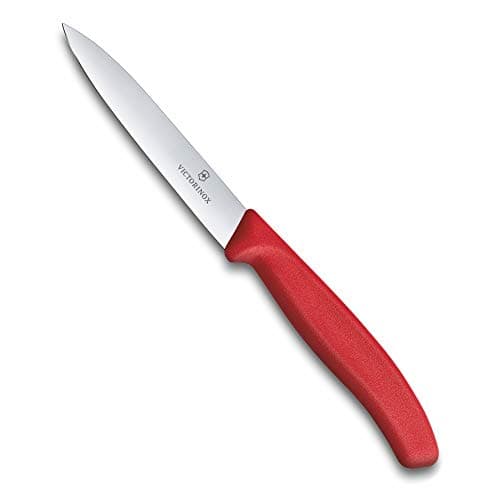
- Victorinox Swiss Classic 4"— for almost everyone. A stamped high-carbon stainless spear-point at ~HRC 55–56 with a textured polypropylene handle, feather-light, and so cheap you will keep two. It is the knife both home cooks and professionals reach for, and buying the expensive alternatives is mostly buying an object. It does not feel substantial, and it is not meant to.
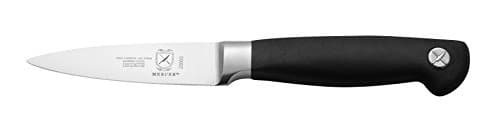
- Mercer Culinary Genesis 3.5" — if you want a forged feel on a budget, or a paring knife that matches a Genesis set. Forged X50CrMoV15 at ~HRC 56, full tang, bolster, ergonomic Santoprene handle. The heft is real and it costs little. That heft is also the reason it is nimbler than the Wüsthof and less nimble than the Victorinox for fine in-hand peeling.
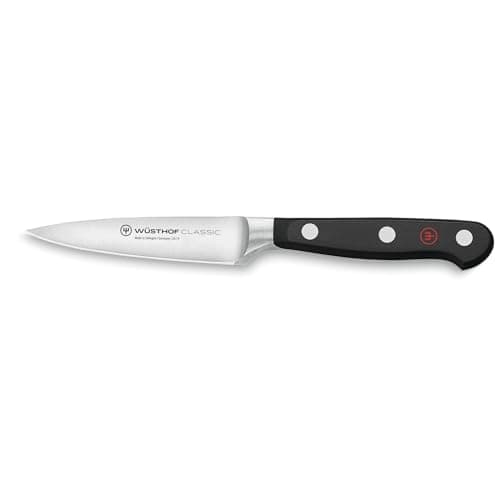
- Wüsthof Classic 3.5" — the buy-forever pick, and the hardest to justify on function. Precision-forged X50CrMoV15 at ~HRC 58, full tang, bolster, triple-riveted POM handle. It is beautiful, it has a lovely planted feel, and it is a great deal of money to peel an apple. Buy it to complete a Classic set or because you want the object.
All three are ranked against six paring knives — including the serrated and bird's-beak specialists — in best paring knives.
The two specialists, and when to add them
A serrated paring knife. Cheap, and genuinely better than a straight edge on tomato skin, citrus peel and the crisp skin of a pepper — the serrations puncture rather than slide. Add it third, not first. The same mechanism is why a bread knife handles tomatoes well, per do you need a bread knife.
A bird's-beak (tourné) knife. The inward curve follows the surface of a round vegetable, which makes it the right tool for turning potatoes, peeling round fruit and scoring. It is a specialist and it costs almost nothing, so it is a pleasant third purchase rather than a necessary one.
Where it sits in the kit
Four knives cover a home kitchen: a chef's knife, a paring knife, a serrated bread knife and something long for slicing. The paring knife is second on that list, because it is the only one of the four that does work the chef's knife physically cannot — the bread knife and the slicer are both doing jobs the chef's knife does badly rather than not at all. How many kitchen knives do you need makes the case in full.
This is also the single best argument against buying a block set. Buying a chef's knife and a paring knife separately, both good, costs less than a 15-piece set that includes eight knives you will never touch — knife set vs open stock runs the numbers, and best chef knife sets covers the sets that are genuinely worth it anyway.
Keeping it sharp and keeping it safe
A short edge is the quickest thing in the kitchen to sharpen — a couple of minutes on a stone, and the small size makes angle control easy. How to sharpen a paring knife is the technique. Two habits matter more than the sharpening: keep it out of the loose drawer where the point gets bent and your fingers find the edge — how to store knives in a drawer — and keep it off the dishwasher rack, per can you put knives in the dishwasher. For in-hand technique on specific jobs, how to cut a mango, how to cut an avocado and how to cut garlic all use one.