Steak knives are the one category of kitchen cutlery people buy almost entirely on looks, and the one where a single specification — printed on every listing, ignored by nearly every buyer — decides whether you are happy with them in five years. That specification is edge type: straight (often sold as “fine edge”) or serrated. It is not a matter of quality. It is a permanent choice about whether these knives are something you maintain or something you eventually replace.
A straight edgeslices. It parts meat fibers cleanly, leaves a cut face that looks like the one a chef's knife makes, and can be put back to shaving sharp on the same stone you use for everything else. It also goes blunt, and it tells you honestly when it has. A serrated edgesaws. The points do the work, they stay proud of the food long after a flat edge would have dulled, and the set stays usable for years with no maintenance at all — but it tears the fibers rather than cutting them, and no practical amount of sharpening brings a scalloped edge back to what it was. Both are honest answers. They are answers to different questions about your kitchen, which is why this list contains three of each rather than pretending one wins.
If you want the shape explained before the shopping, what is a steak knife covers what separates one from an ordinary table knife. Rankings below use our overall score, which weights value heavily — and value deserves that weight here more than in most categories, because a steak knife does perhaps ten seconds of cutting per meal against a chef's knife doing twenty minutes. Money spent at this end of the block earns less than money spent at the other, and the ranking reflects that.
What actually matters in a steak knife
- Edge type — the one that decides everything. Straight for a clean cut and a knife you keep sharp; serrated for a knife that works without you. The failure mode is buying serrated by default, because it is what restaurants hand out and what most sets on a shelf happen to be, and then wondering why the cut face of a good steak looks ragged. The second failure mode is buying straight, never sharpening it, and concluding after two years that straight edges are useless. Pick the one that matches what you will actually do.
- How many places you set.This is the spec that quietly doubles the price. Sets come in four, six and eight, and the cost per place setting swings more than tenfold across this page. Four is the standard household answer; six is the number to buy if you ever host; eight exists for people who host properly and for anyone replacing a whole drawer at once. Count your chairs before you compare prices, because a “cheap” four-piece set is not cheap when you buy it twice.
- Blade length — and why 4½ to 5 inches is the whole range. Every knife here is between 4½ and 5 inches, and that is not a coincidence. A steak knife works on a plate, on a surface you must not scratch, with the point rarely used. Longer buys nothing and hits the person beside you; shorter stops reaching across a ribeye in one stroke. Do not treat blade length as a differentiator in this category — it is effectively fixed.
- Forged or stamped. The usual forged versus stamped argument matters less here than anywhere else on this site. A forged blade with a bolster is stiffer and heavier, which is a real advantage in a chef's knife and a debatable one in a knife that never levers, never chops and lives beside a plate. Two of the best-value picks here are stamped, and that is a legitimate engineering answer rather than a corner cut.
- Handle material, because these get handled with greasy fingers. POM, Santoprene and G10 all stay grippy when wet and survive a dishwasher; wood and horn look better and do neither. Our handle materials guide covers the full trade-off. Every pick on this page uses a synthetic handle, which is a deliberate filter: a steak knife is the piece of cutlery most likely to be scraped into a sink and forgotten.
- Steel and hardness — genuinely less important here. Everywhere else on this site, steel and Rockwell hardnessare the specs that decide performance. A steak knife cuts cooked protein on a ceramic plate for a few seconds a meal. Hard steel's edge retention barely gets a chance to matter, and its brittleness meets a hard glazed surface repeatedly. Softer German stainless around HRC 56–58 is the right engineering answer for this job, which is why no Japanese blade at HRC 61 appears on this list.
- Value. The metric that decides the ranking. The gap between the cheapest and the most expensive place setting here is more than tenfold, and the gap in how well they cut a steak is nothing like tenfold.
What matters less than the price suggests: a presentation box (you throw it away), a bolster (weight you do not need on a plate), brand matching your chef's knife (nobody has ever noticed), and a hollow or Granton edge— the scallops that stop potato sticking to a santoku do nothing on a five-second cut through a steak.
Straight edge or serrated? The honest answer
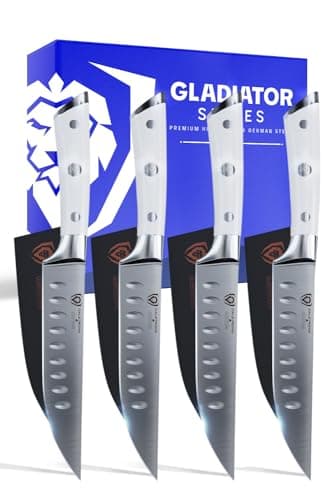
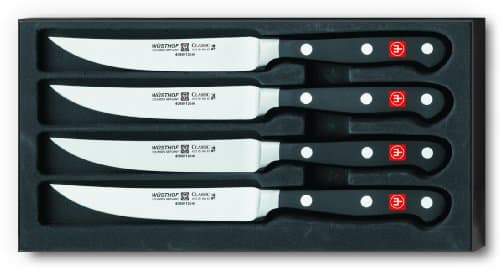
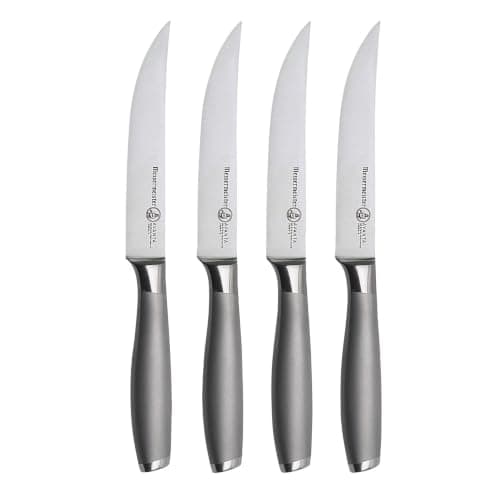
Here it is without hedging. If you own a whetstone, or you are willing to own one, buy a straight edge.It cuts better, it looks better on the plate, and it is the only version of this knife that gets better rather than worse over a decade — five minutes on a stone once a year is the entire maintenance burden. That is the Messermeister Avanta at four places, the Dalstrong if you want it forged, the Wüsthof Classic if the budget is not the constraint.
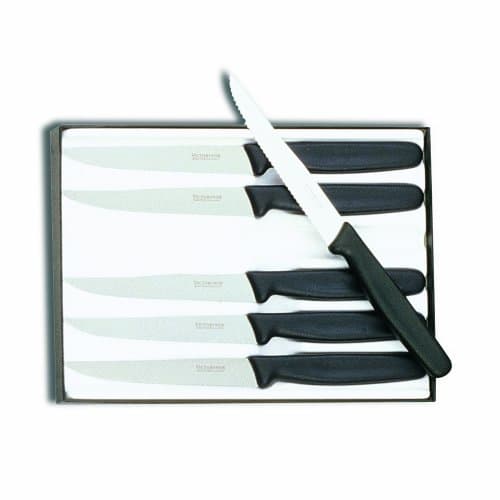
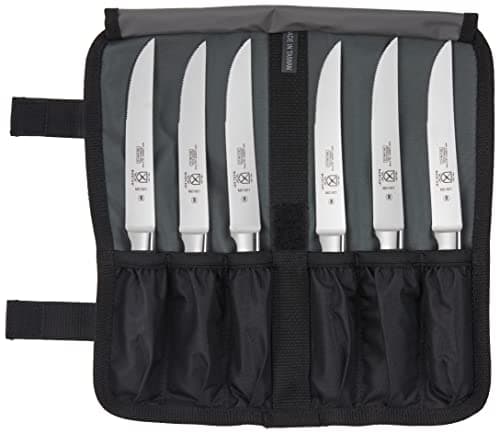
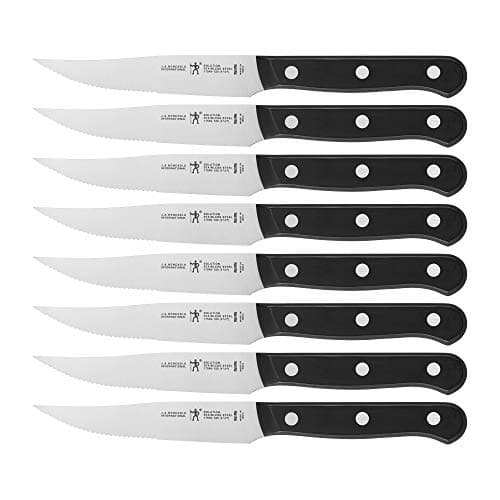
If a sharpening stone is never going to happen in your house, buy serrated and stop feeling bad about it. A serrated steak knife that nobody maintains outperforms a straight-edged one that nobody maintains, every time, for years. That is the Victorinox Swiss Classic six-piece for most households, the Henckels Solution eight-piece if you need to set a bigger table cheaply, and the Mercer Genesisroll if these are traveling to a job. Choosing the maintenance-free option deliberately is a better decision than buying the “better” knife and letting it go dull.
Can you sharpen a serrated steak knife?
Not really, and this is the part that catches people out. A serrated edge is ground on one side only, with the scallops carrying the cutting bevels. You cannot run it flat along a stone the way you would a chef's knife without destroying the geometry. It can be done, one scallop at a time, with a tapered ceramic or diamond rod — how to sharpen a serrated knife covers the method properly — but on a 4½-inch blade with small scallops it is fiddly, slow work for six or eight knives. Realistically, a serrated steak knife is a consumable with a very long life. Buy it knowing that, and it is a fine purchase. Buy it assuming you will sharpen it later and you have made a decision you did not intend to.
The corollary matters too: a serrated edge that has genuinely worn down feels exactly like a blunt one, but a serrated edge that seems dull is usually just dirty or has fibers wedged in the scallops. Wash it properly before you write it off.
How many do you actually need?
Count the chairs at your table, then decide whether you host. Four covers the everyday case in most households. Six is the number people wish they had bought the first time they had friends over. Eight is for genuine entertaining, and the Henckelsexists precisely because setting eight places with good knives is otherwise expensive. Note that the per-place cost across this page runs from a few dollars to the price of a decent chef's knife, so the count you choose changes the budget far more than the brand you choose does.
One under-rated option: buy six cheap serrated ones for the table and one good straight-edged knife for yourself. It sounds absurd until you have done it.
Do you need steak knives at all?
Honestly, plenty of households do not. How many kitchen knives do you need makes the general case that three good blades do almost everything, and steak knives are not among the three. If you eat steak twice a year, a sharp paring knifeor simply slicing the meat in the kitchen with a chef's knife before it reaches the table works fine — and slicing across the grain in the kitchen is a better way to serve steak anyway. Where a set genuinely earns its place is when people carve at the table, when you serve steak often enough that the ritual matters, or when you are tired of watching a guest saw at a ribeye with a butter knife. Steak knives are also one of the few pieces of cutlery that make a good gift, which is why they turn up so often in knife gift guides.
Should they match your knife block?
Several chef knife setsinclude steak knives, and buying them together is tempting. Be careful: a block set with six steak knives in it is usually padding the piece count, and the steak knives are the cheapest thing in the box. If the set is good, buy it for the chef's knife and treat the steak knives as a bonus. If you are buying steak knives specifically, buying them separately gets you a materially better knife for the same money almost every time. The same logic runs through knife set vs open stock.
Sharpening and care
For the straight-edged picks, maintenance is genuinely trivial: these are short blades in soft-ish German steel, and a few passes on a 1000-grit stone restores them in minutes. Match the angle the maker publishes — about 15° per side on the Messermeister, 14° on the Wüsthof, 16–18° on the Dalstrong — and if you are unsure what any of that means, knife sharpening angle explains it, and how to use a whetstone covers the technique. Because the blades are short, this is actually the easiest sharpening job in your kitchen and a good place to practice before you put a stone to a knife you care about.
Care is the same for both edge types and mostly comes down to two habits. Hand wash and dry them rather than putting them in the dishwasher — the reasons why apply doubly to a set of eight knives clattering against each other in a basket. And store them so the edges do not touch: a slotted tray, a roll, or the sheaths the Dalstrong ships with. Loose in a drawer, steak knives dull each other faster than eating with them ever will, which is the point of storing knives in a drawer properly and of knife care and storage generally.