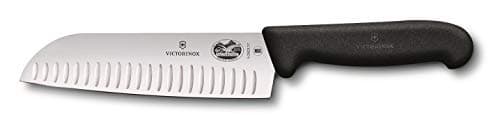
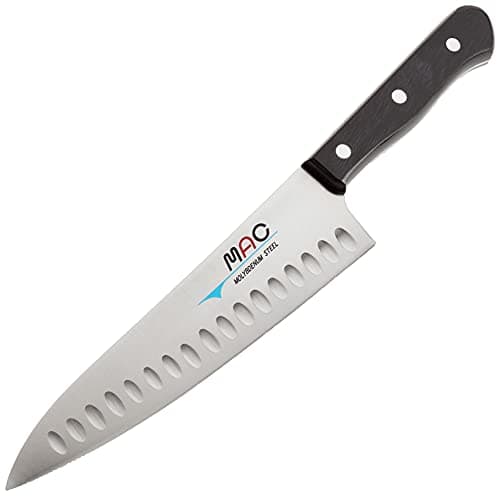
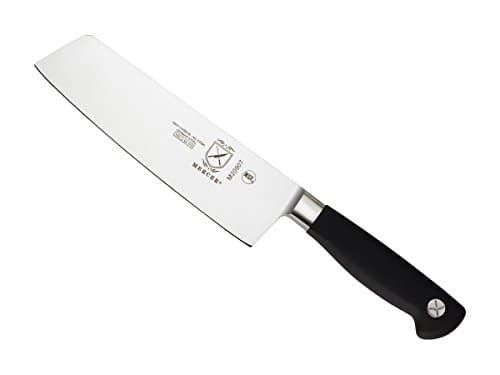
Buy the MAC Japanese Series 6.5" nakiri if vegetables are most of what you cut — a 2.5 mm spine makes it the thinnest blade on this page, and thin is the whole game on a dense carrot or a tall cabbage. If you want one knife that handles vegetables brilliantly and everything else competently, the Victorinox Fibrox Pro granton santoku does it for a fraction of the money. Four knives ranked for vegetable prep, with live prices.
How this list is ranked: for vegetable fitness — thinness behind the edge, blade height for knuckle clearance, and release (whether slices fall off the blade instead of clinging to it) — not raw overall score. That is why the MAC nakiri leads a page that also contains the MAC MTH-80, the knife that tops our main ranking. The scores in the matrix are the same site-wide numbers; only the order is vegetable-weighted.
Why vegetables are the hardest test of a blade
Meat yields. A carrot, a sweet potato and a winter squash do not — they resist, and they split. That makes vegetable prep almost entirely a question of geometry: how much steel the blade has to push aside as it descends. A thick blade acts as a wedge, cracking a carrot sideways before the edge reaches the board; a thin one parts it cleanly. Weight contributes nothing here, which is why the heavy forged German knives that excel at breaking down a chicken are not the knives we reach for on a mandoline's worth of vegetables.
The second factor is release. A tall, flat blade and a wet potato form a vacuum, and slices stick to the steel and fall over. Hollow-ground dimples — a granton edge — break that suction, which is why two of the four picks here have them. What is a granton edge covers the mechanism, and knife edge types explained puts it alongside the alternatives.
Which shape: nakiri, santoku or chef's knife?
- Nakiri — the vegetable specialist. A tall, flat, rectangular blade with no belly and a square tip, designed for straight push-cuts and for sweeping a pile of chopped onion off the board. The flat edge means full contact in one stroke with no rocking, and the height keeps your knuckles clear. It will not rock-chop herbs and it is useless on a joint of meat. Our full ranking is at best nakiri knives.
- Santoku— the compromise, and for most people the right one. Shorter than a chef's knife, taller, flatter, with a gently dropped tip. It push-cuts vegetables nearly as well as a nakiri and still handles proteins and a bit of rocking. See best santoku knives and chef knife vs santoku.
- Chef's knife— the one-knife answer. A curved belly rocks through herbs and a longer blade breaks down a squash. A thin chef's knife does vegetables well; a thick one wedges. Chef knife vs nakiri and santoku vs nakiri work through the choice.
The picks, and who each suits
- MAC Japanese Series 6.5" nakiri (JU-65) — for the cook who preps a lot of vegetables and wants the thinnest blade for the money. At 2.5 mm and about 5.6 oz it is thinner and lighter than any Western nakiri we rank. MAC publishes no hardness or edge angle for this line, so those spec cells are blank rather than guessed.
- Victorinox Fibrox Pro 7" granton santoku— for the cook who wants one knife and the best value on the page. Wickedly sharp out of the box, light, granton-fluted so cucumber and potato slices release, NSF certified, and soft enough to bring back on a stone in minutes. The steel dulls sooner than the MAC's — that is the trade.
- MAC MTH-80— for the cook who wants one knife for everything and will pay for it. Thin, dimpled, HRC 59–61 so it holds its edge for months, and curved enough to rock-chop herbs that a nakiri cannot. Harder steel chips if you twist it through bone.
- Mercer Culinary Genesis 7" nakiri — for the cook who wants the nakiri shape with forged toughness and a grippy NSF handle. It is noticeably thicker behind the edge than the MAC, so it wedges more in dense vegetables; what you get instead is a full-tang forged blade and soft steel that resharpens fast.
The board matters as much as the knife
Two things ruin vegetable prep more often than the blade. The first is a board that slides or is too small — wood vs plastic cutting board covers the choice, and bigger is always better for vegetables because you need somewhere to put the pile. The second is a dull edge: vegetables are where dullness shows first, because a blunt blade crushes a tomato and skates off an onion skin instead of biting. If your knife has started to slide rather than cut, it is a sharpening problem, not a knife problem — see how to tell if a knife is sharp.
Technique, by vegetable
A thin blade does not fix bad technique on the awkward ones. We have step-by-step guides for the vegetables that cause the most trouble: onion, bell pepper, cabbage, butternut squash, avocado and julienne. If you are starting from scratch, knife skills for beginners is the half-hour that makes every one of them easier.