Skip to content
Bevel & Bone

HUB 01 · Chef Knives

Best Lightweight Chef Knives

For fast, precise work and less hand fatigue, a light blade wins. Five nimble chef knives ranked for weight and agility, with live prices.

By Stephen V.Updated How we choose
#ad

We earn a commission when you buy through our Amazon links, at no extra cost to you. It never changes a ranking, and we say so when the cheaper knife is the better buy. How this works.

Not everyone wants a knife they can feel in their forearm after an hour of prep. A light chef's knife is faster, more precise, and far less tiring over a long session — the opposite philosophy to the heavy German workhorse. These five are the lightest, nimblest blades worth buying, ranked for light-and-agile fit with live prices.

How this list is ranked: for light-and-nimble fitness — low weight, agility and how good the knife actually is — not for raw weight alone. That is why the featherweight Mercer Millennia sits mid-pack (it is the lightest here but the plainest) while the slightly heavier Global and MAC lead on the strength of being light and excellent. Every score in the matrix is the same site-wide number; only the order is weight-and-agility-weighted, and we say which is which as we go.

The short answer

Quick picks

#ad · Live prices from the Amazon Product API, as of Aug 1, 2026. Where we have no verified live price we show none — we'd rather leave a gap than print a number that has rotted.

By the numbers

The specs, side by side

Every figure below is the manufacturer's published specification. Where a maker doesn't publish a value, the cell reads "—" rather than a number we made up.

Knife / ToolBladeSteelHardnessEdgeConstructionWeight
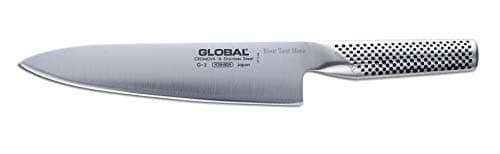
Global G-2 8" Chef's Knife8 in (20 cm)CROMOVA 18 stainless~HRC 56–58~15° per sideOne-piece steel, sand-filled hollow handle~5.8 oz (164 g)
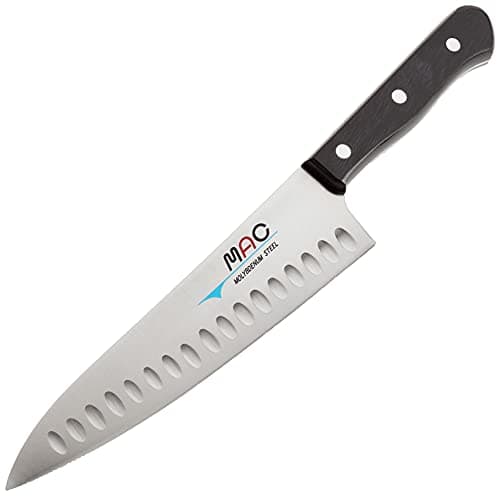
Mac Mth-80 Professional Hollow Edge 8" Chef's Knife8 in (20 cm)Molybdenum-vanadium high-carbon~HRC 59–61~15° per sideThin stamped blade, Pakkawood handle~6.5 oz (184 g)
Victorinox Fibrox Pro 8" Chef's Knife8 in (20 cm)X50CrMoV15 stainless~HRC 55–56~20° per sideStamped, full-length tang~6.6 oz (187 g)
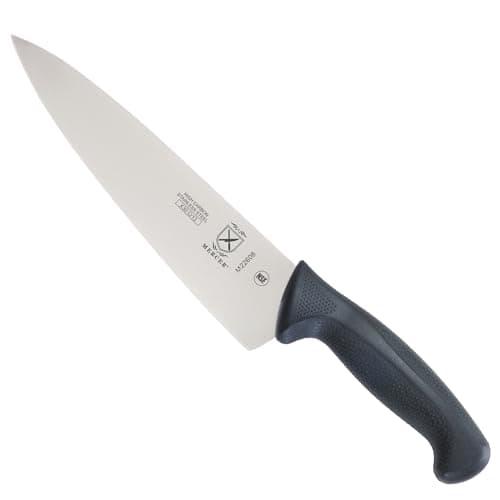
Mercer Culinary Millennia 8" Chef's Knife8 in (20 cm)Japanese stainless (X50CrMoV15 class)~HRC 56~20° per sideStamped, textured Santoprene handle~5.6 oz (159 g)
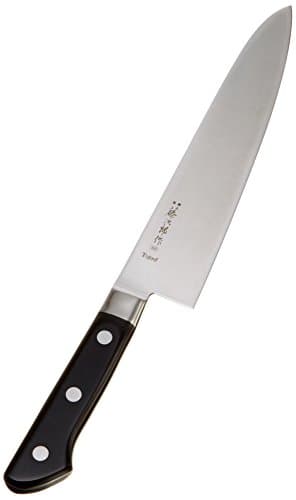
Tojiro DP Gyuto 210 mm Chef's Knife8.3 in (210 mm)VG-10 core, stainless clad (3-layer)~HRC 60~15° per sideStamped, bolsterless, riveted handle~7.4 oz (210 g)

In detail

The picks, in full

01
Global Global G-2 8" Chef's Knife

Cooks who want a light, seamless blade

Global G-2 8" Chef's Knife

8 in / 20 cmCROMOVA 18~HRC 56–58~15° edgeOne-piece
7.0/10

The one-piece stainless knife you either love or hate on feel alone. Light, distinctive, divisive.

Edge retention
7
Out-of-box edge
7
Handling
7
Build
8
Value
6

Pros

  • Seamless one-piece body has no rivets or bolster crevices to trap food — genuinely hygienic
  • Very light and nimble; the dimpled handle is grippier than it looks
  • Made in Japan with a harder-than-German edge

Cons

  • The dimpled all-metal handle is polarizing — some hands find it slippery when greasy
  • Light, blade-forward balance feels wrong to cooks raised on heavy German knives

Don't buy this if…

you've never held one. The handle is the most love-it-or-hate-it thing in this list — try before you buy, or buy somewhere with easy returns.

$149.95View on Amazon

Price as of Aug 1, 2026. Prices change — Amazon's is the one that counts.

#ad · we may earn a commission from this link to Global G-2 8" Chef's Knife

02
Mac Mac Mth-80 Professional Hollow Edge 8" Chef's Knife

The best overall, if budget allows

Mac Mth-80 Professional Hollow Edge 8" Chef's Knife

8 in / 20 cmMolybdenum-vanadium~HRC 59–61~15° edgeDimpled
8.4/10

The knife a lot of cooks quietly consider the best all-rounder made. Thin, sharp, and it stays that way.

Edge retention
9
Out-of-box edge
9
Handling
9
Build
8
Value
7

Pros

  • The blade is unusually thin, so it falls through produce with almost no wedging
  • Harder Japanese-style steel than the German knives — holds its edge markedly longer
  • The dimples (granton edge) genuinely reduce sticking on starchy vegetables
  • Takes and holds a very acute edge

Cons

  • No full bolster; the pinch grip sits right at the blade — some find it exposed
  • Harder steel is a little less forgiving of lateral abuse than soft German steel
  • Costs several times a Victorinox and looks almost as plain

Don't buy this if…

you're rough with your knives — you pry, twist, or hit bone. Harder, thinner steel chips where soft German steel just rolls. Buy the Wüsthof or the Victorinox and treat it like a hatchet if you must.

$114.95View on Amazon

Price as of Aug 1, 2026. Prices change — Amazon's is the one that counts.

#ad · we may earn a commission from this link to Mac Mth-80 Professional Hollow Edge 8" Chef's Knife

03
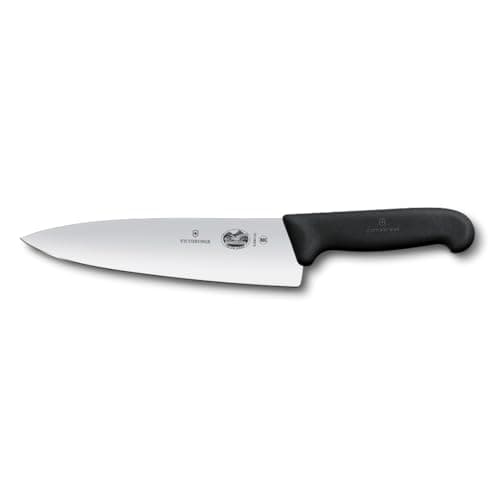
Victorinox Victorinox Fibrox Pro 8" Chef's Knife

Your first good chef knife

Victorinox Fibrox Pro 8" Chef's Knife

8 in / 20 cmX50CrMoV15~HRC 55–56StampedFibrox handle
7.8/10

The default answer to "what's a good first chef knife." Cheap, light, holds a usable edge, and a joy to sharpen.

Edge retention
6
Out-of-box edge
8
Handling
8
Build
7
Value
10

Pros

  • Costs a fraction of a forged German knife and out-cuts most of them out of the box
  • Soft-ish steel takes a screaming edge on a stone in minutes — the easiest knife here to learn to sharpen on
  • Light and nimble; the textured Fibrox handle grips even with wet hands
  • NSF-certified and dishwasher-tolerant (though you still shouldn't)

Cons

  • Softer steel means you hone often and sharpen more frequently than a hard Japanese blade
  • Stamped blade lacks the heft and bolster some cooks want for control
  • It is a tool, not an heirloom — nothing about it is beautiful

Don't buy this if…

you want a knife that keeps its edge for months between sharpenings. This trades edge retention for being cheap and easy to re-sharpen — a great trade for a beginner, a poor one if you refuse to touch a stone.

$47.34View on Amazon

Price as of Aug 1, 2026. Prices change — Amazon's is the one that counts.

#ad · we may earn a commission from this link to Victorinox Fibrox Pro 8" Chef's Knife

04
Mercer Culinary Mercer Culinary Millennia 8" Chef's Knife

The cheapest knife worth owning

Mercer Culinary Millennia 8" Chef's Knife

8 in / 20 cmJapanese steel~HRC 56StampedSantoprene
7.0/10

The culinary-school standby: a cheap, light, NSF stamped knife that culinary students are told to buy.

Edge retention
5
Out-of-box edge
6
Handling
8
Build
6
Value
10

Pros

  • About the cheapest chef knife any professional will actually endorse
  • Light and grippy; the textured handle has a finger guard beginners appreciate
  • NSF-certified — the reason it's on culinary-school supply lists

Cons

  • Soft steel and a rougher factory edge than the Victorinox
  • Fit and finish are exactly what the price suggests

Don't buy this if…

you can stretch to the Victorinox Fibrox. It's a small step up in money for a real step up in edge and finish — the Millennia is the pick only when every dollar counts.

$21.00View on Amazon

Price as of Aug 1, 2026. Prices change — Amazon's is the one that counts.

#ad · we may earn a commission from this link to Mercer Culinary Millennia 8" Chef's Knife

05
Tojiro Tojiro DP Gyuto 210 mm Chef's Knife

The best value in a Japanese knife

Tojiro DP Gyuto 210 mm Chef's Knife

8.3 in / 210 mmVG-10 core~HRC 60~15° edge3-layer clad
8.2/10

The cheapest honest way into a real VG-10 Japanese knife. It punches absurdly far above its price.

Edge retention
8
Out-of-box edge
8
Handling
8
Build
7
Value
10

Pros

  • A genuine VG-10 cutting core at a price the German knives can't touch — this is the value story of the category
  • Harder than any German blade here, so it holds a keen edge far longer
  • Thin, flat-ish profile suits push-cutting and precise work

Cons

  • The Western handle is basic and a little blocky — you're paying for the steel, not the fit and finish
  • Harder steel chips if you twist it through bone or freeze; treat it with respect
  • Reactive-ish edge on the very hard core wants drying after acidic food

Don't buy this if…

this is the only knife in a household that abuses knives. VG-10 rewards good habits and punishes bad ones — a Victorinox is the more forgiving choice for a shared kitchen.

$74.82View on Amazon

Price as of Aug 1, 2026. Prices change — Amazon's is the one that counts.

#ad · we may earn a commission from this link to Tojiro DP Gyuto 210 mm Chef's Knife

Why a lighter knife is often the better knife

Weight in a chef's knife is comfort and preference, not cutting ability — a thin, sharp light blade falls through an onion just as well as a heavy one, and better than a thick one that wedges. What extra weight buys is a planted, do-the-work-for-you feel that some cooks love; what it costs is speed, precision and stamina. If you do a lot of fine, fast knife work, have smaller hands, or simply tire of a heavy blade over a big prep session, lighter is the smarter choice — and it is why so many professionals reach for light stamped knives.

What makes a knife light

Two things: construction and steel distribution. Stamped blades (cut from thin sheet) are lighter than forged ones, and a bolsterless design removes the heavy metal collar at the heel. Japanese-style knives are generally lighter than German ones for the same length, because they are ground thinner and skip the full bolster. The Global goes furthest — a seamless one-piece body with a sand-filled hollow handle keeps it the lightest here — while the German-steel Mercer Millennia is light simply by being a thin, plain stamped blade. None of this costs cutting performance; it is all in the handling.

The picks, and who each suits

  • Global G-2 — the lightest and most distinctive, a seamless one-piece blade that is superbly nimble; try the polarizing dimpled handle before you commit.
  • MAC MTH-80 — the best cutter that is also light and thin; our top overall pick, ideal if you want lightweight and the keenest edge.
  • Victorinox Fibrox — the light, grippy, foolproof value pick and the near-universal first knife.
  • Mercer Millennia — the featherweight budget option; the lightest here, just plainer in steel and finish.
  • Tojiro DP — the heaviest of the five but still light-feeling thanks to thin geometry, and the value way into real Japanese steel.

The trade-off to know

A light blade gives up one thing: the momentum that helps a heavy knife power through dense produce like a winter squash or a big celeriac. For those, a heavier blade (or a hefty German knife) does more of the work for you. For everything else — the daily onions, herbs, proteins and vegetables that make up most cooking — light is faster and less tiring. And whichever you buy, keep it sharp: a light sharp knife beats a heavy dull one every time.

Where to go next

If lightness matters because of hand size, the best chef knives for small hands list re-ranks the field specifically for fit. If you want the full picture of every blade German and Japanese, start at the main ranking; and if you are weighing light-Japanese against heavy-German as a philosophy, our Japanese vs German guide maps each to a type of cook.
How we picked

We do not run a test kitchen

We compiled each product's published specifications — steel, hardness, edge geometry, weight — normalized them into the matrix above, and scored each one against a published rubric. The scores are judgments from those specs and the value math — they are notmeasurements we took, because we do not have a test kitchen and we're not going to pretend we do. Units we claim to have tested: 0.

Questions

Frequently asked

What is the best lightweight chef's knife?

For a light blade that is also an excellent cutter, the Global G-2 (the lightest here) or the thin MAC MTH-80. For light and cheap, the Victorinox Fibrox or the featherweight Mercer Millennia. All are far lighter than a forged German knife.

Are lightweight knives better?

For fast, precise work, smaller hands and long prep sessions, yes — a light blade is quicker and less tiring, and it cuts just as well (cutting comes from geometry, not weight). Heavier knives only win on powering through very dense produce. It is preference, not performance.

Why are Japanese knives lighter than German ones?

They are ground thinner and usually skip the full bolster, so they carry less steel for the same length. That makes them lighter and nimbler (and keener), at the cost of being more chip-prone. See Japanese vs German knives.

Keep reading

Receipts

Sources

We do not run a test kitchen, and we do not pretend to. Specs are the manufacturer's published figures, attributed as such; where we could not verify something, we say so on the page rather than quietly leaving it out. Read our full method.