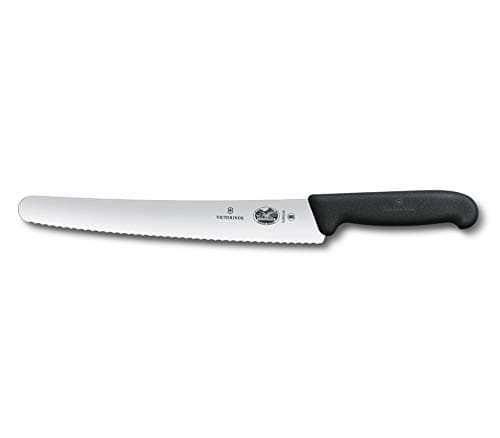
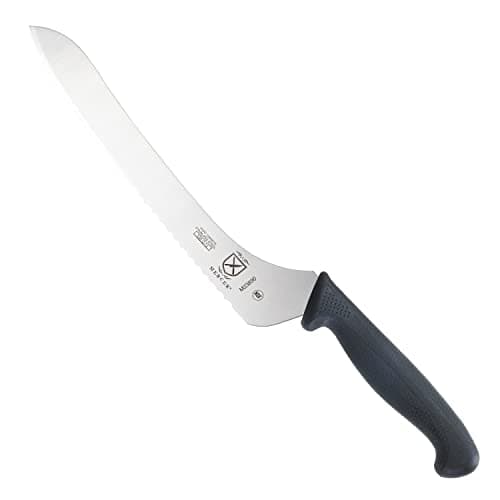
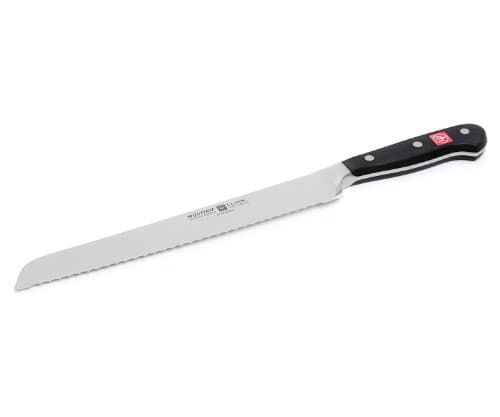
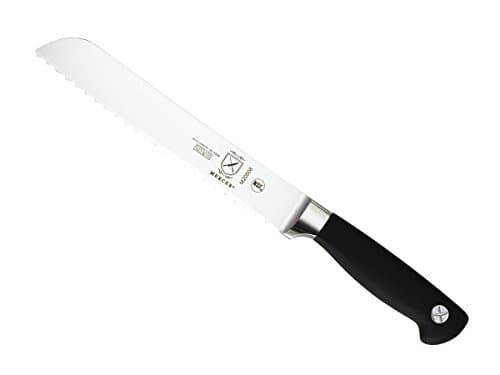
A bread knife is the one edge a chef's knife can't replace — the serrated blade that saws through hard crust and soft crumb without crushing the loaf. It's also the knife people most often overpay for, because of one fact the marketing would rather you didn't know: a $16 serrated knife slices bread about as well as a $180 one.Serrations do the cutting, and you can't easily resharpen them at home, so a bread knife is closer to a semi-disposable tool than a lifetime investment. That truth shapes this whole list — we rank for cutting value, not prestige, and the cheap knives win.
These six are ranked by our overall score, which weights value heavily for exactly the reason above. The premium forged and Damascus knives here are genuinely lovely and score high on build and slicing — but their poor value for the job drops them down the list, because we're answering "what should most people buy," not "what's the fanciest." If you want the beautiful object, it's here too, clearly labeled, with eyes open about the premium.
What actually matters in a bread knife
Before the picks, the five things that decide whether a bread knife is good — and the two that don't matter nearly as much as the price suggests.
- Serration type. The tooth pattern is the whole knife. A pointed serration (deep, sharp teeth) bites aggressively through hard crust; a wavy edge (rounded scallops) slices cleanly with less tearing; a double-serrated edge (fine teeth on teeth, as on the Wüsthof) gives the cleanest, finest cut. All work; the differences are subtle.
- Length. Bread is wide, so length matters more here than on any other knife. A 9–10 inch blade clears a full sourdough boule in one or two strokes; an 8-inch works but saws more. Longer is genuinely better for bread.
- Handle and offset. A comfortable, grippy handle matters because you use a sawing motion. An offset(cranked) handle raises your knuckles above the board — a real advantage for bagels, rolls and flat loaves, a non-issue for tall boules.
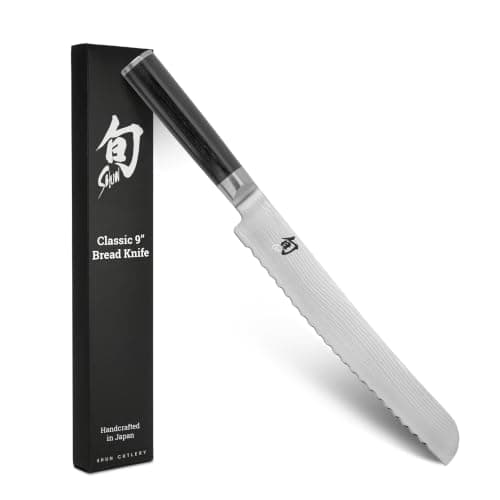
- Steel and edge holding.Harder steel (the Shun's VG-MAX) keeps its bite longer, but because serrations dull slowly and last for years anyway, this matters far less than on a plain-edged chef's knife.
- Value.The one that decides the ranking. Since you can't resharpen serrations at home and a cheap knife cuts bread beautifully, every dollar past "good and long enough" buys feel and finish, not better slices.
What matters lessthan the price implies: forging (heft is nice, but a stamped blade slices bread just as well — see forged vs stamped) and brand prestige. Keep those in mind as you read the picks.
The honest truth: don't overspend on a bread knife
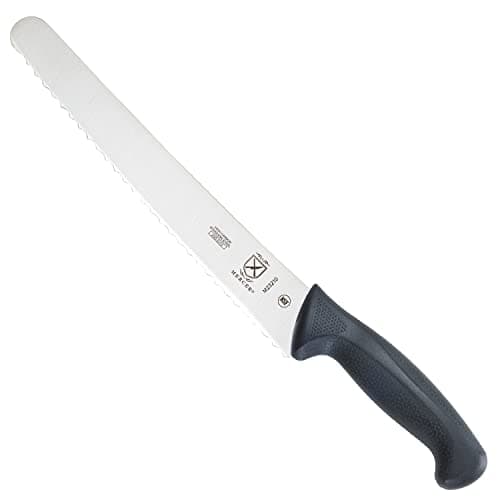
Here's the case, plainly. Serrated edges cut with their teeth, not a fine polished apex, so the precision you pay for in a chef's knife barely applies. And because those teeth are almost impossible to sharpen on a flat stone, a bread knife isn't something you maintain for decades — when it finally dulls, most people replace it. Put those two facts together and the conclusion is clear: buy a good, long, comfortable serrated knife for very little money, and spend the difference on a knife where it counts, like your chef's knife. That's why the $16 Mercer Millennia tops this list and the $180 Shun sits at the bottom — not because the Shun is bad (it's beautiful), but because it's a lot of money to slice bread.
Can you sharpen a bread knife?
Barely, and not on a normal stone. A flat whetstone only touches the tips of the serrations, which flattens the edge instead of sharpening it. The real method uses a tapered ceramic or diamond rod, working each individual scallop — slow, fiddly work covered in how to sharpen a serrated knife. For a cheap knife it's usually not worth it; for a Wüsthof or Shun, the maker or a professional can do it. This is the practical reason the value picks make the most sense for most people.
Serration patterns, and which to choose
Pointed serrations (Victorinox) are aggressive and grip hard crust well, but can tear a very soft crumb slightly. Wavy edges(Mercer Millennia) are the friendly all-rounder — clean on crust and crumb alike. Double serrations (Wüsthof Classic) give the finest, cleanest slice and the most control, which is part of what the premium buys. For everyday loaves, any of them is fine; if you slice a lot of delicate cake or milk bread, the finer wavy or double-serrated edges have a slight edge.
Do you even need a dedicated bread knife?
Yes — it's one of the three knives that cover almost all of home cooking, alongside a chef's knife and a paring knife (the full argument is in how many kitchen knives you need). A chef's knife crushes bread; a serrated edge is the only thing that slices it cleanly. It also handles tomatoes, citrus and anything with a tough skin and soft interior. If you're building a kit from scratch, see best chef knife setsfor whether to buy a block or open stock — but a standalone bread knife this cheap makes the open-stock route easy.
Using and caring for it
Let the length do the work: long, light saws with almost no downward pressure give the cleanest slice — the full technique is in how to slice bread. Hand wash and dry it (the dishwasher dulls and corrodes every knife), and store it so the serrations can't bang against other blades — a block, strip or in-drawer guard. Serrations stay sharp for years, so with basic care even the budget pick lasts a long time. For the broader picture of what a serrated knife is and isn't for, see what a bread knife is used for and chef knife vs bread knife.