Skip to content
Bevel & Bone

HUB 02 · Sharpening

Best Electric Knife Sharpeners

Every electric sharpener buys you speed with your knife's steel. Six machines ranked by how little they charge you for it — and one angle spec that decides the whole purchase.

By Stephen V.Updated How we choose
#ad

We earn a commission when you buy through our Amazon links, at no extra cost to you. It never changes a ranking, and we say so when the cheaper knife is the better buy. How this works.

An electric sharpener does one thing no other tool does: it makes a dull knife sharp in about two minutes, with no skill, on a weeknight, while the pasta water heats. It pays for that with steel. A motor spinning an abrasive takes far more metal off your blade than a stone does, and metal is the one thing a knife cannot get back. That is not a reason nobody should own one — it is the reason you should buy the machine that charges you least.

These six are ranked on exactly that basis, with live prices. Our top pick, the Chef'sChoice 1520 AngleSelect, wins because it is the only machine here that asks which angle your knife is ground to instead of deciding for you. Every other electric on this list has one answer, and if your knives disagree with it, the machine quietly re-grinds them until they agree.

If you have not decided that an electric is the right tool at all, read are electric knife sharpeners bad first — it is the honest version of that argument, and it may talk you out of this page. For the wider field of jigs, crossed-rod systems and pull-throughs, see the best sharpening systems roundup, which ranks manual and powered tools together.

The short answer

Quick picks

#ad · Live prices from the Amazon Product API, as of Aug 29, 2026. Where we have no verified live price we show none — we'd rather leave a gap than print a number that has rotted.

By the numbers

The specs, side by side

Every figure below is the manufacturer's published specification. Where a maker doesn't publish a value, the cell reads "—" rather than a number we made up.

Knife / ToolMechanismAngleAbrasivesStagesSerrated
Chef'sChoice 1520 AngleSelect Electric Knife SharpenerMotorized diamond disc15° or 20° (selectable)100% diamond + stropping disks3Yes
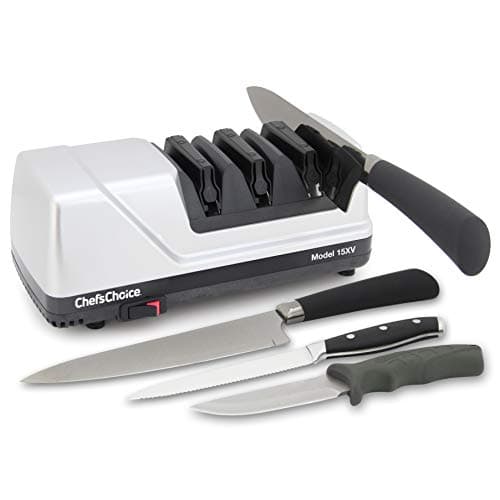
Chef'sChoice 15 Trizor XV Electric SharpenerMotorized diamond disc15° per side (fixed)Diamond stages + stropping stage3Yes
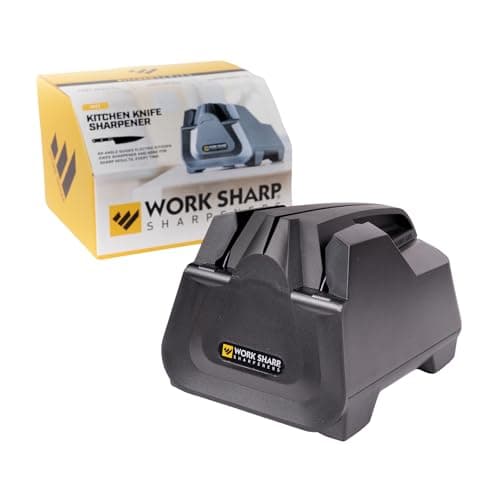
Work Sharp Culinary E2 Electric Kitchen Knife SharpenerFlexible abrasive disc20° (fixed guide)Flexible abrasive discs + ceramic hone2 (sharpen + hone)
Work Sharp Knife & Tool Sharpener Mk.2Abrasive belt20° or 25° (switchable)P80 / P220 / 6000 grit belts3 belt gritsYes
Chef'sChoice 312 Diamond UltraHone Knife SharpenerMotorized diamond disc20° class (fixed)100% diamond — fine, then micron2Yes
Presto 08800 EverSharp Electric Knife SharpenerMotorized grinding wheelFixed (no-guess blade guides)Sapphirite wheels2No

In detail

The picks, in full

01
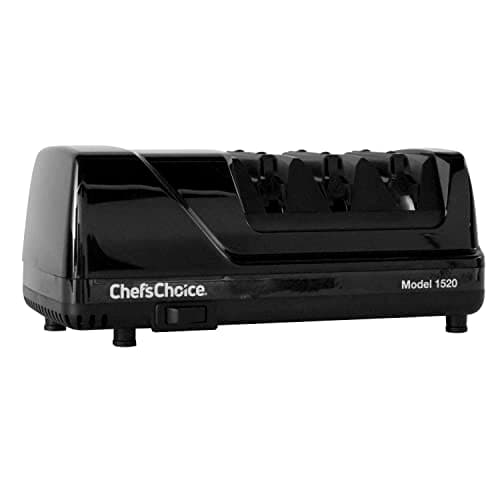
Chef'sChoice Chef'sChoice 1520 AngleSelect Electric Knife Sharpener

A drawer of mixed 15° and 20° knives

Chef'sChoice 1520 AngleSelect Electric Knife Sharpener

Electric15° or 20°100% diamond3-stageSerrated OK
7.8/10

The one electric that lets a 20° knife stay 20° and takes a Japanese-style blade to 15°. That choice is the whole reason it leads.

Results
8
Ease of use
9
Angle consistency
8
Versatility
8
Value
6

Pros

  • Separate 15° and 20° sharpening stages, so you are not forced to re-grind every knife in the house to one angle
  • 100% diamond abrasives plus a dedicated stropping/polishing stage — a genuinely refined finish for a machine
  • Chef'sChoice publishes a serrated-knife capability, which most electrics here do not
  • Three-year limited warranty from the maker

Cons

  • The most expensive machine on this list, and it is still a metal-removing motor
  • Selectable angles only help if you actually know which of your knives is which — get it wrong and you re-profile a knife by accident
  • Bulky on a counter and heavy enough (about 4 lb) that it is not a drawer tool

Don't buy this if…

your knives are all soft German 20° blades. You are paying a premium for an angle choice you will never use — the cheaper two-stage machines below do that one job for half the money.

$152.58View on Amazon

$214.9929% off

Price as of Aug 29, 2026. Prices change — Amazon's is the one that counts.

#ad · we may earn a commission from this link to Chef'sChoice 1520 AngleSelect Electric Knife Sharpener

02
Chef'sChoice Chef'sChoice 15 Trizor XV Electric Sharpener

Fast, hands-off sharpening

Chef'sChoice 15 Trizor XV Electric Sharpener

Electric15° edgeDiamondPowered3-stage
7.4/10

The electric sharpener that's actually good. It converts a 20° German edge to a keener 15° and does it fast.

Results
8
Ease of use
10
Angle consistency
8
Versatility
5
Value
6

Pros

  • Genuinely fast and repeatable — dull to sharp in a couple of minutes with no skill needed
  • Re-profiles softer German knives to a keener 15° edge that then cuts better
  • The three-stage system includes a stropping/polishing stage for a refined finish

Cons

  • Motorized diamond wheels remove more metal than any manual method — it shortens a knife's life
  • Not for hard, thin Japanese knives or single-bevel blades; the fixed geometry can ruin them
  • Bulky, noisy, and the priciest option here

Don't buy this if…

you own nice Japanese knives or you sharpen infrequently. Electric wheels eat metal; on a $150 gyuto that's expensive damage. This is for a busy household of tough Western knives.

$170.00View on Amazon

Price as of Aug 29, 2026. Prices change — Amazon's is the one that counts.

#ad · we may earn a commission from this link to Chef'sChoice 15 Trizor XV Electric Sharpener

03
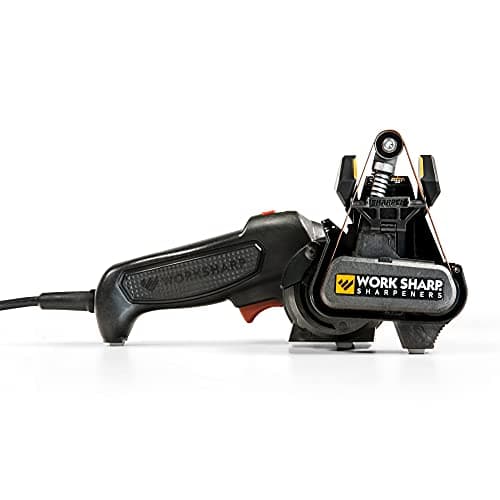
Work Sharp Work Sharp Culinary E2 Electric Kitchen Knife Sharpener

Removing the least metal

Work Sharp Culinary E2 Electric Kitchen Knife Sharpener

Electric20° guideFlexible discCeramic hone90s timer
7.4/10

The gentlest electric here. Flexible abrasive discs and a 90-second timer make it hard to over-grind a knife — which is the failure mode of the whole category.

Results
7
Ease of use
9
Angle consistency
8
Versatility
5
Value
8

Pros

  • Flexible discs put a convex edge on the blade and cut far less aggressively than a diamond wheel — the least destructive electric here
  • A timer stops the machine at 90 seconds, which removes the single biggest way people ruin a knife on a powered sharpener
  • Built-in ceramic honing slot handles the between-sharpenings touch-up, so one small box covers both jobs
  • The smallest and quietest machine on this list — it genuinely fits in a kitchen drawer

Cons

  • 20° guide only: it cannot put a 15° edge on a Japanese knife, and it will slowly widen one that already has it
  • Discs are a consumable — they are replaceable and reversible, but you will buy more
  • Work Sharp does not publish a serrated capability for it, so treat serrated blades as out of scope

Don't buy this if…

you own Japanese knives ground near 15°. The fixed 20° guide will re-profile them wider every time you use it — buy the 1520 or learn a stone instead.

$59.95View on Amazon

Price as of Aug 29, 2026. Prices change — Amazon's is the one that counts.

#ad · we may earn a commission from this link to Work Sharp Culinary E2 Electric Kitchen Knife Sharpener

04
Work Sharp Work Sharp Knife & Tool Sharpener Mk.2

Sharpening more than kitchen knives

Work Sharp Knife & Tool Sharpener Mk.2

Electric belt20° / 25°3 belt grits2-speed3 lb
7.4/10

A belt grinder for the house, not a kitchen appliance. Superb if the chef's knife is one of a dozen things you need sharp; overkill and over-aggressive if it isn't.

Results
7
Ease of use
7
Angle consistency
7
Versatility
8
Value
8

Pros

  • Three belt grits, from P80 for real damage through a 6000 finishing belt — it can rescue an edge no kitchen electric will touch
  • Two motor speeds: the low speed exists specifically so kitchen knives are not fed to a tool-speed belt
  • Leather-lined angle guides flick between 20° and 25° without scratching the blade finish
  • Sharpens scissors, axes and garden tools too, which no other machine here pretends to do

Cons

  • A moving belt removes metal fast — the most aggressive machine on this list by a distance
  • 20° and 25° only, so it has no setting for a Japanese kitchen edge
  • Belts are consumables and the coarse ones go quickly if you use them for repair work
  • Noisy, throws grit, and asks more of the user than any 'insert knife, press button' electric

Don't buy this if…

the only things you sharpen are kitchen knives. This is a workshop tool that happens to do kitchen knives — a 20° kitchen electric does that job with a fraction of the metal loss.

Check price on Amazon →

No buyable offer at the last price check (Aug 29, 2026). We show nothing rather than a stale number.

#ad · we may earn a commission from this link to Work Sharp Knife & Tool Sharpener Mk.2

05
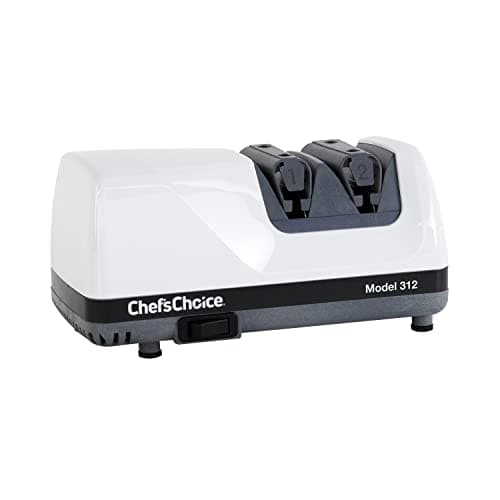
Chef'sChoice Chef'sChoice 312 Diamond UltraHone Knife Sharpener

Maintaining a 20° edge, not re-grinding it

Chef'sChoice 312 Diamond UltraHone Knife Sharpener

Electric20° class100% diamond2-stageSerrated OK
6.6/10

A two-stage machine with no coarse grinding stage at all — so it maintains a 20° edge instead of eating one. The right electric for a knife that is dull, not damaged.

Results
6
Ease of use
9
Angle consistency
8
Versatility
5
Value
5

Pros

  • Both stages are fine abrasives — stage one sets the first bevel, stage two ultra-hones the second — so there is no coarse wheel to over-grind with
  • Conical diamond disks are designed to apply the sharpening pressure for you rather than letting you lean on the blade
  • Handles straight-edge and serrated 20° knives, and small sporting and pocket knives too
  • Compact and simple: two slots, no angle to choose, nothing to get wrong

Cons

  • With no coarse stage it is slow to rescue a badly dull or chipped edge — that is the trade, and it is deliberate
  • 20° class only; it has no answer for a Japanese knife
  • Priced well above the cheapest machines here for one fewer stage than the top picks

Don't buy this if…

your knives are already blunt or chipped. This machine refines an edge; it does not rebuild one. Repair the edge on a coarse stone first, or buy a machine with a grinding stage.

$94.95View on Amazon

$99.995% off

Price as of Aug 29, 2026. Prices change — Amazon's is the one that counts.

#ad · we may earn a commission from this link to Chef'sChoice 312 Diamond UltraHone Knife Sharpener

06
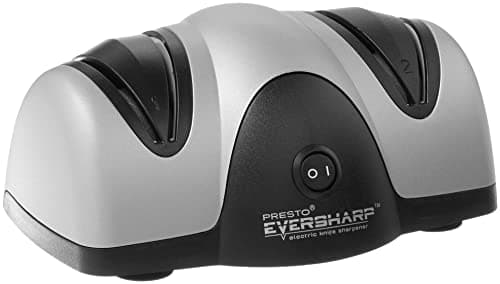
Presto Presto 08800 EverSharp Electric Knife Sharpener

The lowest price that still works

Presto 08800 EverSharp Electric Knife Sharpener

Electric2-stageSapphiriteBlade guides120V
6.0/10

The cheapest way to make a drawer of neglected knives cut again. It is also the bluntest instrument here — know what you are trading.

Results
5
Ease of use
9
Angle consistency
6
Versatility
3
Value
7

Pros

  • Costs a fraction of the Chef'sChoice machines and will bring a genuinely dull kitchen knife back to cutting in a couple of minutes
  • Two stages — a grinding stage then a fine honing and polishing stage — rather than a single carbide scrape
  • Fixed blade guides hold the angle for you, so there is nothing to set and nothing to misjudge
  • Small, light and cheap enough to keep in a holiday house or a rental kitchen

Cons

  • Presto positions it for non-serrated kitchen and sporting knives — serrated blades are out
  • No published angle figure and no way to change it: you get the angle the guides give you
  • A grinding wheel at this price point is the most metal-hungry way to sharpen on this list
  • One-year warranty, against three from Chef'sChoice and Work Sharp

Don't buy this if…

you own a knife you would be sad to replace. On a $30 knife this is a bargain; on a $150 gyuto it is expensive damage delivered quickly.

$47.99View on Amazon

$54.9913% off

Price as of Aug 29, 2026. Prices change — Amazon's is the one that counts.

#ad · we may earn a commission from this link to Presto 08800 EverSharp Electric Knife Sharpener

What an electric sharpener actually does to a knife

A knife edge is a very thin wedge. Sharpening means grinding metal off both faces of that wedge until they meet in a clean apex. Every method does this — a whetstone, a guided jig, an electric. The difference is how much steel comes off to get there, and how much control you have over where it comes off.

A whetstone removes metal at the rate your arm moves it, which is slow, and you can stop the instant the burr forms. A motor removes metal at the rate the motor turns, which is fast, and it keeps doing it for as long as the blade is in the slot. That is the entire trade. It is why a good electric sharpener has a timer, a fine-only stage, or a flexible abrasive — those are all mechanisms for taking the decision away from an impatient human. And it is why the difference between the cheapest machine here and the dearest shows up not in how sharp the knife gets — they all get a knife sharp — but in how many more times you will be able to sharpen it before the blade is visibly narrower than it was.

Put a number on it this way: a kitchen knife sharpened on a stone twice a year will outlive you. The same knife run through a coarse powered wheel every few weeks is a noticeably smaller knife in a decade. Our full explanation of edge wear is in why does my knife get dull so fast, and the reason honing delays all of this is in sharpening vs honing.

The angle spec is the whole decision

If you read one section here, read this one. Kitchen knives are ground to roughly two families of edge angle. Western and German knives — Wüsthof, Zwilling, Victorinox, Mercer — are traditionally around 20° per side. Japanese and Japanese-influenced knives are ground closer to 15°, and some go finer. The full per-steel breakdown is in our knife sharpening angle guide, and the reason the two traditions differ is in Japanese vs German knives.

An electric sharpener grinds at a fixed angle. If that angle is wider than your knife's, the machine grinds the shoulders of the bevel away until the whole edge is its angle — a slower, blunter knife, and a lot of steel gone. If it is narrower, it thins the edge, which cuts better but chips more easily on a hard blade. Neither is a disaster if you chose it. Both are a disaster if you did not know it was happening.

So, concretely:

  • All-German drawer (20°): almost anything here works. The 312 UltraHone, the E2 and the Presto are all 20°-class machines and cost less than the top two.
  • Mixed drawer: buy the 1520 AngleSelect. It has separate 15° and 20° stages, so a Wüsthof and a Tojiro can share a counter without one of them being quietly reground.
  • You want your German knives keener:the Trizor XV deliberately converts a 20° edge to 15°. That is a real upgrade in cutting feel on softer Western steel — and a one-way trip, since going back means grinding the edge wider again.
  • Hard Japanese knives you care about: honestly, none of these. See the section below.

The four mechanisms, and what each one costs you

  • Motorized diamond discs (Chef'sChoice 1520, Trizor XV, 312). Spinning discs faced with diamond abrasive, in coarse-to-fine stages. Fast, precise and the most refined finish in the category when the machine has a stropping stage. The coarse stage is also where most accidental knife-shortening happens.
  • Flexible abrasive discs (Work Sharp E2).A softer, flexing abrasive that follows the blade and leaves a slightly convex edge. It cuts more slowly than diamond, which sounds like a weakness and is actually this machine's best feature — it is much harder to take off metal you did not mean to.
  • Abrasive belts (Work Sharp Mk.2). A moving belt, in grits from P80 to 6000. This is a genuine grinder: it will fix an edge that no kitchen electric can save, and it will remove a frightening amount of steel if you let it. Its low-speed setting exists precisely so that kitchen knives are not fed to a tool-speed belt.
  • Grinding wheels (Presto EverSharp). The old-school approach: hard Sapphirite wheels behind fixed guides, one grinding stage and one honing stage. Cheap, effective on neglected knives, and the least subtle thing on this list.

Which knives to keep away from an electric

Every machine on this page is designed around a double-bevel Western or Western-style kitchen knife. Outside that, the honest answer is often "do not."

  • Hard, thin Japanese knives. A blade at HRC 60+ ground thin behind the edge is exactly the geometry that chips when a powered abrasive heats it, loads it sideways, or thins it further. Our knife hardness guide explains why hardness and fragility travel together. Sharpen these on a stone.
  • Single-bevel knives— yanagiba, usuba, deba. A machine that grinds both sides equally destroys the entire point of the grind. See single bevel vs double bevel.
  • Serrated knives, unless the maker says otherwise. Chef'sChoice publishes serrated capability on the 1520, Trizor XV and 312; Presto positions the EverSharp for non-serrated knives, and Work Sharp does not publish a serrated claim for the E2. A bread knife is better served by a tapered rod anyway — see how to sharpen a serrated knife.
  • Ceramic blades and anything with a hollow-ground Granton dimple pattern near the edge. Ceramic needs diamond and a very light hand; dimples confuse fixed guides.

How to use one without wrecking the knife

Most of the damage blamed on electric sharpeners is really damage done by people using them the way they use a pull-through: hard, fast, and until it feels sharp. Four habits fix nearly all of it.

  • Let the machine set the pressure. Guide the knife; do not press it. Every maker here builds the correct force into the guides and the disc, and leaning on the blade only adds heat and metal loss.
  • Count passes and alternate sides.Equal numbers, each side, heel to tip in one smooth pull. Uneven counts put the apex off-center, which is the real reason a "sharpened" knife still slides off a tomato.
  • Use the coarse stage almost never.On a knife that is merely dull, start at the fine stage. The coarse stage is for damage, and it is the stage that shortens the blade's life.
  • Then stop sharpening and start honing. A honing steel used every few uses keeps the edge aligned so that the electric comes out two or three times a year instead of monthly. That single habit does more to preserve your knives than any choice on this page. The technique is in how to hone a knife.

How this list is ranked

Scores are judgments from published specifications and the value math on how we choose— we do not run a test kitchen and we do not claim to. Three machines here tie on overall score, so the order within that tie is set by fit for kitchen knives specifically: the Trizor XV and the E2 are kitchen tools, while the Mk.2 is a workshop sharpener that happens to accept a chef's knife. The Presto sits last not because it fails, but because a fixed unpublished angle, no serrated support and a hard grinding wheel are exactly the specification list that costs a knife the most steel.

Note also that our best sharpening systems roundup names the Trizor XV as its electric pick. That page ranks every kind of guided tool together, and the Trizor XV is the best-known, most refined electric to put against a clamp jig. This page ranks electrics against each other, where the 1520's selectable angle is decisive in a way it simply is not when the comparison is a whetstone. Same evidence, two different questions.

The alternative we are obliged to mention

A good 1000/6000 whetstone sits in the same price bracket as the cheapest machine here, removes a fraction of the metal, works on every knife you will ever own, and produces a better edge. It asks for twenty minutes of learning. If that trade sounds fine, it is the better purchase, and how to sharpen a chef's knife is the whole skill in one page. If you know with total honesty that you will never do it — and a lot of good cooks know this about themselves — then an electric that you actually use beats a stone in a drawer, because a sharp knife is safer and better than a dull one by a wide margin. That is the real argument for this category, and it is a good one. Weighed head to head, the case is laid out in whetstone vs electric sharpener and electric vs manual knife sharpener.

What we would actually buy

If your knives are a mix of Western and Japanese, the 1520 AngleSelect, and nothing else on this list is close. If they are all German and you want them cutting keener than the factory ever managed, the Trizor XV. If your priority is doing the least possible harm, the Work Sharp E2— a gentle abrasive and a timer is a better safety system than any amount of diamond. If the kitchen knives are one item on a long list of things that need sharpening, the Mk.2. And if the knives are cheap and the budget is the point, the Presto EverSharpis genuinely better than leaving them blunt — just do not put a good knife in it. Whichever you choose, buy a honing steel at the same time. It is the cheapest thing in this hub and it will halve how often the motor comes out.
How we picked

We do not run a test kitchen

We compiled each product's published specifications — steel, hardness, edge geometry, weight — normalized them into the matrix above, and scored each one against a published rubric. The scores are judgments from those specs and the value math — they are notmeasurements we took, because we do not have a test kitchen and we're not going to pretend we do. Units we claim to have tested: 0.

Questions

Frequently asked

What is the best electric knife sharpener?

The Chef'sChoice 1520 AngleSelect, because it has separate 15° and 20° stages and therefore does not force every knife in your kitchen to one angle. If all your knives are 20° German blades and you want them keener, the Chef'sChoice Trizor XV converts them to 15°. If you want the least metal removed, the Work Sharp E2.

Are electric knife sharpeners bad for knives?

They remove more metal than any manual method, which shortens a knife's working life, and a fixed angle can re-grind a knife that was ground differently. On tough Western knives used often they are fine and very convenient. On a hard, thin Japanese blade they are a genuine risk. The long answer is in are electric knife sharpeners bad.

Can you sharpen Japanese knives in an electric sharpener?

Only in a machine with a 15° setting, and even then we would not put a prized gyuto through one. Most electrics are 20°-class, which means they grind a 15° Japanese edge wider every single time. Single-bevel Japanese knives should never go near one. Use a whetstone instead.

Do electric knife sharpeners work on serrated knives?

Some do and some do not, and the maker's specification is the only reliable guide. Chef'sChoice publishes serrated capability on the 1520, Trizor XV and 312 UltraHone. Presto positions the EverSharp for non-serrated knives. Even where it is supported, a tapered rod does a better job — see how to sharpen a serrated knife.

How often should you run a knife through an electric sharpener?

As rarely as it will let you. Two or three times a year is plenty for a home kitchen if you hone regularly between times; monthly trips through a powered wheel visibly shorten a blade over a decade. If your knife feels dull after a fortnight, the fix is a honing steel and a better cutting board, not more grinding — see how often should you sharpen a knife.

Is an electric sharpener better than a pull-through?

Yes, clearly. A two-stage electric grinds a real bevel and then hones it; a carbide pull-through tears a coarse edge and scrapes off steel with no finishing step at all. Both remove more metal than a stone, but the pull-through gives you the worst edge for the metal it takes — pull-through vs whetstone sets out why.

Keep reading

Receipts

Sources

We do not run a test kitchen, and we do not pretend to. Specs are the manufacturer's published figures, attributed as such; where we could not verify something, we say so on the page rather than quietly leaving it out. Read our full method.