Worth it as a second knife if you cook vegetables often — never as your only knife. A nakiri is a tall, flat, thin, square-tipped Japanese vegetable blade, and it does three things better than a chef's knife: it cuts straight down so nothing stays joined at the bottom of the slice, the tall blade scoops a board of diced onion in one go, and the straight edge removes the rocking motion that aggravates wrists and shoulders. It also cannot joint a chicken, cannot pierce anything, and is the wrong knife if you are only ever going to own one.
What the shape actually buys you
- A flat edge, so the cut finishes.A chef's knife has a curved belly: push it straight down and the middle of the edge reaches the board before the ends do, so you get the classic half-severed accordion of onion still hanging together. A nakiri's edge is flat from heel to tip, so a single straight push-cut severs the whole length at once. On a board of carrots, celery and cabbage this is the whole difference.
- Height, so your knuckles clear and the blade carries. A nakiri is tall front-to-back. That gives you clearance over a big pile, and the flat of the blade will lift a board's worth of diced vegetables in one movement without a bench scraper.
- Thinness, so it does not wedge. Dense produce — a sweet potato, a cabbage heart, a daikon — splits rather than slices on a thick blade. Blade geometryexplains the mechanism, and the MAC JU-65's 2.5 mm spine is the clearest example on the site.
- A straight-down motion, which is easier on joints. The rocking cut a curved chef's knife wants involves wrist rotation on every stroke. A nakiri's push cut does not, which is why it comes up in our knives for arthritis advice.
What is a nakiri knife covers the shape in full, and chef knife vs nakiri runs them head to head.
Who should skip it
- Anyone buying their first good knife.Buy an 8-inch chef's knife. It does 90% of the work in a kitchen; a nakiri does one category of it very well. How to choose a chef knife is the right starting point.
- Anyone who wants one knife for everything. No tip means no piercing, no scoring, no getting into a joint. No belly means no rocking cut for herbs, which many cooks genuinely prefer. It is a specialist.
- Anyone who already owns and likes a santoku. The overlap is substantial — a santoku is the compromise shape, with some belly, a usable tip and a shorter flat section. Santoku vs nakiri and what is a santoku knife both cover it. If you want one Japanese-shaped knife that handles meat as well as vegetables, that is the santoku, not this.
- Anyone who will not maintain a thin hard edge. The thinness that makes a nakiri cut is also what makes it chip on a bone or a frozen edge. The Shun in particular needs a stone — stones for Japanese knives.
Worth naming the honest overlap too: a Chinese cleaver does much of what a nakiri does, taller and heavier, and often for less money. See chef knife vs Chinese cleaver and best cleavers if the tall flat blade is what appeals and the Japanese thinness is not the point.
What to look for
- Thinness first.This is the spec that decides whether a nakiri feels like a revelation or like a tall chef's knife. Look for a stated spine thickness around 2–3 mm. A thick forged nakiri misses the point of the shape.
- Length: 165 mm (6.5 in) or 180 mm (7 in). Six and a half inches is the traditional size and is plenty — the blade is tall, so it does not need to be long. Seven inches suits a bigger board.
- Double bevel, not single. A nakiri is a double-bevel knife; its single-bevel cousin is the usuba, which is a professional tool with a different sharpening discipline — single bevel vs double bevel.
- Decide what you are paying for.Hard clad steel at ~HRC 60–61 holds a keener edge much longer; forged German stainless is tougher and far cheaper. Both are legitimate; they are different purchases. Knife hardness explained frames the trade.
- Check what the maker actually publishes.Several makers state no Rockwell figure, edge angle or weight for their nakiri — the matrix below reads "—" in those cells rather than carrying a number we invented.
The three we would buy, and who each suits
- MAC Japanese Series 6.5" JU-65 — the one that best captures why the shape exists. A genuinely thin 2.5 mm molybdenum stainless blade at ~5.6 oz with a Pakkawood handle: it falls through vegetables and weighs almost nothing. MAC publishes very little about it on paper — no Rockwell figure, no edge angle — so if you want a full spec sheet to compare, this is not the pick.
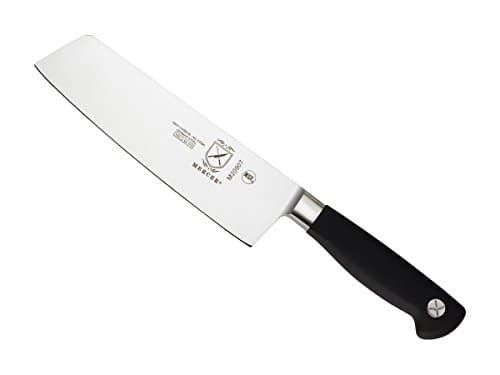
- Mercer Culinary Genesis 7" nakiri (M20907) — the value pick, and the one most cooks should buy to try the shape. Forged, full tang, high-carbon German stainless, taper-ground, Santoprene handle, NSF — for roughly a third of what the German brands charge for a nakiri. It is noticeably thicker than the MAC, which means less of the floaty Japanese feel and more toughness.
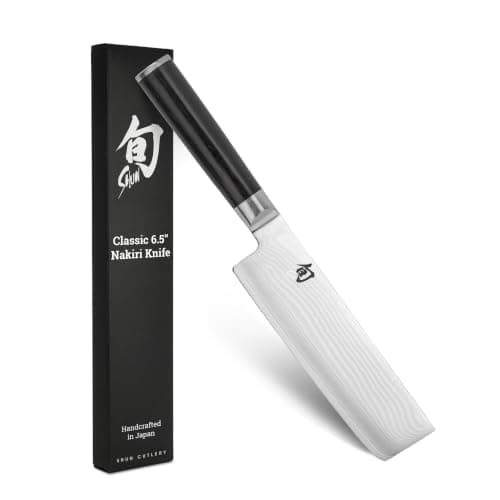
- Shun Classic 6.5" nakiri— the best steel and the keenest edge here. A VG-MAX core at ~HRC 60–61 behind a ~16° edge, clad with 34 Damascus layers a side, D-shaped Pakkawood handle. Buy it if you will maintain it on a whetstone; a pull-through will wreck it, and a right-handed D-handle is a real consideration if you are left-handed.
All six nakiri we track — including the Wüsthof, Zwilling and Mercer Asian options — are ranked in best nakiri knives.
The cheapest honest way to find out
If you are unsure whether the shape suits you, buy the Mercer. It is a small enough outlay that discovering you prefer a chef's knife costs you very little, and it is tough enough to survive being treated like a normal knife while you find out. If you then love the shape, the MAC or the Shun is the upgrade and you will know exactly what you are upgrading for — thinness, and edge retention, in that order.
The same logic applies in reverse. If you already own a good chef's knife and your complaint is specifically that onion stays joined at the root end or that your wrist aches after a big prep session, a nakiri fixes the thing you are complaining about. If your complaint is that your knife is not sharp, buy a stone instead — stones for beginners costs less than any knife here and will change more.
Using one, and the habit to unlearn
The motion is a straight push cut, not a rock: the blade travels slightly forward and down, the flat edge meets the board along its whole length, and you lift and reset. People coming from a chef's knife instinctively try to rock a nakiri and conclude it is awkward — it is, when used that way. How to hold a chef's knife still applies for the grip, and knife skills for beginners covers the push cut. The jobs it is best at are in how to cut a cabbage, how to julienne vegetables and how to cut an onion.
Two care notes. Keep it off bone and frozen food — the thinness is the whole point and it is also the vulnerability. And sharpen it on a stone rather than a pull-through; a flat tall blade is actually easier to hold at a consistent angle than a curved one, which makes a nakiri a good knife to learn freehand sharpening on. How to sharpen a santoku is the closest technique page, and easiest knives to sharpen explains why the flat profile helps.
The verdict in one line
A nakiri is the best second knife in a vegetable-heavy kitchen and a poor first knife anywhere. If you want the ranked options, best nakiri knives and best knives for cutting vegetables are the two pages to read next.