Skip to content
Bevel & Bone

HUB 01 · Chef Knives

Best Utility Knives

The in-between knife: too big for paring, too small for a chef's knife, and the one most people reach for more than they expect. Six utility knives ranked, with the honest case for spending almost nothing.

By Stephen V.Updated How we choose
#ad

We earn a commission when you buy through our Amazon links, at no extra cost to you. It never changes a ranking, and we say so when the cheaper knife is the better buy. How this works.

A utility knife is the 4.5-to-6-inch blade that sits between a paring knife and a chef's knife— and in most kitchens it is the knife that quietly gets used more than either of its neighbors. Sandwiches, a single chicken breast, a block of cheese, a couple of tomatoes, a handful of shallots: all of it is too big for a paring knife to handle comfortably and too small to be worth hauling out eight inches of chef's knife for. Our top pick is the Mercer Culinary Millennia 6" Utility Knife— it is the cheapest knife on this page, and it is first on purpose.

That is the honest headline of this whole category: a utility knife is the worst place in your kitchen to spend money. It does light, low-stress work on a board or in the hand, so the hard steel and thin geometry you genuinely pay for on a chef's knife contribute almost nothing here. These six are ranked by our overall score, which weights value heavily for exactly that reason. The forged Henckels, the Damascus Shun and the Solingen Wüsthof are all lovely knives that score high on edge quality and build — and all three finish below a $14 stamped blade, because we are answering "what should most people buy," not "what is the nicest." The expensive options are here too, clearly labeled, for anyone who wants one.

What actually matters in a utility knife

  • Blade length. The whole category lives between 4.5 and 6 inches. Six inches is the better all-rounder — long enough to cross a sandwich roll, a tomato or a chicken breast in one stroke. Around 4.5 inches it becomes an in-hand knife, better for small produce and closer to a long paring knife. Shorter than that and you have a paring knife; longer than about 7 inches and you have a small chef's knife.
  • Edge type — the real decision. A straight edge makes clean, precise cuts and can be honed and sharpened forever. A wavy serratededge bites through tomato skin, citrus peel and crusty bread that a straight edge slides off — but it is worse at everything else and effectively cannot be resharpened at home. If you buy one utility knife, buy straight. Most kitchens end up wanting one of each, which is affordable precisely because both are cheap.
  • Tip shape. A pointed tip lets you pierce, score and work into tight spots. A round tip cannot puncture a bag, a nonstick pan or your other hand, which is why round-tip utility knives are standard in commercial kitchens and in homes with kids around.
  • Steel and hardness — less than you think.This is the spec that drives the price and matters least here. Soft German-style stainless around HRC 53-58 dulls faster but takes a new edge on a stone in a minute or two. Hard Japanese steel around HRC 60-61 holds longer and takes a finer point — a real benefit on a chef's knife doing hours of prep, and nearly invisible on a knife that cuts four sandwiches a week. More in our knife steel guide and knife hardness explained.
  • Comfort and grip. A utility knife is often used in the hand, off the board, with wet fingers. A grippy handle and a finger guard matter more than heft, forging or a bolster.
  • Value.The metric that decides this ranking. Every dollar past "sharp, comfortable, right length" buys finish and feel, not better cutting.

What matters less than the price implies: forging (a stamped utility knife slices a sandwich exactly as well), bolsters, Damascus cladding and brand prestige. Keep that in mind as you read the picks.

The picks, and who each suits

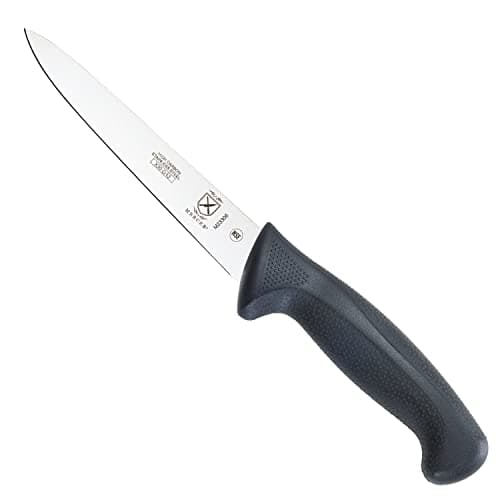
  • Mercer Culinary Millennia 6" — the best utility knife for most kitchens. Straight edge, six inches, grippy guarded handle, soft steel that resharpens in two minutes, and a price that makes the decision for you.
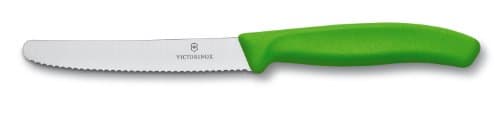
  • Victorinox Swiss Classic 4.5" round tip — for tomatoes, citrus and soft skins. The wavy-edge specialist, and the safest blade shape in a busy kitchen. Buy it as a cheap second knife, not as your only one.
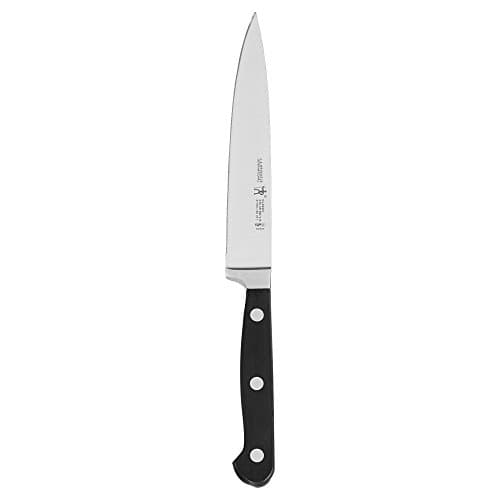
  • Henckels Classic 6" — a forged German blade for less. Fully forged with a seamless blade-to-handle transition and a published ~HRC 55-58, at roughly half the Wüsthof. The sensible stop if you want forged heft.
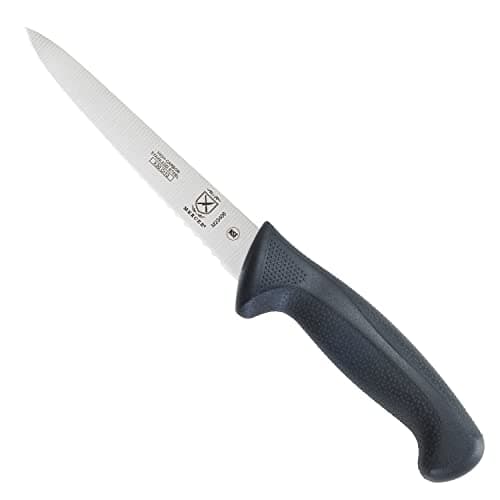
  • Mercer Culinary Millennia 6" wavy edge — for sandwiches, rolls and sub loaves. Six inches of serration, which a 4.5-inch tomato knife cannot match. Skip it if you already own a bread knife.
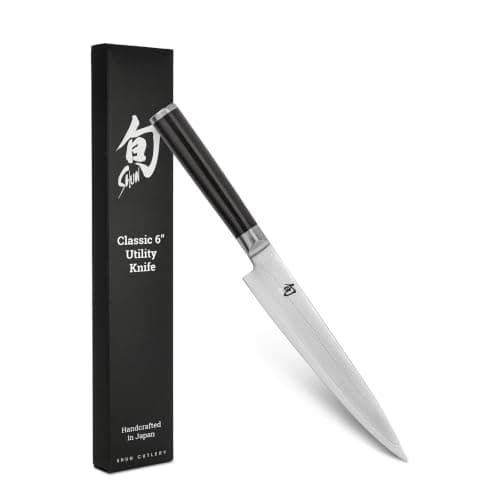
  • Shun Classic 6" — the sharpest and lightest.VG-MAX core at ~HRC 60-61 under Damascus cladding, at about 2.8 oz. The keenest small blade here by a clear margin, at many times our top pick's price.
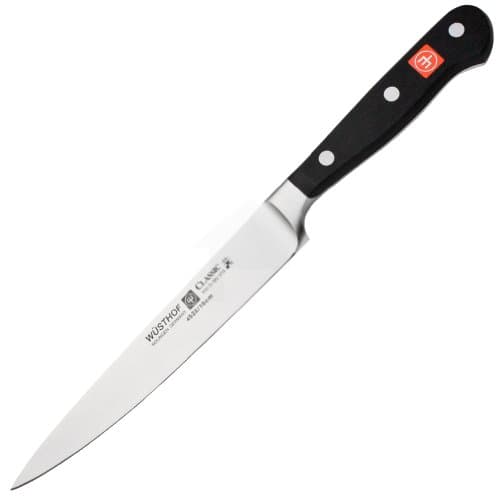
  • Wüsthof Classic 6" — the buy-forever forged German. Precision-forged in Solingen, full tang, bolster, ~14° PEtec edge, lifetime warranty. The nicest object on this page and the least rational purchase on it.

The short answer

Quick picks

#ad · Live prices from the Amazon Product API, as of October 9, 2026. Where we have no verified live price we show none — we'd rather leave a gap than print a number that has rotted.

By the numbers

The specs, side by side

Every figure below is the manufacturer's published specification. Where a maker doesn't publish a value, the cell reads "—" rather than a number we made up.

Knife / ToolBladeEdgeSteelHardnessConstructionHandle
Mercer Culinary Millennia 6" Utility Knife6 in (15.2 cm)Straight, ~15° per sideHigh-carbon Japanese stainless~HRC 53-54Stamped, one-pieceSantoprene over polypropylene, finger guard
Victorinox Swiss Classic 4.5" Utility Knife, Round Tip4.5 in (11.5 cm)Wavy serrated, round tipVictorinox stainless—StampedPolypropylene
Henckels Classic 6" Utility Knife5.9 in (15 cm)Straight (V-edge finish)German stainless~HRC 55-58Fully forged, seamless blade-to-handleTriple-riveted composite, exposed tang
Mercer Culinary Millennia 6" Wavy Edge Utility Knife6 in (15.2 cm)Wavy serratedHigh-carbon Japanese stainless~HRC 53-54Stamped, one-pieceSantoprene over polypropylene, finger guard
Shun Classic 6" Utility Knife6 in (15 cm)Straight, ~16° per sideVG-MAX core, Damascus clad~HRC 60-61Clad (san-mai), 34 Damascus layers per sideD-shaped ebony-finish Pakkawood
Wüsthof Classic 6" Utility Knife6 in (16 cm)Straight, ~14° per side (PEtec)X50CrMoV15 German stainless~HRC 58Precision-forged, full tang, bolster; ~2 mm spineTriple-riveted POM

In detail

The picks, in full

01
Mercer Culinary Mercer Culinary Millennia 6" Utility Knife

The best utility knife for most kitchens

Mercer Culinary Millennia 6" Utility Knife

6 in / 15.2 cmStraight~HRC 53-54~15° edgeStamped
8.0/10

The honest answer for almost everyone: a sharp, light, straight-edged 6-inch blade for the price of a sandwich. Nothing in this class does the job better per dollar.

Versatility
9
Edge quality
7
Comfort
8
Build
6
Value
10

Pros

  • Costs so little that buying the right tool for sandwich-sized work stops being a decision
  • Soft steel at ~HRC 53-54 means it comes back to screaming sharp on a stone in under two minutes
  • Textured Santoprene handle with a real finger guard grips wet, greasy or cold hands
  • NSF-certified, which is why you see these by the box in professional kitchens

Cons

  • The softest steel in this roundup — expect to hone weekly and sharpen often
  • Stamped blade and molded handle feel like equipment, not cutlery
  • Mercer publishes no weight figure for it, so that spec sits empty

Don't buy this if…

…you want a knife that holds its edge for months. This trades retention for being cheap and trivially easy to resharpen — the right trade on a utility knife, the wrong one if you refuse to touch a stone.

$13.99View on Amazon

Price as of October 9, 2026. Prices change — Amazon's is the one that counts.

#ad · we may earn a commission from this link to Mercer Culinary Millennia 6" Utility Knife

02
Victorinox Victorinox Swiss Classic 4.5" Utility Knife, Round Tip

Tomatoes, citrus and soft skins

Victorinox Swiss Classic 4.5" Utility Knife, Round Tip

4.5 in / 11.5 cmWavy serratedRound tipStampedPolypropylene
7.6/10

The wavy-edge round-tip knife that beats every straight blade on tomatoes, citrus and soft-skinned fruit. A specialist, and a cheap one.

Versatility
7
Edge quality
8
Comfort
7
Build
6
Value
10

Pros

  • Wavy serrations bite straight through tomato and citrus skin that a straight edge slides off
  • Round tip will not puncture a bag, a hand or a nonstick pan — the safest blade shape in a busy kitchen
  • Serrations stay usefully grippy for years with no maintenance at all
  • Cheap enough to keep two in the drawer

Cons

  • Serrated edges cannot be honed and are awkward to resharpen at home
  • Worse than a straight edge at everything that is not a soft skin
  • Victorinox publishes no hardness figure for the Swiss Classic line, so that cell is empty
  • The 4.5-inch blade is short for the sandwich and small-roast work a 6-inch handles easily

Don't buy this if…

…you want one utility knife to do everything. Buy the straight-edged Mercer first; add this as the cheap second knife that lives for tomatoes and oranges.

$14.67View on Amazon

Price as of October 9, 2026. Prices change — Amazon's is the one that counts.

#ad · we may earn a commission from this link to Victorinox Swiss Classic 4.5" Utility Knife, Round Tip

03
Henckels Henckels Classic 6" Utility Knife

A forged German blade for less

Henckels Classic 6" Utility Knife

5.9 in / 15 cmStraight~HRC 55-58Fully forgedTriple-rivet
7.4/10

A fully forged, triple-riveted German utility knife at roughly half the Wüsthof's price. The pick if you want forged heft without the Solingen premium.

Versatility
8
Edge quality
8
Comfort
8
Build
8
Value
5

Pros

  • Genuinely forged with a seamless blade-to-handle transition — real heft in the hand
  • Published ~HRC 55-58 lands it between the budget stamped blades and the hard Japanese steels
  • Triple-riveted handle is a classic German shape that suits most hands
  • Matches the Henckels Classic line if you already own the set

Cons

  • Several times the Mercer's price for a knife doing the same light-duty work
  • Henckels Classic is made in Spain, not Solingen — fine, but worth knowing if you are buying 'German'
  • German stainless at this hardness still needs honing far more often than a VG-MAX edge

Don't buy this if…

…you are buying on pure function. The Mercer cuts sandwiches and shallots just as well for a fraction of this. Buy the Henckels for the forged feel and the matching set.

$56.99View on Amazon

$59.995% off

Price as of October 9, 2026. Prices change — Amazon's is the one that counts.

#ad · we may earn a commission from this link to Henckels Classic 6" Utility Knife

04
Mercer Culinary Mercer Culinary Millennia 6" Wavy Edge Utility Knife

Sandwiches, rolls and sub loaves

Mercer Culinary Millennia 6" Wavy Edge Utility Knife

6 in / 15.2 cmWavy serrated~HRC 53-54StampedSantoprene
7.2/10

The long serrated option: six inches of wavy edge that saws crusty rolls, sub loaves and tomatoes a 4.5-inch tomato knife is too short for.

Versatility
7
Edge quality
7
Comfort
8
Build
6
Value
8

Pros

  • Six inches of serration clears a sub roll or a ciabatta in one stroke — a 4.5-inch tomato knife cannot
  • Bites crust and tomato skin without crushing the soft bread or flesh underneath
  • Same cheap, grippy, NSF-certified Millennia platform as our top pick

Cons

  • Serrations cannot be honed and are hard to resharpen at home
  • Overlaps a bread knife if you already own one — check before you buy
  • Poor at the clean, precise slicing a straight edge does effortlessly

Don't buy this if…

…you already own a 10-inch bread knife. This mostly duplicates it. Its real niche is the kitchen that wants one mid-size serrated blade instead of a long one.

$16.71View on Amazon

Price as of October 9, 2026. Prices change — Amazon's is the one that counts.

#ad · we may earn a commission from this link to Mercer Culinary Millennia 6" Wavy Edge Utility Knife

05
Shun Shun Classic 6" Utility Knife

The sharpest, lightest option

Shun Classic 6" Utility Knife

6 in / 15 cmVG-MAX core~HRC 60-61~16° edgeDamascus clad
6.8/10

The keenest blade here by a wide margin: a hard VG-MAX core under Damascus cladding, at under three ounces. Beautiful, precise, and a lot of money for sandwich duty.

Versatility
7
Edge quality
10
Comfort
8
Build
8
Value
1

Pros

  • Hardest steel in this roundup at ~HRC 60-61 — takes the finest point and holds it far longer than any German blade here
  • Astonishingly light at about 2.8 oz, which makes fiddly in-hand work effortless
  • Thin ~0.08 in blade stock slips through a shallot or a chicken breast with almost no wedging
  • Damascus cladding and Pakkawood make it the only genuinely beautiful knife on this list

Cons

  • Costs many times our top pick to do work that barely stresses an edge
  • Hand wash and dry only; a hard, thin ~16° edge chips if you pry, twist or hit bone
  • The D-shaped handle is shaped for a right-hand pinch grip and suits left-handers less well

Don't buy this if…

…you want value. A utility knife does light work where premium steel contributes least — buy the Shun because you want the keenest, prettiest small blade in the drawer, with eyes open about the premium.

$98.37View on Amazon

Price as of October 9, 2026. Prices change — Amazon's is the one that counts.

#ad · we may earn a commission from this link to Shun Classic 6" Utility Knife

06
Wüsthof Wüsthof Classic 6" Utility Knife

A buy-forever forged German knife

Wüsthof Classic 6" Utility Knife

6 in / 16 cmX50CrMoV15~HRC 58~14° PEtec edgeForged
6.6/10

The heirloom: precision-forged in Solingen with a bolster and a ~14° PEtec edge. Lovely in the hand, and the most expensive way on this page to slice a sandwich.

Versatility
7
Edge quality
9
Comfort
8
Build
7
Value
2

Pros

  • Precision-forged full-tang blade with a bolster — the most planted, substantial feel here
  • Wüsthof's PEtec laser-guided ~14° edge is the most acute factory bevel of any German knife on this page
  • Made in Solingen with a lifetime warranty, and it will outlive you
  • Completes a Wüsthof Classic set if you own one

Cons

  • The priciest knife in this roundup, for the least demanding job in the kitchen
  • At ~4.1 oz it is noticeably heavier than the Shun, which some hands dislike for close work
  • Same soft-ish German stainless as much cheaper knives — the premium buys forging and finish, not edge retention

Don't buy this if…

…you are optimizing cost per cut. Nothing about a utility knife rewards a forged bolster. Buy this if you want the Solingen feel and a knife to hand down, not because it slices better.

$115.00View on Amazon

Price as of October 9, 2026. Prices change — Amazon's is the one that counts.

#ad · we may earn a commission from this link to Wüsthof Classic 6" Utility Knife

The honest truth: a $14 utility knife is all most people need

Here is the case, plainly. A utility knife handles light, short-duration jobs — slicing a tomato, splitting a roll, trimming a chicken breast, cubing cheese, cutting a sandwich in half. None of that stresses an edge the way breaking down a butternut squash or doing forty minutes of mirepoix does. The two things you actually pay a premium for on a good knife — edge retention from hard steel and low cutting resistancefrom thin geometry — are the two things a utility knife needs least. Add that a straight utility edge is quick and easy to bring back on a stone, and the conclusion follows: buy a sharp, comfortable, cheap utility knife and put the money into the chef's knife that does the real work, or into a stone that keeps everything you own sharp.

That is why the Mercer tops this list and the Wüsthof sits at the bottom — not because the Wüsthof is bad. It is a beautifully made knife and it will outlive you. It is simply a lot of money for the easiest job in the kitchen, and our scoring says so out loud instead of hiding it behind a brand ranking.

Straight or serrated? The only decision that really matters

Everything else on this page is a preference. This one is a functional fork in the road.

A straight edge is the default and the one to buy first. It cuts cleanly through anything with a cut surface, it slices cheese and cooked meat without tearing, it can be honed on a honing rod in ten seconds, and it can be fully resharpened on a stone for the life of the knife.

A wavy serratededge earns its place for one specific physical reason: its scalloped points concentrate force on a tiny area, so they puncture a tense, slippery skin — tomato, bell pepper, citrus, bread crust — that a straight edge simply slides across. Serrations also stay usefully grippy for years without any maintenance, which is fortunate, because you effectively cannot bring them back at home (see how to sharpen a serrated knife for the limited options). The trade is real: a serrated utility knife tears cheese, crushes soft cooked meat, and cannot make a clean precise cut.

Our recommendation: buy the straight-edged Mercer, and if you eat a lot of tomatoes or crusty rolls, add the wavy Victorinox or the 6-inch wavy Mercer as a second. The combined cost is still less than one premium knife. The deeper explanation of edge shapes is in knife edge types explained.

Do you actually need a utility knife?

Strictly, no. The three knives that cover almost all home cooking are a chef's knife, a paring knife and a serrated bread knife — the full argument is in how many kitchen knives you need. A utility knife is the first knife most people add after those three, and the reason is ergonomic rather than technical: an 8-inch chef's knife is clumsy and over-committed for a single tomato or half a sandwich, and a 3.5-inch paring knife is fiddly and short for the same job. The utility knife is the comfortable middle, which is exactly why it ends up in the sink most often.

If you are deciding between it and its neighbors, we have both comparisons written out: chef knife vs utility knife for the big-blade question, and paring knife vs utility knife for the small one. A fuller account of the jobs it does is in what a utility knife is used for.

Utility knife vs petty knife

If you shop Japanese brands you will meet the pettyknife, which is the same slot in the drawer approached from a different tradition. A petty is typically 120-150 mm (about 4.7-6 in), noticeably thinner behind the edge than a Western utility knife, ground to a more acute angle, and made from harder steel. Functionally it is a utility knife optimized for clean slicing rather than general toughness — keener and more precise, correspondingly more fragile at the tip. The Shun on this list sits close to that philosophy. Our petty knife guide covers the distinction properly, and the broader split is laid out in Japanese vs German knives.

What size utility knife should you buy?

Buy 6 inchesunless you have a specific reason not to. It crosses the things this knife exists for — a tomato, a roll, a chicken breast, a cheese block — in a single pass, and a single clean pass is what produces a tidy cut. A 4.5-inch blade is better in the hand and for small produce, and it stores more easily, but it stops short on anything wide and you end up sawing.

A useful way to think about it: if you already own a paring knife you are happy with, go 6 inches, because the short end is already covered. If you do not own one, a 4.5-inch round-tip utility knife can plausibly serve as both. Sizing across the whole kitchen is covered in chef knife sizes explained.

Sharpening and care

A straight utility knife sharpens exactly like a chef's knife, just scaled down — same angle, same stones, same motion, fewer strokes. The method is in how to sharpen a chef's knife, and soft-steel budget blades like our top pick come back in well under two minutes. Match the angle to the knife: roughly 15-20° per side for the German and stamped blades here, and closer to 16° for the Shun — see knife sharpening angle. If you would rather not maintain a water stone, a diamond plate never dishes and never needs flattening, which suits a knife you sharpen occasionally.

Between sharpenings, a few seconds on a honing rodkeeps a straight edge aligned, which is most of what "feeling dull" actually is — the difference is explained in sharpening vs honing. Hand wash and dry every knife on this page; the dishwasher dulls edges, loosens handles and corrodes steel, including the stainless kind (the reasons are in can you put knives in the dishwasher). Store it so the edge cannot knock against other blades — a block, a magnetic strip or an in-drawer guard, all covered in knife care and storage. Do that and even the cheapest pick here lasts for years.
How we picked

We do not run a test kitchen

We compiled each product's published specifications — steel, hardness, edge geometry, weight — normalized them into the matrix above, and scored each one against a published rubric. The scores are judgments from those specs and the value math — they are not measurements we took, because we do not have a test kitchen and we're not going to pretend we do. Units we claim to have tested: 0.

Questions

Frequently asked

What is the best utility knife for most people?

The Mercer Culinary Millennia 6" straight-edge utility knife. It is sharp, light, grippy, long enough to cross a sandwich roll or a tomato in one stroke, and its soft steel comes back to a keen edge on a stone in under two minutes. A utility knife does light work where premium steel contributes least, so there is little reason to spend more.

What is a utility knife used for in the kitchen?

The jobs that are too big for a paring knife and too small to justify a chef's knife: slicing tomatoes and sandwiches, splitting rolls, trimming a single chicken breast, cubing cheese, cutting a few shallots or a small onion, and sectioning fruit. Full detail in what a utility knife is used for.

Should I buy a straight or serrated utility knife?

Straight, if you only buy one — it cuts cleanly, can be honed in seconds and can be resharpened for the life of the knife. A wavy serrated utility knife is a worthwhile cheap second specifically for tomatoes, citrus, peppers and crusty bread, where its points puncture a tense skin that a straight edge slides off. Serrations cannot be honed and are awkward to resharpen at home.

What size utility knife is best?

Six inches for most kitchens. It crosses a tomato, a roll or a chicken breast in one pass, which is what gives a clean cut. A 4.5-inch blade is better for in-hand work and small produce and can double as a long paring knife, but it makes you saw at anything wide.

Is an expensive utility knife worth it?

Rarely for the cutting alone. The premiums you pay on a good knife buy edge retention and thin geometry, and a utility knife's short, light jobs barely call on either. A forged Henckels or Wüsthof or a Damascus Shun is worth it for the heft, finish, keepsake feel or to match a set — not because it slices a sandwich better.

What is the difference between a utility knife and a petty knife?

They fill the same slot from different traditions. A Japanese petty is usually 120-150 mm, thinner behind the edge, ground more acutely and made from harder steel — keener and more precise, and more fragile at the tip. A Western utility knife is a little thicker and tougher. More in what is a petty knife.

Can you sharpen a utility knife?

A straight-edged one, yes — exactly like a chef's knife, scaled down, at roughly 15-20° per side for the German and stamped blades here. See how to sharpen a chef's knife. Serrated utility knives are the exception; they are effectively replace-rather-than-sharpen tools.

Keep reading

Receipts

Sources

We do not run a test kitchen, and we do not pretend to. Specs are the manufacturer's published figures, attributed as such; where we could not verify something, we say so on the page rather than quietly leaving it out. Read our full method.