Start with what the maker publishes, because it is the only check that works before you touch the knife. A maker who states the steel, the hardness in HRC and the edge angle is a maker confident enough to be measured against those numbers. A listing that says "high-carbon stainless steel", "ultra sharp" and "professional grade" and nothing else is telling you something by omission. After that, six physical checks — tang, grind, spine, bolster, finish and balance — will separate a good knife from a bad one in half a minute.
The seven checks, in order of how much they tell you
1. Does the maker publish real specs?
The three numbers that matter are the steel designation (X50CrMoV15, VG-10, AUS-8, 440C), the hardness (an HRC figure or a range), and the edge angle per side. All three are cheap to publish and awkward to publish if they are unimpressive, which is exactly why their absence is informative. "High-carbon stainless steel" is not a steel designation — nearly every kitchen knife on earth qualifies. The knife steel guide and knife hardness explained cover what the numbers mean.
One fair caveat: a few genuinely good makers publish very little. Dexter states no Rockwell figure for the Sani-Safe and MAC states almost nothing for some lines, and both make knives we rank highly. Silence from an established maker with a long product history is weaker evidence than silence from a brand that appeared on a marketplace last year.
2. Is the tang full, and can you see it?
A full tang runs the whole length of the handle, and in a riveted handle you can see the steel sandwiched between the scales. A partial or "rat-tail" tang is a narrow spike buried in the handle, and it is the single most common failure point in cheap knives — the handle loosens, then it snaps. Look at the butt of the handle for a visible slice of steel, or check for a stated full tang. What is a full tang knife has the detail. Note that bolsterless Japanese knives and seamless one-piece knives like the Global G-2 hide the tang by design and are fine — this check is about construction claims, not visibility alone.
3. Does the blade taper, or is it the same thickness all the way?
This is the check almost nobody does and it tells you the most about how a knife will cut. Sight down the spine from the handle. A good blade gets thinner toward the tip (distal taper) and thinner toward the edge (the grind). A cheap stamped blade is often a flat slab of uniform thickness with a bevel ground on the bottom, which wedges in dense food however sharp the apex is. Blade geometry is the full mechanism, and forged vs stamped knives explains why "stamped" is not itself a mark against a knife — the MAC MTH-80 is stamped, thin and excellent.
4. Is the spine finished?
Run a thumb along the top of the blade. A sharp, square, unfinished spine will bite into your index finger during a pinch grip and it is a direct sign of a finishing step that was skipped. Good knives have the spine rounded or at least eased. It costs the maker a pass on a belt and it is the first thing dropped when a knife is built to a price.
5. Does the handle meet the blade cleanly?
Look for a gap, a step or a lip where the handle material meets the steel. Any of the three will trap food and water, which is both a hygiene problem and the start of corrosion under the scales. Commercial knives solve this explicitly — the Dexter Sani-Safe seals the blade-to-handle joint, and NSF certification requires it. Knife handle materials explained covers which materials survive which kitchens.
6. Where does it balance, and does that suit you?
Rest the knife on one finger at the bolster. A German knife typically balances near the bolster and feels planted; a Japanese knife often balances slightly forward and feels nimble. Neither is better — but a knife that balances a long way back feels like a handle with a blade attached, and one that balances far forward tires your grip. This is the check that is purely about fit, so trust your own hand over any review, including ours. Knife bolster explained covers the full-versus-half bolster question, which matters more for sharpening than for feel.
7. Does the factory edge actually cut?
Last, deliberately, because it is the least durable signal. A knife can be given a screaming factory edge on a belt and still be a bad knife, and a good knife can arrive mediocre and be excellent after ten minutes on a stone. Test it on paper if you can — a sharp knife slices cleanly rather than tearing. How to tell if a knife is sharp has the tests. Treat the result as information about the factory's final step, not about the knife's potential.
Claims that tell you nothing
- "High-carbon stainless steel." True of almost every kitchen knife made. It is not a grade.
- A layer count on a Damascus pattern. 67 layers, 110 layers — the cladding is cosmetic and structural, not the cutting steel. What matters is the core. Some budget knives etch a pattern on rather than forging one. Damascus steel knives explained.
- "Professional grade" and "razor sharp". Unregulated marketing language.
- "Japanese steel" with no grade. Plenty of soft, unremarkable stainless is made in Japan.
- Granton dimples on a chef's knife.Genuinely useful on a long slicer, close to decorative on an 8-inch chef's knife — what is a granton edge.
- An unverifiable HRC claim of 62 and up on a cheap knife. Hardness that high is real in premium Japanese steel and implausible on a knife costing less than a takeaway. If a listing claims it, look for the steel grade behind it.
- Star ratings and review counts. We do not publish them, and we would not use them as a quality signal on a marketplace listing either — see how we choose for what we do instead.
Three knives that pass, at three prices
A useful way to calibrate the checks above is against knives that pass them at very different prices. All three publish their steel, hardness and edge angle; all three have a full tang; all three have a finished spine and a clean handle joint.
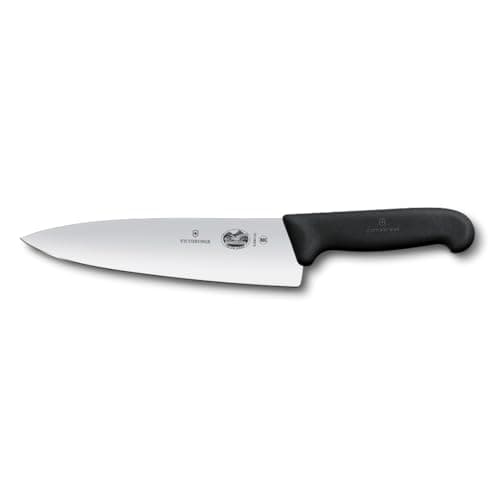
- Victorinox Fibrox Pro 8"— the proof that cheap and good are not opposites. X50CrMoV15 at ~HRC 55–56, ~20° per side, stamped with a full-length tang, NSF certified, ~6.6 oz. It is a tool rather than an object: nothing about it is beautiful, and it out-cuts a lot of knives costing five times more out of the box. Soft steel, so you hone often.
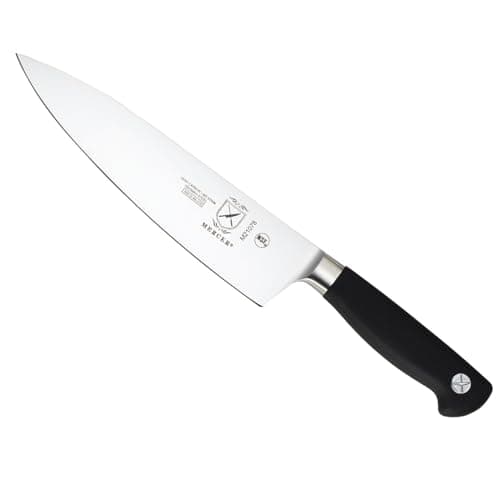
- Mercer Culinary Genesis 8"— a genuinely forged, full-tang German knife with a bolster at a stamped-knife price. Same X50CrMoV15 at ~HRC 56, ~20° per side, ~8.5 oz. It is the cheapest way to own the construction people mean when they say "forged". Deliberately hefty, so skip it if you want nimble.
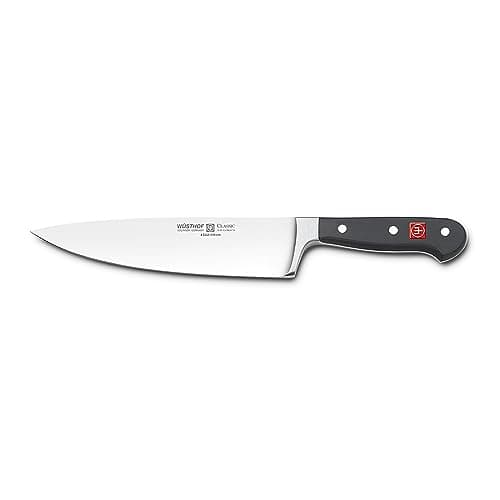
- Wüsthof Classic 8" — what passing every check looks like with nothing held back. Precision-forged X50CrMoV15 at ~HRC 58, a stated 14° per side, full tang, full bolster, ~9.0 oz. Heavy, tough, forgiving, and it will outlive you if you hone it. Not the pick for small hands or anyone who wants a light blade.
The full ranking across both traditions is in best chef knives, and best chef knives for the money ranks specifically on value — which is a different question from quality and worth keeping separate in your head.
Quality and price are not the same question
The checks above measure build and honesty, not price. A Victorinox Fibrox passes all seven and costs a fraction of a Wüsthof Classic, which also passes all seven. What the extra money buys is finish, heft, longevity of the handle and a slightly harder heat treat — real things, and not the same thing as quality.
The corollary is more useful: past the mid-priced forged tier, additional money on a chef's knife mostly buys appearance, brand and craft rather than cutting performance. Are expensive chef knives worth it and are Japanese knives worth it both make that case with numbers. If you are shopping to a budget, the under-$100 list is where the quality-per-dollar curve is steepest.
What to check on a knife you already own
Most people reading this have a drawer of knives of unknown origin, and the checks work there too. Three things to look at:
- Is the handle loose or cracked? Wobble at the joint means water has got in and the knife is near the end of its life, per how many times can a knife be sharpened.
- Is the edge recurved? Hold the knife edge-up and sight along it. A visible scoop in the middle means years of a grinding wheel or heavy pull-through use, and it is why it will no longer cut on a flat board.
- Is it just dull? Which is almost always the real answer. Before you conclude that a knife is bad quality, hone it and then sharpen it properly — how to sharpen a chef knife and why your knife won't get sharp. A great many "bad knives" are good knives nobody has sharpened in five years.
And if you are standing in a shop with none of these pages open, the thirty-second version is: read the spec label, look for a visible full tang, sight down the spine for taper, run a thumb along the spine for finish, and hold it. Four checks, and they catch nearly every bad knife on a shelf. Anatomy of a chef's knife names all the parts if any of the terms above are unfamiliar, and how to choose a chef knife is the full buying walkthrough.