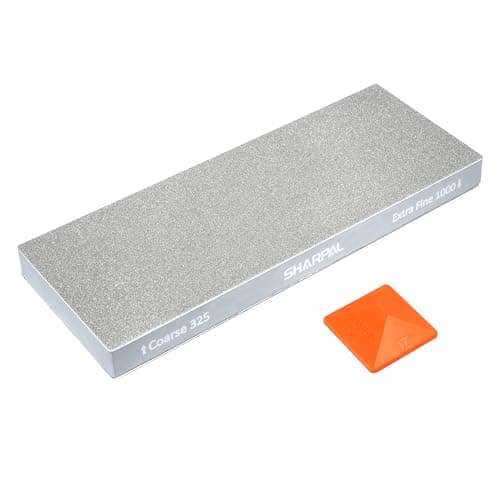
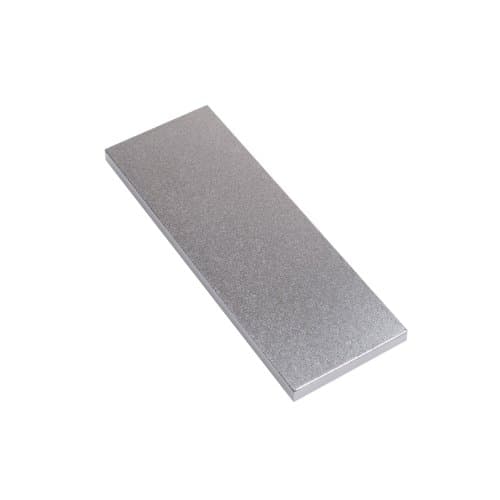
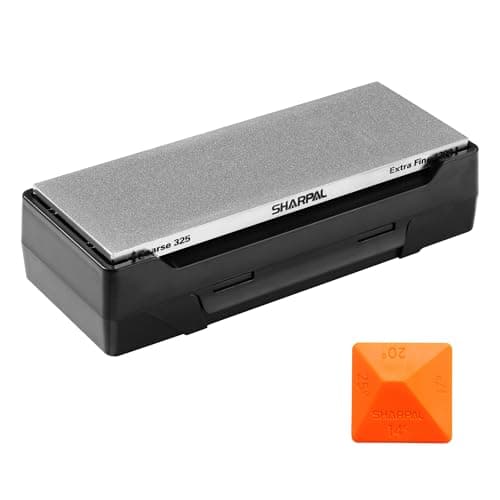
A diamond plate is not a stone at all. It is industrial diamond grit electroplated or bonded onto a rigid metal or polymer base, and that one construction difference removes almost every chore that comes with a water stone: it never dishes, so it never needs flattening; it never needs soaking; it cuts hard modern steel fast; and it will still be flat in ten years. Our top pick is the Sharpal 162N dual-grit plate— two useful grits, a full 8 × 3 in surface, and the best balance here of speed, finish and price.
The trade is equally real, and most pages selling diamond plates do not say it out loud: diamond tops out toothier than a fine water stone.Diamond grit is harder than any knife steel and does not break down as you work, so it keeps cutting aggressively instead of gradually refining the scratch pattern the way a water stone's friable abrasive does. You get a fast, grabby, genuinely sharp working edge. You do not get a polished, mirror-finish, push-cutting edge. For kitchen knives that is usually the right trade — a toothy edge is arguably better on tomato skin and roast chicken skin — but if a mirror polish is what you are after, diamond alone will not get you there. These six are ranked by our overall score, which weights value heavily.
Why choose diamond over a water stone
- It stays flat, forever. This is the headline benefit. Water stones wear into a hollow as you use them and need periodic lapping (see how to flatten a whetstone). A diamond plate's abrasive sits on a rigid base, so a dished diamond plate is not a thing that happens.
- No soaking, no setup. Splash a little water on it and start. No ten-minute soak, no keeping a stone pond, no wondering whether it has absorbed enough. The soak question is covered in soaking vs splash-and-go whetstones.
- It cuts hard steel fast. Hard Japanese steels above about HRC 60 can glaze a soft water stone and make slow progress. Diamond is harder than every knife steel made, so hardness simply stops being a factor.
- It flattens your other stones. A coarse diamond plate is the standard tool for lapping water stones, so it earns its place in a kit even if you prefer to finish on soft stones. That is most of the case for the Atoma and the DMT D8C on this page.
- It is effectively buy-once. Diamond plates do lose some initial aggression as the highest-standing particles break in, then settle into a long stable working life. There is no consumable to replace.
What you give up
- Edge finish. Diamond grit does not friable down as you work, so it keeps cutting the same scratch pattern rather than progressively refining it. Even a 1200-grit diamond plate leaves a toothier edge than a 6000-grit water stone.
- Feedback. Water stones develop a slurry and give a soft, informative drag that tells you when you are on the bevel. Diamond feels harder, faster and more remote, which makes it less forgiving while you are still learning the motion.
- Fine grits are rare and expensive. Most diamond plates stop between 600 and 1200. Water stones go to 6000, 8000 and beyond cheaply. Our diamond vs whetstone comparison goes through this properly, and sharpening stone grits explained covers what the numbers mean.
- Aggression on thin edges. A 325-grit diamond plate removes steel quickly. On a thin, hard Japanese blade it is easy to take off more than you intended in a few passes.
How to read the grit numbers
Diamond grit is usually quoted in mesh, and DMT publishes the micron equivalents, which is the only reliable way to compare brands: coarse 325 mesh is 45 micron, fine 600 mesh is 25 micron, extra-fine 1200 mesh is 9 micron. Sharpal publishes microns too — its 1000-grit face is 15 micron. Atoma quotes a single JIS-style number (#400) with no micron figure, so it cannot be placed on DMT's scale precisely, and we say so rather than guessing.
Practically: 325 and below is repair and reprofiling grit, and the right choice for flattening stones. 600 to 1200 is the sharpening and finishing range for kitchen knives. If you buy one dual-grit plate, 325/1000 or 325/1200 covers both jobs, which is exactly why our top two picks are both dual-grit.
Continuous or interrupted surface?
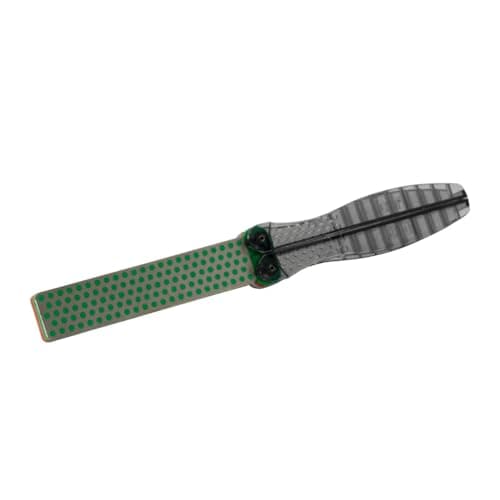
This matters more than most buyers expect. A continuous plate is a solid sheet of diamond-coated surface: smooth strokes, nothing to catch on, and the better choice for kitchen knives. An interruptedplate — DMT's DuoSharp "polka dot" pattern, and Atoma's dotted array — leaves gaps between abrasive areas so swarf and water can escape, which keeps the surface biting and makes it excellent at lapping a muddy stone.
The cost is feel. A narrow blade, a pointed tip or a paring knife can catch on the edges of those holes, and most people find it unsettling for the first few sessions. If you are sharpening kitchen knives freehand and the budget allows, pick continuous. If you are buying primarily to flatten stones, interrupted is genuinely better at that job.
The picks, and who each suits
- Sharpal 162N — the best diamond plate for most kitchens. 325/1200 dual grit on a full 8 × 3 in surface in a non-slip frame. Sharpens and finishes, and flattens your water stones as a side job.
- DMT FWFC DuoSharp 8" — the best value. 325/600, double-sided, made in the USA, for about half what comparable plates cost. The interrupted surface is the compromise you are accepting.
- Sharpal 168H — the best for beginners. 325/1000 on a big 8 × 3 in face, with a 4-angle guide in the box to address the one thing beginners actually get wrong.
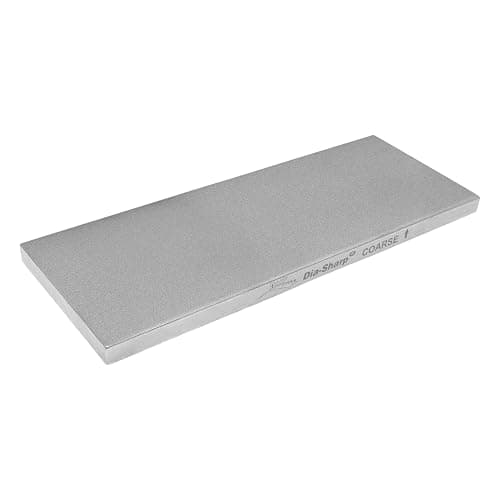
- DMT D8C — the best for edge repair and flattening. Single-sided 325 continuous diamond on steel. Fastest metal removal here; pair it with something finer.
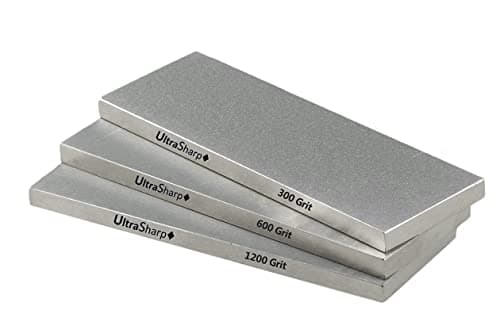
- Ultra Sharp II 3-stone kit — the best full progression. 300, 600 and 1200 on separate plates for roughly the price of one premium stone. The 6 × 2 in plates are small for long knives.
- Atoma #400 — the flattening and reprofiling standard. Diamond on ~10 mm machined aluminum, with replaceable sheets. The best-made plate here, and the one to buy last rather than first.
Should your first stone be diamond?
For a lot of people, yes — and that is a change from the standard advice. The reason is not performance, it is maintenance. The single most common way a beginner abandons sharpening is not a bad angle; it is a dished water stone that has quietly stopped working, producing a worse edge every session for reasons the beginner cannot diagnose. A diamond plate removes that entire failure mode. You cannot ruin it through neglect, and you never have to flatten it.
The counter-argument is feedback. A water stone talks to you through its slurry, and learning to feel the bevel is genuinely easier on one. If you want the traditional path, our beginner stone roundup covers it, and combination whetstones are the usual first buy.
Our honest split: if you are the sort of person who will maintain gear, buy a 1000/6000 water stone and enjoy the better finish. If you suspect you will not — or you own hard Japanese knives, or you just want a tool that works every time you pick it up — buy a dual-grit diamond plate and never think about it again.
Diamond for hard Japanese steel
This is where diamond stops being a convenience and becomes a genuine performance advantage. Steels above roughly HRC 60 — VG-10, VG-MAX, SG2, the powder metallurgy steels — resist a soft water stone enough that progress crawls and the stone glazes over. Diamond is harder than all of them, so it cuts at the same rate regardless. If you own a Japanese chef's knife, a diamond plate for the heavy lifting plus a fine water stone to finish is a strong combination, and it is what we would suggest over either alone. Our stones for Japanese knives page goes deeper, and why Japanese knives are so sharp explains why the steel is like that. The same argument applies to the hard-steel blades in other categories — the VG-MAX picks in best cleavers and best utility knives both sharpen faster on diamond than on a soft stone.
Using a diamond plate without wrecking an edge
Two rules, and both are the opposite of water-stone habits.
Use far less pressure. Diamond cuts on contact. The reflex to lean on a stone to make it bite will strip steel off a thin edge in a handful of passes. Let the weight of the blade and a light guiding hand do it, and count your strokes rather than working until it feels right.
Expect fewer strokes.A 325-grit diamond plate will raise a burr faster than you are used to. Check for the burr early and often — the method is in how to remove a burr— and stop as soon as it runs the full edge. The underlying motion is identical to a water stone, and the walkthrough in how to sharpen a chef's knife applies unchanged. Hold the angle per knife sharpening angle: roughly 15-17° per side for Japanese blades, 20° for German ones.
Finishing: how to get a refined edge out of a diamond setup
If the toothy finish bothers you, there are two good fixes and both are cheap relative to the plate.
The first is to finish on a fine water stone. Do all the work on diamond, then take ten light passes per side on a 6000-grit stone. You get diamond's speed and flatness with a water stone's polish, and the fine stone barely wears because it is only doing the last step.
The second is to strop. A few passes on leather, or even on the back of a cutting board, knocks the weak burr off and aligns the apex — see how to strop a knife. Between sharpenings, a ceramic rod or honing steel handles the day-to-day realignment; the distinction is in sharpening vs honing and the rods themselves in best honing steels.
Care: there is almost none, but not quite none
Diamond plates ask for very little, which is the point. Rinse the swarf off after use and dry the plate — the steel particles you just removed will rust, and a plate left wet with swarf on it can stain. Do not scrub with anything abrasive; the diamond is fine, but the base and the plating are not indestructible. Do not use oil unless the maker specifically calls for it; every plate on this page runs dry or with water.
The one thing to accept rather than fix: a new plate feels more aggressive for the first few uses, then settles down as the tallest diamond particles break in. That is normal and is not the plate wearing out. Cleaning routine for stones generally is in how to clean a whetstone.