Skip to content
Bevel & Bone

HUB 01 · Chef Knives

Best Professional Chef Knives

What actually gets used on a line: light, grippy, quick to bring back on a steel — and cheap enough that losing one isn't a disaster.

By Stephen V.Updated How we choose
#ad

We earn a commission when you buy through our Amazon links, at no extra cost to you. It never changes a ranking, and we say so when the cheaper knife is the better buy. How this works.

Walk into a working kitchen and the knife rack is a surprise: not the Damascus-clad blades that fill the search results, but a row of plain stamped knives with plastic handles, most of them under $50. That is not a budget compromise. A knife that has to survive a twelve-hour service, a sanitizer bucket, a shared rack and the occasional walk out the back door in someone else's knife roll is being judged on a completely different set of criteria than a knife that lives in a home block.

How this list is ranked: for professional-kitchen fitness — grip when your hands are wet, a handle that meets commercial sanitation standards, an edge you can bring back on a rod in ten seconds between tasks, and a replacement cost you can absorb — not for raw overall score. That is why the highest-scoring knife here, the MAC MTH-80, sits third rather than first, and why two $20–50 stamped blades sit above knives that cost four times as much. Every score in the matrix is still the same site-wide number; only the order is professional-weighted, and we say which is which as we go.

The short answer

Quick picks

#Knife / ToolBest forScorePrice
01
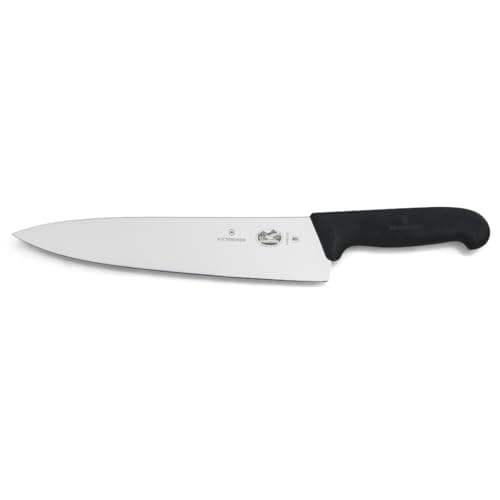
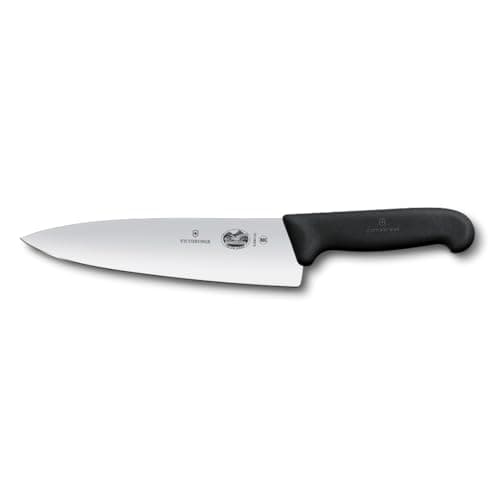
Victorinox Victorinox Fibrox Pro 8" Chef's Knife
Victorinox Fibrox Pro 8" Chef's Knife

The default answer to "what's a good first chef knife." Cheap, light, holds a usable edge, and a joy to sharpen.

Your first good chef knife
7.8
$44.99Amazon
02
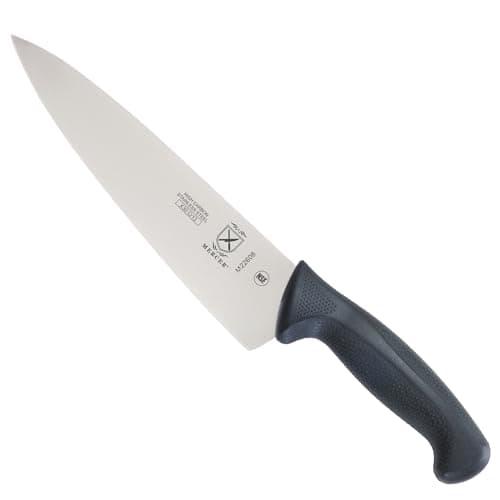
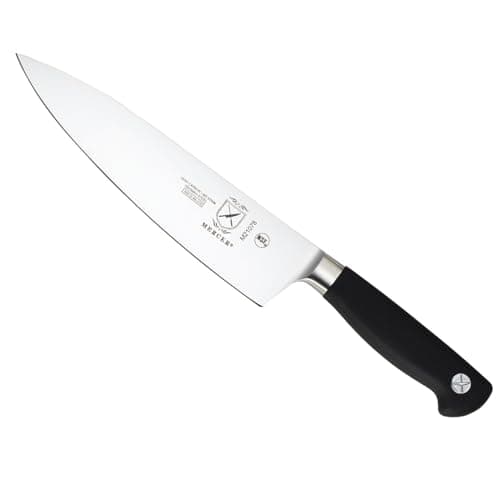
Mercer Culinary Mercer Culinary Genesis 8" Chef's Knife
Mercer Culinary Genesis 8" Chef's Knife

A forged, full-bolster German knife at a stamped-knife price. The value pick if you want heft.

A forged knife on a budget
7.6
$47.53Amazon
03
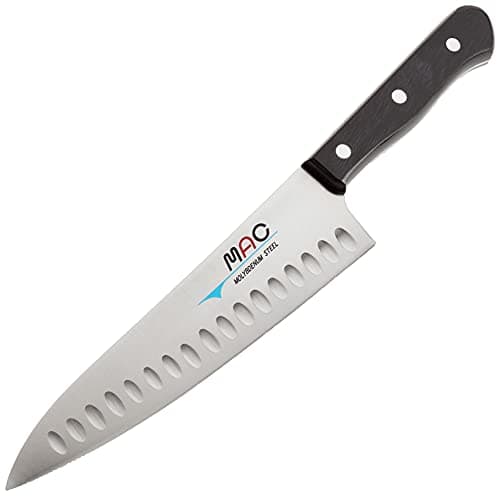
Mac Mac Mth-80 Professional Hollow Edge 8" Chef's Knife
Mac Mth-80 Professional Hollow Edge 8" Chef's Knife

The knife a lot of cooks quietly consider the best all-rounder made. Thin, sharp, and it stays that way.

The best overall, if budget allows
8.4
$114.95Amazon
04
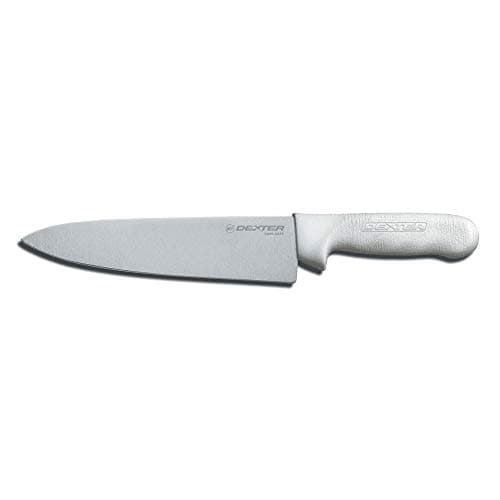
Dexter-Russell Dexter-Russell Sani-Safe 8" Chef's Knife
Dexter-Russell Sani-Safe 8" Chef's Knife

Foodservice equipment, not cutlery. NSF-certified, sealed at the handle, made in Massachusetts, and priced to be replaced without a second thought.

Commercial kitchens and sanitation-first cooks
7.2
$46.50Amazon
05
Victorinox Victorinox Fibrox Pro 10" Chef's Knife
Victorinox Fibrox Pro 10" Chef's Knife

The 8-inch legend, stretched. If you break down big produce or proteins, the extra 2 inches earns its keep.

Bigger hands and bigger cutting boards
7.4
$52.47Amazon
06
Mercer Culinary Mercer Culinary Millennia 8" Chef's Knife
Mercer Culinary Millennia 8" Chef's Knife

The culinary-school standby: a cheap, light, NSF stamped knife that culinary students are told to buy.

The cheapest knife worth owning
7.0
$21.00Amazon
07
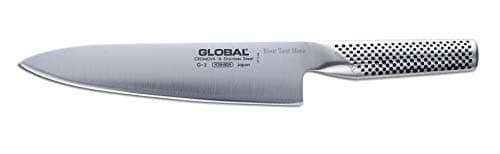
Global Global G-2 8" Chef's Knife
Global G-2 8" Chef's Knife

The one-piece stainless knife you either love or hate on feel alone. Light, distinctive, divisive.

Cooks who want a light, seamless blade
7.0
$149.95Amazon
08
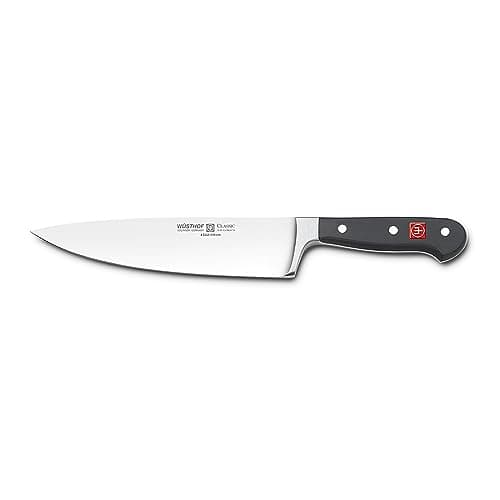
Wüsthof Wüsthof Classic 8" Chef's Knife
Wüsthof Classic 8" Chef's Knife

The archetypal German chef knife. Heavy, tough, forgiving, and it will outlive you if you hone it.

A do-everything German workhorse
7.4
$170.00Amazon

#ad · Live prices from the Amazon Product API, as of Jul 23, 2026. Where we have no verified live price we show none — we'd rather leave a gap than print a number that has rotted.

By the numbers

The specs, side by side

Every figure below is the manufacturer's published specification. Where a maker doesn't publish a value, the cell reads "—" rather than a number we made up.

Knife / ToolBladeSteelHardnessEdgeConstructionWeight
Victorinox Fibrox Pro 8" Chef's Knife8 in (20 cm)X50CrMoV15 stainless~HRC 55–56~20° per sideStamped, full-length tang~6.6 oz (187 g)
Mercer Culinary Genesis 8" Chef's Knife8 in (20 cm)X50CrMoV15 German stainless~HRC 56~20° per sideForged, full tang, short bolster~8.5 oz (241 g)
Mac Mth-80 Professional Hollow Edge 8" Chef's Knife8 in (20 cm)Molybdenum-vanadium high-carbon~HRC 59–61~15° per sideThin stamped blade, Pakkawood handle~6.5 oz (184 g)
Dexter-Russell Sani-Safe 8" Chef's Knife8 in (20 cm)DEXSTEEL high-carbon stainless— (individually ground and honed)Stamped; sealed blade-to-handle joint, textured polypropylene
Victorinox Fibrox Pro 10" Chef's Knife10 in (25 cm)X50CrMoV15 stainless~HRC 55–56~20° per sideStamped, full-length tang~8.0 oz (227 g)
Mercer Culinary Millennia 8" Chef's Knife8 in (20 cm)Japanese stainless (X50CrMoV15 class)~HRC 56~20° per sideStamped, textured Santoprene handle~5.6 oz (159 g)
Global G-2 8" Chef's Knife8 in (20 cm)CROMOVA 18 stainless~HRC 56–58~15° per sideOne-piece steel, sand-filled hollow handle~5.8 oz (164 g)
Wüsthof Classic 8" Chef's Knife8 in (20 cm)X50CrMoV15 stainless~HRC 5814° per side (Precision Edge Technology)Forged, full tang, full bolster~9.0 oz (255 g)

In detail

The picks, in full

01
Victorinox Victorinox Fibrox Pro 8" Chef's Knife

Your first good chef knife

Victorinox Fibrox Pro 8" Chef's Knife

8 in / 20 cmX50CrMoV15~HRC 55–56StampedFibrox handle
7.8/10

The default answer to "what's a good first chef knife." Cheap, light, holds a usable edge, and a joy to sharpen.

Edge retention
6
Out-of-box edge
8
Handling
8
Build
7
Value
10

Pros

  • Costs a fraction of a forged German knife and out-cuts most of them out of the box
  • Soft-ish steel takes a screaming edge on a stone in minutes — the easiest knife here to learn to sharpen on
  • Light and nimble; the textured Fibrox handle grips even with wet hands
  • NSF-certified and dishwasher-tolerant (though you still shouldn't)

Cons

  • Softer steel means you hone often and sharpen more frequently than a hard Japanese blade
  • Stamped blade lacks the heft and bolster some cooks want for control
  • It is a tool, not an heirloom — nothing about it is beautiful

Don't buy this if…

you want a knife that keeps its edge for months between sharpenings. This trades edge retention for being cheap and easy to re-sharpen — a great trade for a beginner, a poor one if you refuse to touch a stone.

$44.99View on Amazon

Price as of Jul 23, 2026. Prices change — Amazon's is the one that counts.

#ad · we may earn a commission from this link to Victorinox Fibrox Pro 8" Chef's Knife

02
Mercer Culinary Mercer Culinary Genesis 8" Chef's Knife

A forged knife on a budget

Mercer Culinary Genesis 8" Chef's Knife

8 in / 20 cmX50CrMoV15~HRC 56ForgedSantoprene handle
7.6/10

A forged, full-bolster German knife at a stamped-knife price. The value pick if you want heft.

Edge retention
6
Out-of-box edge
7
Handling
8
Build
8
Value
9

Pros

  • Genuinely forged with a full tang — heft and balance closer to a Wüsthof than to its price tag
  • Short bolster leaves the whole edge usable and makes it easier to sharpen heel-to-tip
  • Grippy, ergonomic Santoprene handle that survives a commercial kitchen

Cons

  • Same soft German steel as the Victorinox, so edge retention is only average
  • Heavier than a stamped blade — a plus for some hands, a minus for others

Don't buy this if…

you want the lightest possible knife. This is a deliberately hefty German-style blade; if you like a nimble Japanese feel, the Tojiro is the better call at a similar price.

$47.53View on Amazon

Price as of Jul 23, 2026. Prices change — Amazon's is the one that counts.

#ad · we may earn a commission from this link to Mercer Culinary Genesis 8" Chef's Knife

03
Mac Mac Mth-80 Professional Hollow Edge 8" Chef's Knife

The best overall, if budget allows

Mac Mth-80 Professional Hollow Edge 8" Chef's Knife

8 in / 20 cmMolybdenum-vanadium~HRC 59–61~15° edgeDimpled
8.4/10

The knife a lot of cooks quietly consider the best all-rounder made. Thin, sharp, and it stays that way.

Edge retention
9
Out-of-box edge
9
Handling
9
Build
8
Value
7

Pros

  • The blade is unusually thin, so it falls through produce with almost no wedging
  • Harder Japanese-style steel than the German knives — holds its edge markedly longer
  • The dimples (granton edge) genuinely reduce sticking on starchy vegetables
  • Takes and holds a very acute edge

Cons

  • No full bolster; the pinch grip sits right at the blade — some find it exposed
  • Harder steel is a little less forgiving of lateral abuse than soft German steel
  • Costs several times a Victorinox and looks almost as plain

Don't buy this if…

you're rough with your knives — you pry, twist, or hit bone. Harder, thinner steel chips where soft German steel just rolls. Buy the Wüsthof or the Victorinox and treat it like a hatchet if you must.

$114.95View on Amazon

Price as of Jul 23, 2026. Prices change — Amazon's is the one that counts.

#ad · we may earn a commission from this link to Mac Mth-80 Professional Hollow Edge 8" Chef's Knife

04
Dexter-Russell Dexter-Russell Sani-Safe 8" Chef's Knife

Commercial kitchens and sanitation-first cooks

Dexter-Russell Sani-Safe 8" Chef's Knife

8 in / 20 cmDEXSTEEL stainlessStampedSealed polypropylene handleNSF certified
7.2/10

Foodservice equipment, not cutlery. NSF-certified, sealed at the handle, made in Massachusetts, and priced to be replaced without a second thought.

Edge retention
5
Out-of-box edge
7
Handling
8
Build
7
Value
9

Pros

  • NSF-certified with a sealed blade-to-handle joint — no rivet gaps or bolster crevice for food to hide in
  • The textured polypropylene handle keeps its grip wet or greasy, which is the entire point in a working kitchen
  • Soft-ish stainless comes straight back on a honing rod, so a cook can fix the edge mid-shift instead of finding a stone
  • Made in Southbridge, Massachusetts and priced like a consumable

Cons

  • Dexter publishes no HRC, no bevel angle and no weight for this knife, so three of our spec columns sit empty
  • Edge retention is ordinary — this is a hone-every-shift knife, not a hold-it-for-months one
  • Utilitarian to a fault: a white plastic handle and a stamped blade will never be the knife you show anyone

Don't buy this if…

you want one knife you'll still admire in twenty years. This is designed to be sanitized, resharpened and eventually thrown away. The Wüsthof or the MAC is the knife you keep.

$46.50View on Amazon

Price as of Jul 23, 2026. Prices change — Amazon's is the one that counts.

#ad · we may earn a commission from this link to Dexter-Russell Sani-Safe 8" Chef's Knife

05
Victorinox Victorinox Fibrox Pro 10" Chef's Knife

Bigger hands and bigger cutting boards

Victorinox Fibrox Pro 10" Chef's Knife

10 in / 25 cmX50CrMoV15~HRC 55–56StampedFibrox handle
7.4/10

The 8-inch legend, stretched. If you break down big produce or proteins, the extra 2 inches earns its keep.

Edge retention
6
Out-of-box edge
8
Handling
7
Build
7
Value
9

Pros

  • The same superb value as the 8-inch, with more edge for melons, squash and large roasts
  • A longer blade rock-chops and slices in fewer strokes once you're used to it
  • Still light for its length

Cons

  • A 10-inch blade intimidates beginners and wants a big board
  • Same soft steel: hone and sharpen often

Don't buy this if…

you have a small kitchen or you're new to knife skills. Ten inches is a lot of blade to control; the 8-inch is the safer first knife for most people.

$52.47View on Amazon

$80.0034% off

Price as of Jul 23, 2026. Prices change — Amazon's is the one that counts.

#ad · we may earn a commission from this link to Victorinox Fibrox Pro 10" Chef's Knife

06
Mercer Culinary Mercer Culinary Millennia 8" Chef's Knife

The cheapest knife worth owning

Mercer Culinary Millennia 8" Chef's Knife

8 in / 20 cmJapanese steel~HRC 56StampedSantoprene
7.0/10

The culinary-school standby: a cheap, light, NSF stamped knife that culinary students are told to buy.

Edge retention
5
Out-of-box edge
6
Handling
8
Build
6
Value
10

Pros

  • About the cheapest chef knife any professional will actually endorse
  • Light and grippy; the textured handle has a finger guard beginners appreciate
  • NSF-certified — the reason it's on culinary-school supply lists

Cons

  • Soft steel and a rougher factory edge than the Victorinox
  • Fit and finish are exactly what the price suggests

Don't buy this if…

you can stretch to the Victorinox Fibrox. It's a small step up in money for a real step up in edge and finish — the Millennia is the pick only when every dollar counts.

$21.00View on Amazon

Price as of Jul 23, 2026. Prices change — Amazon's is the one that counts.

#ad · we may earn a commission from this link to Mercer Culinary Millennia 8" Chef's Knife

07
Global Global G-2 8" Chef's Knife

Cooks who want a light, seamless blade

Global G-2 8" Chef's Knife

8 in / 20 cmCROMOVA 18~HRC 56–58~15° edgeOne-piece
7.0/10

The one-piece stainless knife you either love or hate on feel alone. Light, distinctive, divisive.

Edge retention
7
Out-of-box edge
7
Handling
7
Build
8
Value
6

Pros

  • Seamless one-piece body has no rivets or bolster crevices to trap food — genuinely hygienic
  • Very light and nimble; the dimpled handle is grippier than it looks
  • Made in Japan with a harder-than-German edge

Cons

  • The dimpled all-metal handle is polarizing — some hands find it slippery when greasy
  • Light, blade-forward balance feels wrong to cooks raised on heavy German knives

Don't buy this if…

you've never held one. The handle is the most love-it-or-hate-it thing in this list — try before you buy, or buy somewhere with easy returns.

$149.95View on Amazon

Price as of Jul 23, 2026. Prices change — Amazon's is the one that counts.

#ad · we may earn a commission from this link to Global G-2 8" Chef's Knife

08
Wüsthof Wüsthof Classic 8" Chef's Knife

A do-everything German workhorse

Wüsthof Classic 8" Chef's Knife

8 in / 20 cmX50CrMoV15~HRC 5814° per sideForged
7.4/10

The archetypal German chef knife. Heavy, tough, forgiving, and it will outlive you if you hone it.

Edge retention
7
Out-of-box edge
7
Handling
7
Build
9
Value
7

Pros

  • Forged from a single billet with a full bolster and full tang — the reference for a durable German blade
  • Wüsthof's newer 14°-per-side edge is noticeably keener than the old 20° grind
  • Tough enough to shrug off the abuse a home cook actually inflicts
  • Triple-riveted POM handle is essentially indestructible

Cons

  • Heavy — a real workout over a long prep session
  • The full bolster eventually blocks the heel and complicates sharpening the whole edge
  • Full retail price is high; it's frequently the knife people overpay for

Don't buy this if…

you want a light, nimble knife or you have smaller hands. This is a heavy German blade by design — the MAC or Tojiro will feel far more agile.

$170.00View on Amazon

Price as of Jul 23, 2026. Prices change — Amazon's is the one that counts.

#ad · we may earn a commission from this link to Wüsthof Classic 8" Chef's Knife

The five things a professional knife has to do

Before any of the picks, here is the rubric we applied — in the order a working cook would weight them. It is deliberately different from the one behind our main ranking, because the job is different.

  • Grip when wet, greasy or gloved. The single most common reason a pro knife gets rejected. Textured polymer handles (Fibrox, Santoprene, Sani-Safe polypropylene) hold on when a polished wood or riveted handle turns into a bar of soap. This is a safety spec before it is a comfort one.
  • Cleanability and sanitation. Commercial kitchens are inspected. A sealed blade-to-handle joint with no rivet gaps and no bolster crevice is what NSF certification is checking for — the NSF/ANSI 2 food equipment standard sets requirements for the materials, design and construction of food-handling equipment, and cleanability of the joints and corners is explicitly part of it.
  • Speed of maintenance. Nobody sets up a whetstone during service. Softer German-class stainless realigns on a honing rod in seconds and comes back on a stone in minutes; very hard Japanese steel holds longer but needs real time and a finer stone when it finally goes. Our sharpening vs honing explainer is the distinction this whole point rests on.
  • Tolerance for abuse. Frozen edges, a bone you did not see, a plastic board that has gone hard, a cook who scrapes with the edge instead of the spine. Soft steel rolls and is fixed on a rod; hard, thin steel chips and needs regrinding.
  • Replacement cost. Knives in shared kitchens get lost, stolen and destroyed. A sub-$50 knife you can replace next week is a genuinely different tool from a near-$200 one you cannot.

Why the best-cutting knife is not first

The MAC MTH-80 out-scores everything else on this page in our matrix, and on pure cutting performance it deserves to. It is also the knife plenty of working chefs buy the moment they can — it is literally sold as a professional series. We still put it third, for two honest reasons. First, harder steel around HRC 59–61 ground to an acute edge is less forgiving of the things that happen to a knife on a line than the soft stainless above it. Second, it costs roughly what three Victorinox blades cost, and in a kitchen where knives disappear, that math is part of the decision. Buy it if it is your knife, it travels home with you, and nobody else touches it. Do not buy it as a shared-rack workhorse.

What NSF certification actually means on a knife

It is not a quality mark and it says nothing about how well a knife cuts. NSF certification means the knife has been evaluated against the food equipment standard for materials, design and construction — smooth corners in the food zone, no gaps that trap debris, materials that survive repeated cleaning and sanitizing. That is why the Mercer Millennia and the Dexter Sani-Safe show up on culinary-school supply lists and in institutional kitchens: some operations require it. If you are cooking at home, it is a nice-to-have that happens to correlate with a handle that will not get slippery. If you are cooking for a health department, it may be non-negotiable — check your local rules rather than our page.

Eight inches or ten?

Eight is the default for a reason: it fits a standard board, it fits most hands, and it does everything. Ten inches earns its place on a prep shift — breaking down cases of produce, portioning large proteins, anything where fewer, longer strokes beats more, shorter ones. Plenty of line cooks carry both and use the 8-inch for 90% of the day. If you are buying one knife and are not sure, buy the 8-inch; the two-inch upgrade is cheap enough to add later, and we cover the sizing logic in how to choose a chef's knife.

Maintenance is most of the job

The gap between a professional's knife and a home cook's knife is usually not the knife. It is that the professional hones theirs several times a shift and sharpens it properly on a schedule, while the home knife gets sharpened when someone remembers. A sub-$50 Victorinox honed daily cuts better than a near-$200 Japanese blade that has not seen a stone since it was unboxed — which is the argument for buying a honing steel and a whetstone with your knife rather than after it. If you have never done it, our step-by-step sharpening walkthrough takes about twenty minutes to learn and pays for itself immediately.

What a home cook should take from this page

Two things. First, the fact that professionals overwhelmingly use cheap stamped knives is the strongest available evidence that you do not need to spend a lot to cut well — the same conclusion we reach the long way round in are expensive chef knives worth it. Second, the criteria diverge for a reason. If your knife is not being shared, sanitized in a dish pit or thrown in a rack, you can weight cutting performance and finish far higher than a line cook can — which is exactly what our main ranking and the under-$200 upgrade tier do. Neither list is wrong. They are answering different questions, and the trick is knowing which one you are asking.

What we deliberately left off

No Shun, no Miyabi, no hand-hammered anything. They are excellent knives and several of them top our Japanese chef knife ranking, but a bolsterless Damascus blade with a D-shaped wooden handle is the wrong tool for a wet, fast, shared environment — the handle gets slick, the hard edge chips, and the price makes every mistake expensive. We also left off knife sets: a working cook buys knives one at a time, for a reason we lay out on the knife sets page.
How we picked

We do not run a test kitchen

We compiled each product's published specifications — steel, hardness, edge geometry, weight — normalized them into the matrix above, and scored each one against a published rubric. The scores are judgments from those specs and the value math — they are notmeasurements we took, because we do not have a test kitchen and we're not going to pretend we do. Units we claim to have tested: 0.

Questions

Frequently asked

What chef knives do professional chefs actually use?

Far more often than not, an inexpensive stamped knife with a textured polymer handle — the Victorinox Fibrox Pro and Mercer knives dominate professional kitchens and culinary-school supply lists. Chefs who buy an upgrade for themselves commonly go to something like the MAC MTH-80. Premium Damascus knives are usually personal knives that stay out of the shared rack.

Are professional chef knives different from home chef knives?

The knives themselves are often identical — what differs is the criteria. A professional weights grip when wet, sanitation, speed of honing and replacement cost far above finish and prestige, because the knife is shared, sanitized and occasionally lost. A home cook can weight cutting performance and how much they enjoy holding it much higher.

What does NSF certified mean on a knife?

That the knife has been evaluated against the NSF/ANSI food equipment standard for materials, design and construction — smooth food-zone corners, no gaps that trap debris, and materials that tolerate repeated cleaning. It is a sanitation mark, not a performance mark: it tells you nothing about how sharp the knife is.

Is a Victorinox good enough for a professional kitchen?

It is arguably the definitive professional kitchen knife. It is NSF-certified, light enough for a long shift, grips when wet, takes a genuinely keen edge, and costs little enough to replace. Its one real weakness — soft steel that needs honing often — matters less to someone who hones several times a shift anyway.

Should a professional cook buy a Japanese knife?

As a personal knife, often yes — harder steel holds an edge through a long prep list. As a shared or abused knife, usually no: hard, thin edges chip on frozen product and bone where soft steel just rolls. Our Japanese vs German comparison maps the trade-off in full.

How often do professionals sharpen their knives?

Honing happens constantly — several times a shift, on a rod, taking seconds. Actual sharpening on a stone is far less frequent and depends entirely on the steel and the workload. The distinction between the two is the single most useful thing a home cook can borrow from a professional kitchen; we cover it in sharpening vs honing.

Keep reading

Receipts

Sources

We do not run a test kitchen, and we do not pretend to. Specs are the manufacturer's published figures, attributed as such; where we could not verify something, we say so on the page rather than quietly leaving it out. Read our full method.