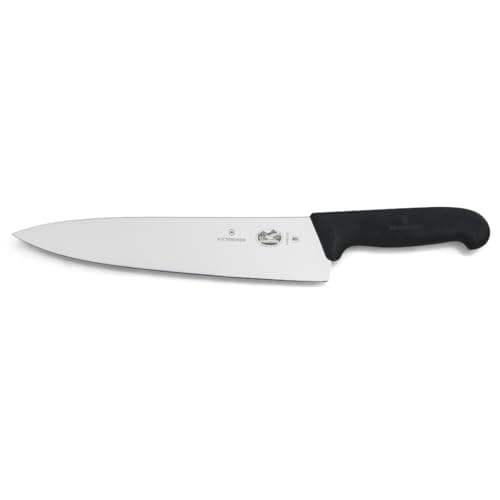
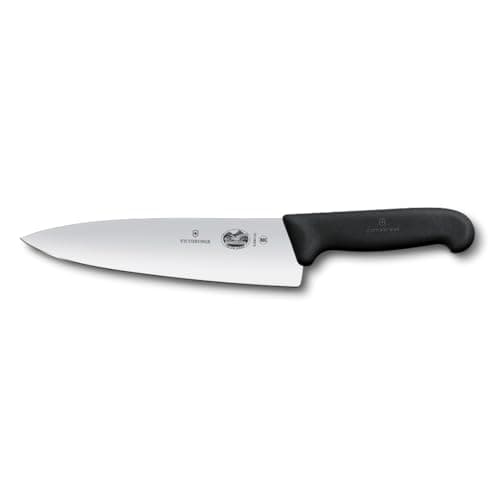
Buy the Victorinox Fibrox Pro 8" if you want a knife that will shrug off a dishwasher — a moulded one-piece Fibrox handle with nothing to swell or come loose, soft stainless steel that is quick to bring back on a stone, and a price that makes the whole question low-stakes. Four knives ranked by our overall score, with live prices — and one piece of honesty up front: a dishwasher is still the worst thing you can do to any of them.
Every knife here is built for a commercial kitchen, which is the real reason it copes. Sealed or moulded synthetic handles cannot absorb water, swell, or crack the way a riveted wood scale can; soft stainless resists the pitting that detergent causes faster on high-carbon steel; and NSF certification means the blade-to-handle joint has no crevice for water to sit in. What a dishwasher still does — to these and to everything else — is explained below.
What a dishwasher actually does to a knife
Three separate kinds of damage, and only one of them is about the handle.
- Edge damage. The blade knocks against racks and other items through a long wash-and-dry cycle. That rolls and micro-chips a fine edge, which is why knives come out of a dishwasher duller than they went in. It is the same mechanism as storing knives loose in a drawer.
- Corrosion. Dishwasher detergent is strongly alkaline and the cycle holds steel wet and hot for a long time. Stainless resists it; high-carbon and clad Japanese blades can pit and stain. See how to prevent knife rust.
- Handle damage.This is the one a knife's construction decides. Wood scales swell and shrink until the rivets loosen; some composite handles craze. Moulded Fibrox, textured Santoprene and sealed polypropylene do none of that — they are specified for commercial dish machines.
So "dishwasher-safe" honestly means "the knife will not be destroyed", not "the knife will not be dulled". Our full answer is in can you put knives in the dishwasher.
The picks, and who each suits
- Victorinox Fibrox Pro 8" — for almost everyone. The moulded Fibrox handle has no rivets and no seam, the X50CrMoV15 stainless is corrosion-resistant, and it is NSF-certified. It is also the easiest knife here to bring back to sharp, which matters precisely because a dishwasher will dull it.
- Victorinox Fibrox Pro 10" — for bigger boards, melons, squash and large roasts. Identical construction and steel to the 8-inch, two inches more edge. Not a first knife: ten inches is a lot of blade to control.
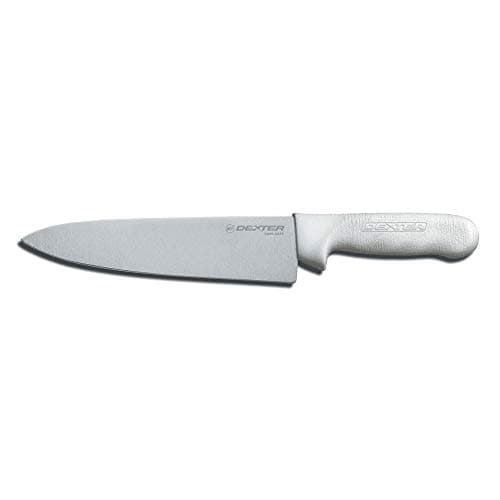
- Dexter-Russell Sani-Safe 8" — for the sanitation-first kitchen. The blade-to-handle joint is sealed rather than riveted, so there is genuinely nothing for water or food to get into, and it is made to be sanitized daily. Dexter publishes no Rockwell figure, bevel angle or weight for this knife, so those spec cells are empty rather than invented. Dexter vs Victorinox puts the two side by side.
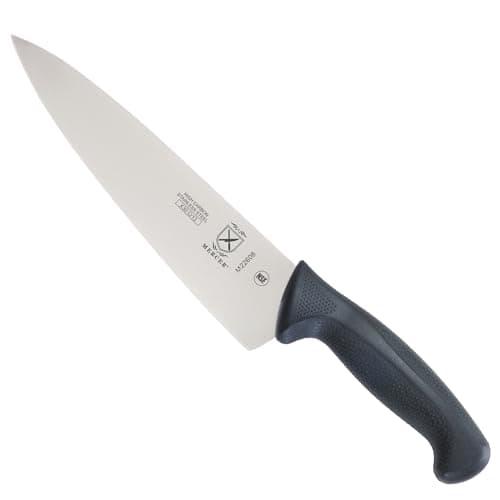
- Mercer Culinary Millennia 8" — for the cheapest version of this idea. NSF, textured Santoprene with a finger guard, and light in the hand. The factory edge and finish are the plainest here, which is also why you will not mind what the dishwasher does to it.
Which knives should never go in
Keep these out of the machine without exception: anything with a wood or Pakkawood handle (Shun, MAC, Miyabi, most Japanese knives), carbon steel and clad carbon-core blades, anything you paid a lot for, and serrated bread knives — not because the machine harms them especially, but because serrations are very hard to resharpen when they do dull. Hard, thin Japanese edges are the most vulnerable thing in a dishwasher: they chip where soft German steel merely rolls.
The thirty-second alternative
Hand-washing a knife takes about fifteen seconds and removes all three problems at once: warm water, a drop of detergent on a cloth, wipe spine-to-edge away from your hand, rinse, dry immediately. Drying is the part people skip and the part that matters — water left standing on any blade is how rust spots start. The full routine is in how to clean a knife, and knife care and storage covers where it goes afterwards.
If you are going to use the dishwasher anyway
Plenty of working kitchens do, and these knives are built for it. Reduce the damage: lay the knife flat in the top rack rather than point-up in the cutlery basket, keep it from touching other steel, skip the heated dry cycle, and take it out and dry it as soon as the cycle ends. Then hone it — a honing steel straightens the rolled edge a wash cycle creates in about thirty seconds, and how to hone a knife shows the motion. These are all stamped blades, cheap and quick to re-sharpen, which is exactly what makes the trade reasonable.