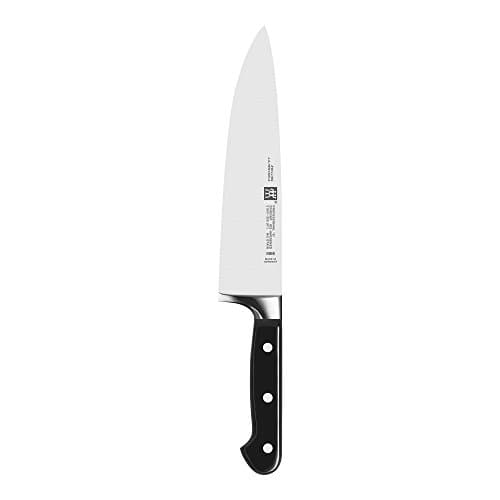
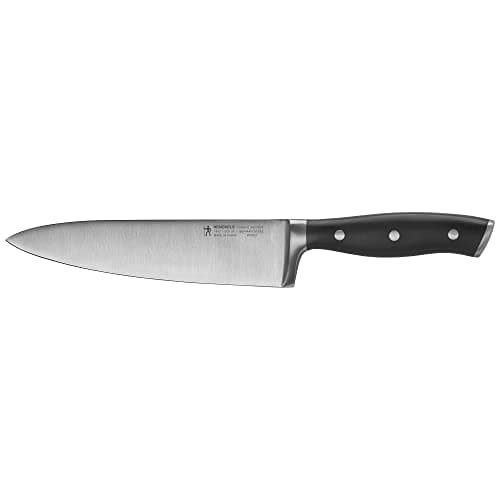
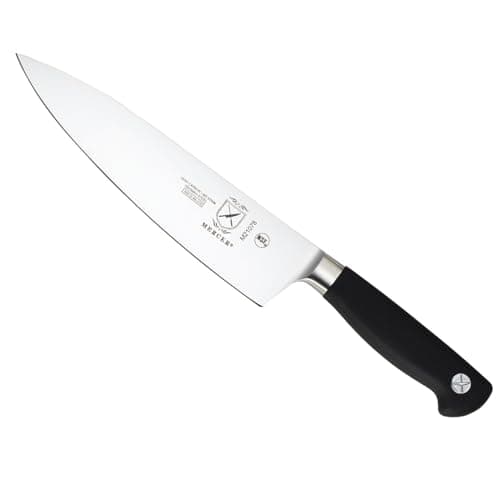
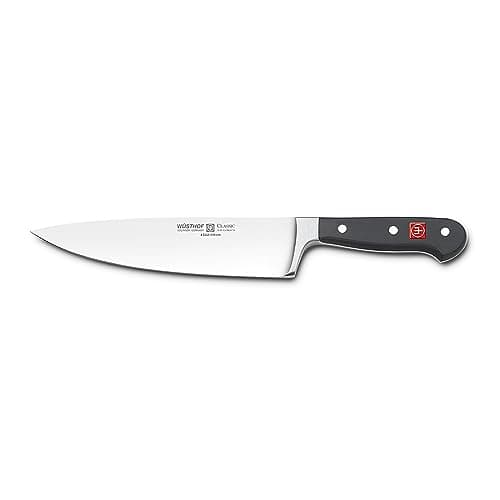
A "German" chef's knife is a recipe, not a postcode: a forged, full-tang blade in soft-ish X50CrMoV15-class stainless, run to roughly HRC 56–58, with heft and a bolster you can lean on. It gives up the keen, brittle edge of a hard Japanese knife in exchange for something a home kitchen values more — an edge that rolls instead of chipping, shrugs off abuse, and comes back with thirty seconds on a honing rod. This is the workhorse tradition, and these are the ones worth buying.
How this list is ranked:for the classic German experience — a genuinely forged Solingen blade you'll keep for decades — not by raw overall score. That's why the Mercer Genesis sits last despite the highest number in the table: it runs the same German steel and forges a real full tang, but it's made in Taiwan and priced like a consumable, so it's the value outlier here rather than the archetype. If pedigree matters to you, start at the top; if only cut-per-dollar does, jump to the bottom.
What actually makes a knife "German"
Three things, and only one of them is the country. First, the steel: X50CrMoV15 and its cousins are tough, corrosion-resistant, and deliberately soft — they take a good edge quickly and lose it just as quickly, which is a fair trade if you hone often. Second, the construction: a forged blade struck from a single billet, a full tang running the length of the handle, and usually a bolster — the thick collar between blade and handle that adds heft and (on a full bolster) protects your knuckles. Third, the geometry: a taller, curved belly built for rock-chopping, where you keep the tip on the board and roll the blade through the food.
The one spec that decides how a German knife feels
It isn't the steel — all four here are within a couple of Rockwell points. It's the bolster. A full bolster (Wüsthof Classic, Henckels) runs all the way to the heel: reassuring under a pinch grip, but it eventually blocks the last inch of edge and makes sharpening heel-to-tip a chore. A half or slopedbolster (Zwilling Pro's curved bolster, Mercer's short one) leaves the whole edge exposed, so you can sharpen the entire blade and use every millimeter of it. If you plan to learn a whetstone, the sloped bolster is quietly the more important feature.
Where German loses — and why most home cooks won't care
A hard Japanese blade holds its edge markedly longer and falls through an onion with less wedging. A German knife won't match that keenness or retention; what it gives you instead is forgiveness. You can twist it in a squash, catch a bone, leave it wet, hand it to a houseguest — and it rolls rather than chips, and a rod brings it straight back. For a shared kitchen, that resilience beats a keener edge you have to baby. If you'd rather have the keenness, that's the whole point of Japanese vs German knives and the best Japanese chef knives.
How to buy a German knife without overpaying
The uncomfortable truth for a commission-funded site: German knives are the ones people most reliably overpay for. Full retail on a Wüsthof or Zwilling is high, and the blade is not four times better than a forged Mercer — it's better finished, better balanced, and it will outlive you, but the cutting gap is small because the steel is nearly identical. Two rules keep you honest:
- Never pay full price for a Solingen knife. Wüsthof, Zwilling and Henckels blades cycle on and off deal constantly. The live price in the table above is the one that matters; the list price is a starting point for a discount.
- Buy the handle, not the badge. A Wüsthof and a Zwilling are more alike than different. Hold both if you can and buy whichever grip your hand prefers — that decision matters more than the logo.
Care: a German knife is easy to keep, on one condition
Soft steel dulls fast, so the deal is simple — hone before most sessions and the edge never really leaves you. A honing rod realigns the rolled edge in seconds; see the best honing steels. Then actually sharpen on a stone every few months when honing stops biting, using this walkthrough. German steel is the most forgiving steel to learn on, which is exactly why we send beginners to it. Hand-wash and dry it; the dishwasher dulls the edge and loosens the handle.