A gyuto isa chef's knife. Korin — one of the longest-running Japanese cutlery importers in the US — files the gyuto as "a versatile chef's knife" for "cutting meat, fish and vegetables," explicitly "suitable for preparing Western cuisine." So this is not a comparison of two jobs. It's a comparison of two sets of engineering assumptions applied to the same job — and the differences are real enough to change which one you should own.
The short answer: a Western chef's knife is built to survive you. A gyuto is built to cut, and assumes you'll look after it. Everything below is downstream of that one sentence.
The differences that matter
| Trait | Western chef's knife | Gyuto |
|---|
| Steel hardness | ~HRC 55–58 | ~HRC 60–61 |
| Factory edge | ~14–20° per side, by maker | ~15–16° per side |
| Blade behind the edge | Thicker, more taper to grind through | Ground thin, less material to push aside |
| Profile | Curved belly, built to rock | Flatter, built to push-cut |
| Standard size | 8 in (203 mm) | 210 mm or 240 mm |
| When the edge gives up | It rolls — a rod straightens it | It chips — a stone has to fix it |
| Maintenance rhythm | Hone often, sharpen occasionally | Hone rarely (ceramic), sharpen properly |
The angle gap is smaller than the internet thinks
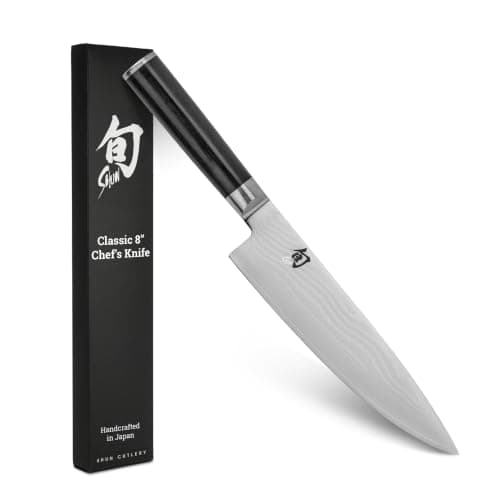
The standard line is "German knives are 20° per side, Japanese knives are 15°." That was true a couple of decades ago and it is not reliably true now. Wüsthof publishes 58 HRC for the Classic and tells owners to sharpen it to roughly 14–14.5° per side; Kai publishes a 16°-per-side edge for the Shun Classic. On the published numbers the German knife is ground keener than the Japanese one.
So if the bevel angle is not the difference, what is? Two things the marketing rarely quantifies: how hard the steel is, and how much metal sits behind the edge. A 14° bevel on a thick, soft blade still wedges through a potato and still rolls over by Thursday. The same 14° on a hard, thinly-ground blade slices and stays put. Our blade geometry guide is the long version of that argument; the steel and HRC guide covers the hardness half.
Three differences you will actually feel
Strip away the folklore and there are exactly three places where the two philosophies diverge in the hand.
- Edge retention, and how the edge fails. Hard steel around HRC 60 keeps a keen edge for weeks of the same prep that has a soft German blade needing a rod every few days. The cost is the failure mode: soft steel deforms and rolls, which a honing rod pushes back straight in ten seconds; hard steel is brittle enough to chip, and a chip has to be ground out on a stone. Neither is a defect. They are the two ends of one dial, and you pick which failure you would rather deal with.
- Wedging.This is the difference people notice within a minute of using a good gyuto. A thin blade separates food; a thick one splits it. Halve a large onion or a butternut squash with a heavy Western knife and you feel the blade pushing the halves apart as it descends. The gyuto's thinner grind does far less of that — which is also why it is the worse tool for anything that wants brute force.
- Cutting motion. A curved Western belly rocks: heel planted, tip up, roll through the herbs. A flatter gyuto profile prefers a push cut — forward and down, lifting between strokes — with more of the edge meeting the board each time. Most cooks adapt in a week. Some never enjoy it, and there is nothing wrong with that; it is the same reason the santoku comparison ends in "buy the shape that matches how you already cut."
The naming trap
Two warnings before you shop, because the word "gyuto" carries less information than you would hope.
First: most Japanese chef's knives sold in the West are hybrids.Kai's own listing for the Shun Classic describes a curved belly that lets you rock through herbs, and sells the blade on being thinner and "less tiring to use than comparable European-style Chef's knives" — a Japanese core with a Western profile, deliberately. The MAC MTH-80 in our MAC review plays the same game. That is a feature if you are switching over from a German knife, but it does mean the shape difference in that table above is a spectrum, not a wall.
Second: "gyuto" is not a quality mark.Anyone can print it on a listing. What tells you whether you are getting the real trade-off is the spec sheet: a named steel (VG-10, VG-MAX, SG2, AUS-10, a molybdenum-vanadium alloy), a published hardness in the high 50s or low 60s, and a stated edge angle. If a listing gives you a "gyuto" with no steel name and no hardness figure, you are buying the word, not the knife.
210 mm or 240 mm?
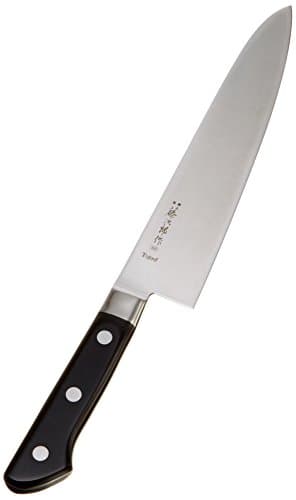
Gyutos are sold in millimeters, and the two common sizes are 210 mm (about 8.3 in) and 240 mm (about 9.5 in). JapaneseChefsKnife.com's sizing guide puts it plainly: 210 mm favors maneuverability and "often feels familiar, especially if you are coming from an 8-inch Western chef's knife," and it is the recommendation for first-time buyers; 240 mm favors efficiency and longer strokes and suits people who already know they like a long blade. If you are cross-shopping against an 8-inch Western knife, 210 mm is the like-for-like size — which is exactly why the Tojiro below is a 210.
Which one should you buy?
Buy the Western chef's knife if the knife lives in a shared kitchen where other people use it; you cut through chicken bones and joints; you would rather hone in ten seconds than sharpen properly on a stone; you like weight in the hand and rock-chop by instinct; or this is the only knife you own and it needs to tolerate everything.
Buy the gyuto if you cook often and cut mostly vegetables, fish and boneless proteins; you already sharpen (or genuinely intend to learn); you want the edge to last between sharpenings rather than the blade to survive abuse; or you have used a thin blade before and cannot go back. The full field is ranked in best Japanese chef knives, and the wider philosophical version of this argument lives in Japanese vs German knives.
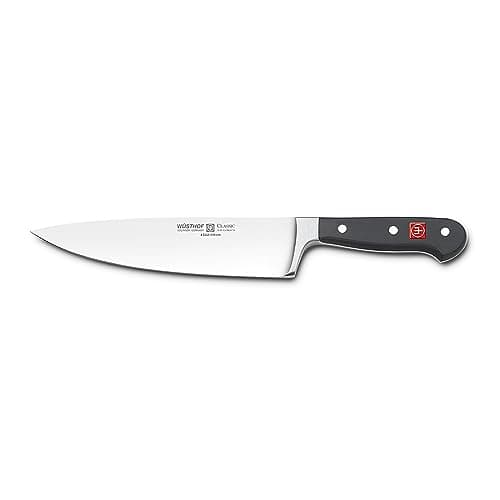
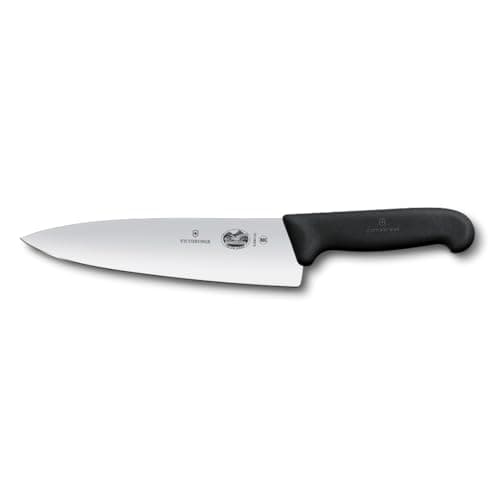
A note on the four knives below:they are grouped, not ranked. The first two are Western chef's knives — the cheap workhorse and the archetype — and the last two are gyutos, at the value and premium ends. The scores are comparable because they come from the same rubric, but a higher number here means "better knife for the money," not "correct side of the argument."
What changes after you buy a gyuto
A gyuto is not a drop-in replacement — it comes with three habits attached, and the people who end up disappointed are almost always the people who skipped them.
- The board. Wood or soft plastic only. Glass, stone, ceramic and steel boards will chip a hard, thin edge, and that chip is a stone job, not a rod job. See knife care and storage for storage that doesn't bang the edge either.
- The hone. A traditional steel rod barely bites on a blade at HRC 60 — it was designed for softer Western steel. A fine ceramic rod does the job on hard blades, which is why our honing steels roundup splits its picks by blade hardness rather than by price.
- The stone. Sooner or later a hard edge needs abrasive, and pull-through sharpeners are the wrong tool for a 15° Japanese bevel. Budget a combination whetstone with the knife — the whetstone roundup starts cheap, and how to sharpen a chef's knife is the twenty-minute version of the skill.
None of that is onerous. But it is the real cost of the gyuto side of this comparison, and a buyer's guide that leaves it out is selling you something. If reading that list made you tired, the Western knife is your answer and you have just saved yourself money.
The hybrid, if you want both
There is a middle path, and it is genuinely popular: a Japanese-made blade in hard steel, ground thin, but with a Western handle and enough belly to rock. The MAC MTH-80 is the archetype — Japanese molybdenum-vanadium steel at a published ~HRC 59–61, a ~15° edge, and handling most German-knife owners find immediately familiar. It tops our overall ranking for exactly this reason. A hybrid still chips like a hard blade, so the care list above still applies — what it buys you is the transition, not an exemption.
Cost, honestly
Both camps run from budget to serious money, and the price bands overlap almost completely. The cheapest Western workhorse and the cheapest genuine VG-10 gyuto sit within one restaurant dinner of each other; the archetypal forged German knife and the Damascus-clad Japanese one both land in the premium bracket. What the money buys differs, though. On the Western side, more money buys forging, fit and finish, and a lifetime of toughness. On the Japanese side, above the entry-level gyuto you are mostly buying cladding, handle work and a hand-finished edge — not a dramatically better cut. That is the case our are expensive chef knives worth it post makes with the numbers. Live prices sit in the table above and update from Amazon; we don't print a figure we haven't verified.
If you only remember one thing
The gyuto is not an upgrade in the way a bigger TV is an upgrade. It is a different trade: more cutting performance in exchange for more care. Take the trade if you will do the care, and don't if you won't — a sharp Western knife beats a chipped, neglected Japanese one every single time, and that is not a consolation prize.