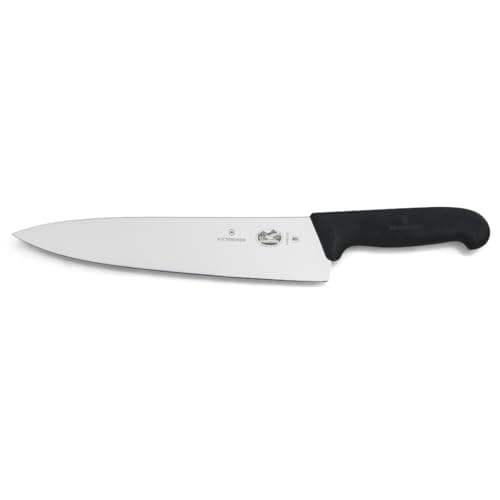
Buy the Victorinox Fibrox Pro 10" chef's knife first. It is the knife that does the largest share of meat work in a home kitchen — breaking down a chicken, cubing a chuck roast, portioning chops, trimming a pork shoulder — and it costs less than most dedicated carving knives. If you only ever buy one knife for meat, that is the one. The other four on this list each do a job the chef's knife does badly, and you add them in the order below as your cooking demands them.
How this list is ranked: in the order a cook should actually buy these knives, not by overall score. Meat is three distinct jobs — breaking down raw cuts, working around bone, and slicing cooked meat thin — and each job wants a different blade. A superb 12-inch slicer scores well and is still the wrong first purchase, because it cannot break down a chicken. Where a pick ranks below another with a higher score, it is because it answers a question you will ask later.
The three jobs, and the blade each one wants
Almost every mistake in this category comes from using one knife for all three jobs. They pull in opposite directions:
- Breaking down raw meat.Cubing, trimming, portioning and cutting through cartilage. This wants length and a bit of weight — an 8- or 10-inch chef's knife. The blade has to be tall enough that your knuckles clear the board and stiff enough to push through silverskin and connective tissue without flexing away.
- Working around bone. Separating a thigh from a drumstick, lifting meat off a rib, taking a shoulder apart at the seam. This wants a narrowblade — five or six inches, thin front-to-back, with a point that can get into a joint. A chef's knife is far too wide to follow a bone, and trying to make it do so is how edges get chipped.
- Slicing cooked meat. Carving a roast, slicing brisket across the grain, taking even slices off a turkey breast. This wants length and thinness, and ideally a granton (fluted) edge so the slice releases instead of clinging. Downward pressure is the enemy here — a long blade lets you draw the cut instead of pushing it, which is what keeps the slice intact.
The reason the 10-inch chef's knife tops the list is that it is the only one of the three that is merely imperfect at the other two jobs rather than useless at them. It can carve a roast acceptably. It cannot get around a joint, which is why the boning knife is pick two. Chef knife sizes explained covers why 10 inches rather than 8 for this work, and chef knife vs carving knife works through where the chef's knife finally runs out.
What to look for
- Grip that works greasy. This is the one category where handle material is a safety feature rather than a preference. Raw meat leaves fat on your hands, and a polished wooden handle gets slippery. Textured TPE (Victorinox Fibrox), Santoprene (Mercer Genesis) and glass-reinforced nylon all stay put when wet. Knife handle materials explained compares them.
- Softer steel, not harder.Meat work means occasional bone contact, and a hard, thin Japanese edge chips where a softer German one rolls and can be honed straight again. Around HRC 55–58 is the right range here. This is the one category where we steer you away from the hardest steel on the site — see knife hardness explained.
- Flex grade on the boning knife. Stiff for red meat and bone, semi-stiff for mixed work, flexible for fish and poultry skin. Get this wrong and the knife fights you. The picks below are stiff, because this is a meat page; our knives for cutting fish list ranks the flexible end.
- A granton edge on the slicer. The oval scallops ground into the face of a slicing knife break the suction between the blade and the slice. On a roast or a brisket the difference is obvious. On everything else it is marketing — see what is a granton edge.
- Length on the slicer, not width. The blade must be longer than the cut is wide so the slice comes off in one draw. Eleven inches covers a pork loin or a turkey breast; a packer brisket wants twelve.
The picks, and who each suits
- Victorinox Fibrox Pro 10"— the first meat knife for almost everyone. Ten inches of X50CrMoV15 at ~HRC 55–56, stamped and light at ~8.0 oz, with the Fibrox handle that grips with fat on your hands. Soft enough that bone contact rolls the edge instead of chipping it, and easy to bring back on a stone. Skip it if your kitchen is small or your knife skills are new: ten inches is a lot of blade.
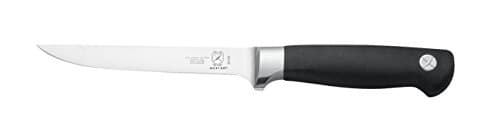
- Mercer Culinary Genesis 6" stiff boning knife — for anyone who buys bone-in. Forged, full tang, a published 15° edge at ~HRC 56, and a Santoprene handle, at a price most stamped knives sit at. Stiff is the right grade for pork shoulders, rib racks and beef primals. Wrong knife if you mostly fillet fish.
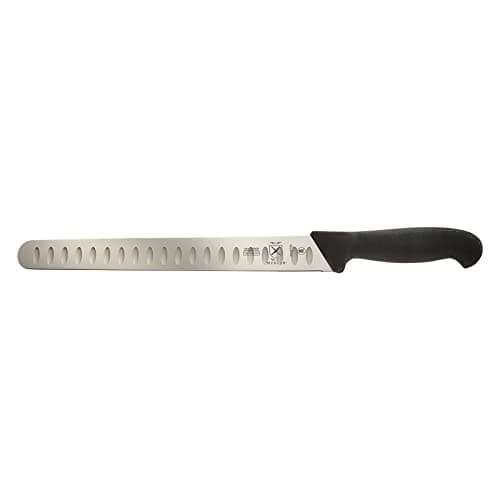
- Mercer Culinary BPX 11" granton slicer— the carving knife to buy if the object does not matter. Eleven inches, granton edge, published 15° per side at HRC 57–58, ice-hardened and taper-ground, for roughly the price of a roasting pan. It looks like what it is: a working slicer from a professional line.
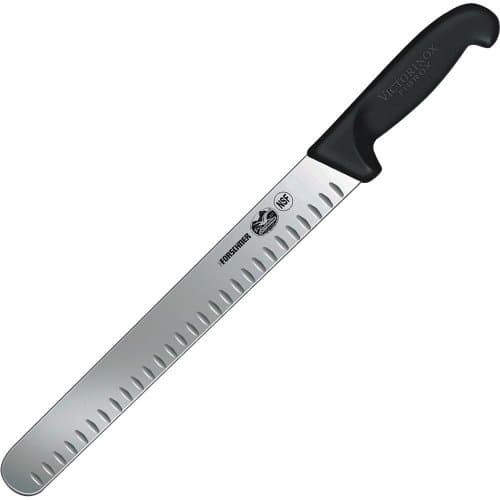
- Victorinox Fibrox Pro 12" granton slicer — for brisket, whole birds and catering-scale roasts. Nearly twelve inches of blade at about 6.2 oz with a rounded tip, which is why it lives on carving stations. Victorinox publishes neither a steel grade nor a Rockwell figure for it, and the extra two inches is more knife than a home board usually needs — buy it only if you genuinely cut big.
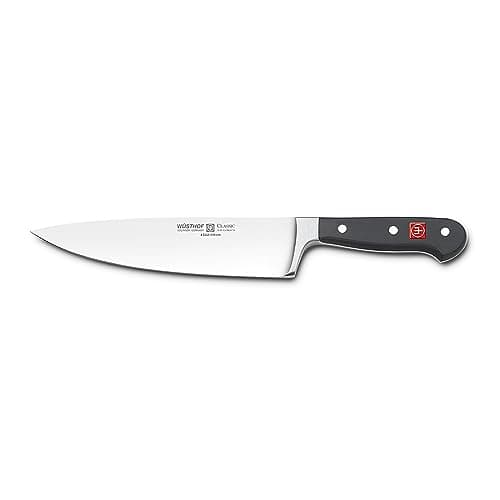
- Wüsthof Classic 8" — for the cook who wants one forged knife to keep. Precision-forged X50CrMoV15 at ~HRC 58 behind a 14° edge, full bolster, ~9.0 oz. The weight does real work when you are pushing through cartilage, and it will outlive you if you hone it. Heavy, and shorter than ideal for large cuts.
Why we do not put a hard Japanese knife on this list
A MAC MTH-80 or a Shun Classic will cut a steak beautifully. They are also the knives most likely to come back from a meat session with a chip in the edge, because at ~HRC 60–61 behind a 15–16° bevel the steel is harder than the bone it meets and gives up a flake rather than bending. Why Japanese knives are so sharp explains the trade, and how to fix a chipped knife edge is the repair job you are signing up for. If you already own a hard Japanese knife, keep it for the slicing and let a cheap German blade do the bone work. That is what most professional kitchens do, for exactly this reason.
Sequence: what to buy, and when
If you cook meat a few times a week and currently own one chef's knife, the honest upgrade path is short. Add the boning knife first — it unlocks buying bone-in chicken and whole shoulders, which is where the money is in meat, and it costs very little. Add the slicer second, and only if you roast: the chef's knife carves adequately, and the slicer's advantage shows up on long cuts (brisket, loin, turkey breast) rather than on a Sunday chicken. The 10-inch chef's knife replaces your 8-inch for this work rather than joining it, if board space allows.
Technique matters more than the next knife up. How to cut up a whole chicken is the single best skill to learn here, and how to carve a turkey covers the slicing end. Both are done with the knives on this page.
Keeping a meat knife sharp
Meat is hard on edges in a way vegetables are not: bone, cartilage, silverskin and the board strike at the end of a push cut all roll a soft edge quickly. The fix is honing, not sharpening — a few passes on a rod before each session keeps a German blade cutting for months between stones. Our honing steel ranking covers the rods, and sharpening vs honing explains why the two are not the same job. When the rod stops working, how to sharpen a chef knife is the stone routine, and how to sharpen a boning knife handles the narrow blade.
One hygiene note that is also an edge note: raw meat means you will want to wash these knives immediately and often, and that is fine provided it happens by hand. The dishwasher is what kills them — see can you put knives in the dishwasher, and dishwasher-tolerant knives if that is non-negotiable in your house.