Hundreds of times — far more than you will sharpen it in a lifetime of home cooking. A proper sharpening on a whetstone removes a few thousandths of an inch of steel from the very edge, and a chef's knife has something like an inch and a half of blade height above that edge. Sharpen twice a year and you will not run out of knife. What actually ends a kitchen knife's life is a chip you cannot grind out, a cracked handle, a snapped tip, or years of a grinding wheel — not the sharpening itself.
The arithmetic, honestly
Nobody can give you a precise number, and anyone who does is inventing it: how much steel comes off depends on your stone's grit, how dull the knife was, how heavy-handed you are, and how hard the steel is. But the order of magnitude is not in doubt, and it settles the question.
A sharpening session is about re-forming an apex a few microns wide. You are grinding back the damaged metal immediately behind it — a band measured in thousandths of an inch, not in sixteenths. Meanwhile an 8-inch chef's knife is roughly 1.5–2 inches tall at the heel. Even on a pessimistic estimate, you would need many hundreds of full stone sharpenings before the blade's profile changed enough to matter, and the knife would have been through several handles by then.
Two things change that picture dramatically, and both are worth knowing:
- Grinding wheels. An electric sharpener with abrasive wheels removes far more steel per pass than a stone — that is how it works that fast. Run a knife through one weekly for a decade and the blade visibly narrows. You can see it on old restaurant knives, which develop a scooped, recurved profile from exactly this. Our electric sharpeners, assessed and pull-through vs whetstone cover how much is at stake.
- Reprofiling. Changing the edge angle — taking a 20° German grind down to 15° — removes a genuine amount of metal because you are reshaping the whole bevel, not just the apex. It is a thing you do once per knife, deliberately, not routine maintenance. Knife sharpening angle explains when it is worth it.
What actually ends a knife's life
In order of how often we see it as the real cause:
- A chip too deep to grind out.On hard Japanese steel at HRC 60+, hitting bone or twisting through a joint can take a flake out of the edge. A small one grinds away; a deep one would mean removing so much steel that the blade's geometry is ruined. How to fix a chipped knife edge shows where the line is.
- Handle failure. Riveted wood handles crack and delaminate, particularly after dishwasher cycles. On a stamped knife that is usually the end, because a new handle costs more than the knife — can you put knives in the dishwasher.
- A snapped tip. Prying with the point, or a drawer full of loose knives. Grinding a new point costs you blade length and changes the profile.
- Rust pitting. Deep pits along the edge mean the steel there is gone, and each sharpening exposes more of them — how to remove rust from a knife and how to prevent knife rust.
- Decades of a grinding wheel. The slow version of the same story, and the only one on this list that is genuinely about steel removal.
Note what is not on that list: sharpening on a stone, done reasonably, a few times a year. How long should a chef knife last takes the lifespan question from the other end.
What to look for in the tool that actually extends the answer
Here is the useful reframing. The number of sharpenings a knife can take is not your constraint; the number you need is the variable you control. Honing removes no meaningful metal at all — it straightens an edge that has rolled over rather than grinding a new one — and on a soft German blade it can cut the number of stone sessions you need by an order of magnitude. Sharpening vs honing is the full explanation; the short version is that a rod is the tool that makes the question in this page's title irrelevant.
What separates one rod from another:
- Match the surface to your steel.A traditional fine-cut steel rod works on soft Western blades at HRC 55–58 and barely bites on hard Japanese steel. For HRC 60+ you want a fine ceramic rod, which is mildly abrasive rather than purely realigning — ceramic vs steel honing rod.
- Length: the rod should be longer than your blade.A 10-inch rod covers an 8-inch chef's knife in one stroke. A short rod makes you work in sections, which is how angles drift.
- A real hand guard. You are drawing an edge toward your hand repeatedly. This is not a nicety.
- Fine cut, not coarse. Coarse-ribbed steels remove metal and leave a toothy edge. Fine cut is what you want for maintenance between sharpenings.
The three rods worth owning
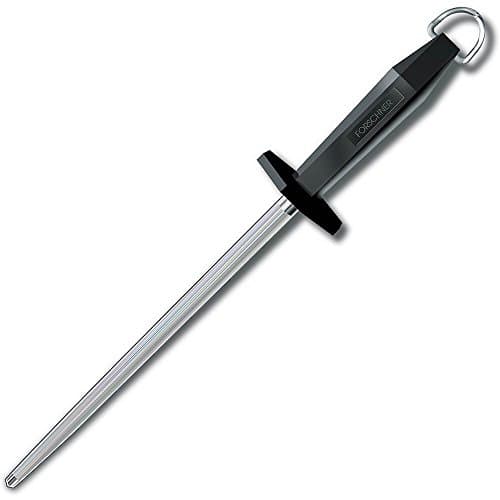
- Victorinox 10" fine cut honing steel (40581)— the default, and the one to buy if your knives are German or Swiss. A 10-inch fine-cut (#5) rod with a polyamide handle, finger guard, hanging ring and magnetic tip, from the people who make the default chef's knife. Wrong rod if your knives are hard Japanese steel: a traditional steel barely bites at HRC 60+.
- Mercer Culinary 12" ceramic honing rod — the rod for hard Japanese blades. Fine 1200-grit ceramic with an ergonomic nylon handle and hand guard, and 12 inches of rod covers any kitchen knife in one stroke. It is mildly abrasive, so it genuinely refreshes a hard edge where a steel rod slides off. Overkill, and several times the price, if you own soft German steel and already hone daily.
- Wüsthof 10" sharpening steel — for the German set on the counter. Fine-cut rod, triple-riveted POM handle, made in Germany, well balanced. It hones no better than the Victorinox for more money; buy it because it matches, which is a legitimate reason.
All three are ranked in full, against five rods, in best honing steels. The technique — and it does need technique — is in how to hone a knife.
How to make each sharpening remove less
If you want the number of available sharpenings to stretch further still, four habits do it:
- Sharpen before the knife is badly dull. A mildly dull edge needs a few light passes on a medium stone. A badly dull one needs the coarse stone, which is where the steel actually goes. How to tell if a knife is sharp gives you the check.
- Use the finest stone that will do the job. Start at 1000, not 400, unless there is damage to remove. Sharpening stone grits explained covers the progression.
- Use light pressure. Pressing harder does not sharpen faster past a point; it dishes your stone, rounds your apex and removes metal you did not need to lose.
- Protect the edge between sessions. Most dulling is avoidable damage, not wear: glass and stone boards, scraping food sideways with the edge, the dishwasher, and loose storage. Why does my knife get dull so fast and knife care and storage cover the lot.
So should you worry about sharpening too often?
No — with one exception. Sharpening a kitchen knife on a stone whenever it needs it is simply maintenance, and the blade will outlast your interest in the question. The exception is a powered grinding wheel used habitually: that is the one practice that measurably shortens a knife's life, and if it is your routine, our guided systems ranking and whetstone vs electric sharpener are both worth reading. If you would rather not do any of it yourself, is professional knife sharpening worth it has the economics — and the warning about which services use belt grinders.