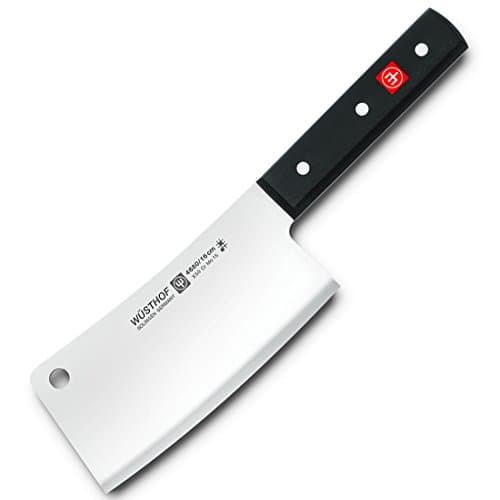
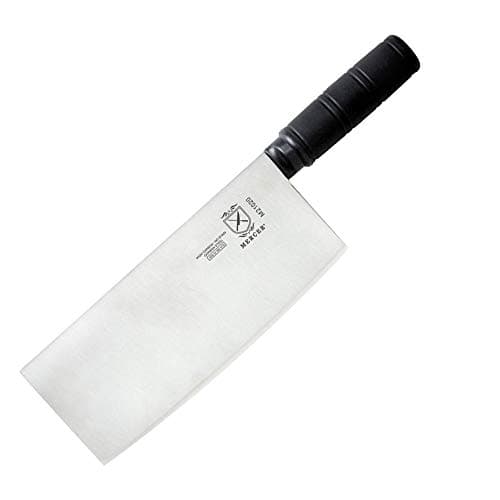
"Cleaver" is one word doing the work of two completely different knives, and almost every bad cleaver purchase comes from not knowing which one you are buying. A Chinese vegetable cleaver (a cai dao, sold in the US as a "Chinese chef's knife") is a thin, tall, surprisingly light blade used the way you would use a chef's knife — for slicing, dicing and shaving produce. A Western bone cleaver is a short, thick, heavy chopper for splitting joints and small bones. They look alike in a photo and they are not interchangeable in a kitchen. Our top pick overall is the Mercer Culinary Asian Collection 8" Chinese Chef's Knife, because the tall thin blade is what most people are actually looking for.
So the honest first answer is a question: do you want to chop vegetables, or split bones?If it is vegetables — and for most home cooks it is — buy a thin Chinese cleaver and ignore the heavy ones entirely. If you genuinely break down bone-in chicken, ribs or pork shoulder at home, buy a forged bone cleaver and do not expect it to be pleasant on an onion. This page ranks six of them by our overall score, which weights value heavily, and labels every pick with which of the two families it belongs to.
The two cleavers, side by side
- Chinese vegetable cleaver (cai dao).Roughly 7-8 in long and 3-3.5 in tall, thin stock, a flat or barely curved edge, and light — often lighter than a German chef's knife. The tall face is the point: it is a built-in bench scraper that moves a whole board of prep into the pan in one motion. Used with a push-cut or a straight chop, not a rock-chop. This is the knife a huge number of cooks use as their only knife.
- Western bone cleaver. Shorter (around 6 in), much thicker at the spine (3.5 mm and up), noticeably heavy (around a pound), with a deliberately obtuse edge angle. The weight does the cutting. It splits chicken joints, trims ribs and cracks small bones. It is bad at produce, and that is not a defect.
There is a third thing sold as a cleaver that we have deliberately not ranked: the heavy "bone chopper" or hand-axe style blade from unbranded sellers. Those publish no steel spec, no hardness and no origin, and we will not rank a knife whose maker tells us nothing about it.
What actually matters in a cleaver
- Blade height — the spec that decides everything. It is why we put it second in the comparison table. Around 3 to 3.5 inches gives you a true vegetable cleaver with a usable scooping face and enough knuckle clearance to chop without barking your fingers. Under about 3 inches you have a chopper, not a slicer.
- Spine thickness and weight. This is the real fork in the road. Thin and light (a few millimeters, well under a pound) cuts cleanly through produce. Thick and heavy (3.5 mm+, around a pound) survives bone. A thin cleaver used on bone chips; a heavy cleaver used on vegetables wedges and crushes.
- Edge angle.A vegetable cleaver wants a relatively acute edge — the Shun here is hand-sharpened to about 16° per side. A bone cleaver wants a deliberately obtuseone; the Wüsthof cleaver is published at about 18° per side where that line's chef's knives are about 14°, and that is correct engineering, not a corner cut. More in knife sharpening angle.
- Construction. For a vegetable cleaver, stamped is genuinely fine and keeps it light. For anything that takes impact on bone, you want forged with a full tang— the forces involved will eventually find a weak blade-to-handle joint.
- Handle. Round wooden handles are traditional on Chinese cleavers and some cooks love them; textured synthetic handles grip better with wet hands and survive a dishwasher-adjacent life better. Handle materials are covered in knife handle materials explained.
- Steel and hardness. Matters more on a thin vegetable cleaver, where a keen edge is the whole value, than on a bone cleaver, where toughness beats hardness every time. Background in our knife steel guide and knife hardness explained.
The picks, and who each suits
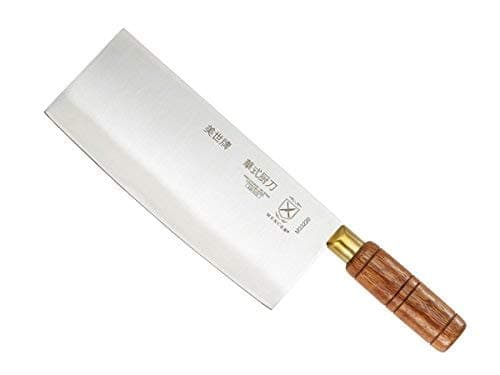
- Mercer Culinary Asian Collection 8" — your first Chinese vegetable cleaver. Tall 3.25-inch thin blade, grippy Santoprene, NSF certified, and cheap enough that finding out whether the cleaver grip suits you costs almost nothing.
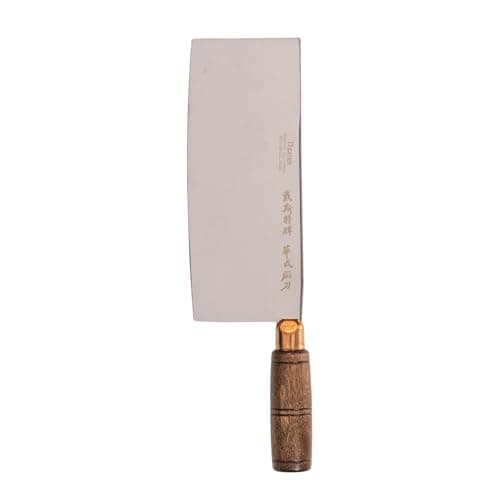
- Dexter-Russell Traditional 8" — a hand-ground blade made in the USA. Individually ground at the factory, so it arrives sharper than anything else near the price, on a rosewood handle with a brass ferrule.
- Mercer Culinary 8" wood handle — the cheapest way to try one. Same tall thin geometry as our top pick, traditional round wooden handle, lowest price here.
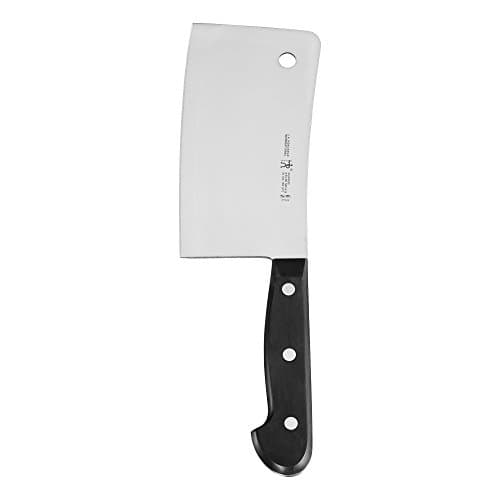
- Henckels Classic 6" Meat Cleaver — for bones, joints and carcasses. The actual bone cleaver, fully forged, around 0.9 lb, and appreciably cheaper than the Wüsthof. Buy this only if you really do break down bone-in meat.
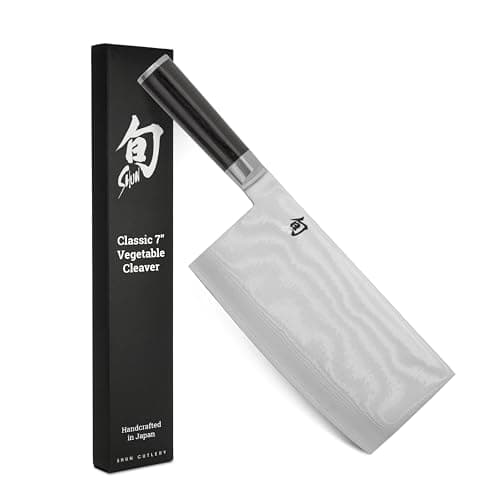
- Shun Classic 7" Vegetable Cleaver — the premium Japanese option. VG-MAX core at ~HRC 60-61 under Damascus cladding, the tallest blade here at 3.5 in, and the keenest by a wide margin. Also roughly five times our top pick.
- Wüsthof Classic 6" Cleaver — the buy-forever bone cleaver. Forged in Solingen, ~3.5 mm spine, ~442 g, lifetime warranty. The best-built tool here and the worst value on the page.
Most people searching for a cleaver want a vegetable cleaver
The mental image attached to the word "cleaver" is a butcher splitting a rack of ribs, so people buy the heavy chopper. Then they try to dice an onion with it, find that a thick obtuse edge wedges and crushes rather than cutting, and conclude they do not like cleavers. What they actually did was buy the wrong one of the two tools the word covers.
Count the bone work you genuinely do at home. For most households the honest answer is "a chicken, a few times a year" — and a chicken can be broken down perfectly well with a boning knife and a pair of kitchen shears, which is how most cooks do it anyway (the method is in how to cut up a whole chicken). Meanwhile the thin tall Chinese cleaver gets used every single day, because it does the same job as a chef's knife plus the scooping. That asymmetry is why our ranking puts three vegetable cleavers above both bone cleavers.
How a Chinese cleaver actually gets used
It is not a chopper swung from the elbow. A cai dao is used with a push cut— the blade moves forward and down through the food against the board — or a straight vertical chop for herbs and scallions. The pinch griptransfers directly: thumb and forefinger on the blade just ahead of the handle, remaining fingers wrapped. Because the blade is tall, your knuckles clear the board easily, which many people find more comfortable than a chef's knife once they adjust.
The flat edge profile means it does not rock. If you are used to rock-chopping with a curved German blade, there is a genuine adjustment period of a week or two — the same adjustment you make moving to a nakiri, which is essentially a smaller, lighter version of the same idea. The payoff is full-contact cuts: a flat edge meeting a flat board severs scallions along the whole length at once, where a curved blade leaves the ends attached.
And then the scooping. The tall blade face is the most underrated feature in this category: you turn the knife on its side, use the flat as a bench scraper, and move a whole board of diced onion into the pan in one movement instead of three trips with cupped hands. Once you have done it for a week, going back feels clumsy.
Cleaver vs chef's knife vs nakiri
All three are general-purpose produce knives with different trade-offs. A chef's knife has a curved belly for rock-chopping and a usable point for detail work. A nakiriis flat-edged and tall-ish but light and short, built purely for vegetables. A Chinese cleaver is flat-edged, taller again, and long — the most blade face and the most reach of the three, at the cost of having no point at all. That missing point is worth planning around: a cleaver cannot do close in-hand work, so most cleaver kitchens keep a small knife alongside it — see best utility knives.
We have the direct comparisons written out if you are deciding: chef knife vs cleaver for the general question, and chef knife vs Chinese cleaver for the specific one. If you want the background on what the word means before you shop, start with what is a cleaver.
Can you chop bones with a vegetable cleaver?
No, and this is the single most expensive mistake in this category. A thin Chinese cleaver is roughly as thick as a chef's knife. Driving it into a joint will roll or chip the edge, and on a hard bone it can take a visible crescent out of the blade. Fixing that means grinding the edge back on a coarse stone — see how to fix a chipped knife edge — and you will lose real blade height doing it.
If you need bone capability, buy a bone cleaver as a second knife. That is what the Henckels and the Wüsthof on this page are for, and it is why we rank them separately rather than pretending any one cleaver covers both jobs.
Sharpening and care
A thin Chinese cleaver sharpens exactly like a chef's knife — same stones, same angle, same motion — and it is arguably easier, because the tall flat blade gives you a big stable reference face against the stone and there is no curved belly to follow. The method is in how to sharpen a chef's knife, and 15-20° per side suits every vegetable cleaver here except the Shun, which wants about 16°. A 1000/6000 combination stone handles all of them, and a diamond plate is the lower-maintenance alternative if you would rather not flatten a stone.
A bone cleaver is different: keep the edge deliberately blunter than you would a slicing knife. An acute edge on a tool that hits bone will chip, so aim for about 20° or more per side and do not chase a hair-splitting finish. The reasoning is in knife edge types explained.
Care is the usual: hand wash and dry everything, and be especially strict with the Dexter and the wood-handled Mercer, because bare wood handles dry out, swell and eventually loosen if they are soaked or run through a dishwasher (the full case is in can you put knives in the dishwasher). Storage is a real consideration with a cleaver, because most blocks will not take a 3.5-inch-tall blade — a magnetic strip or an in-drawer guard is usually the answer, and both are covered in best knife storage.