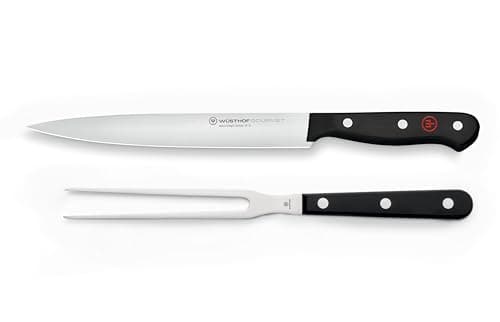
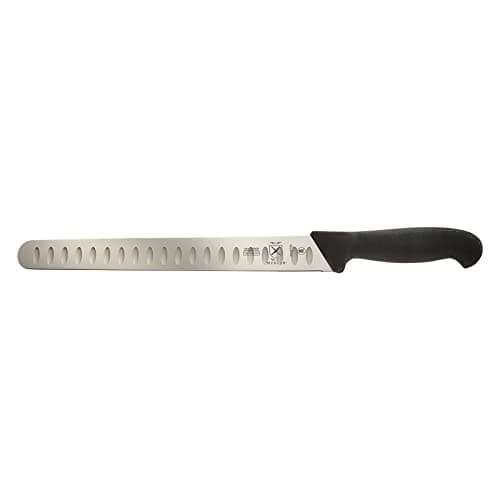
Almost every ragged, torn, gray-edged slice of roast beef that has ever left a home kitchen was cut with a chef's knife. Not because the chef's knife was blunt — though it usually was — but because it was too short. A carving knife exists to solve exactly one geometry problem: crossing a whole roast, a turkey breast or a brisket in one uninterrupted draw, so the cut face is a single clean plane instead of the overlapping ledges a short blade leaves behind. Everything else about the category — the steel, the dimples, the fork in the box — is downstream of that.
Two specifications decide which one you should own, and both are printed on every listing. The first is blade length, and the honest rule is that the blade must be longer than the widest thing you will cut, with a couple of inches to spare for the sawing stroke you should not be making. The second is the edge face: whether the blade has granton scallops or a hollow grind — those oval dimples along the flat — or is plain steel. The dimples do not make the knife sharper. They break the suction that a wet slice of meat forms against a flat blade, so the slice falls away instead of riding up and folding over. On a dry loaf that is a gimmick. On a medium-rare eye of round it is the difference between a slice and a smear.
If you want the shape explained before the shopping, what is a carving knife covers what separates one from every other long blade in the kitchen, and chef knife vs carving knife is the head-to-head. Rankings below use our overall score, which weights value heavily — and that weighting bites harder here than in most categories, because a carving knife in a normal household is used a handful of times a year. Money that would buy a premium carver buys a great deal more cutting when it is spent on the chef's knife you use every day.
What actually matters in a carving knife
- Blade length — the spec that decides everything. Eight inches carves a chicken. Ten inches carves a normal roast or a leg of lamb. Eleven to twelve inches is what a big turkey, a bone-in ham or a packer brisket actually needs, and it is the range professional carving stations live in. The failure mode is buying the 8-inch knife because it looks less alarming in a drawer, then sawing through a 14-inch turkey breast in three passes and wondering why the slices fall apart. Measure the largest thing you genuinely cook, then buy longer than that.
- Granton or hollow edge versus a plain face. Scallops ground into the flat create air pockets that break suction on wet, dense protein. What is a Granton edge covers the mechanism properly. Four of the six picks here have one, and on roast beef, ham and turkey breast it is a genuine functional advantage rather than a styling cue. It is not magic: it does nothing for sharpness, nothing for edge retention, and nothing at all on dry food.
- Rigidity, and why a carving knife is not a fillet knife. A carver should be stiff. You are driving a long blade through dense muscle in a straight line, and a blade that flexes wanders off the plane you are trying to cut. Flexibility is the virtue of a boning or fillet knife, where following a curved bone is the whole job. Buying a flexible slicer for roast carving is one of the more common mis-purchases in this category.
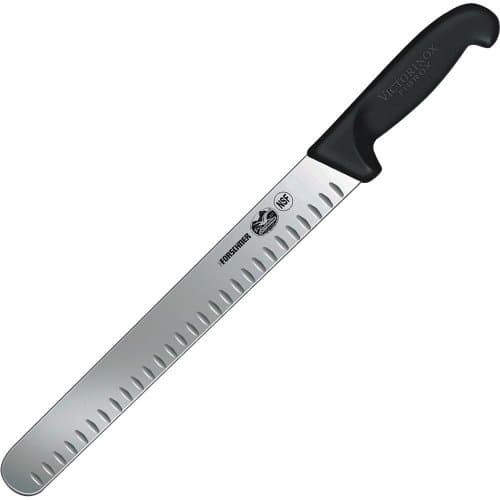
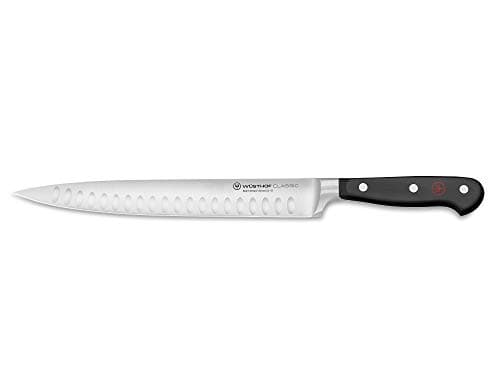
- Weight, and why less is more here.In a chef's knife, heft helps: the blade's own mass does some of the work of chopping. A carving knife never chops. It draws. Mass buys you nothing and costs you control over a long, unsupported blade — which is why the lightest knife on this page, the roughly 6.2-ounce Victorinox, is also the easiest one to steer through a big roast, and why the heaviest, the full-bolstered Wüsthof, scores lower on handling despite being the better-made object.
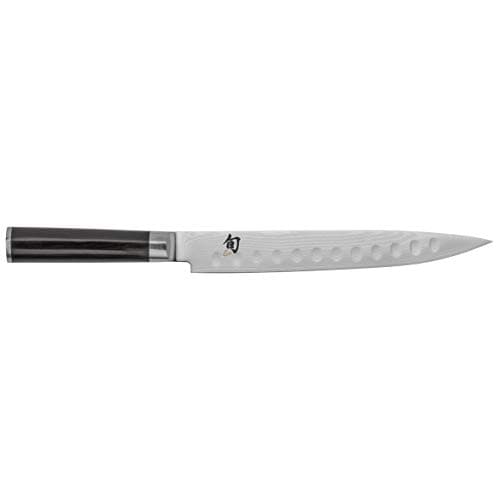
- Steel and hardness — real, but secondary. Everywhere else on this site, steel and Rockwell hardnessare the specs that decide performance. A carving knife makes perhaps forty cuts a year through cooked protein, with no bone contact if you are doing it right. Hard steel's edge retention barely gets the chance to matter, and its brittleness meets a carving-board bone or a serving platter often enough to be a real risk. HRC 56–58 German stainless is a perfectly rational answer here; the HRC 60–61 Shun is a luxury, and we rank it honestly as one.
- The handle, because your hands will be greasy.A carving knife is used on hot meat with rendered fat running down the board, usually with an audience. Textured synthetics — Fibrox, Santoprene, glass-reinforced nylon, POM — all stay grippy when slick, and every pick here uses one. Our handle materials guide covers the full trade-off, but the short version for this category is that a handsome wooden handle is the one place where looks cost you something real.
- The fork, and whether you need it. A carving fork holds the roast still without your fingers near a long moving blade, and it is genuinely safer than pinning a hot bird with a spatula. Only one pick here includes one. If you already own tongs you trust, you do not need a set; if this is a gift or a first carving kit, the fork is most of the reason the set exists.
- Value. The metric that decides the ranking. The spread from cheapest to dearest on this page is more than fivefold, and the spread in how well they carve a Sunday roast is nothing like fivefold.
What matters less than the price suggests: a full bolster (weight at the heel you do not need, and it blocks the last inch of edge when you sharpen), Damascus cladding(decorative layers around the cutting core — see Damascus steel knives explained), a presentation box, and matching the brand of your chef's knife. The one thing brand-matching buys you is a shared sharpening angle, which is a small convenience rather than a reason to spend.
How long a blade do you actually need?
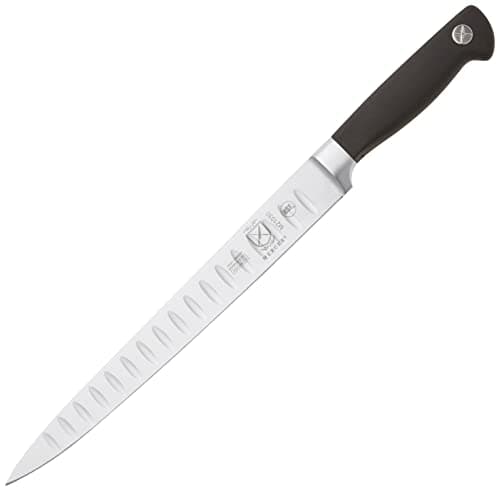
Work it backwards from the food, not from the drawer. The blade has to be longer than the widest cross-section you cut, plus about two inches of run-out so the stroke finishes cleanly instead of stopping mid-slice. A roast chicken is four or five inches across, so an 8-inch blade covers it. A standard beef roast, a pork loin or a leg of lamb is six to eight inches, so 10 inches is the comfortable answer — that is the Mercer Genesis. A whole turkey breast, a bone-in ham or a brisket flat regularly runs past ten inches, which is why the 11-inch BPX and the 12-inch Victorinox are the two picks a holiday cook should be looking at. If you are choosing between two lengths, take the longer one: an over-long carver is slightly awkward on a small board, while a too-short one ruins every slice it takes.
This is the same logic that runs through chef knife sizes explained, but it is far less forgiving here. An 8-inch chef's knife that is an inch short just means an extra rock of the blade. A carving knife that is an inch short means a visible ledge down the face of every slice.
Do the dimples actually do anything?
Yes, and less than the marketing suggests. The scallops on a granton or hollow-ground blade hold pockets of air along the flat, so a freshly cut slice of wet protein has less contact area to stick to and drops away rather than clinging and tearing. On roast beef, ham and turkey breast — dense, moist, and cut in wide slices — that is a real, noticeable benefit, which is why four of these six picks have them and why every commercial carving station knife you have ever seen does.
What the dimples do notdo: make the blade sharper, help it hold an edge, reduce the force needed to start a cut, or do anything whatsoever on bread, vegetables or cheese. They also make the blade very slightly harder to sharpen, because the scallops interrupt the flat you are registering against the stone — not enough to matter on a 1000-grit stone, but enough to notice. If a plain-faced carver is otherwise the right knife, the missing dimples are not a reason to walk away; they are worth perhaps one rank position.
Do you need a carving knife at all?
Plenty of households do not, and we would rather say so than sell you one. How many kitchen knives do you need makes the general case that three blades cover almost everything, and a carver is not among the three. If you roast a chicken most Sundays and nothing bigger, a sharp 8- or 10-inch chef's knifedoes the job well enough that nobody at the table will know. The category earns its place when you cook things that are wider than your chef's knife is long — a whole turkey, a bone-in ham, a brisket, a prime rib — or when you carve in front of people and want it to look like carving rather than hacking.
The honest middle path, if you carve once or twice a year: buy the cheapest genuinely good long blade on this page rather than the nicest one. An 11-inch granton slicer that lives in a drawer for eleven months and earns its keep in December is a sensible purchase. A premium carver doing the same duty cycle is an ornament.
Carving knife, slicing knife, or brisket knife?
These three names cover overlapping products and the labels are applied loosely by every maker on this page. In rough usage: carving knifetends to mean 8–10 inches with a pointed tip, sold for roasts and poultry; slicertends to mean 10–14 inches, often with a rounded tip, sold for deli work and large cuts; brisket knifeis a slicer marketed to barbecue. The meaningful differences are length and tip shape, not the word on the box. A pointed tip lets you start a cut precisely and pick at a joint; a rounded tip is safer around the hand steadying the meat and will not catch on a platter. Neither is better — but if you want one knife that does both jobs, take the pointed tip.
What none of them replace is a boning knife. A carver is stiff and long precisely so it will not follow a bone. Separating a leg, removing a breast from the carcass or lifting a ham off the bone is a different tool's job, and how to cut up a whole chicken shows where the handover happens.
Sharpening and care
A carving knife is one of the easier blades in the kitchen to maintain, for a reason worth knowing: it does not meet bone, it does not meet a board edge-first very often, and it is used a few times a year. Most carvers arrive at the holidays dull not because they wore out but because they sat in a drawer knocking against other steel for eleven months — storing knives in a drawer properly fixes more carving-knife dullness than sharpening does.
When it does need work, match the angle the maker publishes: 15° per side on both Mercers, 14° on the Wüsthof Classic, 16° on the Shun, and no published figure at all for the Victorinox or the Gourmet set — treat those as a standard Western 20° and you will not go wrong. Knife sharpening angle explains what those numbers mean, and how to use a whetstone covers the technique. The long, thin blade is the only complication: it wants steady, unhurried passes and a stone long enough to register against, and it will flex if you lean on it. For the two German blades, a few passes on a honing steel before the roast comes out of the oven is usually all the attention they need.
Care is the usual short list, with one addition. Hand wash and dry rather than using the dishwasher — the reasons why apply to every knife here, and to the PakkaWood-handled Shun absolutely. Store it so nothing touches the edge; a long blade is the worst possible fit for a crowded drawer, and knife storage ranks the options by what the edge actually contacts. And carve on wood rather than a platter: a ceramic serving dish will take an edge off a carving knife in a single Thanksgiving, which is one of the arguments in wood vs plastic cutting board.