Skip to content
Bevel & Bone

HUB 01 · Chef Knives

Best Santoku Knives

The lighter, flatter Japanese cousin of the chef's knife — brilliant for fast, precise vegetable work. Six santoku knives ranked, from budget workhorse to Damascus showpiece.

By Stephen V.Updated How we choose
#ad

We earn a commission when you buy through our Amazon links, at no extra cost to you. It never changes a ranking, and we say so when the cheaper knife is the better buy. How this works.

A santoku is the Japanese all-rounder — a lighter, flatter, more nimble take on the western chef's knife. The name means "three virtues" (slicing, dicing, mincing), and its shorter blade with a rounded sheepsfoot tip and almost no belly makes it a precise, confidence-building knife for fast vegetable work. If you cook by pushing and chopping straight down more than you rock, a santoku often just feels right — and the field runs from a stamped blade that costs about as much as a takeaway to a hand-finished Damascus showpiece.

These six are ranked by our overall score, which weights value heavily but — unlike a paring knife, where the job is so light that cheap wins outright — a santoku does real cutting, so a thin, hard, well-made blade genuinely earns some of its premium. That's why a Japanese Mac tops the list rather than the cheapest option, with the value champion right behind it. The beautiful and the expensive are here too, clearly labeled, so you can spend where it's worth it and stop where it isn't.

What actually matters in a santoku

  • Blade length and profile. Most santoku run 6.5 to 7 inches(165–180 mm) with a flat edge and a rounded "sheepsfoot" tip. The flat profile suits a push-cut— straight down and forward — rather than the rocking motion a curved chef's knife invites. Shorter and flatter is the whole point; it's why the knife feels controllable.
  • Steel and hardness. This is the biggest split. A hard Japanese steel (VG-MAX, molybdenum-vanadium, around HRC 60) takes a keener edge and holds it far longer, but is thinner and more chip-prone. A softer western steel(X50CrMoV15, around HRC 56) dulls sooner but is tougher and comes back in seconds on a stone. Neither is "better" — it's the same trade-off our knife steel guide walks through.
  • Edge geometry. A santoku is ground thin, and most sold in the west are a conventional double bevel(sharpened on both sides) — not the tricky single-bevel blades of a sushi counter. Many add a granton or hollow edge: the rows of dimples you see on several picks here. More on what those actually do below.
  • Weight and balance.Light and lively is a santoku's signature feel, and much of its appeal over a heavier chef's knife. A thin Japanese blade floats; a forged German santoku is planted and heavy. Which you prefer is genuinely personal — but if you came to santoku for nimbleness, weight works against you.
  • Value.The metric that decides the ranking. A santoku is a simple shape to make well, so once a blade is thin, sharp and comfortable, every extra dollar buys harder steel, finer finish and Damascus looks — real, but with fast-diminishing returns.

What matters less than the price implies: Damascus cladding(the wavy pattern is mostly cosmetic — the cutting comes from the core steel), and brand prestige. Keep that in mind as you read the picks.

The short answer

Quick picks

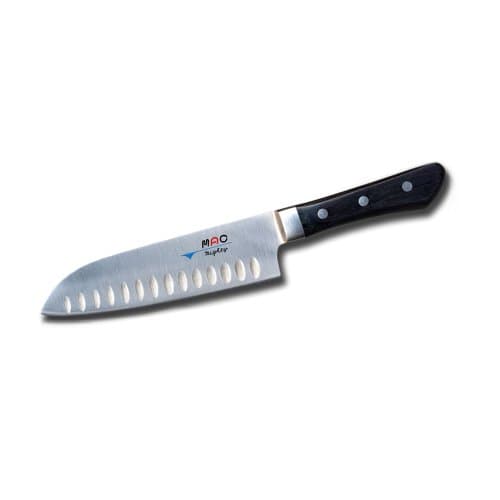
  • Mac Mac Professional Hollow Edge 6.5" Santoku (MSK-65)
    01 Mac Professional Hollow Edge 6.5" Santoku (MSK-65)
    8.4

    The santoku a lot of cooks consider the best all-rounder made: a thin, hard Japanese blade with dimples that falls through vegetables and holds its edge for months. The overall pick, if the budget stretches.

    Best for: The best santoku overall

    $128.95Amazon
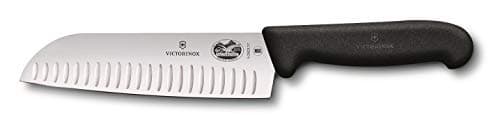
  • Victorinox Victorinox Fibrox Pro 7" Granton Santoku
    02 Victorinox Fibrox Pro 7" Granton Santoku
    8.2

    The value answer to 'which santoku should I buy': a light, granton-edged blade that's razor-sharp out of the box, a joy to sharpen, and cheap enough that pro kitchens buy them by the dozen.

    Best for: The best value santoku for most people

    $46.68Amazon
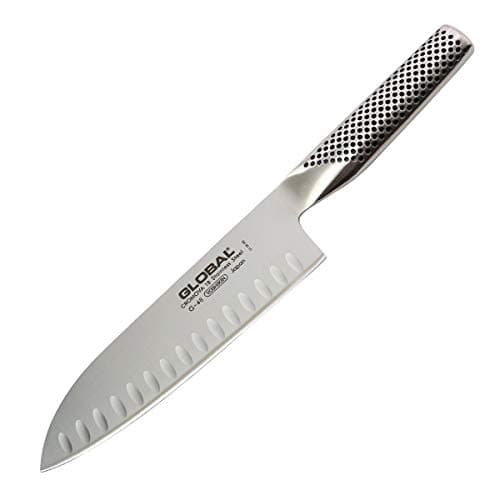
  • Global Global G-48 7" Hollow Ground Santoku
    03 Global G-48 7" Hollow Ground Santoku
    7.8

    The instantly recognisable one-piece stainless santoku: a dimpled CROMOVA 18 blade, a seamless sand-filled handle, and a light, lively balance. A distinctive Japanese cutter you either love or find too light.

    Best for: The iconic all-stainless Japanese santoku

    $149.95Amazon
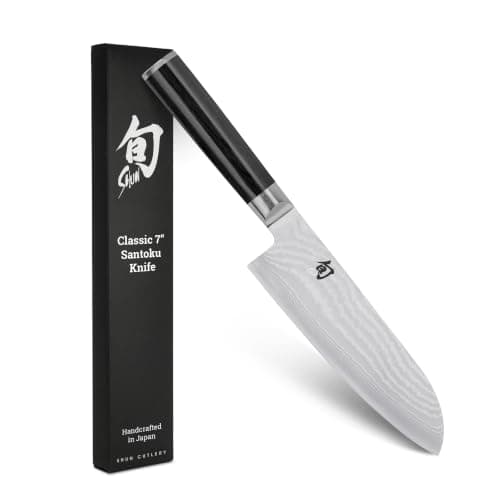
  • Shun Shun Classic 7" Santoku
    04 Shun Classic 7" Santoku
    7.6

    The showpiece: a hard VG-MAX edge under Damascus cladding with a Pakkawood handle. The keenest, prettiest santoku here — and, like most Damascus knives, more about beauty than measurably better cutting.

    Best for: A premium Damascus showpiece

    $144.98Amazon
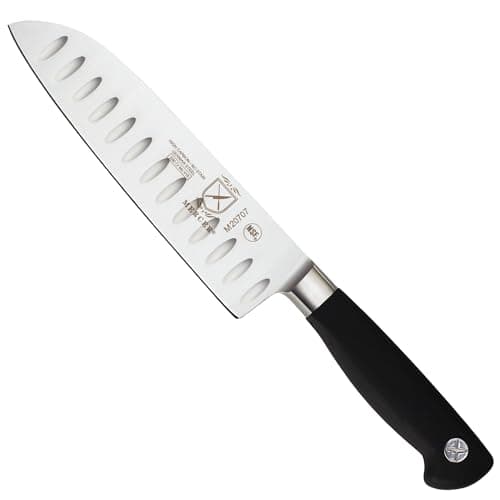
  • Mercer Culinary Mercer Culinary Genesis 7" Santoku
    05 Mercer Culinary Genesis 7" Santoku
    7.4

    A forged, full-tang German-steel santoku with a granton edge at a budget price — the value way to get real heft and a bolster in a santoku, matching the popular Genesis chef's knife.

    Best for: A forged santoku on a budget

    $39.95Amazon
  • Wüsthof Wüsthof Classic 7" Hollow Edge Santoku
    06 Wüsthof Classic 7" Hollow Edge Santoku
    7.2

    The forged German heirloom: a precision-forged, full-bolster blade with a hollow edge and a lifetime of durability. Beautifully made and built to last — but heavy, and the priciest knife here.

    Best for: A forged German heirloom

    $170.00Amazon

#ad · Live prices from the Amazon Product API, as of Aug 29, 2026. Where we have no verified live price we show none — we'd rather leave a gap than print a number that has rotted.

By the numbers

The specs, side by side

Every figure below is the manufacturer's published specification. Where a maker doesn't publish a value, the cell reads "—" rather than a number we made up.

Knife / ToolBladeSteelHardnessEdgeConstructionWeight
Mac Professional Hollow Edge 6.5" Santoku (MSK-65)6.5 in (165 mm)High-carbon molybdenum-vanadium~HRC 59-61~15° per side, hollow (dimpled)Thin blade, bolster, Pakkawood handle~6.1 oz (176 g)
Victorinox Fibrox Pro 7" Granton Santoku7 in (17 cm)X50CrMoV15 stainless~HRC 55-56Granton (fluted), double bevelStamped, full tang, Fibrox handle
Global G-48 7" Hollow Ground Santoku7 in (18 cm)CROMOVA 18 stainless~HRC 56-58Hollow ground (dimpled)One-piece stainless, dimpled sand-filled handle~6.3 oz (180 g)
Shun Classic 7" Santoku7 in (18 cm)VG-MAX core, Damascus clad~HRC 60-61~16° per sideClad (san-mai), Damascus; Pakkawood handle~6.8 oz (194 g)
Mercer Culinary Genesis 7" Santoku7 in (18 cm)X50CrMoV15 German stainless~HRC 56Granton edgeForged, full tang, bolster, Santoprene handle
Wüsthof Classic 7" Hollow Edge Santoku7 in (18 cm)X50CrMoV15 German stainless~HRC 58~10° per side, hollow edgePrecision-forged, full tang, bolster, POM handle~6.4 oz (182 g)

In detail

The picks, in full

01
Mac Mac Professional Hollow Edge 6.5" Santoku (MSK-65)

The best santoku overall

Mac Professional Hollow Edge 6.5" Santoku (MSK-65)

6.5 in / 165 mmMo-va high-carbon~HRC 59-61~15° edgeDimpled
8.4/10

The santoku a lot of cooks consider the best all-rounder made: a thin, hard Japanese blade with dimples that falls through vegetables and holds its edge for months. The overall pick, if the budget stretches.

Edge retention
9
Out-of-box edge
9
Handling
9
Build
8
Value
7

Pros

  • Thin, hard mo-va steel takes and holds a keener edge than any Western knife here
  • Dimpled blade and a light 6.5-inch body make quick, precise work of vegetables
  • The santoku sibling of the Mac chef's knife many cooks quietly rate the best all-rounder made

Cons

  • A premium price for a santoku — several times the cost of the Victorinox
  • The hard, thin edge chips if you twist it through bone or a frozen edge

Don't buy this if…

you want one cheap knife that shrugs off careless treatment — a softer, cheaper blade like the Victorinox is more forgiving and re-sharpens faster. Buy the Mac for the cutting, and treat it kindly.

$128.95View on Amazon

Price as of Aug 29, 2026. Prices change — Amazon's is the one that counts.

#ad · we may earn a commission from this link to Mac Professional Hollow Edge 6.5" Santoku (MSK-65)

02
Victorinox Victorinox Fibrox Pro 7" Granton Santoku

The best value santoku for most people

Victorinox Fibrox Pro 7" Granton Santoku

7 in / 17 cmX50CrMoV15~HRC 55-56GrantonStamped
8.2/10

The value answer to 'which santoku should I buy': a light, granton-edged blade that's razor-sharp out of the box, a joy to sharpen, and cheap enough that pro kitchens buy them by the dozen.

Edge retention
6
Out-of-box edge
9
Handling
9
Build
7
Value
10

Pros

  • Wickedly sharp out of the box and light and nimble in the hand
  • Granton fluting keeps potato and cucumber slices from sticking to the blade
  • Soft-ish steel takes a screaming edge on a stone in minutes — the easiest knife here to learn on
  • Costs a fraction of the Japanese and German blades, and NSF-certified for pro use

Cons

  • Soft steel dulls sooner than a hard Japanese blade, so you hone and sharpen more often
  • Plain stamped blade and Fibrox handle — purely a tool, nothing about it is beautiful

Don't buy this if…

you want a knife that holds its edge for months or feels like an heirloom. This trades edge retention and looks for being cheap and effortless to re-sharpen — a great trade for most cooks, a poor one if you refuse to touch a stone.

$46.68View on Amazon

Price as of Aug 29, 2026. Prices change — Amazon's is the one that counts.

#ad · we may earn a commission from this link to Victorinox Fibrox Pro 7" Granton Santoku

03
Global Global G-48 7" Hollow Ground Santoku

The iconic all-stainless Japanese santoku

Global G-48 7" Hollow Ground Santoku

7 in / 18 cmCROMOVA 18~HRC 56-58Hollow groundOne-piece
7.8/10

The instantly recognisable one-piece stainless santoku: a dimpled CROMOVA 18 blade, a seamless sand-filled handle, and a light, lively balance. A distinctive Japanese cutter you either love or find too light.

Edge retention
8
Out-of-box edge
8
Handling
8
Build
9
Value
6

Pros

  • Seamless one-piece stainless build with no handle seams to trap food — genuinely hygienic
  • Light, lively balance and a thin hollow-ground edge that cuts cleanly
  • A design classic that has been in pro kitchens for decades

Cons

  • The smooth, dimpled steel handle turns slippery with wet or oily hands for some cooks
  • Light, distinctive balance divides people — try the feel before committing to the price

Don't buy this if…

you want a grippy, planted handle or a bargain — the metal handle is polarizing and it costs Japanese-premium money. Buy it for the seamless build and the classic feel; skip it if you cook with wet hands and want grip.

$149.95View on Amazon

Price as of Aug 29, 2026. Prices change — Amazon's is the one that counts.

#ad · we may earn a commission from this link to Global G-48 7" Hollow Ground Santoku

04
Shun Shun Classic 7" Santoku

A premium Damascus showpiece

Shun Classic 7" Santoku

7 in / 18 cmVG-MAX core~HRC 60-61~16° edgeDamascus clad
7.6/10

The showpiece: a hard VG-MAX edge under Damascus cladding with a Pakkawood handle. The keenest, prettiest santoku here — and, like most Damascus knives, more about beauty than measurably better cutting.

Edge retention
9
Out-of-box edge
9
Handling
8
Build
9
Value
3

Pros

  • Hard VG-MAX core takes and holds the finest edge of any knife here
  • Flowing Damascus cladding and a D-shaped Pakkawood handle make it genuinely beautiful
  • Light and precise, with a refined 16° edge

Cons

  • Among the priciest here, and the Damascus cladding is largely cosmetic — you pay for looks
  • Hard, thin edge is more chip-prone; hand-wash only and keep it off bone

Don't buy this if…

you're buying on value or plan to be rough with it — a Mac cuts about as well for less drama, and a Victorinox costs a fraction. Buy the Shun for the beauty and the edge, with eyes open about the premium.

$144.98View on Amazon

Price as of Aug 29, 2026. Prices change — Amazon's is the one that counts.

#ad · we may earn a commission from this link to Shun Classic 7" Santoku

05
Mercer Culinary Mercer Culinary Genesis 7" Santoku

A forged santoku on a budget

Mercer Culinary Genesis 7" Santoku

7 in / 18 cmX50CrMoV15~HRC 56GrantonForged
7.4/10

A forged, full-tang German-steel santoku with a granton edge at a budget price — the value way to get real heft and a bolster in a santoku, matching the popular Genesis chef's knife.

Edge retention
6
Out-of-box edge
7
Handling
7
Build
8
Value
9

Pros

  • Genuinely forged with a full tang and bolster — real heft for the money
  • Granton edge and a grippy Santoprene handle built for a commercial kitchen
  • Matches the Genesis chef's knife if you're building a set

Cons

  • Soft German steel means only average edge retention, and it's thicker than a Japanese blade
  • Heavier and less nimble than a stamped Victorinox or a thin Japanese santoku

Don't buy this if…

you want the thin, keen feel a santoku is famous for — a Japanese blade like the Mac or Global delivers that and this doesn't. Buy the Mercer for a forged, grippy, inexpensive workhorse.

$39.95View on Amazon

Price as of Aug 29, 2026. Prices change — Amazon's is the one that counts.

#ad · we may earn a commission from this link to Mercer Culinary Genesis 7" Santoku

06
Wüsthof Wüsthof Classic 7" Hollow Edge Santoku

A forged German heirloom

Wüsthof Classic 7" Hollow Edge Santoku

7 in / 18 cmX50CrMoV15~HRC 58~10° edgeForged
7.2/10

The forged German heirloom: a precision-forged, full-bolster blade with a hollow edge and a lifetime of durability. Beautifully made and built to last — but heavy, and the priciest knife here.

Edge retention
7
Out-of-box edge
7
Handling
8
Build
9
Value
5

Pros

  • Precision-forged full-tang blade with a bolster and a planted, durable feel
  • Hollow edge reduces sticking, and the classic triple-riveted handle lasts for decades
  • Matches the Wüsthof Classic line if you own the set

Cons

  • The heaviest santoku here — the opposite of the light, nimble feel many santoku buyers want
  • The most expensive on the list, with softer steel than the Japanese blades that cost less

Don't buy this if…

you want a light, thin santoku or the best value — this is a hefty German knife at a premium price. Buy it for the forged build, the durability, or to complete a Classic set.

$170.00View on Amazon

Price as of Aug 29, 2026. Prices change — Amazon's is the one that counts.

#ad · we may earn a commission from this link to Wüsthof Classic 7" Hollow Edge Santoku

Santoku or chef's knife — which should you buy?

If you own neither, buy the chef's knifefirst: it's the more versatile shape, the curved edge rocks through herbs and handles a wider range of jobs, and the longer blade breaks down big produce a santoku struggles with. A santoku is the knife you add (or reach for) because you preferit: it's shorter, lighter and flatter, which many cooks find easier to control for fast, precise vegetable work — slicing, dicing and mincing in clean straight strokes. The full side-by-side is in chef knife vs santoku; the short version is that a santoku isn't better or worse, it's a different feel, and plenty of cooks who own both end up using the santoku for everyday veg and the chef's knife for everything else.

Hard Japanese steel or soft western steel?

This is the decision that actually changes how the knife lives in your kitchen. A hard Japanese blade like the Mac or Shun(around HRC 60–61) gets scarily sharp and stays sharp for months — but the thin, hard edge will chip if you twist it through a squash or hit a bone, and it wants a whetstone rather than a pull-through. A softer western blade like the Victorinox or Mercer(around HRC 56) won't hold its edge as long, but it's tougher, more forgiving of clumsy technique, and comes back to sharp in a couple of minutes. If you already maintain an edge and cook carefully, go hard and Japanese; if you want one low-fuss knife you won't baby, go softer. It's the same choice our Japanese vs German guide lays out at length.

What the granton (dimpled) edge actually does

Several of these knives have a row of oval dimples ground into the blade — a granton, hollow or "kullenschliff" edge. The dimples create little air pockets so wet, starchy slices (potato, cucumber, apple) release from the blade instead of clinging in a stack. That's genuinely useful for fast slicing — but be clear on what it isn't: a granton edge does not make a knife sharper, and the effect is modest. Choose your santoku on steel, geometry and feel first; treat the dimples as a nice-to-have, not a deciding feature.

Single or double bevel? (You almost certainly want double)

Traditional Japanese knives are often ground on one side only — a single bevel that a right-handed sushi chef uses for paper-thin slices. Every knife on this list is a conventional double bevel, sharpened on both sides, which is what almost every home cook wants: it works in either hand, cuts straight down without steering, and sharpens like any western knife. If you specifically want a single-bevel blade you already know it — and this isn't the list for you.

Do you even need a santoku?

Honestly, no — not if you already have a chef's knife you like. A santoku overlaps heavily with it, and the three knives that cover almost all of home cookingare a chef's knife, a paring knife and a serrated bread knife, not a santoku. Where a santoku earns its place is as a preference: if the chef's knife feels too long or too tip-heavy, or you do a lot of vegetable prep and love a light, flat blade that chops straight down, a santoku can quietly become the knife you reach for every day. If you're leaning Japanese and still weighing shapes, the gyuto vs santoku comparison covers the long-blade alternative, and santoku vs nakiricovers the dedicated vegetable knife. There's a plain-English primer in what is a santoku knife too.

Sharpening and care

A double-bevel santoku sharpens exactly like a chef's knife — the method is in how to sharpen a santoku knife. The one wrinkle is angle: hard Japanese blades are ground thinner (around 15–16° a side), so match that on the stone and finish on a higher grit; softer western blades are more forgiving. Skip the electric pull-through on the harder knives — it grinds away too much of a good edge. Whichever you buy, hand wash and dry it (the dishwasher dulls and corrodes every knife), and store it so the edge can't knock against other blades — a block, strip or in-drawer guard. Do that and even the budget picks stay sharp for years.

How we picked

We do not run a test kitchen

We compiled each product's published specifications — steel, hardness, edge geometry, weight — normalized them into the matrix above, and scored each one against a published rubric. The scores are judgments from those specs and the value math — they are notmeasurements we took, because we do not have a test kitchen and we're not going to pretend we do. Units we claim to have tested: 0.

Questions

Frequently asked

What is the best santoku knife?

For outright cutting, the Mac Professional 6.5-inch santoku — a thin, hard Japanese blade that takes and holds a keener edge than anything else here. For most people, the Victorinox Fibrox Pro granton santoku is the smarter buy: it's razor-sharp, light, easy to sharpen and costs a fraction as much. Which is "best" depends on whether you want the finest cutter or the best value.

Is a santoku better than a chef's knife?

Neither is better — they're different. A chef's knifeis longer, curved and more versatile, and it rocks through herbs and breaks down big produce a santoku can't. A santoku is shorter, lighter and flatter, which many cooks find easier to control for fast, precise vegetable work. If you can only own one, own a chef's knife; see chef knife vs santoku.

What size santoku should I buy?

About 6.5 to 7 inches (165–180 mm), which is the standard range and covers almost every home kitchen. Shorter feels nimble and precise; a full 7 inches gives a little more reach for larger vegetables. Much longer and you're really looking at a gyuto instead.

Are santoku knives single or double bevel?

The santoku knives sold for home kitchens — including every pick on this list — are double bevel, sharpened on both sides, so they cut straight down and work in either hand. Traditional single-bevel Japanese knives exist but are a specialist choice, not what you get here.

What are the dimples on a santoku for?

The dimples are a granton(hollow) edge. They create small air pockets so wet, starchy slices — potato, cucumber, apple — release from the blade instead of sticking. It helps with fast slicing, but it does not make the knife sharper, and the effect is modest. Pick your santoku on steel and feel first.

Can you sharpen a santoku knife?

Yes — a double-bevel santoku sharpens just like a chef's knife; see how to sharpen a santoku knife. Match the blade's angle on the stone (thinner, around 15–16° a side, on the hard Japanese blades) and skip the electric pull-through on premium knives — it removes too much steel. Softer western santoku are more forgiving and come back in a couple of minutes.

Keep reading

Receipts

Sources

We do not run a test kitchen, and we do not pretend to. Specs are the manufacturer's published figures, attributed as such; where we could not verify something, we say so on the page rather than quietly leaving it out. Read our full method.