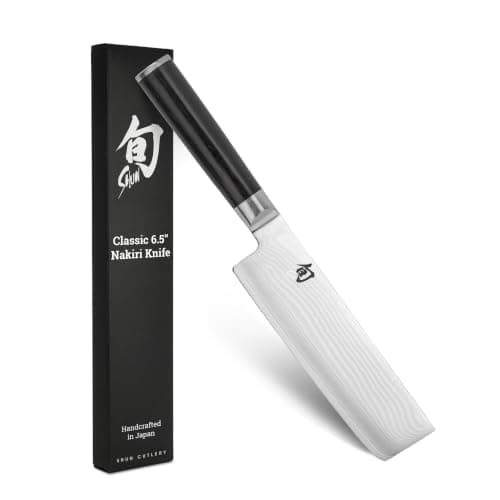
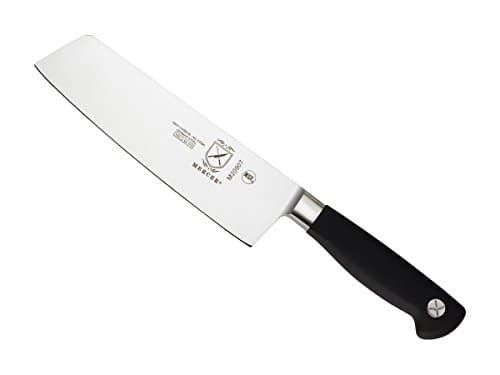
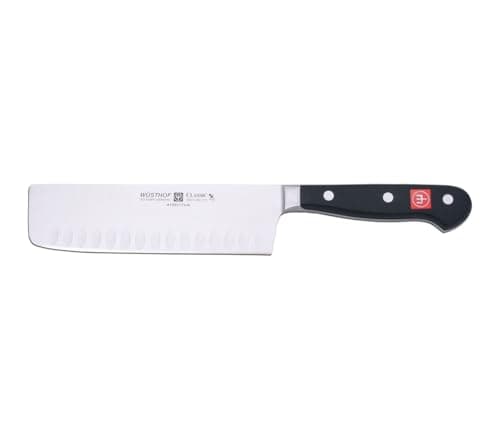
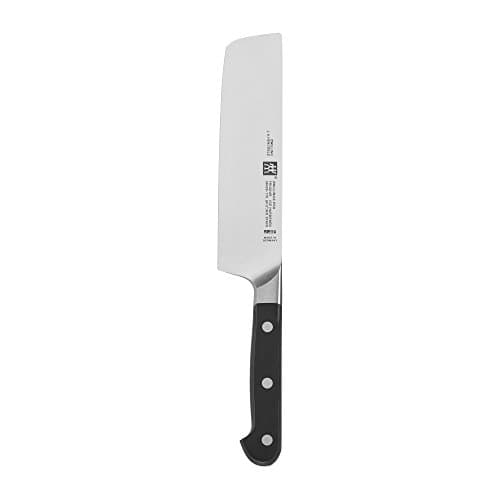
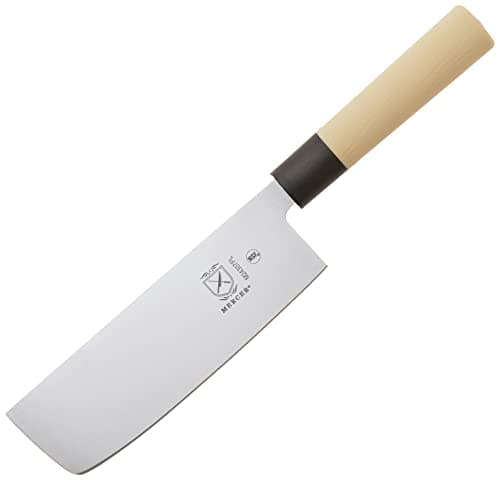
A nakiri is the Japanese vegetable specialist— a tall, flat-edged, square-tipped blade built to do one job better than any chef's knife can. There is no curve to rock on and no point to pierce with; you simply push the edge straight down and the whole length of it meets the board at once. For anyone who works through a lot of cabbage, carrot, daikon or onion, that single change makes prep noticeably faster and the cuts noticeably more even.
It is also the most misunderstood knife in a Japanese range, so it is worth being blunt up front: a nakiri is a second knife, not a first one. It will not break down a chicken, core a tomato, or do any of the tip work a paring knife handles. Buy it because you like the vegetable job it does, not because you expect it to replace anything. If you want the plain-English primer first, what is a nakiri knife covers the shape before the shopping.
These six are ranked by our overall score, which weights value heavily. A nakiri is a simple shape to make — no bolster geometry to get right, no curve to blend — so the thing that separates a great one from a merely fine one is how thin it is behind the edge. That is why a mid-priced Japanese blade tops the list ahead of knives costing twice as much, and why the cheapest pick here is still a genuinely usable knife.
What actually matters in a nakiri
- Blade thickness — the one that decides everything. A nakiri cuts by dropping straight through dense produce, so a thick blade wedges: the carrot cracks or the potato splits ahead of the edge instead of parting cleanly. Thin wins here more decisively than on any other knife shape. Our top pick is 2.5 mm at the spine; the German blades are noticeably more substantial, and you feel it in a dense sweet potato.
- Length and height. Nakiri run 6.5 to 7 inches(165–180 mm) — and unlike a chef's knife, the height matters as much as the length. A tall blade gives your knuckles clearance over the board and doubles as a scoop for moving a pile of diced onion to the pan. Shorter and taller is the nakiri shape working as intended.
- Steel and hardness. The familiar split. A hard Japanese steel (VG-MAX around HRC 60–61) takes a keener edge and holds it for months, but is thinner and more chip-prone. A softer German steel(X50CrMoV15 around HRC 57–58) dulls sooner but shrugs off clumsy treatment and comes back on a stone in minutes. Our knife steel guide walks the whole trade-off.
- Edge angle and bevel. Every knife here is a conventional double bevel, sharpened on both sides, which is what almost every home cook wants. The angles run from about 10° a side on the Wüsthof to 16° on the Shun — and note that a lower number is not automatically better. A keen 10° on soft steel and a 16° on hard steel can end up equally sharp and equally durable; the pairing matters more than either figure alone.
- Weight and balance. A nakiri should feel light and quick. The Japanese blades here float; the forged German ones are planted and heavy. Neither is wrong, but if you came to the shape for nimbleness, weight works directly against you.
- Value.The metric that decides the ranking. Once a nakiri is thin, sharp and comfortable, extra money buys harder steel, finer finish and Damascus looks — all real, with fast-diminishing returns on a knife that chops vegetables.
What matters less than the price suggests: Damascus cladding(the wavy pattern is decorative — the cutting is done by the core steel), a bolster(useful on a chef's knife, largely irrelevant on a knife you push straight down), and brand prestige. Keep that in mind as you read the picks.
Nakiri or santoku — which vegetable knife?
This is the decision most buyers are actually making, and the answer is genuinely about shape rather than quality. A santoku keeps a little belly curve and a sloped sheepsfoot tip, so it can rock slightly, pierce a little, and stand in as a general-purpose knife. A nakiri gives all of that up: the edge is dead flat and the tip is squared off, which makes it better at the one job and useless at the others. If you want one Japanese knife that does most things, buy the santoku. If you already own a knife you like for general work and want vegetable prep to get faster, buy the nakiri. The full side-by-side is in santoku vs nakiri.
Nakiri or a chef's knife?
If you own neither, buy the chef's knifefirst — it is the most versatile blade in any kitchen, and the three knives that cover almost all home cookingare a chef's knife, a paring knife and a serrated bread knife. A nakiri is what you add when vegetable prep is the part of cooking you do most. Where it genuinely beats a chef's knife is volume work: because the flat edge contacts the board along its whole length, you get complete cuts without the little forward-and-back rocking a curved blade needs, and a tall blade sweeps the pile off the board afterwards. Chef knife vs nakiri has the detailed comparison.
What a nakiri cannot do
Be clear-eyed about the limits before you spend, because they are real. There is no tip, so there is no coring a tomato, no scoring, no detail work, and no getting into the joints of a chicken — those jobs need a paring knife or a boning knife. The flat edge does not rock, so mincing a pile of herbs the way you would with a chef's knife feels awkward. And the thin, tall blade is built for produce, not protein: no bones, no frozen food, and no twisting, which is exactly how people chip these knives.
Hard Japanese steel or forged German steel?
A hard Japanese blade like the Shungets keener and stays sharp far longer, but wants a whetstone and careful use — the edge is thin enough to chip on a squash rind if you twist it. A forged German blade like the Wüsthof or Zwilling is tougher, more forgiving and easy to bring back, at the cost of honing more often and carrying more weight. The Mac sits deliberately between them: Japanese-thin, but not so hard that it is fragile. Our Japanese vs German guide lays the whole choice out.
Nakiri vs usuba (and why you want the double bevel)
You will see the usuba described as the professional version of this knife, and in a sense it is: it is the traditional single-bevel vegetable knife used in Japanese kitchens, ground on one side only. It is also a specialist tool that steers in the cut until you learn it, must be bought handed, and needs a different sharpening technique. Every knife on this list is a conventional double bevel— works in either hand, cuts straight down without steering, sharpens like any Western knife. That is the right answer for essentially every home cook.
Sharpening and care
A double-bevel nakiri sharpens exactly like a chef's knife — the method is in how to use a whetstone, and the angle question is covered in knife sharpening angle. Match the blade you bought: roughly 15–16° a side on the Japanese knives, a little lower on the German ones. The flat edge is actually the easiest profile on this site to sharpen, because there is no curve to sweep through — keep the whole edge flat on the stone and work in sections. Skip the pull-through on the harder blades; it grinds away too much steel. Whatever you buy, hand wash and dry it — the dishwasher dulls and corrodes every knife — and store it so the tall, thin edge cannot knock against other blades, in a block, on a strip or in a guard.
Nakiri against the other vegetable knives
A nakiri is one of three sensible answers to "what should I cut vegetables with", and it is not automatically the right one. Our best knives for cutting vegetables ranks nakiri, santoku and thin chef's knives together, for thinness behind the edge and for release — the two things that actually decide vegetable prep.
Where to go next
If you are not yet sure the shape suits you, is a nakiri worth it sets out what the tall flat blade does better than a chef's knife, who should skip it, and the cheapest honest way to find out.