Skip to content
Bevel & Bone

HUB 01 · Chef Knives

The Best Knives for Cutting Fish

Fish rewards a thin, flexible blade and punishes a heavy one. Four knives ranked by how closely each follows a bone — and what we would skip.

By Stephen V.Updated How we choose
#ad

We earn a commission when you buy through our Amazon links, at no extra cost to you. It never changes a ranking, and we say so when the cheaper knife is the better buy. How this works.

Start with the Victorinox Swiss Classic 6" narrow flexible boning knife. At about 2.6 oz it is the lightest, most delicate blade here, it flexes enough to ride along a rib cage and under skin, and it costs so little that it is the honest way to find out whether you will fillet fish often enough to want something better. If you already know you will, the forged Mercer Genesis flexible is the step up. The long Shun slicer at the bottom of the list is a different job entirely — portioning a finished loin — and most people do not need it.

How this list is ranked: by fitness for fish — flex, thinness and how little the blade weighs — rather than by overall score. That is a deliberately different axis from our boning knife ranking, where a semi-stiff blade wins because it handles the widest range of work. On fish, semi-stiff is a compromise, so it ranks third here and first there. The scores in the table are the same; the question is not.

What fish actually asks of a knife

Fish is soft, wet, thin-boned and sold in one piece. Nothing about it wants force. The three things that matter:

  • Flex. A flexible blade bends along a rib cage and against the skin, so the knife follows the fish instead of cutting straight through it. That is the whole trick of filleting, and it is why a stiff blade leaves meat on the bone and skin on the fillet. Flex is graded, not binary — stiff, semi-stiff and flexible are three different tools. Boning knife vs fillet knife covers where the two categories separate.
  • Thinness and light weight. A heavy blade compresses soft flesh before it cuts it, which is how a neat fillet turns ragged. Under three ounces is noticeably better than over seven for this work, independent of everything else.
  • A narrow blade with a usable point. You need to get in behind a collar bone and under a pin bone. A tall blade physically cannot.

Note what is not on that list: steel hardness. Fish bones are soft, so edge retention matters much less here than on a meat board, and the cheap stainless on the two Victorinox blades is entirely adequate. What does matter is rust — these knives spend their life wet and occasionally salty, so dry them immediately and see how to prevent knife rust. A carbon-steel blade is a bad idea for fish for exactly this reason, whatever carbon vs stainless says about edge quality elsewhere.

What to look for

  • Match the flex to the fish. Flexible for trout, bream, mackerel, sea bass, salmon sides and any skinning job. Semi-stiff once the fish gets big enough that you are pushing through a collar or a tail joint — a whole salmon, a large cod. Stiff is for meat, not fish.
  • Six inches is the useful length at home.Dedicated fillet knives run to seven and nine inches, which is genuinely better on a large flat fish and awkward on everything else. Our registry does not carry a long dedicated fillet blade today, and we would rather say so than sell you a substitute: if you fillet big flatfish weekly, a 7–9 inch fillet knife is the right buy and none of these four is it.
  • Grip that works wet. Fish is wetter than meat. TPE and Santoprene handles stay put; a polished wooden handle does not. Handle materials compares them.
  • For portioning, length and thinness — not flex. Once the fish is a boneless loin and you want even, clean-faced slices, the blade should be long, thin, hard and rigid. That is the opposite of a fillet knife, and it is the one place a hard Japanese edge belongs on this page.

The short answer

Quick picks

#ad · Live prices from the Amazon Product API, as of October 11, 2026. Where we have no verified live price we show none — we'd rather leave a gap than print a number that has rotted.

By the numbers

The specs, side by side

Every figure below is the manufacturer's published specification. Where a maker doesn't publish a value, the cell reads "—" rather than a number we made up.

Knife / ToolBladeEdgeSteelHardnessConstruction
Victorinox Swiss Classic 6" Narrow Flexible Boning Knife5.9 in (15 cm), narrowTapered, ground in two directionsHigh-carbon stainless~HRC 55–56Stamped, TPE handle, ~2.6 oz
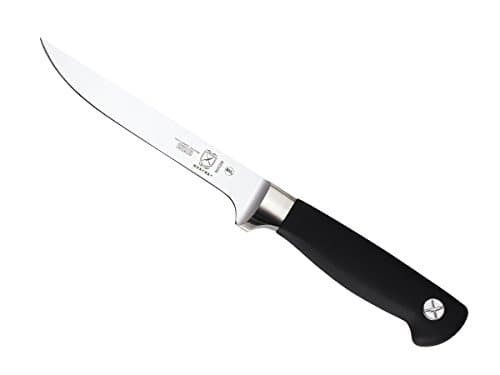
Mercer Culinary Genesis 6" Flexible Boning Knife (M20206)6 in (15.2 cm), narrow—High-carbon German no-stain—Forged, full tang, thick bolster, Santoprene handle, ~7.4 oz
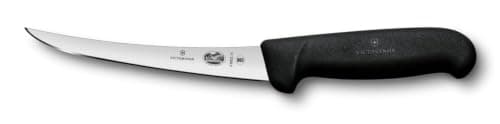
Victorinox Fibrox Pro 6" Curved Boning Knife, Semi-Stiff6 in (15 cm), curved—X50CrMoV15 stainless~HRC 55–56Stamped, Fibrox Pro (TPE) handle, ~3.4 oz
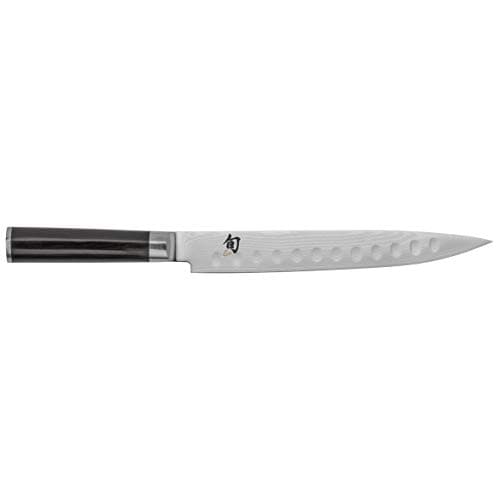
Shun Classic 9" Hollow Ground Slicing Knife (DM0720)9 in (22.9 cm)Hollow ground, 16° per sideVG-MAX core, 68-layer Damascus cladding~HRC 60–61 (dealer-published)Japanese forged, composite tang, ~0.6 lb, Seki

In detail

The picks, in full

01
Victorinox Victorinox Swiss Classic 6" Narrow Flexible Boning Knife

Best budget boning knife

Victorinox Swiss Classic 6" Narrow Flexible Boning Knife

5.9 in / 15 cmFlexibleNarrow~2.6 ozSwiss made
6.8/10

The cheapest honest way to find out whether you need a boning knife at all — and at 2.6 oz, the most delicate blade here on fish and poultry skin.

Edge retention
5
Out-of-box edge
7
Handling
7
Build
5
Value
10

Pros

  • Costs less than a takeout meal and is a genuinely capable knife, not a toy
  • At ~2.6 oz it is the lightest blade here by a wide margin — you feel the skin line through it
  • Swiss made, dishwasher tolerant, and cheap enough that you will not baby it

Cons

  • Stamped, with no bolster and no finger guard — you must be deliberate about hand position
  • The thinnest, most flexible blade here is also the easiest to bend permanently if you lever with it
  • Build quality is functional; this will not be the knife you keep for twenty years

Don't buy this if…

…you work through bone regularly. A thin flexible blade near a joint is how people bend knives and cut themselves — the stiff Mercer or the semi-stiff Victorinox is the safe grade for that job.

$29.95View on Amazon

Price as of October 11, 2026. Prices change — Amazon's is the one that counts.

#ad · we may earn a commission from this link to Victorinox Swiss Classic 6" Narrow Flexible Boning Knife

02
Mercer Culinary Mercer Culinary Genesis 6" Flexible Boning Knife (M20206)

Best mid-price flexible

Mercer Culinary Genesis 6" Flexible Boning Knife (M20206)

6 in / 15.2 cmFlexibleForgedFull tangNSF
7.4/10

The forged flexible blade for people who will not spend three figures. Same Genesis build as the stiff version, ground thin enough to follow a fish.

Edge retention
6
Out-of-box edge
7
Handling
8
Build
8
Value
8

Pros

  • Forged and full-tang flexibility for a fraction of what Wüsthof charges for the same combination
  • The narrow flexible blade skins, trims fat and lifts fish fillets cleanly
  • Grippy NSF Santoprene handle — the practical choice for messy protein work

Cons

  • Mercer publishes no hardness or edge angle for this SKU, so both cells are blank rather than borrowed from the stiff version
  • At ~7.4 oz it is the heaviest knife here, which is odd on a blade sold for finesse
  • Soft German steel; edge retention is ordinary

Don't buy this if…

…you want the lightest possible touch on fish. The heft works against you — the 2.6 oz Victorinox Swiss Classic is far more delicate, and much cheaper.

$43.62View on Amazon

Price as of October 11, 2026. Prices change — Amazon's is the one that counts.

#ad · we may earn a commission from this link to Mercer Culinary Genesis 6" Flexible Boning Knife (M20206)

03
Victorinox Victorinox Fibrox Pro 6" Curved Boning Knife, Semi-Stiff

The best boning knife overall

Victorinox Fibrox Pro 6" Curved Boning Knife, Semi-Stiff

6 in / 15 cmSemi-stiffCurvedSwiss madeNSF
8.0/10

The knife on the butcher's bench and in the culinary-school kit, for the price of a good lunch. Semi-stiff is the grade that handles the most jobs, and this is the cheapest honest way to own it.

Edge retention
6
Out-of-box edge
8
Handling
9
Build
7
Value
10

Pros

  • Semi-stiff is the most useful single flex grade — enough spine to drive through a chicken joint, enough give to follow a rib
  • Costs a fraction of the forged blades here and is the knife working butchers actually reach for
  • Soft-ish steel comes back to shaving sharp on a stone in a couple of minutes, which matters on a knife that meets bone
  • The textured Fibrox handle stays grippy with wet, greasy hands — the single most important safety feature on a boning knife

Cons

  • Stamped and plain; there is no heft, no bolster and nothing handsome about it
  • Softer steel dulls faster than the Japanese or German blades, so expect to sharpen more often
  • Victorinox publishes no edge angle for it, so that spec cell is blank rather than guessed

Don't buy this if…

…you mainly fillet fish or skin poultry, where a genuinely flexible blade does the job better and a semi-stiff one fights you. Buy the Swiss Classic or the Wüsthof flexible instead.

$31.37View on Amazon

$35.0010% off

Price as of October 11, 2026. Prices change — Amazon's is the one that counts.

#ad · we may earn a commission from this link to Victorinox Fibrox Pro 6" Curved Boning Knife, Semi-Stiff

04
Shun Shun Classic 9" Hollow Ground Slicing Knife (DM0720)

The finest cut face, if budget allows

Shun Classic 9" Hollow Ground Slicing Knife (DM0720)

9 in / 22.9 cmHollow ground16° per side~HRC 60–61Seki, Japan
7.4/10

A VG-MAX core at ~HRC 60–61 behind a 16° edge, hollow ground and clad in 68 layers of Damascus. The cleanest cut face on this page, for the most money.

Slicing
9
Edge quality
9
Handling
8
Build
9
Value
2

Pros

  • The hardest steel and the keenest published geometry here — 16° per side at ~HRC 60–61 parts meat fibers instead of pushing them
  • Holds that edge far longer than any German or Swiss blade on this page, which matters when you are carving for twelve people rather than two
  • Light for its length at about 0.6 lb, with a D-shaped handle that indexes the blade angle for you without looking
  • The one knife here that is genuinely beautiful on a carving board, and it carries a limited lifetime warranty

Cons

  • Costs roughly five times the Mercer BPX and does not cut a Sunday roast five times better
  • Hard, thin steel chips where soft steel rolls — touch a bone or a plate edge with this and you have a repair job, not a honing job
  • Nine inches is short for the price; the far cheaper Victorinox reaches three inches further
  • PakkaWood and hand-sharpened asymmetry mean hand wash only and a more demanding stone session than a German blade needs

Don't buy this if…

…you carve bone-in cuts. A hollow-ground HRC 60–61 edge is the wrong tool to meet a rib or a drumstick joint, and the money is better spent on a cheaper carver plus a proper boning knife.

$187.06View on Amazon

$199.956% off

Price as of October 11, 2026. Prices change — Amazon's is the one that counts.

#ad · we may earn a commission from this link to Shun Classic 9" Hollow Ground Slicing Knife (DM0720)

The picks, and who each suits

  • Victorinox Swiss Classic 6" narrow flexible— for almost anyone filleting fish at home. Stamped high-carbon stainless at ~HRC 55–56, tapered and ground in two directions, and about 2.6 oz in the hand. It is the most delicate blade here on skin and pin bones and the cheapest. Do not take it near bone you intend to push through — a thin flexible blade at a joint is how people bend knives.
  • Mercer Culinary Genesis 6" flexible— for the cook who fillets often and wants a forged knife. Same Genesis build as the stiff version with the spine ground thin: full tang, thick bolster, Santoprene handle, high-carbon German no-stain steel. Mercer publishes no Rockwell figure or edge angle for it, so the matrix reads "—" in both cells. At ~7.4 oz the heft works against you on small fish.
  • Victorinox Fibrox Pro 6" curved, semi-stiff— for big fish and mixed work. The curved semi-stiff blade is the grade that handles a whole salmon's collar as readily as a chicken thigh, in X50CrMoV15 at ~HRC 55–56 and ~3.4 oz, with the Fibrox handle. If you want one blade for fish and poultry, this is the compromise. On small delicate fish it fights you.
  • Shun Classic 9" hollow-ground slicer— for portioning, not filleting. A VG-MAX core at ~HRC 60–61 behind a 16° edge, hollow ground and Damascus clad, which gives the cleanest cut face of anything on this page. It is rigid and expensive, it is the wrong tool to put near a bone, and it only makes sense if you regularly slice a boneless loin for raw or seared service.

Filleting, skinning and portioning are three cuts

Filleting is a long, shallow draw with the blade angled against the rib cage, using the bones as a guide rail. The flex does the work; your job is to keep the blade pressed lightly against the bone and let it follow.

Skinning is the opposite geometry — the blade lies almost flat, bevel toward the skin, and you pull the skin against the edge rather than cutting down through it. This is the cut a stiff blade cannot do cleanly, and the one where the 2.6 oz Victorinox is noticeably better than the 7.4 oz Mercer.

Portioning is a single draw of a long rigid blade through a boneless loin, with no sawing. Here flex is a liability, which is why the Shun sits on the list at all. The same logic applies to carving meat — see best knives for cutting meat for the long granton slicers, which cost a fraction of the Shun and do the cooked-protein version of this job.

What we would skip

A chef's knife for filleting. It is too tall and too stiff to follow a rib cage, and the result is a ragged fillet with half the meat left behind. It is fine for cutting a fillet into portions and for gutting, and that is where it should stop — chef knife vs utility knife covers the smaller general-purpose option.

A dedicated single-bevel Japanese fish knife. Yanagiba and deba are the right traditional tools and we do not stock them, because a single-bevel blade needs a different sharpening skill altogether — single bevel vs double bevel explains what you would be taking on. Do not buy one as a first fish knife.

Anything hard and thin for bone work.At ~HRC 60–61 the Shun will chip on a collar bone, exactly as it says in its own "don't buy if". Fish bones are soft, but the spine and the head are not.

Care: the part that actually decides how long these last

Fish knives die of rust and of being thrown in a sink, not of being worn out. Rinse and dry immediately after use, never leave one soaking, and store it where the thin edge is protected — how to store kitchen knives and best knife storage cover the options. Sharpening a narrow flexible blade needs a lighter touch than a chef's knife, and the technique is in how to sharpen a boning knife. A fine ceramic rod is the better hone for the Shun; ceramic vs steel honing rod explains why.
How we picked

We do not run a test kitchen

We compiled each product's published specifications — steel, hardness, edge geometry, weight — normalized them into the matrix above, and scored each one against a published rubric. The scores are judgments from those specs and the value math — they are not measurements we took, because we do not have a test kitchen and we're not going to pretend we do. Units we claim to have tested: 0.

Questions

Frequently asked

What is the best knife for cutting fish?

A narrow flexible boning or fillet knife. Our pick is the Victorinox Swiss Classic 6-inch narrow flexible — about 2.6 oz, flexible enough to follow a rib cage, and inexpensive. For large whole fish, a semi-stiff curved blade handles the collar better.

Can you use a boning knife to fillet fish?

Yes, if it is the flexible grade. A flexible boning knife and a fillet knife do the same job; fillet knives are usually longer and thinner still. A stiff boning knife is the wrong tool — it will not follow the bones.

Do I need a Japanese knife for fish?

No. Traditional yanagiba and deba are excellent and are single-bevel blades that need a specific sharpening skill. For home filleting, a Western flexible blade is easier to use and far easier to maintain.

What length fillet knife should I buy?

Six inches covers most fish sold at a counter. Seven to nine inches is genuinely better on large flat fish and clumsy on small ones. If you fillet big flatfish regularly, buy a long dedicated fillet knife — none of the four here is that knife.

Will a fish knife rust?

Stainless blades will stain if left wet, and carbon steel will rust quickly. Rinse and dry straight after use and never leave the knife in the sink. Avoid carbon steel for fish altogether.

Keep reading

Receipts

Sources

We do not run a test kitchen, and we do not pretend to. Specs are the manufacturer's published figures, attributed as such; where we could not verify something, we say so on the page rather than quietly leaving it out. Read our full method.