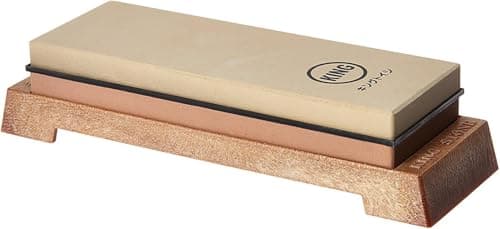
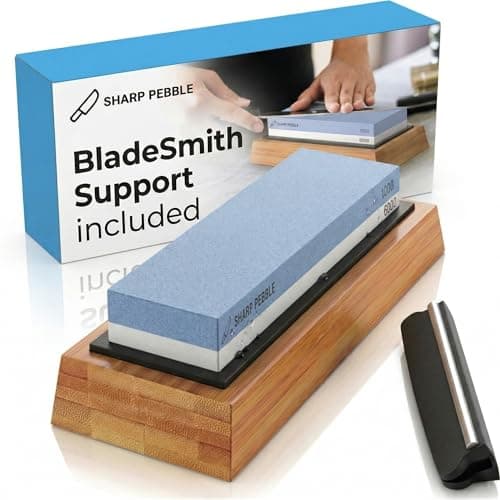
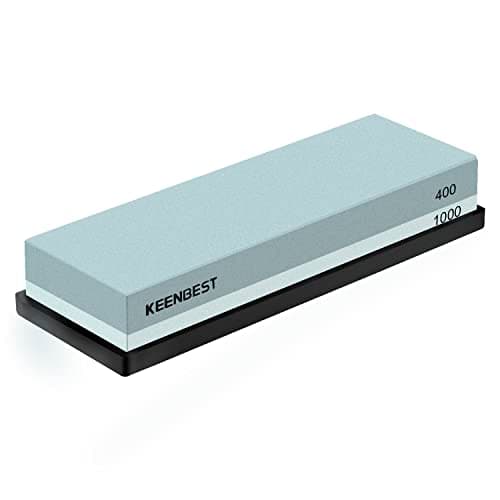
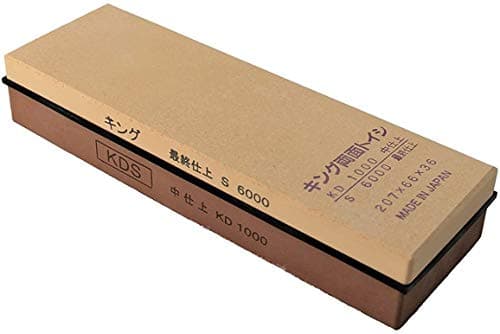
Buy the King KDS 1000/6000 if you are buying your first whetstone — a soft, forgiving, fast-cutting combination water stone that sharpens on one face and polishes on the other, and the stone that has taught more people to sharpen than any other. If you would rather not improvise a holder, the King KW65 is the same stone with a bigger face and a rubber base in the box. Four stones ranked by our overall score, with live prices.
This page exists because the single most common mistake in sharpening is spending too much. A whetstone is not a tool where more money buys a better edge — the edge comes from your angle and your patience, and a cheap soft stone is a better teacher than an expensive hard one because it gives you more feedback. Every stone here is a complete answer for a kitchen. Nothing above this tier will make your knives sharper; it will only make the process tidier.
What under $50 buys, and what it does not
At this price you get the grits that matter and a stone thick enough to last years. What you give up is maintenance convenience: these are soft water stones, so they dish (hollow out in the middle) and need flattening, and most of them need a soak before use. Harder ceramic and diamond stones solve both problems and cost more — that is the whole difference. If flattening and soaking sound like chores you will skip, soaking vs splash-and-go is the page to read before you buy.
A note on prices: we show them live, so a stone hovering near $50 today can nudge over tomorrow. The button shows Amazon's current number, or "Check price" where we cannot verify a live one.
Grit is the only number that matters
For kitchen knives, 1000 grit sharpens and 6000 grit refines— that pairing is the entire job, which is why three of the four stones here are 1000/6000 or 400/1000 combinations. Lower grits (220–400) exist to repair chips and reset a badly abused bevel; higher grits (3000–8000) exist to polish an edge that is already sharp. You do not need a five-stone progression and you should not buy one. Sharpening stone grits explained has the full breakdown, and knife sharpening angle covers the other half of the technique.
The picks, and who each suits
- King KDS 1000/6000 — for the first-time sharpener who wants the classic. Soft, fast-cutting and endlessly forgiving of a wobbly angle, with a thick 1½-inch block that gives you years of stone. It is sold bare, so you will need a damp towel or a stand, and it needs a five-to-ten-minute soak. Full detail in the King KDS review.
- King KW65 1000/6000 with base— for the cook who wants the classic without improvising a holder. A larger face (easier on a long chef's knife, because you can use full strokes) and a rubber base that holds it steady on the counter. Same soft, forgiving feel; same soaking and flattening. See the King KW65 review.
- Sharp Pebble 1000/6000 — for the beginner who wants everything in one box. An angle guide, a weighted bamboo holder and a rubber base ship with it, so there is nothing else to buy on day one. It is the most popular combination stone sold, and the aluminium-oxide binder gives good tactile feedback. The Sharp Pebble review covers the detail.
- Two-sided 400/1000 (KEENBEST) — for finding out whether you like sharpening before you spend real money. 400 grit resets a genuinely dull or chipped edge and 1000 sets a working one, which makes it the right pair for rescuing neglected knives. There is no polishing grit, quality varies unit to unit, and it wears fast — it is a toe-in-the-water stone, not a keeper.
What else you need (and what you do not)
You need three things besides the stone: water, a flat non-slip surface, and about fifteen minutes. You do not need an angle guide — they help on the first session and then teach you to depend on them — and you do not need a strop. What you will want eventually is something to flatten the stone with, because every soft water stone hollows out in the middle and a hollow stone cannot produce a straight edge. A cheap diamond plate, a flattening stone or a sheet of wet-and-dry on glass all work; how to flatten a whetstone explains the three options, and how to clean a whetstone covers the swarf that builds up on the face.
Your first session
Soak the stone until it stops bubbling, set it on a damp towel, and work the 1000-grit side at a consistent angle until you can feel a burr along the whole edge, then do the same on the other face and finish on the 6000. The full routine, with the burr check that tells you when to stop, is in how to sharpen a chef's knife and how to use a whetstone. If the edge still will not bite afterwards, the cause is almost always one of the four in why your knife will not get sharp — usually a burr you never removed. Between sharpenings, a honing steel keeps the edge straight for weeks.
When to spend more
Three reasons, and only three. You sharpen often enough that soaking is what stops you (buy a hard splash-and-go ceramic). Your knives are hard Japanese steel at HRC 60 or above and a soft stone wears too fast (buy a stone matched to hard steel). Or you are tired of flattening (buy a diamond plate, which never dishes). None of those are about the sharpness of the result — the honest version of that argument is in are expensive whetstones worth it.