Buy the Shapton Kuromaku 1000 if you sharpen Japanese knives — a hard magnesia-bonded ceramic that cuts HRC 60+ steel quickly, stays flat instead of dishing under it, and needs a splash of water rather than a soak. Pair it with a finishing grit and you have the whole job. Four stones ranked for hard Japanese steel, with live prices.
How this list is ranked: for hard-steel fitness, not general score — so the order differs from our main stone ranking, which is led by the soft King because it is the better teacher. Japanese knives change three things about the job: the steel is harder (roughly HRC 59–61 against 55–58 for German blades), the bevel is narrower (about 15° per side against 20°), and the edge is thinner, so it chips rather than rolls. Each of those pushes you toward a different stone, and that is what this page ranks for.
Why hard steel wants a different stone
- Hard steel abrades a soft stone, not the other way round. A soft binder gives up its grit quickly when you work HRC 61 steel across it, which means faster dishing and more flattening. Hard ceramic and diamond hold their shape. The result is the same sharpness either way — the difference is maintenance, not edge quality.
- A 15° bevel is less forgiving. Narrower bevels show every wobble, because the same angular error removes proportionally more metal from the apex. A stone that stays dead flat helps here; so does slowing down. Our sharpening angle guide covers what angle to actually hold.
- Hard, thin edges chip. German steel rolls over when abused and a honing rod straightens it. Japanese steel chips instead, and a chip has to be ground out — that is a coarse-grit job, which is why a diamond plate is on this list. How to fix a chipped knife edge is the procedure.
- High grits actually show up. On soft German steel the difference between a 6000 and an 8000 finish disappears within a week of cutting. Hard steel holds the refinement long enough to notice it, which is the one case where a finishing stone earns its money.
The picks, and who each suits
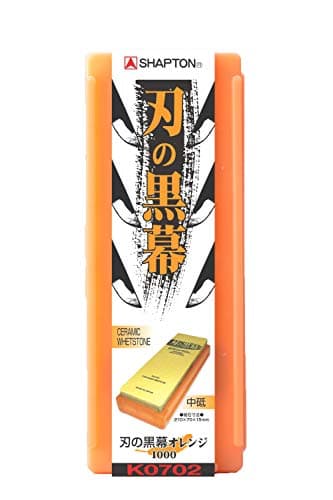
- Shapton Kuromaku 1000 — for the cook who sharpens Japanese knives regularly and wants the least friction. Splash and go, no soaking, cuts quickly on hard steel, and its hard binder stays far flatter than a King under the same work. It is a single grit, so budget a finisher; grits-per-dollar is the weak spot. See the Shapton Kuromaku review.
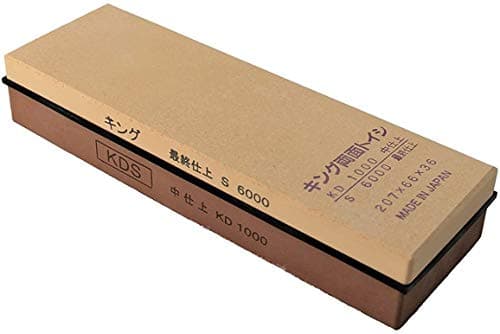
- King KDS 1000/6000 — for the cook who wants both grits in one stone and does not mind soaking. The 6000 side is a genuinely good finisher for a Japanese edge, and the soft surface gives the tactile feedback that teaches you to feel the burr. It will dish faster against hard steel than against German steel — flatten it more often.
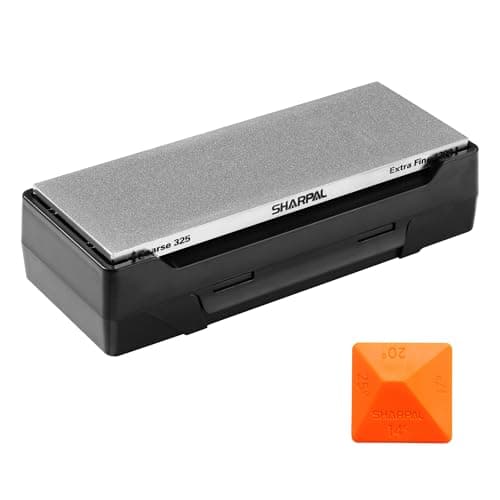
- Sharpal 162N diamond plate — for chip repair and for flattening your other stones. 325 grit grinds a chip out of a thin Japanese edge faster than any water stone, and the plate never dishes, so it is also the tool that keeps the King and the Sharp Pebble true. Diamond leaves a toothier finish, so it is a first step, not a last one.
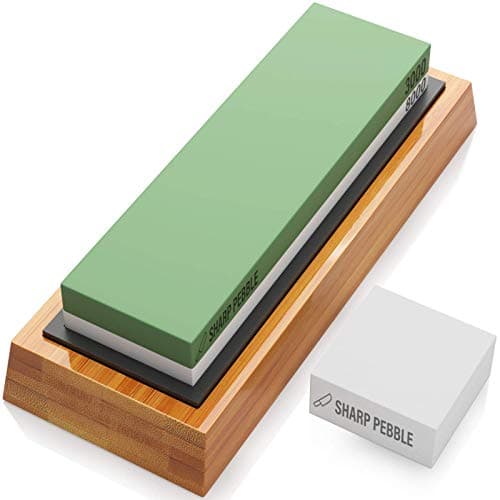
- Sharp Pebble 3000/8000 — for the cook who already has a 1000-grit stone and wants to see what a polished edge feels like. These are polishing grits: they remove almost no metal and cannot sharpen a dull knife on their own. On a hard Japanese blade the refinement lasts long enough to be worth it; on a soft German one it does not. It ships with a flattening stone, which a soft finishing stone needs. The Sharp Pebble 3000/8000 review is candid about who should skip it.
The two-stone setup we would actually buy
For a kitchen with Japanese knives in it: the Shapton 1000 for sharpening and the King's 6000 side (or the Sharp Pebble 3000/8000) for finishing, with the Sharpal diamond plate kept in a drawer for chips and for flattening. That is three purchases over time, not three on day one — start with one 1000-grit stone, learn to raise and remove a burr, and add the others when you can tell why you want them. If you only ever buy one stone, a 1000/6000 combination is still the right answer, and best combination whetstones ranks those specifically.
What not to do to a Japanese knife
Three things ruin thin hard edges, and all three are avoidable. Do not run it through a pull-through sharpener — the fixed carbide slots are ground for a 20° Western bevel and will reset your 15° edge while tearing metal out of it. Do not use a hard steel honing rod on it; a ceramic rod is the right tool for hard steel, and honing steel vs whetstone explains why honing and sharpening are different jobs. And do not twist or pry with it — the single most common cause of a chipped Japanese knife is using it on bone or a frozen edge.
Which knives this page is for
Everything in our Japanese chef knife ranking — MAC, Tojiro, Shun, Miyabi, Global — plus Japanese-style santoku and nakiri blades. If you are not sure how hard your knife is, knife hardness explained shows where published HRC figures come from and what they mean, and why Japanese knives are so sharp covers the steel-and-geometry combination behind it. Softer German knives are better served by the cheaper, faster-cutting stones in best whetstones under $50.
Where to go next
Hard Japanese steel is also the strongest case for diamond abrasive, because diamond is harder than every knife steel made and does not care whether a blade is HRC 58 or 63. Our best diamond sharpening stones roundup ranks six plates and makes the pairing argument we would actually follow for a hard thin blade: diamond for the heavy lifting, a fine water stone to finish.