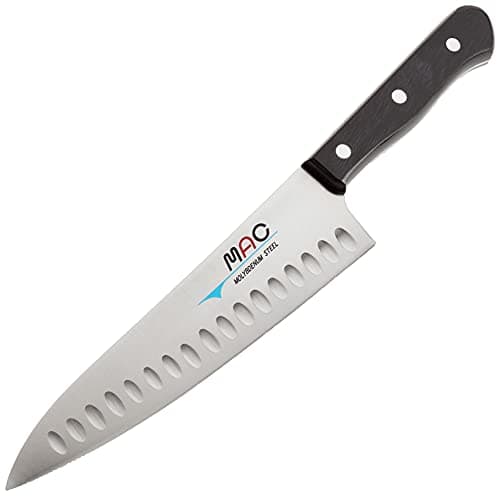
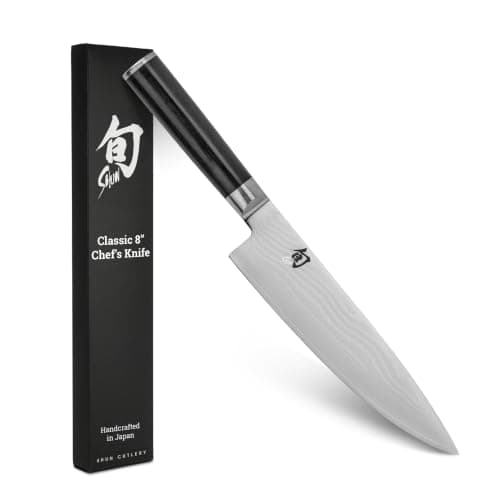
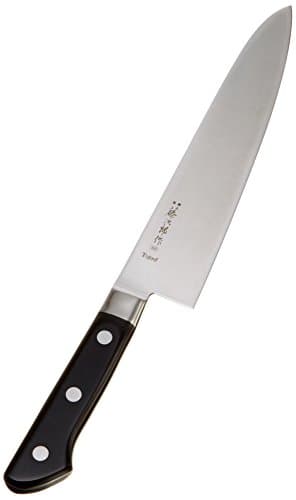
Yes — and the entry point is the Tojiro DP gyuto, not a premium showpiece. A VG-10 core at ~HRC 60 behind a ~15° edge costs less than many German knives and delivers the two things people actually buy a Japanese knife for: it arrives much sharper, and it stays that way far longer. The catch is real and worth stating up front: harder, thinner steel chips where soft steel rolls, so if your knife meets bone, gets twisted through joints, or lives in the dishwasher, a Japanese blade is a bad purchase at any price.
What you are actually paying for
Three published specifications explain nearly the whole difference, and none of them is mystique:
- Hardness, around HRC 60–61 instead of 55–58. Harder steel supports a finer apex and loses it more slowly. That is the edge-retention claim, and it is the one that holds up — the Tojiro and MAC both sit at ~HRC 59–61 against ~HRC 55–56 for a Victorinox Fibrox. Knife hardness explained covers the Rockwell scale.
- A lower edge angle, ~15° per side instead of ~20°. Harder steel can support a thinner edge without folding, so Japanese makers grind more acutely. A more acute edge needs less force to start a cut. That is what people mean when they say a Japanese knife "falls through" an onion.
- A thinner blade behind that edge. The MAC MTH-80 is a thin stamped blade; a forged German knife is substantially thicker behind the edge, and that thickness has to wedge food apart as the cut deepens. Blade geometry is the full mechanism, and it is the most under-discussed spec in the category.
Those three compound, which is why the difference is noticeable rather than theoretical. What they do not buy is toughness. Hardness and toughness trade against each other in steel, and that trade is the entire case against. Our Japanese vs German knives comparison runs the two traditions side by side, and why Japanese knives are so sharp goes deeper on the geometry.
Who should not buy one
This is the honest half of the answer, and it is the half most recommendations skip. Do not buy a Japanese knife if:
- Your knife meets bone.Jointing chicken, splitting a rib rack, hacking through a squash stem at speed. At HRC 60–61 the steel is harder than the bone and gives up a flake rather than bending. Keep a cheap German blade for that work — see best knives for cutting meat.
- It is a shared kitchen where knives get abused. A VG-10 edge rewards good habits and punishes bad ones. A Victorinox is the more forgiving pick for a household that will put knives in the sink.
- You will not maintain it. A hard thin edge is glorious for six months and then it is a dull knife that is harder to bring back than a German one, because a traditional steel rod barely bites on it. You need a whetstone or a fine ceramic rod — ceramic vs steel honing rod.
- You are left-handed and buying a D-shaped handle. The Shun Classic's handle is right-handed by design. Symmetrical Western-handled Japanese knives exist and are the better choice — best chef knives for left-handed cooks.
- You want heft. Many cooks genuinely prefer a heavy, forward-balanced knife. That is a preference, not an error, and a light Japanese blade will feel flimsy to you.
What to look for if the answer is yes
- Published HRC and edge angle."Japanese steel" on a listing means nothing — plenty of budget knives use soft stainless made in Japan. A stated ~HRC 60 and a stated 15–16° per side are the specs that make the category worth buying.
- Clad construction is fine and often preferable.A hard VG-10 or VG-MAX core with softer stainless either side gives you the edge without the whole blade being brittle. Tojiro's three-layer DP and Shun's 68-layer Damascus are both this. Damascus steel knives explained separates the function from the pattern.
- Handle shape: Western or D-shaped. A Western handle is symmetrical and familiar. A D-shape is handed and fits one hand better. Neither is better; one is more restrictive.
- Stainless or stainless-clad, for a first one. Reactive carbon steel is a genuinely different ownership experience — carbon vs stainless and how to season a carbon steel knife explain what you would be taking on.
- Double bevel, not single. Traditional single-bevel knives are superb and need a different sharpening skill — single bevel vs double bevel. Every pick below is double bevel.
- A whetstone, bought at the same time. Not optional. Budget for it — stones for Japanese knives is the shortlist.
The three we would buy, and who each suits
- Tojiro DP Gyuto 210 mm — the cheapest honest way in, and the one most people should buy. A real VG-10 core at ~HRC 60, stainless clad in three layers, ~15° per side, ~7.4 oz, bolsterless. It is plain-looking and the handle is unremarkable, and it cuts like a knife costing twice as much. Not the pick for a household that abuses knives.
- MAC MTH-80— the best all-rounder here if the budget stretches. Molybdenum-vanadium high-carbon steel at ~HRC 59–61, ~15° per side, a thin blade with a dimpled (granton) face, ~6.5 oz. A lot of cooks quietly consider it the best all-round chef's knife made. The Pakkawood handle is good rather than beautiful, and the thinness is the thing you must not abuse.
- Shun Classic 8"— for the cook who wants the object as well as the edge. A VG-MAX core at ~HRC 60–61 behind a 16° edge, clad in 68 Damascus layers, with a D-shaped Pakkawood handle. The Damascus is real, not etched. It is right-handed, it is the most chip-prone of the three, and you are paying partly for how it looks — which is a legitimate reason as long as you know you are.
Those three are ranked against the rest of the category in best Japanese chef knives, and against German knives in best chef knives. If this would be your first, the gentler on-ramp is best Japanese chef knives for beginners.
Where the money stops buying performance
Here is the uncomfortable part for a site funded by commissions. The performance curve flattens early. Going from an entry-level German knife to the Tojiro buys you a genuine, obvious improvement in sharpness and edge retention — for roughly half again the money. Going from the Tojiro to the Shun roughly doubles the outlay and buys cladding pattern, a nicer handle, finish, and perhaps a marginally keener factory edge — it does not buy you twice the knife. Past the Shun you are buying craft, scarcity and appearance. Every figure that matters here is in the live price table above, with the date it was checked.
That is not an argument against spending more. It is an argument for knowing what the extra money is for. Are expensive chef knives worth it takes the question across the whole price ladder, and best chef knives for the money ranks by exactly this logic.
The ownership cost nobody mentions
Buying the knife is the smaller decision. A hard Japanese edge needs a whetstone, because a traditional steel honing rod slides off steel at HRC 60+ without biting. That means either a stone and the hour it takes to learn — how to use a whetstone and how to sharpen a chef knife — or a fine ceramic rod for maintenance and a sharpening service once or twice a year. Budget for one of those two routes before you buy the knife, not after.
The habits matter as much as the tools: a wooden or soft plastic board rather than glass or stone, hand washing only, and never using the edge to scrape food off a board. Knife care and storage, can you put knives in the dishwasher and why does my knife get dull so fast cover the rest. Do that, and the edge-retention advantage you paid for actually shows up. Skip it, and the Shun goes dull faster than a Victorinox Fibrox a third of its price that you hone before every session.
The pragmatic answer: own both
Most professional kitchens we would point at do exactly this — a hard Japanese knife for slicing and precision prep, and a cheap, tough German or Swiss blade for bone, frozen edges, squash and anything a stagiaire might pick up. The Tojiro plus a Victorinox Fibrox costs less than one premium Japanese knife and beats it for nearly every home cook, because it removes the only real risk in the Japanese case. How many kitchen knives do you need works through the full kit, and why restaurant cooks use cheap knives explains why the second knife is not a compromise.