The usual advice — "learn on a soft German knife, graduate to Japanese later" — is sound, and it is exactly what our beginners ranking says. But plenty of people simply want their first good knife to be a Japanese one, and that is a reasonable thing to want. The trick is picking a Japanese knife that is built to forgive a learner: stainless rather than reactive carbon steel, a double bevel you can sharpen on an ordinary stone, hardness in the high-50s to low-60s HRC rather than the mid-60s, and a handle you already know how to hold. Every pick below clears that bar. None of them is a fragile laser or a single-bevel specialist.
How this list is ranked: for a first Japanese knife, not for raw score. We weighted forgiveness (edge angle, hardness, blade thickness), ease of sharpening, price, and how familiar the handle will feel to someone coming from a Western knife. That is why the Tojiro DP leads and the Miyabi Koya — the sharpest and most refined knife here — sits last: its 9.5–12° edge at 61 HRC is the geometry most likely to chip in an untrained hand. Our overall best Japanese chef knives ranking orders a similar field by score instead; read that one if you already sharpen confidently.
What makes a Japanese knife beginner-friendly
"Japanese knife" covers everything from a $40 stamped stainless gyuto to a $600 hand-forged carbon-steel blade that rusts if you look at it. Four published specs separate the learner-friendly end of that range from the rest, and every one of them is printed by the maker — no testing required:
- Stainless steel, not carbon. VG10, VG-MAX, FC61, CROMOVA 18 and MAC's molybdenum-vanadium alloys are all stainless. They will not develop a patina, will not rust overnight if you leave them damp, and do not need the wipe-as-you-go discipline that white and blue carbon steels demand. Our carbon vs stainless guide explains the trade-off; for a first Japanese knife, take stainless and do not look back.
- A double bevel. Every pick here is sharpened on both sides, like a Western knife, so it cuts straight and sharpens on a normal whetstone at a normal angle. Single-bevel Japanese knives (yanagiba, usuba, deba) steer in the cut and need a different sharpening method entirely — see single bevel vs double bevel. They are wonderful; they are not first knives.
- Hardness around HRC 58–61, not 63–66. Hardness is what lets a Japanese edge stay keen — and what makes it chip instead of roll when you twist through a squash or clip a chicken bone. The knives here span roughly HRC 56 (Global) to 61 (Shun, Miyabi), which is hard enough to feel the Japanese difference without the brittleness of powder steels hardened into the mid-60s. Our knife hardness guide puts numbers to it.
- An edge angle of 15–16°, or a spine that is not paper-thin. A 15° edge is already noticeably keener than the ~20° on a German knife. Going more acute than that — the 12° class — buys sharpness a beginner cannot yet maintain and pays for it in chips. Shun's 16° and MAC and Tojiro's ~15° are the sweet spot for a learner; the sharpening angle guide explains why a couple of degrees matters so much.
The picks, and why they are in this order
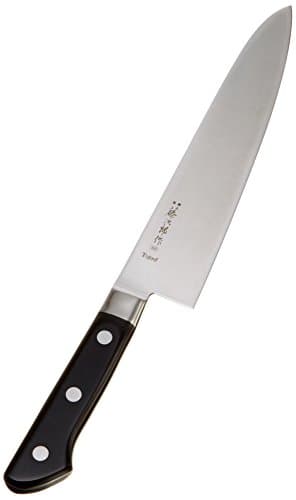
- Tojiro DP Gyuto 210 mm — the first Japanese knife. A genuine VG10 core clad in softer stainless, ~HRC 60, ~15° edge, a plain Western riveted handle, and the lowest price of any Japanese-made VG10 knife we track. The cladding matters for a beginner: the soft outer layers support the hard core, so the blade tolerates flex better than a monosteel blade of the same hardness. Its handle is blocky and the fit and finish are basic — you are paying for steel, not polish — but that is exactly the right priority for a first knife. Full case in our Tojiro DP review.
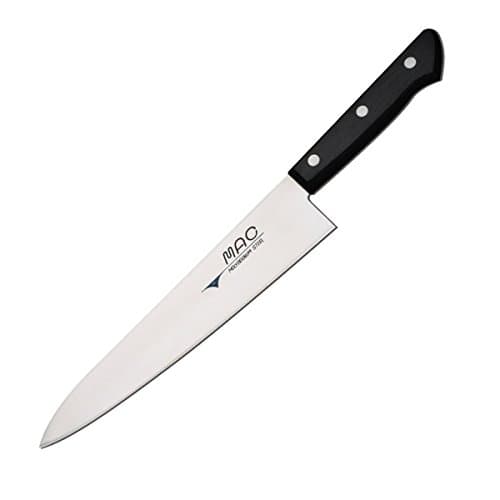
- MAC Chef Series HB-85 — the lightest way in. MAC's entry-level 8.5" gyuto shares the brand's molybdenum-vanadium steel at ~HRC 60 and a 15° edge with its famous Professional line, in a 2.0 mm blade MAC says is the lightest chef's knife it makes. For a learner that lightness is a feature: a nimble knife encourages the pinch grip and the push-cut, which is how a Japanese knife wants to be used. It gives up the MTH-80's dimples and some handle heft to hit its price, and it stocks in smaller quantities on Amazon than the MTH-80, so check the buy button.
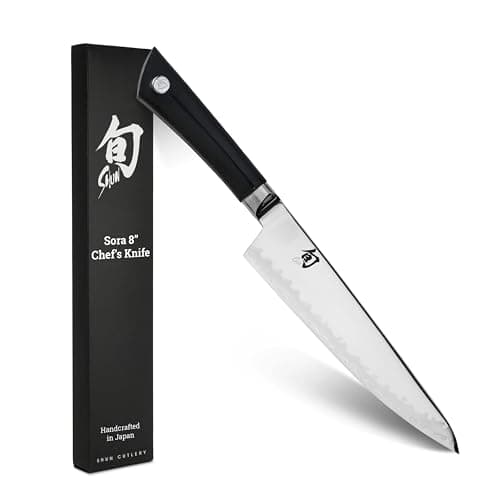
- Shun Sora 8" — Shun's edge, a beginner's handle. Shun brazes a VG10 san mai cutting edge to a cheaper 420J stainless upper and puts it on a textured polymer handle. The result is the least intimidating Shun: the same 16° edge angle and ~HRC 60–61 at the edge as the Classic, a grip that feels like a Western knife and does not slip when wet, and a price well under the Classic's. The compromise is visible — a two-tone blade and a plain handle — and the 420J upper is ordinary steel. It cuts like a Shun; it does not feel like one.
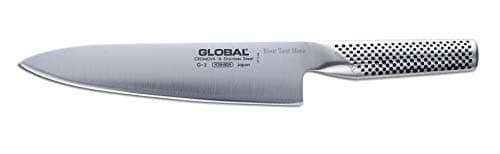
- Global G-2 — the most forgiving steel here. At ~HRC 56–58, Global's CROMOVA 18 is the softest stainless on this page, which makes the G-2 the hardest knife here to chip and the easiest to sharpen back — closer to a German knife in maintenance, Japanese in weight and profile. It is fourth, not first, for one reason: the seamless dimpled-steel handle is the most polarizing grip in the category, and a beginner buying online cannot try it first. If you have held one and liked it, move it up your list. Our Global G-2 review covers the handle question honestly.
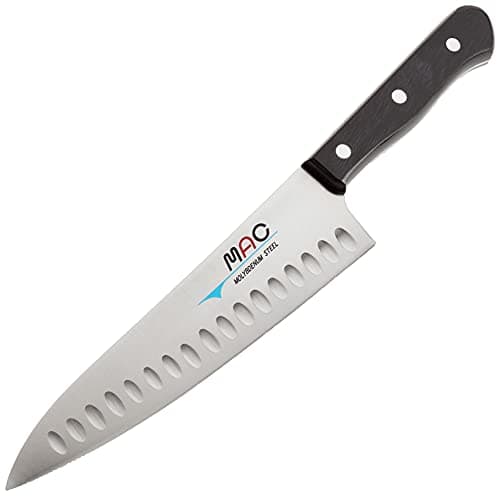
- MAC MTH-80 — the knife to grow into. The best all-rounder in our overall ranking is also a good first Japanese knife — Western handle, ~15° edge, ~HRC 59–61, dimples that stop starchy slices sticking — it just costs more than a first knife needs to. If the budget stretches, buy it and skip the upgrade step entirely; if it does not, the HB-85 above gets you most of the way. Full case in the MAC MTH-80 review.
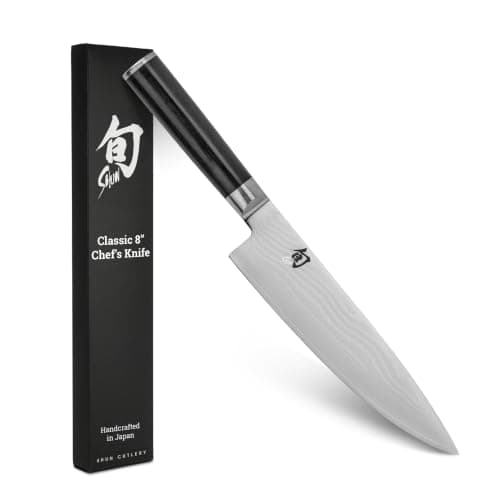
- Shun Classic 8" — the beautiful first knife. VG-MAX core, 68-layer Damascus cladding, a D-shaped Pakkawood handle and a 16° edge. It is the knife most people picture when they say "Japanese knife," and a perfectly reasonable one to start on if you accept two things: it costs considerably more than the Tojiro for a similar edge, and the D-shaped handle is made for right-handers. Our Shun Classic review and the Tojiro vs Shun comparison settle whether the extra money is worth it to you.
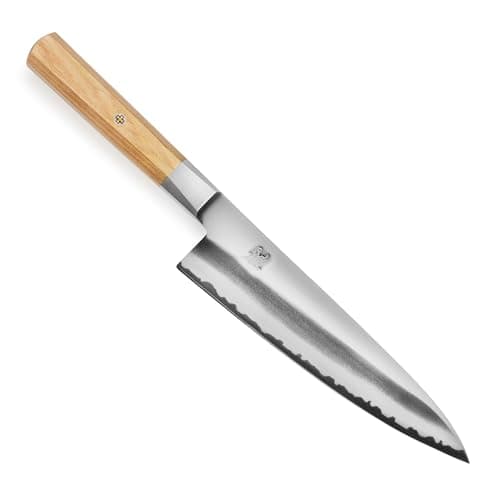
- Miyabi Koya 8" — for the careful beginner only. The cheapest way into Miyabi's hand-honed Honbazuke edge: FC61 stainless at 61 HRC, a 9.5–12° edge and an octagonal wa handle, handcrafted in Seki. It is the sharpest knife on the page out of the box and the one we would least like to hand to someone who has never sharpened. If you already own a whetstone, cut on wood or plastic, and never twist a blade, it is a wonderful first Japanese knife; if any of that is new to you, start higher up this list and come back.
Two Japanese knives we deliberately left off
Kai's Wasabi Black 8" chef's knife is a long-standing beginner recommendation, but Kai's US site no longer lists the Wasabi Black line and a major dealer marks the model discontinued; the remaining Amazon stock is old inventory. We do not put a discontinued knife at the top of a beginner's list. Shun's Kanso 8" is a fine knife but currently sells on Amazon within a few dollars of the Classic — the Sora is the Shun that actually saves a beginner money.
The short answer
Quick picks
#ad · Live prices from the Amazon Product API, as of October 9, 2026. Where we have no verified live price we show none — we'd rather leave a gap than print a number that has rotted.
By the numbers
The specs, side by side
Every figure below is the manufacturer's published specification. Where a maker doesn't publish a value, the cell reads "—" rather than a number we made up.
| Knife / Tool | Blade | Steel | Hardness | Edge | Construction | Weight |
|---|
| Tojiro DP Gyuto 210 mm Chef's Knife | 8.3 in (210 mm) | VG-10 core, stainless clad (3-layer) | ~HRC 60 | ~15° per side | Stamped, bolsterless, riveted handle | ~7.4 oz (210 g) |
|---|
| MAC Chef Series 8.5" Chef's Knife (HB-85) | 8.5 in (21.5 cm) | High-carbon chrome-molybdenum-vanadium | ~HRC 60 | ~15° per side | Thin (2.0 mm) stamped blade, riveted Pakkawood handle, steel bolster | ~4.9 oz (139 g) |
|---|
| Shun Sora 8" Chef's Knife | 8 in (20 cm) | VG10 san mai cutting edge, 420J stainless upper (composite) | ~HRC 60–61 | 16° per side | Composite blade (brazed edge/upper), PP/TPE polymer handle | ~6.6 oz (188 g) |
|---|
| Global G-2 8" Chef's Knife | 8 in (20 cm) | CROMOVA 18 stainless | ~HRC 56–58 | ~15° per side | One-piece steel, sand-filled hollow handle | ~5.8 oz (164 g) |
|---|
| Mac Mth-80 Professional Hollow Edge 8" Chef's Knife | 8 in (20 cm) | Molybdenum-vanadium high-carbon | ~HRC 59–61 | ~15° per side | Thin stamped blade, Pakkawood handle | ~6.5 oz (184 g) |
|---|
| Shun Classic 8" Chef's Knife | 8 in (20 cm) | VG-MAX core, 68-layer Damascus clad | ~HRC 60–61 | 16° per side | Bolsterless, D-shaped Pakkawood handle | ~7.5 oz (213 g) |
|---|
| MIYABI Koya 8" Chef's Knife (Gyutoh) | 7.9 in (20 cm) | FC61 fine-carbide stainless (4000FCv2), ice-hardened | ~HRC 61 | ~9.5–12° per side (Honbazuke hand-honed) | Concealed tang, octagonal beige Pakkawood handle | ~6.1 oz (174 g) |
|---|
In detail
The picks, in full
The best value in a Japanese knife
Tojiro DP Gyuto 210 mm Chef's Knife
8.3 in / 210 mmVG-10 core~HRC 60~15° edge3-layer clad
The cheapest honest way into a real VG-10 Japanese knife. It punches absurdly far above its price.
- Edge retention
- 8
- Out-of-box edge
- 8
- Handling
- 8
- Build
- 7
- Value
- 10
Pros
- +A genuine VG-10 cutting core at a price the German knives can't touch — this is the value story of the category
- +Harder than any German blade here, so it holds a keen edge far longer
- +Thin, flat-ish profile suits push-cutting and precise work
Cons
- −The Western handle is basic and a little blocky — you're paying for the steel, not the fit and finish
- −Harder steel chips if you twist it through bone or freeze; treat it with respect
- −Reactive-ish edge on the very hard core wants drying after acidic food
Don't buy this if…
…this is the only knife in a household that abuses knives. VG-10 rewards good habits and punishes bad ones — a Victorinox is the more forgiving choice for a shared kitchen.
The lightest, cheapest way into a MAC
MAC Chef Series 8.5" Chef's Knife (HB-85)
8.5 in / 21.5 cmMolybdenum-vanadium~HRC 60~15° edge4.9 oz
MAC's entry-level gyuto: the same hard, thin Japanese steel as the famous MTH-80 in a lighter, plainer, cheaper package.
- Edge retention
- 8
- Out-of-box edge
- 8
- Handling
- 9
- Build
- 7
- Value
- 8
Pros
- +MAC calls it the lightest chef's knife it makes — at under 5 oz it is nimble in a way no German knife is
- +A 2.0 mm spine with the gyuto's gradual taper: it slides through produce rather than wedging
- +The same molybdenum-vanadium steel family and ~HRC 60 as MAC's pricier lines, at the lowest MAC price on Amazon
- +Western riveted handle with a small steel bolster — nothing about the grip needs learning
Cons
- −No dimples (granton edge), so starchy slices stick to the blade more than on the MTH-80
- −The half-bolster and thinner handle feel spare next to a forged German knife of the same price
- −Hard, thin steel is less forgiving of twisting and bone contact than a soft stamped blade
Don't buy this if…
…you want heft. This is a feather; if a heavy, forward-balanced knife is what feels 'right' in your hand, the Tojiro DP or a German blade will suit you better.
A VG10 edge with a forgiving handle
Shun Sora 8" Chef's Knife
8 in / 20 cmVG10 edge, 420J upper~HRC 60–6116° per sideComposite
Shun's entry line puts a real VG10 cutting edge under a cheaper stainless upper — the Shun sharpness without the Shun price.
- Edge retention
- 8
- Out-of-box edge
- 8
- Handling
- 7
- Build
- 7
- Value
- 8
Pros
- +The part that cuts is VG10 — the same steel class as knives costing twice as much
- +Shun's 16° edge is a touch more obtuse than the 12–15° of harder Japanese blades, which makes it more chip-tolerant for a learner
- +Textured polymer handle grips wet and is the most conventional-feeling grip of any Shun
- +Made in Seki, Japan; 10-year warranty; a visible braze line tells you exactly where the hard steel is
Cons
- −The 420J upper is soft, low-cost stainless — the knife is only 'premium' at the edge
- −The two-tone composite look is not to everyone's taste, and the polymer handle reads as plain
- −Heavier and blunter-feeling in the hand than the Tojiro or either MAC
Don't buy this if…
…you want the knife to look and feel like a $150 Shun. It cuts like one; it does not feel like one. If fit and finish matter to you, save for the Classic.
Cooks who want a light, seamless blade
Global G-2 8" Chef's Knife
8 in / 20 cmCROMOVA 18~HRC 56–58~15° edgeOne-piece
The one-piece stainless knife you either love or hate on feel alone. Light, distinctive, divisive.
- Edge retention
- 7
- Out-of-box edge
- 7
- Handling
- 7
- Build
- 8
- Value
- 6
Pros
- +Seamless one-piece body has no rivets or bolster crevices to trap food — genuinely hygienic
- +Very light and nimble; the dimpled handle is grippier than it looks
- +Made in Japan with a harder-than-German edge
Cons
- −The dimpled all-metal handle is polarizing — some hands find it slippery when greasy
- −Light, blade-forward balance feels wrong to cooks raised on heavy German knives
Don't buy this if…
…you've never held one. The handle is the most love-it-or-hate-it thing in this list — try before you buy, or buy somewhere with easy returns.
The best overall, if budget allows
Mac Mth-80 Professional Hollow Edge 8" Chef's Knife
8 in / 20 cmMolybdenum-vanadium~HRC 59–61~15° edgeDimpled
The knife a lot of cooks quietly consider the best all-rounder made. Thin, sharp, and it stays that way.
- Edge retention
- 9
- Out-of-box edge
- 9
- Handling
- 9
- Build
- 8
- Value
- 7
Pros
- +The blade is unusually thin, so it falls through produce with almost no wedging
- +Harder Japanese-style steel than the German knives — holds its edge markedly longer
- +The dimples (granton edge) genuinely reduce sticking on starchy vegetables
- +Takes and holds a very acute edge
Cons
- −No full bolster; the pinch grip sits right at the blade — some find it exposed
- −Harder steel is a little less forgiving of lateral abuse than soft German steel
- −Costs several times a Victorinox and looks almost as plain
Don't buy this if…
…you're rough with your knives — you pry, twist, or hit bone. Harder, thinner steel chips where soft German steel just rolls. Buy the Wüsthof or the Victorinox and treat it like a hatchet if you must.
A beautiful knife that also performs
Shun Classic 8" Chef's Knife
8 in / 20 cmVG-MAX core~HRC 60–6116° per sideDamascus clad
The Japanese knife people buy with their eyes. The Damascus is real, and so is the very acute edge.
- Edge retention
- 8
- Out-of-box edge
- 9
- Handling
- 8
- Build
- 9
- Value
- 6
Pros
- +Genuinely hard VG-MAX core holds a keen 16° edge well
- +The D-shaped handle locks into a right-handed pinch grip beautifully
- +The Damascus cladding is functional (it's the softer jacket around a hard core), not just decoration
Cons
- −The D-shaped handle is built for right-handers; lefties should look elsewhere
- −Hard, thin edge chips if you treat it like a German knife
- −You pay a real premium for the finish
Don't buy this if…
…you're left-handed or you want a knife you never have to baby. The right-handed handle and the chip-prone edge both punish the wrong owner.
A first wa-handled Japanese knife
MIYABI Koya 8" Chef's Knife (Gyutoh)
7.9 in / 20 cmFC61 stainless~HRC 61~9.5–12° edgeOctagonal Pakkawood
The cheapest way into Miyabi's hand-honed edge: FC61 steel at 61 HRC with an octagonal wa handle, for a beginner who already knows they are careful.
- Edge retention
- 9
- Out-of-box edge
- 9
- Handling
- 8
- Build
- 8
- Value
- 6
Pros
- +Miyabi's Honbazuke hand-honed edge at the lowest price in the Miyabi range — the sharpest factory edge on this page
- +FC61 is a fine-grained stainless that takes a very keen edge and resists rust well for a hard steel
- +The octagonal wa handle teaches the Japanese pinch grip naturally and suits smaller hands
- +Handcrafted in Seki, Japan, under Zwilling's ownership — warranty and service run through Zwilling
Cons
- −A 9.5–12° edge at 61 HRC is the most chip-prone geometry here — it punishes twisting, bones and glass boards
- −Concealed-tang wa handle has no bolster and a lighter, blade-forward balance that Western-knife users may find unfamiliar
- −Zwilling's US site lists the older Koh line rather than the Koya, so the Koya is mainly an Amazon and dealer item — confirm the exact model before you buy
Don't buy this if…
…you are still learning to hone and sharpen. This edge rewards care and punishes carelessness; buy the Tojiro or a MAC first and come back to this once a whetstone feels normal in your hands.
What to check before you buy your first Japanese knife
- Your cutting board. Glass, granite, ceramic and marble boards will chip a Japanese edge within a week. If you own one, budget for a wood or plastic board before the knife — wood vs plastic is the whole decision in one page.
- How you will hone it. A steel honing rod is too hard for a ~HRC 60 edge and can chip it. Every knife on this page wants a ceramic rod or a fine stone instead — see ceramic vs steel honing rods. If you already own a Wüsthof steel, do not use it on these.
- How you will sharpen it. Pull-through sharpeners are typically ground for 20° German edges and will re-profile a 15° Japanese edge into something blunter. A 1000-grit whetstone is the correct tool and costs less than any knife here; our beginner whetstone ranking and how to use a whetstone get you from zero to a burr in one afternoon.
- Handle shape. Western riveted handles (Tojiro, both MACs) need no adjustment. Shun's D-shaped Classic handle favors right-handers. An octagonal wa handle (Miyabi Koya) is symmetrical and suits both hands but sits further back, shifting balance toward the blade. Our handle materials guide and how to hold a chef's knife cover the grip.
- Blade length. Every pick here is 8 to 8.5 inches (200–215 mm), the standard first size. Japanese makers also sell 180 mm and 240 mm versions of most of these lines; a small kitchen or small hands can justify the 180, but do not buy a 240 as a first knife. The chef knife sizes guide has the reasoning.
Gyuto or santoku for a first Japanese knife?
Every knife here is a gyuto — the Japanese take on the Western chef's knife, with a pointed tip and enough belly to rock-chop. It is the right first shape because it does everything a chef's knife does and asks you to change nothing about how you cut. A santoku is shorter, flatter and tipless; many beginners love it, but it rewards a straight push-cut you may not have yet. If you are torn, our chef knife vs santoku comparison and what is a gyuto settle it; if you want the santoku anyway, the best santoku knives ranking includes the MAC and Shun versions of the knives above.
When to skip the Japanese knife entirely
Be honest with yourself about three things. If the knife will be shared with a household that puts knives in the dishwasher, buy a Victorinox and read why knives and dishwashers do not mix. If you cook a lot of bone-in meat and break down squashes with a twist, a soft German knife will roll where any knife here chips. And if you have no intention of learning to use a whetstone, a German knife plus a steel rod is the lower-maintenance path. None of those is a failing; the Japanese vs German guide lays out the whole trade-off without taking sides.
The one accessory to buy with it
A 1000-grit whetstone. Not a block, not a second knife. Japanese steel that is kept sharp is a joy; Japanese steel that is allowed to dull and then dragged through a pull-through is a wasted purchase. The King KW65 in our beginner stones ranking costs less than the cheapest knife here, and how to sharpen a chef's knife walks you through the first session. If you do chip an edge while learning, how to fix a chipped knife edge shows that it is a stone job, not a replacement.
How we picked
We do not run a test kitchen
We compiled each product's published specifications — steel, hardness, edge geometry, weight — normalized them into the matrix above, and scored each one against a published rubric. The scores are judgments from those specs and the value math — they are not measurements we took, because we do not have a test kitchen and we're not going to pretend we do. Units we claim to have tested: 0.
Questions
Frequently asked
What is the best Japanese chef knife for a beginner?+
The Tojiro DP Gyuto 210 mm. It has a real VG10 core clad in softer stainless (which supports the hard edge), a ~15° double bevel you can sharpen on any whetstone, a familiar Western handle, and the lowest price of any Japanese-made VG10 knife we track — so it is cheap enough to learn on.
Are Japanese knives too hard for beginners?+
Not if you pick the right ones. Stainless, double-bevel gyutos hardened to roughly HRC 58–61 with a 15–16° edge — every knife on this page — tolerate a learner fine on a wood or plastic board. The knives that punish beginners are the very hard (HRC 63+), very thin, or carbon-steel blades, and the single-bevel specialists.
Can I use a honing steel on a Japanese knife?+
Avoid a metal honing steel. A ~HRC 60 edge is harder than most steel rods and can chip against one. Use a ceramic honing rod, or simply touch the edge up on a fine whetstone every few weeks.
Is the Shun Sora a real Shun?+
Yes — it is made by Shun in Seki, Japan, with a VG10 san mai cutting edge. Shun keeps the price down by brazing that edge to a cheaper 420J stainless upper and using a polymer handle instead of Pakkawood. The steel that touches your food is the premium part.
Should my first Japanese knife be a gyuto or a santoku?+
A gyuto (chef's knife shape), unless you already know you prefer a shorter, flatter blade. The gyuto does everything a Western chef's knife does and asks you to change nothing about your technique; a santoku rewards a straight push-cut that most beginners have not yet developed.
Do I need a whetstone if I buy a Japanese knife?+
Yes, eventually — and ideally from day one. Pull-through sharpeners are typically set for ~20° German edges and will blunt a 15° Japanese edge. A single 1000-grit stone is enough, and it costs less than any knife here.
Receipts
Sources
We do not run a test kitchen, and we do not pretend to. Specs are the manufacturer's published figures, attributed as such; where we could not verify something, we say so on the page rather than quietly leaving it out. Read our full method.