Skip to content
Bevel & Bone

HUB 01 · Chef Knives

Best Boning Knives

Flex grade decides this category, not brand or steel. Six boning knives ranked across stiff, semi-stiff and flexible — with an honest account of which one your cooking actually needs.

By Stephen V.Updated How we choose
#ad

We earn a commission when you buy through our Amazon links, at no extra cost to you. It never changes a ranking, and we say so when the cheaper knife is the better buy. How this works.

A boning knife is the narrow, pointed blade that separates meat from bone — and unlike almost every other knife in your kitchen, the version you should buy depends less on brand, steel or price than on a single specification most shoppers never look at: flex grade. Get that right and the cheapest knife on this page will outperform the most expensive one. Get it wrong and you have bought a beautiful tool that fights you every time you use it.

That is the reason this list is not simply ordered from cheap to expensive. The six knives below span all three grades — stiff, semi-stiff and flexible— because they are genuinely different tools for genuinely different jobs, and the honest answer to “which boning knife is best” starts with what you cut. If you want the plain-English primer before the shopping, what is a boning knife used for covers the shape itself.

Rankings use our overall score, which weights value heavily. Boning is the one category where that weighting is not a thumb on the scale but a reflection of reality: this is a knife that repeatedly meets bone, cartilage and grit, so it dulls faster than anything else you own and gets sharpened more often. Spending heavily on a blade you will grind away is a worse trade here than anywhere else in the kitchen — which is exactly why a mid-price Swiss workhorse sits above a Damascus Japanese blade costing five times as much.

What actually matters in a boning knife

  • Flex grade — the one that decides everything. A stiff blade does not bend under pressure, so force you apply at the handle arrives at the tip: that is what you want for beef and pork, for driving through a joint, for anything where you are working around heavier bone. A flexibleblade bends noticeably, letting the edge ride the curve of a ribcage or slide along the skin of a fish without gouging — the right choice for poultry, fish and fine trimming. A semi-stiff blade splits the difference and is the correct answer for most people buying one boning knife for a mixed kitchen. Makers print this on the listing; it is not something you have to infer.
  • Curved or straight. A curved blade follows the contour of a bone, which is what you want when you are working around a chicken carcass or a rib. A straight blade gives longer, cleaner strokes and is easier to control for trimming fat and silverskin off a flat cut. Curved is the more common shape and the more forgiving one to learn on; straight is the specialist.
  • Length — and why shorter is better here. Boning knives run 5 to 6 inches, and every knife on this list is 6. Unlike a chef's knife, where length buys you capability, a boning knife is used in confined spaces with your other hand very close to the edge. Longer means less control and more blade you cannot see. If you have small hands or you mostly break down poultry, a 5-inch blade is a legitimate choice.
  • The handle, which matters more here than on any other knife. You will use this blade with wet, fatty, cold hands, applying real force, with the edge pointing towards your other hand. A grippy synthetic handle — Fibrox, Santoprene, POM — is a safety feature, not a downgrade from wood. Two of the picks here add a finger guard or a substantial bolster for the same reason. Our handle materials guide covers the trade-offs, and knife safety basics is worth five minutes before your first session.
  • Steel and hardness — with a twist. The usual Japanese versus German trade-off applies: hard steel (VG-MAX around HRC 60–61) takes a keener edge and holds it far longer; softer steel (around HRC 55–58) dulls sooner but shrugs off abuse and comes back on a stone in minutes. The twist is that hard steel is a riskier bet on a boning knife than on any other blade, because this is the knife most likely to strike bone. A thin, hard edge chips where a softer one rolls and can be honed straight again. Our knife steel guide has the full picture.
  • Forged or stamped. Forged blades with a full tangare stiffer, heavier and more durable; stamped blades are lighter, cheaper and — on a flexible knife — often more appropriate, because the flex you are paying for is easier to achieve in a thin stamped blade. This is the one category where “stamped” is not automatically the lesser answer.
  • Value. The metric that decides the ranking, and the one that most deserves its weight here. A boning knife meets bone, connective tissue and the occasional bit of grit; it is consumable in a way a santoku is not.

What matters less than the price suggests: Damascus cladding (decorative — the core steel does the cutting), weight (a heavy boning knife is usually a worse one), and brand prestige. Note also that two Victorinox knives appear on this list at opposite ends of it. That is not padding: the semi-stiff Fibrox Pro and the featherweight Swiss Classic are different flex grades, different builds and different jobs, and the gap between them illustrates the point of the whole page better than any two other knives here would.

The short answer

Quick picks

#ad · Live prices from the Amazon Product API, as of Aug 29, 2026. Where we have no verified live price we show none — we'd rather leave a gap than print a number that has rotted.

By the numbers

The specs, side by side

Every figure below is the manufacturer's published specification. Where a maker doesn't publish a value, the cell reads "—" rather than a number we made up.

Knife / ToolBladeFlexSteelHardnessEdgeConstruction
Victorinox Fibrox Pro 6" Curved Boning Knife, Semi-Stiff6 in (15 cm), curvedSemi-stiffX50CrMoV15 stainless~HRC 55–56Stamped, Fibrox Pro (TPE) handle, ~3.4 oz
Shun Classic 6" Boning & Fillet Knife (DM0743)6 in (15.2 cm), curvedSemi-flexibleVG-MAX core, 68-layer Damascus clad~HRC 60–6116° per sideForged, full composite tang, D-shaped Pakkawood handle, ~6.4 oz
Mercer Culinary Genesis 6" Stiff Boning Knife (M20106)6 in (15.2 cm), narrowStiffHigh-carbon German no-stain~HRC 5615° per sideForged one-piece, full tang, thick bolster, Santoprene handle
Wüsthof Classic 6" Flexible Boning Knife6 in (16 cm), narrow S-shapeFlexibleX50CrMoV15 German stainless~HRC 5814° per side (PEtec)Precision-forged, full tang, triple-riveted POM handle, ~5.3 oz
Mercer Culinary Genesis 6" Flexible Boning Knife (M20206)6 in (15.2 cm), narrowFlexibleHigh-carbon German no-stainForged, full tang, thick bolster, Santoprene handle, ~7.4 oz
Victorinox Swiss Classic 6" Narrow Flexible Boning Knife5.9 in (15 cm), narrowFlexibleHigh-carbon stainless~HRC 55–56Tapered, ground in two directionsStamped, TPE handle, ~2.6 oz

In detail

The picks, in full

01
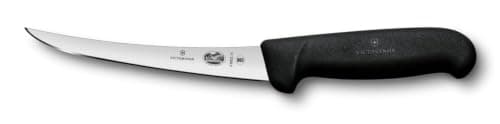
Victorinox Victorinox Fibrox Pro 6" Curved Boning Knife, Semi-Stiff

The best boning knife overall

Victorinox Fibrox Pro 6" Curved Boning Knife, Semi-Stiff

6 in / 15 cmSemi-stiffCurvedSwiss madeNSF
8.0/10

The knife on the butcher's bench and in the culinary-school kit, for the price of a good lunch. Semi-stiff is the grade that handles the most jobs, and this is the cheapest honest way to own it.

Edge retention
6
Out-of-box edge
8
Handling
9
Build
7
Value
10

Pros

  • Semi-stiff is the most useful single flex grade — enough spine to drive through a chicken joint, enough give to follow a rib
  • Costs a fraction of the forged blades here and is the knife working butchers actually reach for
  • Soft-ish steel comes back to shaving sharp on a stone in a couple of minutes, which matters on a knife that meets bone
  • The textured Fibrox handle stays grippy with wet, greasy hands — the single most important safety feature on a boning knife

Cons

  • Stamped and plain; there is no heft, no bolster and nothing handsome about it
  • Softer steel dulls faster than the Japanese or German blades, so expect to sharpen more often
  • Victorinox publishes no edge angle for it, so that spec cell is blank rather than guessed

Don't buy this if…

you mainly fillet fish or skin poultry, where a genuinely flexible blade does the job better and a semi-stiff one fights you. Buy the Swiss Classic or the Wüsthof flexible instead.

$28.00View on Amazon

$35.0020% off

Price as of Aug 29, 2026. Prices change — Amazon's is the one that counts.

#ad · we may earn a commission from this link to Victorinox Fibrox Pro 6" Curved Boning Knife, Semi-Stiff

02
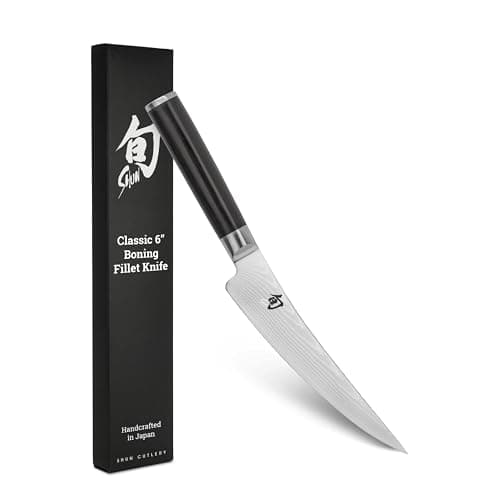
Shun Shun Classic 6" Boning & Fillet Knife (DM0743)

Best steel and edge retention

Shun Classic 6" Boning & Fillet Knife (DM0743)

6 in / 15.2 cmCurved gokujoVG-MAX core~HRC 60–6116° edge
8.0/10

The hardest steel and the most acute edge in the category, on a curved gokujo profile that gets closer to the bone than anything else here.

Edge retention
9
Out-of-box edge
9
Handling
8
Build
9
Value
5

Pros

  • A hand-sharpened 16° edge on VG-MAX at around HRC 60–61 — it parts silverskin from a tenderloin rather than tearing it
  • The gokujo curve rides the contour of a bone closely, which is the whole reason this profile exists
  • Holds that edge for months of normal home use rather than weeks
  • Full composite tang keeps it light in the hand despite the forged construction

Cons

  • Costs several times what the Victorinox does for a knife doing the same job
  • Hard, thin steel near bone is the classic chipping scenario — this blade punishes prying and twisting
  • The D-shaped handle is shaped for right-handers

Don't buy this if…

you break down bone-in poultry or chops regularly, or you sharpen with a pull-through. This is the least forgiving knife on the list around hard contact; the Victorinox or the Mercer stiff will take that abuse without complaint.

$157.69View on Amazon

Price as of Aug 29, 2026. Prices change — Amazon's is the one that counts.

#ad · we may earn a commission from this link to Shun Classic 6" Boning & Fillet Knife (DM0743)

03
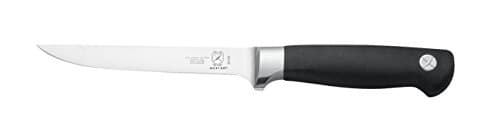
Mercer Culinary Mercer Culinary Genesis 6" Stiff Boning Knife (M20106)

Best stiff boning knife

Mercer Culinary Genesis 6" Stiff Boning Knife (M20106)

6 in / 15.2 cmStiffForged15° edgeNSF
7.8/10

A genuinely forged, full-tang stiff boning knife at a stamped-knife price. If you break down pork shoulders or beef primals, this is the grade you want.

Edge retention
6
Out-of-box edge
8
Handling
8
Build
8
Value
9

Pros

  • A stiff blade transmits force directly — it drives through a joint instead of flexing away from it
  • Forged, full tang and bolstered at a price where nearly everything else is stamped
  • Mercer publishes a real 15° edge angle and HRC 56±1, which most makers in this bracket do not
  • NSF-certified Santoprene handle keeps its grip through fat and cold water

Cons

  • Soft at around HRC 56 — you will hone it often and sharpen it more than the Shun
  • The thick bolster adds security but also weight the Victorinox does without
  • A stiff blade is the wrong tool for fish, and it will not follow a ribcage

Don't buy this if…

you bought a boning knife to fillet fish or skin chicken breasts. Stiff is the opposite grade for that work — take the flexible Genesis, which is the same knife with the spine ground thinner.

$34.49View on Amazon

Price as of Aug 29, 2026. Prices change — Amazon's is the one that counts.

#ad · we may earn a commission from this link to Mercer Culinary Genesis 6" Stiff Boning Knife (M20106)

04
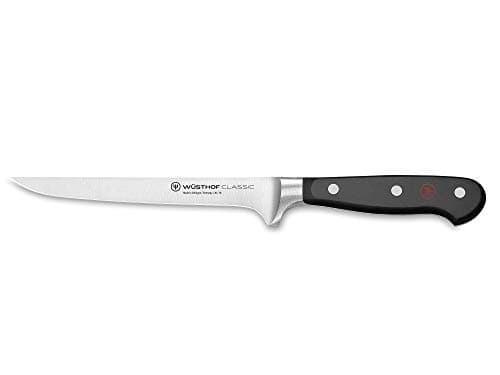
Wüsthof Wüsthof Classic 6" Flexible Boning Knife

Best forged flexible blade

Wüsthof Classic 6" Flexible Boning Knife

6 in / 16 cmFlexibleX50CrMoV15~HRC 5814° edge
7.6/10

A precision-forged German flexible blade with a documented 58 HRC and a 14° PEtec grind. The most thoroughly specified knife in the category.

Edge retention
7
Out-of-box edge
8
Handling
8
Build
9
Value
6

Pros

  • Flexible and forged is a rare combination — most flexible boning knives are stamped
  • The PEtec grind takes it to about 14° a side, keener than the German norm and a real advantage on skin and silverskin
  • Triple-riveted POM handle and full tang; this is a knife built to be handed down
  • Wüsthof publishes hardness, blade width and handle length, so nothing on the spec sheet is inference

Cons

  • Roughly four times the price of the Victorinox for work the Victorinox handles competently
  • Still HRC 58 German steel — it needs honing far more often than the Shun
  • Heavier than a flexible blade needs to be, which blunts some of the finesse you paid for

Don't buy this if…

you want one boning knife for everything. A flexible blade wanders when you push it through a joint; the semi-stiff Victorinox or the stiff Mercer are the general-purpose grades.

$99.50View on Amazon

$120.0017% off

Price as of Aug 29, 2026. Prices change — Amazon's is the one that counts.

#ad · we may earn a commission from this link to Wüsthof Classic 6" Flexible Boning Knife

05
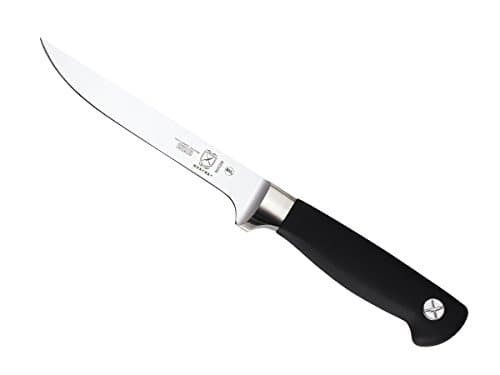
Mercer Culinary Mercer Culinary Genesis 6" Flexible Boning Knife (M20206)

Best mid-price flexible

Mercer Culinary Genesis 6" Flexible Boning Knife (M20206)

6 in / 15.2 cmFlexibleForgedFull tangNSF
7.4/10

The forged flexible blade for people who will not spend three figures. Same Genesis build as the stiff version, ground thin enough to follow a fish.

Edge retention
6
Out-of-box edge
7
Handling
8
Build
8
Value
8

Pros

  • Forged and full-tang flexibility for a fraction of what Wüsthof charges for the same combination
  • The narrow flexible blade skins, trims fat and lifts fish fillets cleanly
  • Grippy NSF Santoprene handle — the practical choice for messy protein work

Cons

  • Mercer publishes no hardness or edge angle for this SKU, so both cells are blank rather than borrowed from the stiff version
  • At ~7.4 oz it is the heaviest knife here, which is odd on a blade sold for finesse
  • Soft German steel; edge retention is ordinary

Don't buy this if…

you want the lightest possible touch on fish. The heft works against you — the 2.6 oz Victorinox Swiss Classic is far more delicate, and much cheaper.

$41.96View on Amazon

Price as of Aug 29, 2026. Prices change — Amazon's is the one that counts.

#ad · we may earn a commission from this link to Mercer Culinary Genesis 6" Flexible Boning Knife (M20206)

06
Victorinox Victorinox Swiss Classic 6" Narrow Flexible Boning Knife

Best budget boning knife

Victorinox Swiss Classic 6" Narrow Flexible Boning Knife

5.9 in / 15 cmFlexibleNarrow~2.6 ozSwiss made
6.8/10

The cheapest honest way to find out whether you need a boning knife at all — and at 2.6 oz, the most delicate blade here on fish and poultry skin.

Edge retention
5
Out-of-box edge
7
Handling
7
Build
5
Value
10

Pros

  • Costs less than a takeout meal and is a genuinely capable knife, not a toy
  • At ~2.6 oz it is the lightest blade here by a wide margin — you feel the skin line through it
  • Swiss made, dishwasher tolerant, and cheap enough that you will not baby it

Cons

  • Stamped, with no bolster and no finger guard — you must be deliberate about hand position
  • The thinnest, most flexible blade here is also the easiest to bend permanently if you lever with it
  • Build quality is functional; this will not be the knife you keep for twenty years

Don't buy this if…

you work through bone regularly. A thin flexible blade near a joint is how people bend knives and cut themselves — the stiff Mercer or the semi-stiff Victorinox is the safe grade for that job.

$27.48View on Amazon

Price as of Aug 29, 2026. Prices change — Amazon's is the one that counts.

#ad · we may earn a commission from this link to Victorinox Swiss Classic 6" Narrow Flexible Boning Knife

Which flex grade do you actually need?

This is the decision, so here it is without hedging. If you mostly break down whole chickens, trim silverskin off a tenderloin, and want one knife for everything, buy semi-stiff — the Victorinox Fibrox Pro. If you work with beef and pork, separate ribs, or push through joints with any regularity, buy stiff — the Mercer Genesis, whose forged spine transmits force instead of absorbing it. If you mostly fillet fish or skin poultry breasts, buy flexible — the Victorinox Swiss Classic if you want it cheap and light, the Wüsthof Classic if you want it forged and made to last.

The failure mode worth naming: people buy flexible because it sounds more capable, then try to break down a chicken with it. A flexible blade wandersunder pressure — it deflects away from the cut you intended and towards the hand steadying the bird. That is not just frustrating, it is the most common way people injure themselves with this knife. If you are buying one boning knife and you are not sure, semi-stiff is the safe default.

Boning knife or fillet knife?

They overlap, and several knives are sold as both — the Shunis literally named “Boning & Fillet.” The distinction that matters: a fillet knifeis longer (usually 7–9 inches), thinner and very flexible, built for one long stroke down the spine of a fish. A boning knifeis shorter, stiffer and more pointed, built for working around bone in meat and poultry. If fish is the bulk of your work, a dedicated fillet knife is the better tool — what is a fillet knife used for covers it, and boning knife vs fillet knife has the full side-by-side. If fish is occasional, a flexible boning knife does the job well enough that a second knife is hard to justify.

Do you need a boning knife at all?

Honestly: many home cooks do not. The three knives that cover the overwhelming majority of home cooking are a chef's knife, a paring knifeand a serrated bread knife — how many kitchen knives do you need makes that case in full. A boning knife earns its place when you buy whole chickens rather than parts, break down large cuts to save money, butcher game, or fillet fishyou caught. Those are real, common reasons — buying whole birds is materially cheaper per pound, and cutting up a whole chicken takes about four minutes once you have the right blade. But if you buy chicken breasts and pre-trimmed steaks, this knife will live in a drawer.

Hard Japanese steel or soft Western steel?

Boning inverts the usual advice. Everywhere else on this site, harder steel is the upgrade — it takes a keener edge and holds it longer. Here, the blade's job description includes contacting bone, and a thin edge at HRC 60–61 chips when it does, in a way a blade at HRC 56 simply does not. The Shunis the finest knife on this list by every objective measure of steel and grind, and it is genuinely extraordinary at fine trimming — separating silverskin, working a tenderloin, lifting a fillet. It is also the one knife here you can damage in a single careless movement. Buy it if your work is precise and boneless-adjacent. Buy the softer Western blades if you are going through joints. Neither choice is the timid one; they are answers to different questions.

Sharpening and care

Boning knives go dull faster than anything else in the block, so plan on maintaining this one. The technique is the same as any Western blade but the shape adds two wrinkles: the blade is narrow, so there is less steel to register the angle against the stone, and it is often curved, so you have to sweep through the belly rather than holding one flat pass. Work in short sections, keep the tip on the stone through the sweep, and go slowly — the full method is in how to sharpen a boning knife, with the general technique in how to use a whetstone and the angle question in knife sharpening angle. Match what you bought: about 15–16° a side on the Mercer and Shun, around 14° on the Wüsthof.

A flexible blade is harder to sharpen than a stiff one because it moves under the pressure of the stone — support it with your fingertips close to the contact point and use lighter strokes. Whatever you buy, hand wash and dry it immediately; protein and salt are harder on steel than vegetables are, and this is the knife most likely to be left in the sink after a messy job. Store it so the point is protected, in a block, on a strip or in a guard— a narrow tip rattling loose in a drawer is both a broken tip and a hazard.

How we picked

We do not run a test kitchen

We compiled each product's published specifications — steel, hardness, edge geometry, weight — normalized them into the matrix above, and scored each one against a published rubric. The scores are judgments from those specs and the value math — they are notmeasurements we took, because we do not have a test kitchen and we're not going to pretend we do. Units we claim to have tested: 0.

Questions

Frequently asked

What is the best boning knife?

For most people the Victorinox Fibrox Pro 6-inch curved semi-stiff — it is the grade that handles the widest range of jobs, it is the knife working butchers actually use, and it costs a fraction of the forged alternatives. If you break down beef and pork, the stiff Mercer Genesis is the better grade. If you want the finest steel and edge and your work is fine trimming rather than joints, the Shun Classic is the best blade here.

Should a boning knife be stiff or flexible?

Stiff for beef, pork and anything where you drive through a joint. Flexible for fish and poultry, where the blade needs to ride a curve or follow skin. Semi-stiffif you are buying one knife for a mixed kitchen — it is the most useful single grade and the right default when you are unsure. A flexible blade used on heavy work deflects away from the cut, which is both frustrating and the main way people hurt themselves with this knife.

What size boning knife should I buy?

Six inches suits almost everyone, and every knife on this list is that length. Five inches is a reasonable choice if you have smaller hands or you mostly work on poultry, where the extra maneuverability in a tight cavity is worth more than the reach. Longer than six inches and you are effectively buying a fillet knife, which is a different tool.

Is a boning knife the same as a fillet knife?

No, though the categories overlap and some knives are sold as both. A fillet knife is longer, thinner and very flexible, built for long strokes down a fish. A boning knife is shorter, more pointed and available in stiffer grades, built for working around bone in meat and poultry. Full comparison in boning knife vs fillet knife.

Can you use a chef's knife instead of a boning knife?

For a whole chicken, yes — a chef's knifewill get through it, and plenty of cooks do exactly that. What you give up is precision and yield: the wide blade cannot follow a bone closely, so you leave meat behind, and the lack of a fine point makes joints harder to find. For trimming silverskin or filleting anything, a chef's knife is the wrong shape entirely.

Why do boning knives go dull so quickly?

Because they contact bone, cartilage and connective tissue, which are far harder on an edge than vegetables. That is also why we weight value heavily in this category and why we are cautious about very hard steel here — you will sharpen this knife more often than any other, and a chipped hard edge takes far more work to repair than a rolled soft one. See how to sharpen a boning knife.

Do you need a finger guard on a boning knife?

It is not essential, but it is a genuine safety feature on a knife used with greasy hands and real force. A substantial bolster — as on the forged Mercer and Wüsthof picks — does much the same job. What matters more is a handle that stays grippy when wet, which is why every knife here uses a synthetic handle rather than wood.

Keep reading

Receipts

Sources

We do not run a test kitchen, and we do not pretend to. Specs are the manufacturer's published figures, attributed as such; where we could not verify something, we say so on the page rather than quietly leaving it out. Read our full method.