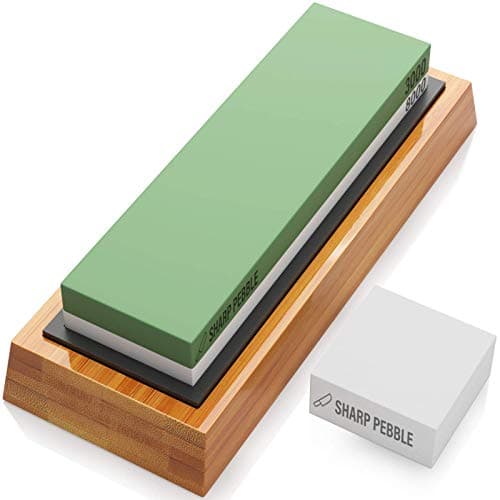
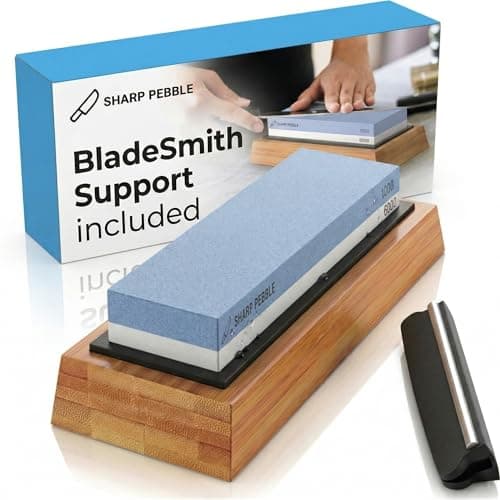
The Sharp Pebble 1000/6000 kit is the one to buy for a kitchen. It is the only kit here that arrives genuinely complete for the job most people are trying to do: a 1000-grit side that does the sharpening, a 6000 side that finishes it, a bamboo holder with a rubber base so the stone cannot slide, and an angle guide for the first few sessions. Nothing else to buy, nothing in the box you will not use. If you want a plate that never needs flattening and ships with a four-angle guide, the Sharpal 168H is the better kit; if you want to find out whether you enjoy sharpening at all before spending real money, the two-sided 400/1000 kit costs less than a takeout lunch.
How this list is ranked: on completeness — what is actually in the box, scored against the six-item checklist below — not on abrasive performance alone. That is deliberately a different question from best sharpening stones, which ranks bare stones on how well they cut. The King KDS is the best first stone on this site and it is not on this page at all, because it ships as a block of abrasive and nothing else. A kit that cuts slightly slower but keeps itself still, tells you the angle and can be flattened is the better purchase for someone starting out.
The six-item checklist
Sharpening fails for mechanical reasons far more often than abrasive ones. A kit earns its name by removing those failure modes from the box:
- 1. A coarse or medium side that actually removes metal (300–1000 grit). This is where a dull edge is rebuilt. Kits that start at 3000 are finishing kits, not sharpening kits, and they will frustrate anyone whose knives are genuinely blunt.
- 2. A finer side to clean up the burr (1000–6000). Raising a burr is the easy half. Removing it cleanly is what separates an edge that feels sharp for a day from one that lasts a month — how to remove a burr.
- 3. A holder or base that stops the stone moving. A stone that slides on a wet counter is dangerous and makes a consistent angle impossible. A rubber base or a bamboo cradle is the single most useful non-abrasive item a kit can contain. A damp dish towel is the free substitute, and it is genuinely nearly as good.
- 4. An angle guide, for the first few weeks. A cheap plastic wedge that clips to the spine will not teach you to freehand, but it will stop you grinding a 30° shoulder onto a knife while you learn what 15° feels like. Knife sharpening angle explains what to aim for, and guided vs freehand covers when to drop the guide.
- 5. Something to flatten the stone with. Water stones go hollow in the middle with use, and a hollow stone cannot hold an angle. Most kits ignore this entirely, which is why it is the thing people buy second — how long does a whetstone last and how to flatten a whetstone.
- 6. Somewhere to keep it. Minor, and it decides whether the kit lives on a counter or at the back of a cupboard. A case or a box that holds the stone wet-side-up matters more than it sounds.
A seventh item gets sold as essential and is not: a leather strop. It refines an already-sharp edge beautifully and does nothing for a dull one. Treat it as a bonus, never as a reason to choose a kit — how to strop a knife covers what it does and does not do.
What a kit cannot give you
Two things, and both are worth knowing before you spend:
A kit cannot replace a honing rod. Sharpening removes metal and should happen a few times a year. Honing removes none and should happen before most cooking sessions, and on soft German steel it is the maintenance that keeps a knife off the stone for months. No kit on this page includes one, and every one of them is improved by adding one — sharpening vs honing is the distinction, and best honing steels is the shortlist.
A kit cannot give you the technique. Angle consistency is the whole skill, and it takes an hour of practice on a knife you do not care about. Start with how to use a whetstone, then how to sharpen a chef knife. If your edge never seems to arrive, why your knife won't get sharp is the diagnosis list, and the answer is almost always an unremoved burr or a wandering angle rather than the kit.
The six kits, and who each suits
- 1. Sharp Pebble 1000/6000 — the complete kitchen kit. A combination water stone in a non-slip bamboo holder with a rubber base, plus an angle guide. Checklist score: coarse-enough side ✓, finishing side ✓, holder ✓, angle guide ✓, flattener ✗, storage ✓ — five of six, and the best balance here for kitchen knives. The 1000 side rebuilds a dull edge and the 6000 finishes it, which is the whole range a kitchen knife needs. Honest cons: it soaks for five to ten minutes before every session, which is the most common reason a stone stays in the drawer; the face is a little small at ~180 × 60 mm for a 10-inch blade; and it ships with nothing to flatten itself with, so that is your second purchase.
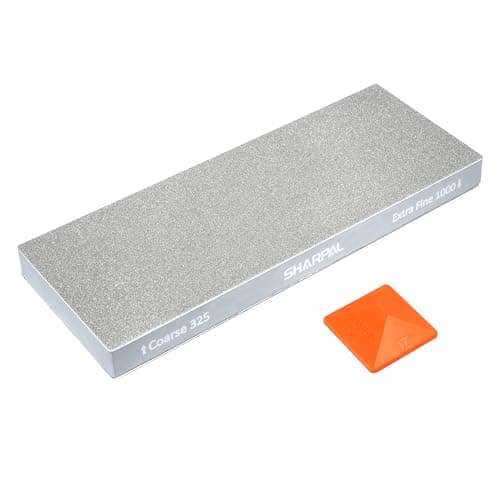
- 2. Sharpal 168H — the kit for angle control. A double-sided diamond plate, 325 coarse and 1000 extra fine, 8 × 3 in, with a non-slip pad and a four-angle guide in the box. Checklist: coarse ✓, fine ✓, base ✓, angle guide ✓✓, flattener — not needed, because a diamond plate never dishes — storage ✓. That never-dishes property is why it ranks this high: it removes the one maintenance job the other kits leave you with, and the big 3-inch face is forgiving to learn on. Honest cons: diamond tops out toothy, so it will not give you the polished edge a 6000-grit water stone will; the plate feels harsh under the blade compared with a soft stone; and it costs more than the Sharp Pebble.
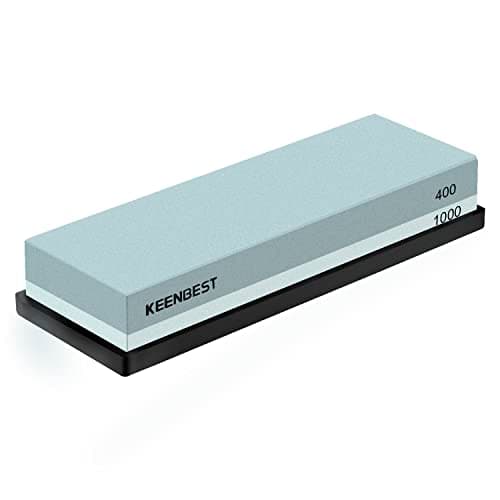
- 3. Two-sided 400/1000 — the cheapest complete kit. A combination water stone with a non-slip base and an angle guide, for less than a takeout lunch. Checklist: coarse ✓✓ (400 is genuinely aggressive, which soft German steel wants), medium ✓, base ✓, angle guide ✓, flattener ✗, storage ✗ — and that 400/1000 pairing is almost exactly right for Wüsthof, Zwilling, Henckels, Mercer and Victorinox steel. Honest cons: it is a small, soft, thin stone that will dish quickly and will not last like the others, there is no finishing grit above 1000, and the included guide is basic. Buy it as a trial, not as a keeper — stones for German knives explains why the grit pair suits that steel so well.
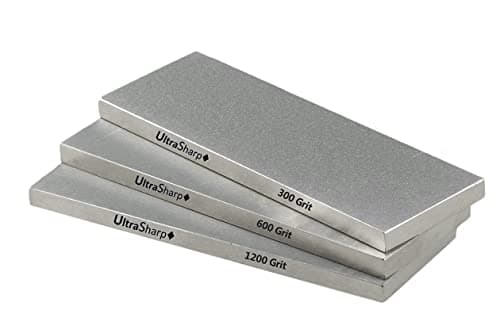
- 4. Ultra Sharp II 3-stone diamond kit — the full progression. Three monocrystalline diamond plates at 300, 600 and 1200 grit, 6 × 2 in each. Checklist: coarse ✓✓, medium ✓, fine ✓, base ✗, angle guide ✗, flattener — not needed. This is the kit for someone who wants a genuine grit ladder and will supply their own technique: 300 repairs a damaged edge, 600 sharpens, 1200 refines, and none of the three will ever need flattening. Honest cons: no holder and no guide, so it is the least beginner-friendly kit here; the 6 × 2 in plates are small for a chef's knife and you will be working in sections; and three separate plates means three things to store.
- 5. Sharp Pebble 3000/8000 — the finishing kit, with the flattener. A combination finishing stone in a bamboo holder, and the only kit on this page that includes a 120/320 flattening stone. Checklist: coarse ✗, refine ✓, polish ✓, holder ✓, angle guide ✗, flattener ✓✓, storage ✓. Read that first mark carefully — this kit cannot sharpen a dull knife, because 3000 grit is too fine to remove meaningful metal. It is the second kit you buy, not the first. Honest cons: useless on its own for a blunt edge; 8000 grit is largely wasted on soft German steel, which cannot hold that apex; and the included flattening stone is sized for these stones rather than for a big 8-inch block.
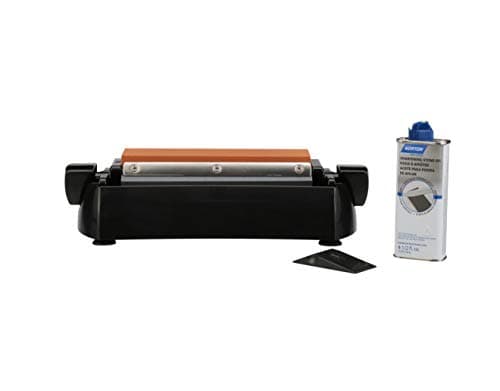
- 6. Norton IM200 — the complete traditional kit. Three 8 × 2 in oilstones — coarse and medium Crystolon plus a fine India — in a cast reservoir bench holder that catches and recycles the oil. Checklist: coarse ✓✓, medium ✓, fine ✓, holder ✓✓, angle guide ✗, flattener ✗, storage ✓. It is the most complete abrasive progression here and it will outlast everything else on this page by decades; India and Crystolon stones were developed for exactly the soft Western steel most kitchen knives are made of. Honest cons: oil is a commitment — messy, and it means this lives in a workshop rather than beside a sink; it is by far the most expensive kit here; and it is slower than diamond. Buy it for the tool shed and the traditionalist, not for a tidy kitchen.
Which kit for which situation
- Your first kit, kitchen knives, German or Swiss steel: Sharp Pebble 1000/6000. If budget is the binding constraint, the two-sided 400/1000.
- You know you will not maintain a stone: Sharpal 168H. A diamond plate asks nothing of you between sessions — no soaking, no flattening.
- Hard Japanese steel at HRC 60+: Sharp Pebble 1000/6000 now and the 3000/8000 later, or a dedicated stone from stones for Japanese knives. Hard steel is the one case where high grit genuinely pays.
- A chipped or badly neglected edge: the Ultra Sharp II 300 or the Norton's coarse Crystolon. See how to fix a chipped knife edge before you start.
- You want repeatable results without learning freehand: none of these. A clamped guided system is the honest answer — best sharpening systems ranks those, and best electric knife sharpeners covers the powered route and its costs.
- A gift: the Sharp Pebble 1000/6000 or the Sharpal 168H. Both look like a complete present out of the box; best knife sharpening gifts has the rest of the category.
What to add after the kit
In order of how much difference each makes. A honing rod first — it is the maintenance that decides how often you need the kit at all, and on soft steel the effect is dramatic. Something to flatten with second, if your kit is a water stone and did not include one; a coarse diamond plate does the job and doubles as a repair stone. A bigger stone third, if you have discovered you enjoy this — an 8 × 3 in face makes a long blade far easier than a 7 × 2.4 in one. A strop is last, and optional.
One thing to skip entirely: the pull-through sharpener that so often gets bundled with a "kit" on a marketplace listing. Fixed carbide wheels scrape metal off at a preset angle regardless of how your knife is ground, and they remove a surprising amount of it. Pull-through vs whetstone and are electric knife sharpeners bad both cover the damage. If a kit's selling point is that it includes one, that is a reason not to buy that kit.