Skip to content
Bevel & Bone

HUB 04 · Reviews

Wüsthof Classic 8" Review

The archetypal German chef's knife. Heavy, forgiving, forged to outlive you — and the benchmark every other German knife is measured against.

By Stephen V.Updated How we choose
#ad

We earn a commission when you buy through our Amazon links, at no extra cost to you. It never changes a ranking, and we say so when the cheaper knife is the better buy. How this works.

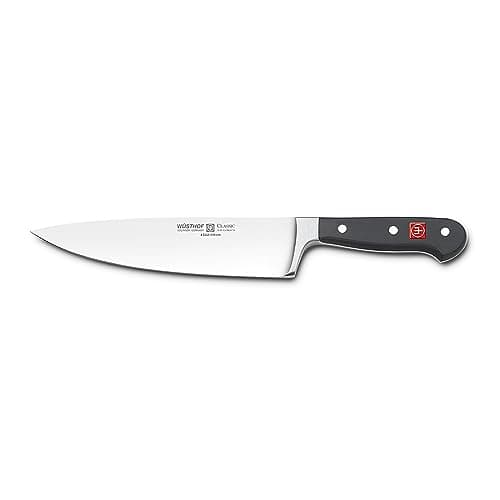
If you pictured "a chef's knife" right now, you probably pictured something close to the Wüsthof Classic. Forged in Solingen, heavy in the hand, with a full bolster and a triple-riveted black handle, it has been the default premium German knife for so long that it's become the reference point — the knife other German knives get compared to. The question isn't whether it's good. It's whether the heavy, forgiving German formula is the one you want.

What the spec sheet tells you

The Classic is forged from a single billet of German X50CrMoV15 stainless hardened to about HRC 58, with a full tang, a full bolster, and — on the current production — Wüsthof's 14°-per-side Precision Edge. That last number matters: the old Wüsthof grind was a much more obtuse ~20° per side, and the newer, keener edge closes most of the out-of-box sharpness gap people used to complain about. The steel is soft-ish by design, which is the whole German trade-off — the edge rolls instead of chipping, so it survives the twisting, prying, and hard boards a home cook actually inflicts, at the cost of needing a honing steel more often than a hard Japanese blade.

How it feels to use

Heavy. At around nine ounces it's one of the weightiest knives we cover, and that's a feature or a flaw depending on your hand. Cooks who like the blade to do some of the work love it; the heft lends authority to rock-chopping herbs and powering through a squash. Over a long prep session, though, it tires some people — and it's a poor match for small hands. The full bolster is the other double-edged detail: it protects your knuckles and gives a reassuring pinch-grip landing, but it eventually blocks the heel and makes it fiddly to sharpen the whole edge on a stone as the knife wears. If that bothers you, the Zwilling Pro's sloped bolster solves exactly that problem.

Who it's for

The cook who wants one heavy, do-everything German knife that will shrug off decades of normal use and never intimidate them. It's the safe lifetime buy — which is why it anchors our best German chef knives list, tops our home-cooks ranking for its forgiveness, and is the default answer for a gift. It is not the knife if you want the lightest, keenest blade or you have smaller hands — a MAC or a Tojiro will feel far more agile and hold an edge longer.

Value

Full retail on a Classic is high, and it's frequently the knife people overpay for — Solingen forged knives go on deep discount constantly, so paying sticker is the one real mistake here. Judged on cutting-per-dollar against a Victorinox it loses on paper; judged as a buy-once heirloom you hone and hand down, the math looks very different. Buy it on sale, keep it honed, and learn to sharpen it on a stone once or twice a year, and it will genuinely outlast you.
In detail

The knife, in detail

01
Wüsthof Wüsthof Classic 8" Chef's Knife

A do-everything German workhorse

Wüsthof Classic 8" Chef's Knife

8 in / 20 cmX50CrMoV15~HRC 5814° per sideForged
7.4/10

The archetypal German chef knife. Heavy, tough, forgiving, and it will outlive you if you hone it.

Edge retention
7
Out-of-box edge
7
Handling
7
Build
9
Value
7

Pros

  • Forged from a single billet with a full bolster and full tang — the reference for a durable German blade
  • Wüsthof's newer 14°-per-side edge is noticeably keener than the old 20° grind
  • Tough enough to shrug off the abuse a home cook actually inflicts
  • Triple-riveted POM handle is essentially indestructible

Cons

  • Heavy — a real workout over a long prep session
  • The full bolster eventually blocks the heel and complicates sharpening the whole edge
  • Full retail price is high; it's frequently the knife people overpay for

Don't buy this if…

you want a light, nimble knife or you have smaller hands. This is a heavy German blade by design — the MAC or Tojiro will feel far more agile.

$170.00View on Amazon

Price as of Jul 28, 2026. Prices change — Amazon's is the one that counts.

#ad · we may earn a commission from this link to Wüsthof Classic 8" Chef's Knife

Questions

Frequently asked

Is the Wüsthof Classic worth the money?

As a buy-once, hand-it-down German workhorse, yes — if you buy it on sale. It's forged, essentially indestructible, and forgiving. But it doesn't out-cut a knife a third of its price, so it's worth it for the durability and feel, not for raw sharpness. Never pay full retail; Solingen knives discount often.

What angle is the Wüsthof Classic sharpened to?

Current production ships at 14° per side (Wüsthof's Precision Edge Technology), noticeably keener than the older ~20° grind. Maintain it near that angle — see our sharpening angle guide.

Wüsthof Classic vs Zwilling Pro — which German knife?

They're more alike than different: both forged, heavy, soft-ish German steel. The main split is the bolster — the Wüsthof's is full (blocks the heel over time), the Zwilling Pro's is sloped (keeps the whole edge sharpenable). Buy whichever handle your hand prefers, and buy it on sale.

Does the Wüsthof Classic hold its edge well?

Only averagely — soft German steel at ~HRC 58 dulls faster than a hard Japanese blade. The upside is it's easy to bring back: a honing steel before most sessions realigns the rolled edge, and it needs a proper stone sharpening only a couple of times a year.

Keep reading

Receipts

Sources

We do not run a test kitchen, and we do not pretend to. Specs are the manufacturer's published figures, attributed as such; where we could not verify something, we say so on the page rather than quietly leaving it out. Read our full method.