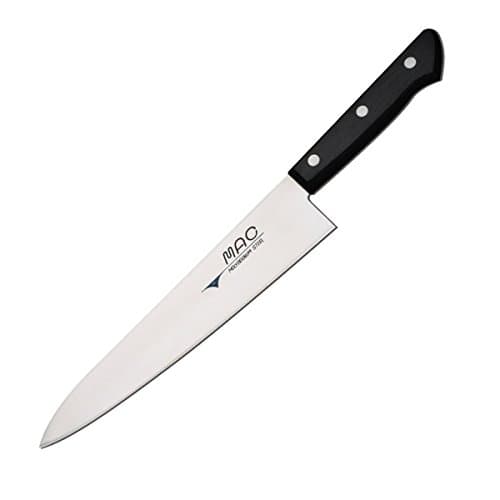
The MAC HB-85 is the knife to buy if you want the thing MAC is actually good at — a hard, very thin blade that needs almost no force to cut — and do not want to pay for the MTH-80 that the enthusiast forums talk about. At a published ~HRC 60, a 2.0 mm blade and ~4.9 oz, it is the lightest knife on this site and the lowest-effort cut we rank. What you give up against the MTH-80 is the dimpled face, a little refinement and some of the brand's reputation. What you keep is the geometry, which is the part that cuts.
What the spec sheet says
MAC publishes the numbers that matter for this knife, which is not universal in this category. The HB-85 is an 8.5-inch (21.5 cm) blade in high-carbon chrome-molybdenum-vanadium stainless, hardened to around HRC 60, ground to roughly 15° per side, on a stamped blade measuring 2.0 mm at the spine, with a riveted Pakkawood handle and a steel bolster. Total weight is about 4.9 oz (139 g).
Three of those figures do the work, and they compound:
- HRC 60 is genuinely hard for a knife at this price. A Victorinox Fibrox sits at ~HRC 55–56 and a Wüsthof Classic at ~HRC 58. Harder steel supports a finer apex and loses it more slowly, which is the edge-retention claim and the one that holds up — knife hardness explained covers the Rockwell scale properly.
- ~15° per side is acute, where a German knife is typically ground nearer 20°. Harder steel can support a thinner edge without folding over, so Japanese makers grind more acutely, and a more acute edge needs less force to start a cut.
- 2.0 mm at the spine is the under-discussed number. Edge angle only describes the last fraction of a millimetre. What happens after that is decided by how thick the blade is behind the edge, because a thick blade has to wedge food apart as the cut deepens. A 2.0 mm stamped blade is thin by any standard — blade geometry is the full mechanism, and it is the single best reason to buy this knife.
Together those three are why a 4.9 oz knife can out-cut a 9 oz forged one. It is not doing it with mass; it is doing it by being thin and keen enough that mass is not needed.
HB-85 versus MTH-80: what the extra money buys
This is the question anyone looking at the HB-85 is really asking, since the MTH-80 is the knife MAC is famous for and our top pick overall on best chef knives.
The steel is the same family and hardness. Both are MAC's high-carbon molybdenum-vanadium stainless; the MTH-80 is published at ~HRC 59–61 and the HB-85 at ~HRC 60. Both are ground to roughly 15° per side. On the two specs that decide how an edge performs, these knives are siblings.
Three things differ. The MTH-80 is a Professional-series knife with a dimpled (granton) face, which breaks the suction that makes wet slices cling to a blade. It is 8 inches rather than 8.5, and it is heavier at ~6.5 oz against ~4.9 oz — a third more knife in your hand. And its fit and finish are a clear step up: the HB-85 is the Chef Series, which is MAC's plainer, cheaper line.
Which to buy. If you slice a lot of wet produce — potatoes, cucumber, zucchini — the dimples are a real feature and the MTH-80 is worth the difference; what is a granton edge explains when they help and when they are decoration. If you want the lightest possible knife, or you are buying your first Japanese blade and would rather not spend MTH-80 money to find out whether you like the feel, the HB-85 is the smarter purchase. The half-inch of extra length is a wash: useful on a big board, slightly unwieldy on a small one. Our MTH-80 review covers that knife in full.
What it is like to use
The defining characteristic is how little force it needs. A thin blade at HRC 60 behind a 15° edge falls through an onion rather than being pushed through it, and over a long prep session that is the difference you notice — not sharpness in the abstract, but the absence of effort. It is the reason this knife is our top pick on best kitchen knives for arthritis, where cutting effort is the whole ranking axis.
The weight cuts both ways, honestly. At 4.9 oz this is a feather, and if a heavy forward-balanced knife is what feels "right" in your hand you will find it insubstantial — MAC says as much itself. The balance sits near the bolster rather than out at the tip, which suits a pinch grip; how to hold a chef's knife covers that. The Pakkawood handle is well shaped, hard and smooth — fine dry, less grippy than a textured Fibrox or Santoprene handle when your hands are wet or oily, which is the knife's weakest point.
The 8.5-inch length is marginally longer than the 8-inch default most kitchens settle on, and that is a small plus for breaking down a squash or a chicken and a small minus on a crowded board. Chef knife sizes explained works through the trade.
Who should not buy it
Anyone whose knife meets bone. At ~HRC 60 behind a 15° edge, the steel is harder than the bone it meets and gives up a flake rather than bending. Jointing chicken, splitting a rib rack or hacking at a frozen edge will chip this knife where a soft German blade would simply roll and be honed straight again. Keep a cheap tough blade for that work — best knives for cutting meat is the split most professional kitchens run.
A shared or careless kitchen. Hard steel rewards good habits and punishes bad ones. If the knife will end up in a sink, in a dishwasher, or scraping diced onion off a board with its edge, buy a Victorinox and be happier.
Anyone who will not maintain it. A traditional steel honing rod barely bites at HRC 60 — it slides off. Keeping this knife at its best needs a whetstone or a fine ceramic rod, which is a real ownership cost to budget for before you buy, not after.
Anyone who wants heft. Not a flaw, a preference. If a planted, heavy knife is what you like, the Tojiro DP at ~7.4 oz or a forged German blade will suit you far better.
Living with it
Hand wash and dry it, every time — the dishwasher is what kills riveted wooden handles and it is the fastest way to ruin this knife, per can you put knives in the dishwasher. Use a wooden or soft plastic board, never glass or stone. Store it where the thin edge is protected rather than loose in a drawer — how to store kitchen knives.
For maintenance, a fine ceramic rod between sharpenings and a whetstone when it genuinely dulls. A 1000-grit stone does the work and a 6000 finishes it, which is the range in most kitchen kits — best knife sharpening kits ranks those on completeness, and stones for Japanese knives is the shortlist for hard steel specifically. The technique is in how to sharpen a chef knife, and ceramic vs steel honing rod explains why the rod in your block probably will not do.
The verdict
The HB-85 is the cheapest honest way into MAC, and the specs that make MAC worth buying — hardness, edge angle and above all a 2.0 mm blade — are all present. It is the lightest and lowest-effort knife we rank, which makes it an unusually good fit for anyone with hand or wrist trouble and a genuinely good first Japanese knife for a careful cook. Buy the MTH-80 instead if you want the dimpled face and a little more mass in the hand, and buy a Victorinox or a Mercer instead if your kitchen is hard on knives. Honest limitations: a smooth hard handle that is less secure when wet, a plain finish, and the chipping risk that comes with every blade at this hardness.
Where it sits on our lists: best Japanese chef knives for beginners and best kitchen knives for arthritis. For the brand in context, see best chef knife brands.