Skip to content
Bevel & Bone

HUB 04 · Reviews

Work Sharp Precision Adjust Review

The closest thing to a foolproof sharp edge without a whetstone. A clamped, angle-locked guided system — and the honest case for still learning a stone.

By Stephen V.Updated How we choose
#ad

We earn a commission when you buy through our Amazon links, at no extra cost to you. It never changes a ranking, and we say so when the cheaper knife is the better buy. How this works.

Not everyone wants to learn to freehand on a stone, and that's a legitimate position. The Work Sharp Precision Adjust exists for exactly that cook: it clamps the knife, locks the angle, and lets you draw an abrasive down each side until the edge is sharp — no muscle memory required. It's the top pick in our best sharpening systems roundup, and this is the closer look.

What the spec sheet tells you

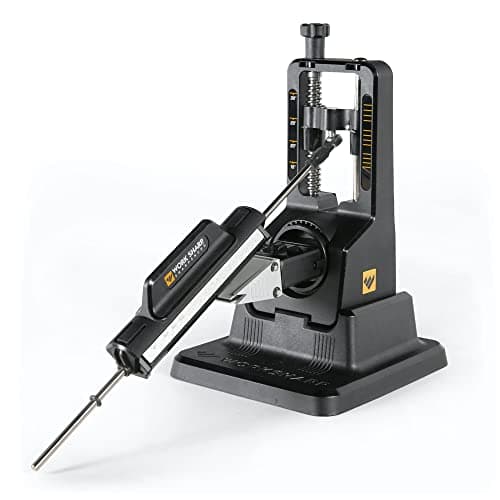
It's a fixed-angle guided system: a clamp holds the blade, and a pivoting rod carries the abrasive at an angle you click-set anywhere from 15° to 30° in roughly 1° steps. It ships with coarse and fine diamond plates plus a ceramic rod, so it can repair a dull edge, set a working one, and refine it — the full progression a bevel angle needs, in one tool. The angle being locked is the whole point: the number one reason people fail on a stone is a wandering angle, and this removes that variable entirely.

How it performs

Genuinely sharp, genuinely repeatable — the closest thing to foolproof among the tools we cover, which is why it scores a 9 on both results and angle consistency. Because you set the exact angle, you can match whatever bevel your knife came with (a keen ~15° per side for a hard Japanese blade, ~20° for a German one) instead of being forced onto a fixed preset like a pull-through. The trade-offs are honest: clamping and stroking each side is slower than a quick pull-through, and the clamp can struggle with very tall or very short blades.

Who it's for

The cook who wants reliably sharp knives and does notwant to spend a few weeks learning to freehand. It's also a great tool for someone who sharpens a mixed drawer of knives and wants each done at its correct angle. It is not the pick if your goal is the skill itself: a guided jig sharpens the knives in front of you, but only freehand technique works on any knife, anywhere, with nothing but a stone.

Value

Strong. It costs more than a cheap pull-through and less than a premium stone setup, and it delivers edges a pull-through can't touch while removing far less metal. If you know you won't learn a stone, this is the smart buy. If part of you wants the craft, put the same money toward a beginner whetstone and our step-by-step guide — a King stone is the better teacher, even if this is the easier tool.
In detail

The knife, in detail

01
Work Sharp Work Sharp Precision Adjust Knife Sharpener

Guided results without a stone

Work Sharp Precision Adjust Knife Sharpener

Guided rod15–30° setCoarse+fineManualClamp
8.4/10

The best answer for someone who wants repeatable, sharp results without learning to freehand on a stone.

Results
9
Ease of use
8
Angle consistency
9
Versatility
8
Value
8

Pros

  • The angle is locked in, so you get a consistent bevel without the freehand learning curve
  • Diamond plates plus a ceramic rod cover repair through finishing
  • Genuinely sharp, repeatable edges — the closest thing to foolproof here

Cons

  • Clamping and stroking each side is slower than a quick pull-through
  • The clamp can struggle with very tall or very short blades

Don't buy this if…

you want to learn to sharpen freehand on a stone — the skill that works on any knife anywhere. A guided jig is a fine destination, but a King stone is the better teacher.

$69.95View on Amazon

Price as of Jul 28, 2026. Prices change — Amazon's is the one that counts.

#ad · we may earn a commission from this link to Work Sharp Precision Adjust Knife Sharpener

Questions

Frequently asked

Is the Work Sharp Precision Adjust good for beginners?

Yes — the locked angle removes the hardest part of sharpening, so a beginner gets consistent, sharp edges almost immediately. The only caveat is that it sharpens knives for you rather than teaching the freehand skill; if learning the craft matters to you, pair it with (or choose) a whetstone.

What angle should I set on the Work Sharp Precision Adjust?

Match the knife: roughly 20° per side for a German knife, ~15° for a hard Japanese blade. The click-set dial covers 15–30°. See our knife sharpening angle guide for the number per steel type.

Work Sharp Precision Adjust vs a whetstone — which should I buy?

The Work Sharp is easier and more foolproof; a whetstone is the more versatile skill that works on any knife and gives the finest edge. If you want results with no learning curve, buy the Work Sharp. If you want to learn to sharpen anything, start with a stone.

Keep reading

Receipts

Sources

We do not run a test kitchen, and we do not pretend to. Specs are the manufacturer's published figures, attributed as such; where we could not verify something, we say so on the page rather than quietly leaving it out. Read our full method.