Skip to content
Bevel & Bone

HUB 01 · Chef Knives

Zwilling vs Victorinox

A forged Solingen knife against the cheap Swiss one every cook eventually recommends. The question is not which is better built — it is what the extra money actually buys.

By Stephen V.Updated How we choose
#ad

We earn a commission when you buy through our Amazon links, at no extra cost to you. It never changes a ranking, and we say so when the cheaper knife is the better buy. How this works.

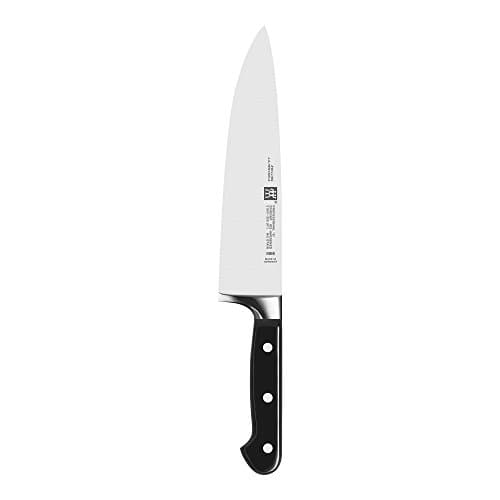
Buy the Victorinox Fibrox Pro 8" if you want the most cutting per dollar in the kitchen, and the Zwilling Professional S if you want a knife with heft, a lifetime warranty and an edge you can sharpen heel to tip. The Victorinox is a stamped X50CrMoV15 blade at ~HRC 55–56 behind a ~20° edge, ~6.6 oz, NSF-certified, and it out-cuts most forged knives out of the box. The Zwilling is a Sigmaforge single-billet forged blade at ~HRC 57 behind a ~15° edge, ~8.8 oz, with a curved bolster that leaves the whole edge reachable on a stone. The honest finding is that the money buys construction, mass and longevity — not a dramatically better cut.

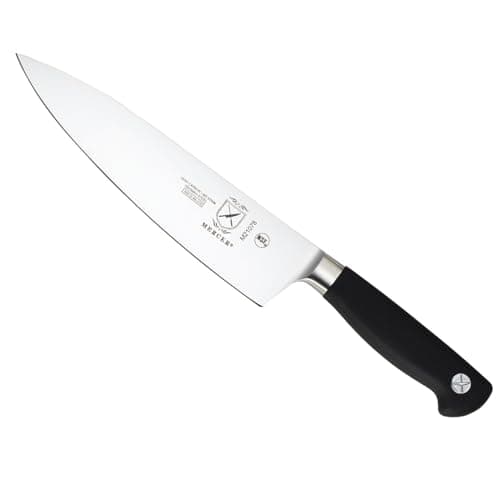
The third knife in the table exists because it collapses the question: the Mercer Genesisis genuinely forged with a full tang, in the same X50CrMoV15, at close to the Victorinox's price. If what you want is "forged, cheap," that is the answer rather than either of these two.

The specs, side by side

SpecZwilling Professional S 8"Victorinox Fibrox Pro 8"
SteelZwilling special-formula stainlessX50CrMoV15 stainless
Hardness (maker-stated)~HRC 57 (Friodur ice-hardened)~HRC 55–56
Edge angle~15° per side~20° per side
ConstructionSigmaforge single billet, curved bolster, full tangStamped, full-length tang, no bolster
Weight~8.8 oz (249 g)~6.6 oz (187 g)
HandleTriple-riveted polymerTextured Fibrox (TPE) — grips wet
Certification / supportLifetime warranty against defectsNSF-certified; mail-in resharpening service

The short answer

Quick picks

#ad · Live prices from the Amazon Product API, as of October 17, 2026. Where we have no verified live price we show none — we'd rather leave a gap than print a number that has rotted.

By the numbers

The specs, side by side

Every figure below is the manufacturer's published specification. Where a maker doesn't publish a value, the cell reads "—" rather than a number we made up.

Knife / ToolBladeSteelHardnessEdgeConstructionWeight
Zwilling Professional S 8" Chef's Knife8 in (20 cm)Zwilling special-formula stainless~HRC 57~15° per sideSigmaforge (single billet), curved bolster~8.8 oz (249 g)
Mercer Culinary Genesis 8" Chef's Knife8 in (20 cm)X50CrMoV15 German stainless~HRC 56~20° per sideForged, full tang, short bolster~8.5 oz (241 g)
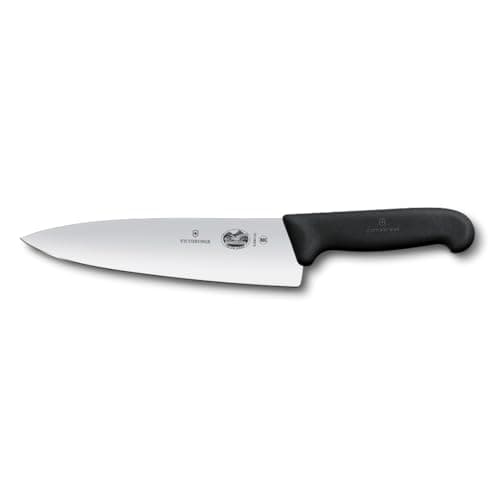
Victorinox Fibrox Pro 8" Chef's Knife8 in (20 cm)X50CrMoV15 stainless~HRC 55–56~20° per sideStamped, full-length tang~6.6 oz (187 g)

In detail

The picks, in full

01
Zwilling Zwilling Professional S 8" Chef's Knife

A German knife you can sharpen heel-to-tip

Zwilling Professional S 8" Chef's Knife

8 in / 20 cmSpecial formula steel~HRC 57~15° edgeForged
7.4/10

A forged German alternative to the Wüsthof, with a curved bolster that keeps the whole edge usable.

Edge retention
7
Out-of-box edge
7
Handling
7
Build
9
Value
7

Pros

  • The sloped bolster stops short of the heel, so unlike a full-bolster Wüsthof you can sharpen the entire edge
  • Ice-hardened (Friodur) blade holds an edge slightly better than a standard German knife
  • Excellent fit and finish; a genuine lifetime tool

Cons

  • Every bit as heavy as the Wüsthof, with the same soft-ish steel ceiling on edge retention
  • Premium price when it isn't on sale

Don't buy this if…

…you already prefer the Wüsthof's grip. These two are more alike than different; buy whichever handle your hand likes, and don't pay full price for either.

$137.98View on Amazon

$169.9919% off

Price as of October 17, 2026. Prices change — Amazon's is the one that counts.

#ad · we may earn a commission from this link to Zwilling Professional S 8" Chef's Knife

02
Mercer Culinary Mercer Culinary Genesis 8" Chef's Knife

A forged knife on a budget

Mercer Culinary Genesis 8" Chef's Knife

8 in / 20 cmX50CrMoV15~HRC 56ForgedSantoprene handle
7.6/10

A forged, full-bolster German knife at a stamped-knife price. The value pick if you want heft.

Edge retention
6
Out-of-box edge
7
Handling
8
Build
8
Value
9

Pros

  • Genuinely forged with a full tang — heft and balance closer to a Wüsthof than to its price tag
  • Short bolster leaves the whole edge usable and makes it easier to sharpen heel-to-tip
  • Grippy, ergonomic Santoprene handle that survives a commercial kitchen

Cons

  • Same soft German steel as the Victorinox, so edge retention is only average
  • Heavier than a stamped blade — a plus for some hands, a minus for others

Don't buy this if…

…you want the lightest possible knife. This is a deliberately hefty German-style blade; if you like a nimble Japanese feel, the Tojiro is the better call at a similar price.

$41.98View on Amazon

Price as of October 17, 2026. Prices change — Amazon's is the one that counts.

#ad · we may earn a commission from this link to Mercer Culinary Genesis 8" Chef's Knife

03
Victorinox Victorinox Fibrox Pro 8" Chef's Knife

Your first good chef knife

Victorinox Fibrox Pro 8" Chef's Knife

8 in / 20 cmX50CrMoV15~HRC 55–56StampedFibrox handle
7.8/10

The default answer to "what's a good first chef knife." Cheap, light, holds a usable edge, and a joy to sharpen.

Edge retention
6
Out-of-box edge
8
Handling
8
Build
7
Value
10

Pros

  • Costs a fraction of a forged German knife and out-cuts most of them out of the box
  • Soft-ish steel takes a screaming edge on a stone in minutes — the easiest knife here to learn to sharpen on
  • Light and nimble; the textured Fibrox handle grips even with wet hands
  • NSF-certified and dishwasher-tolerant (though you still shouldn't)

Cons

  • Softer steel means you hone often and sharpen more frequently than a hard Japanese blade
  • Stamped blade lacks the heft and bolster some cooks want for control
  • It is a tool, not an heirloom — nothing about it is beautiful

Don't buy this if…

…you want a knife that keeps its edge for months between sharpenings. This trades edge retention for being cheap and easy to re-sharpen — a great trade for a beginner, a poor one if you refuse to touch a stone.

$46.87View on Amazon

Price as of October 17, 2026. Prices change — Amazon's is the one that counts.

#ad · we may earn a commission from this link to Victorinox Fibrox Pro 8" Chef's Knife

What forging actually does — and does not do

Forging a blade from a single billet produces a thicker spine, a bolster, and a mass distribution you can feel. It does not make the steel harder, and it does not make the edge sharper; heat treatment does the first and grinding does the second. Zwilling's ~HRC 57 comes from Friodur ice-hardening, not from the hammer. The full argument is in forged vs stamped knives, and the short version is that stamped is not a synonym for cheap — the MAC MTH-80, one of the best-cutting knives on this site, is stamped.

What the Zwilling's mass buys is momentum on dense produce and a knife that feels substantial. What the Victorinox's lack of mass buys is a knife that is quick, unfatiguing over an hour of prep, and easy for a small hand to steer. Neither is objectively right.

The curved bolster is Zwilling's real advantage

Zwilling's Pro line uses a curvedbolster rather than the full collar on a Wüsthof Classic, which means the entire edge — including the heel — reaches a flat stone. Over ten years of sharpening that is a genuine functional difference rather than a styling one, and it is the strongest single reason to pick the Zwilling over its German rival. See knife bolster explained and Wüsthof vs Zwilling.

The angles are the quiet story

The Victorinox is ground at roughly 20° per side and the Zwilling at roughly 15°. At equal sharpness, the narrower Zwilling edge enters food with less force. But 20° on soft steel is a deliberate, sensible pairing: a wider edge on a softer blade is harder to roll, and the Victorinox's softer steel takes a screaming edge on a stone in minutes. It is the easiest knife in this registry to learn to sharpen on, which is exactly why it is the pick on best chef knives for beginners.

Which to buy

  • Victorinox Fibrox Pro: your first good knife, a second knife for bone and squash beside something hard, a knife for a shared or careless kitchen, or a knife you want to learn to sharpen on. NSF, grips wet, and Victorinox will resharpen it by mail. The catch: nothing about it is beautiful, and you will hone it often.
  • Zwilling Professional S: a knife to keep for thirty years, if you want weight in the hand, a bolster, a finished object and a lifetime warranty — and if the heel-to-tip sharpening access matters to you. The catch: it is heavy, and it costs several times the Victorinox for a modest gain in cut.
  • Mercer Genesis: the compromise. Forged, full tang, short bolster, X50CrMoV15 at ~HRC 56, NSF, Santoprene handle, at a price much closer to the Victorinox. If "I want forged but not Solingen money" describes you, buy this and stop reading.

If you are outfitting a whole drawer rather than buying one knife, knife set vs open stock argues that two good knives bought separately beats a fifteen-piece block, and best chef knives under $100 ranks this whole price tier.
How we picked

We do not run a test kitchen

We compiled each product's published specifications — steel, hardness, edge geometry, weight — normalized them into the matrix above, and scored each one against a published rubric. The scores are judgments from those specs and the value math — they are not measurements we took, because we do not have a test kitchen and we're not going to pretend we do. Units we claim to have tested: 0.

Questions

Frequently asked

Is Zwilling worth the extra money over Victorinox?

For construction, warranty and feel, yes. For raw cutting performance, barely — a Victorinox Fibrox Pro out of the box cuts close to a forged German knife costing several times more. Buy the Zwilling for the object and the sharpening access, not because it slices better.

Is a stamped knife worse than a forged one?

No. Forging changes mass, spine thickness and whether there is a bolster; heat treatment sets hardness and grinding sets sharpness. Some of the best-cutting knives made are stamped, including the MAC MTH-80.

Why do professional kitchens use Victorinox?

Because it is NSF-certified, grips with wet hands, holds a usable edge, sharpens in minutes on a stone, and costs little enough that losing one is not an event. Soft steel rolls instead of chipping, which is the right failure mode for a shared line.

What angle should I sharpen each at?

Around 20° per side for the Victorinox and around 15° for the Zwilling, matching each factory grind. Both take a fine steel honing rod between sharpenings.

Keep reading

Receipts

Sources

We do not run a test kitchen, and we do not pretend to. Specs are the manufacturer's published figures, attributed as such; where we could not verify something, we say so on the page rather than quietly leaving it out. Read our full method.