A diamond plate needs three things a water stone does not: no soak, much lighter pressure, and a plate that has been broken in. Wet it, hold your angle, and let the diamonds cut — if you lean on it the way you lean on a 1000-grit water stone you will tear the edge and strip diamonds off the plate. Everything else — angle, burr, grit progression, stropping off the wire edge — works the same as using a whetstone.
Diamond is harder than any knife steel, which is why these plates cut fast, never dish and never need flattening. That same hardness is why pressure is the enemy: the abrasive does not yield, so the force goes into the edge and into the bond holding the diamonds down. Diamond vs whetstone is the choice between the two systems; this page assumes you have already chosen diamond.
What to look for in a plate before you start
- Continuous or interrupted surface. An interrupted ("polka-dot") plate like the DMT DuoSharp clears swarf well but the hole edges can catch a narrow kitchen blade, and the feel unsettles beginners. A continuous plate — the Sharpal 162N and 168H, the DMT D8C — gives a smoother stroke. For kitchen knives, continuous is the easier learn.
- Grit pair. 325 coarse with a 1000 or 1200 fine side covers every routine kitchen job. A 325-only plate like the D8C is a repair and flattening tool, not a complete setup.
- Size. 8 × 3 in gives real room to track an 8-inch chef's knife. Narrower plates work but you will steer more.
- Base. Diamond on steel or on machined aluminum stays flatter under pressure than diamond on a thin polymer frame. A non-slip pad matters more than it sounds, because you are using less downforce to hold the plate still.
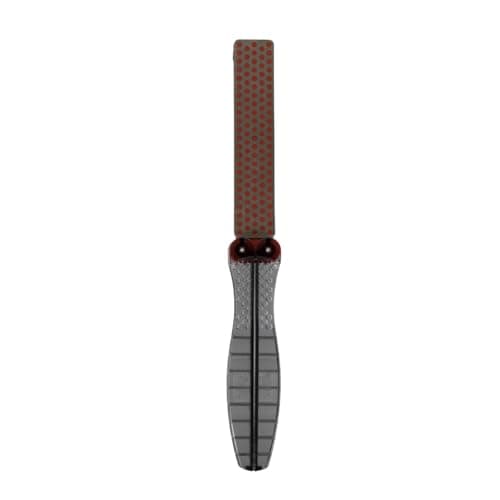
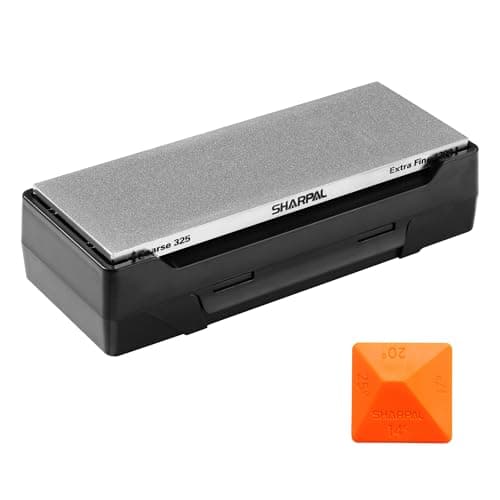
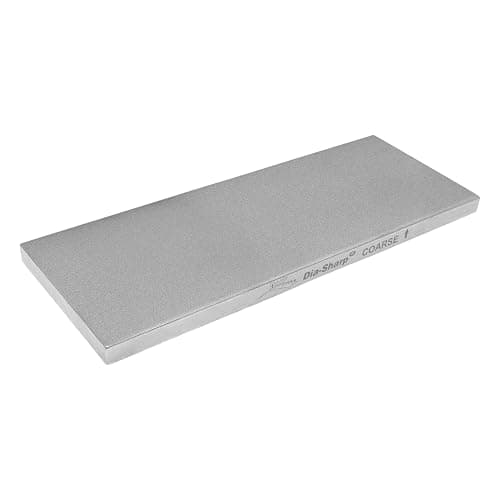
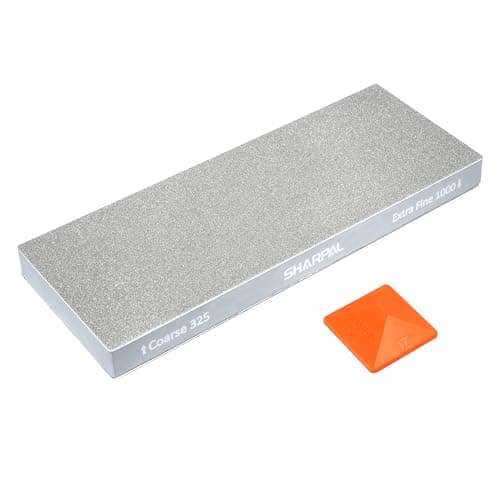
Four plates from the registry are below, with live prices. The full diamond roundup ranks six of them against each other.
The short answer
Quick picks
#ad · Live prices from the Amazon Product API, as of October 17, 2026. Where we have no verified live price we show none — we'd rather leave a gap than print a number that has rotted.
By the numbers
The specs, side by side
Every figure below is the manufacturer's published specification. Where a maker doesn't publish a value, the cell reads "—" rather than a number we made up.
Step by step
How to do it
01
Break in a new plate first
A brand-new diamond plate cuts aggressively because the tallest diamonds sit proud of the bond. Run an old or cheap knife over it for a few minutes before you touch anything good — the high points knock down, the plate settles, and the scratch pattern becomes even. Skipping this is why a first-time user thinks a new plate gouges.
02
Wet the plate — never soak it
Do not put a diamond plate in water to soak; there is nothing in it to absorb water, and a steel-backed plate can rust at the edges if left wet. Splash the surface with water, or add a drop of dish soap to the water to help swarf float clear. Some plates can be used dry, but water keeps the surface cleaner and the stroke smoother.
03
Set the plate on a non-slip base and pick your grit
Put the plate on its rubber frame, pad or a damp towel. Start on the 325-grit coarse side only if the knife is genuinely dull or damaged. For a routine touch-up, start on the fine side (1000 or 1200) — diamond removes metal fast, and starting coarse out of habit shortens the knife's life.
04
Set the angle: about 15 degrees for Japanese, 20 for German
Lay the blade flat, then lift the spine. Roughly 15 degrees per side for a hard Japanese knife, roughly 20 for a softer German or Swiss one — match the factory grind rather than the plate. A clamp-free angle guide, like the one in the Sharpal 168H box, is a useful training aid for holding it steady.
05
Use a fraction of the pressure you would on a water stone
This is the step that separates diamond from everything else. Use roughly the weight of the knife plus a little — enough to keep the bevel in contact, no more. Diamond does not need force to cut, and heavy pressure both tears a ragged edge and strips diamonds off the plate, which is the main way people wear out a plate that should last a decade.
06
Work heel to tip until a burr forms
Push the edge across the plate as if shaving a thin layer off it, covering the full edge from heel to tip. On a chef's knife, lift the handle slightly as you reach the curved belly so the contact point tracks the edge. Sharpen one side until you can feel a tiny wire burr along the whole opposite edge with a fingertip drawn away from the edge — never along it.
07
Match the second side, then step to the fine grit
Flip the knife and repeat at the same angle with the same number of strokes until the burr flips over. Then move to the fine side (1000 or 1200) and make light alternating passes per side to refine the apex and shrink the burr. Diamond at 1200 grit leaves a toothier edge than a 6000-grit water stone — that is normal, and it slices rope, skin and tomatoes beautifully.
08
Remove the burr and finish
Finish with a few very light edge-trailing alternating strokes, or strop on leather, cardboard or a loaded strop, to break off the last of the wire edge. Test on paper: a sharp knife slices clean rather than tearing. Rinse and dry the knife completely.
09
Clean the plate and dry it fully
Rinse the swarf off under running water and scrub with a drop of dish soap and a nylon brush or a kitchen sponge — a loaded plate stops cutting and feels dull, which people often mistake for a worn-out plate. Dry it completely before storing, especially a steel-backed plate.
In detail
The picks, in full
Beginners and angle control
Sharpal 168H Dual-Grit Diamond Sharpening Stone
Diamond plate325 / 10008 × 3 inAngle guide includedNo soak
The beginner's diamond plate: a big 8 × 3 continuous surface, a 4-angle guide in the box, and a published flatness tolerance.
- Cutting speed
- 8
- Feedback
- 6
- Durability
- 9
- Beginner-friendly
- 9
- Value
- 8
Pros
- +Comes with a 4-angle guide, which addresses the single thing beginners actually get wrong — holding a consistent angle
- +Full 8 × 3 in continuous surface gives real room to stabilize a chef's knife, unlike the narrower DuoSharp
- +Sharpal publishes a flatness tolerance of ±0.002 in, which is a specific verifiable claim rather than a marketing adjective
- +1000-grit finishing side goes a step finer than the DMT DuoSharp's 600
Cons
- −A clamp-free angle guide still only gets you close — it is a training aid, not a jig like the Work Sharp Precision Adjust
- −325 is the coarsest side, so this is not the plate for serious edge repair or reprofiling
- −Diamond at 1000 grit still leaves a toothier edge than a 6000-grit water stone
Don't buy this if…
…you already hold a steady angle freehand. The guide is most of what you are paying extra for over the DuoSharp; without it, buy on grit and size instead.
The best value in diamond
DMT FWFC DuoSharp 8" Double-Sided Diamond Stone, Fine/Coarse
Diamond plate325 / 600Double-sidedInterrupted surfaceNo soak
The cheapest way into real diamond sharpening: both useful grits, made in the USA, and it will still be dead flat in a decade.
- Cutting speed
- 8
- Feedback
- 6
- Durability
- 9
- Beginner-friendly
- 8
- Value
- 10
Pros
- +Both grits most kitchen knives ever need, on one plate, for about half what a comparable continuous-surface stone costs
- +Monocrystalline diamond on a flat frame — it never dishes, never needs flattening and never needs soaking
- +The interrupted 'polka dot' surface clears swarf and slurry instead of loading up, so it keeps biting
- +Made in the USA and effectively a buy-once tool
Cons
- −That interrupted surface is a real drawback on kitchen knives — a narrow or pointed blade can catch on the hole edges and the feel is unsettling at first
- −600 grit is the finishing limit, which is a working edge, not a polished one
- −Narrower than the 3-inch plates here at 2 5/8 in, so there is less room to track a long blade
Don't buy this if…
…the catchy feel of a dotted surface will put you off sharpening. Pay more for a continuous plate like the Sharpal 162N or the DMT D8C and you get the same durability with a smoother stroke.
Low-maintenance and fast
Sharpal 162N Dual-Grit Diamond Sharpening Stone
Diamond plate325 / 1200Dual gritNo soakNever dishes
A diamond plate that never dishes, never needs flattening, and doubles as the tool that flattens your water stones.
- Cutting speed
- 9
- Feedback
- 6
- Durability
- 10
- Beginner-friendly
- 8
- Value
- 9
Pros
- +Diamond stays dead flat forever — no dishing, no flattening, no soaking
- +Fast on hard modern steels that wear a water stone down quickly
- +Also flattens your water stones, so it earns its place even if you sharpen on softer stones
Cons
- −Diamond gives a toothier, less polished edge than a fine water stone
- −Coarse/fine only — no true polishing grit for a refined finish
- −Diamond plates lose a little aggression as they break in
Don't buy this if…
…you want a mirror-polished, hair-splitting finish. Diamond tops out toothy; pair it with a 6000-grit water stone or a strop if you want a truly refined edge.
Edge repair, reprofiling and flattening stones
DMT D8C Dia-Sharp 8" Bench Stone, Coarse
Diamond plate325 coarse8 × 3 inContinuous surfaceMade in USA
The repair plate: a single-sided 325-grit continuous diamond surface on steel. Fastest metal removal here, and the tool that flattens all your water stones.
- Cutting speed
- 9
- Feedback
- 6
- Durability
- 10
- Beginner-friendly
- 7
- Value
- 7
Pros
- +Continuous surface means no holes to catch a blade tip — the smoothest stroke of any plate on this page
- +Fastest metal removal here, which is what you want for a chipped edge or a full reprofile
- +Doubles as a lapping plate for every water stone you own, so it earns its place even if you finish on soft stones
- +Monocrystalline diamond on a steel substrate, made in the USA — the most durable construction in the roundup
Cons
- −Single-sided and coarse only, so it cannot finish an edge on its own — you must pair it with something finer
- −Costs more than the double-sided DuoSharp while doing fewer jobs
- −325 grit on a hard thin Japanese edge is aggressive; it is easy to remove more steel than you meant to
Don't buy this if…
…this would be your only stone. It is a specialist first step. If you want one plate that sharpens and finishes, buy the Sharpal 162N or the 168H instead.
Why diamond suits some kitchens and not others
Diamond plates earn their place on three properties: they never dish, so they never need flattening; they do not soak, so there is no ten-minute wait before you can start; and they cut hard steel fast, which matters on knives at ~HRC 60 and above. That combination makes them the low-friction choice for someone who sharpens occasionally and resents setup — and it is why the kit in best knife sharpening kits leans on them.
The trade is feel and finish. A water stone gives more feedback through the handle and takes an edge to a mirror polish at 6000 or 8000 grit; diamond tops out coarser in practice and feels harder, less communicative, under the blade. If you enjoy sharpening, you will probably prefer stones. If you want the edge back in four minutes, diamond wins. Sharpening stone grits explained puts the two grit scales side by side.
The other job a diamond plate does
A coarse diamond plate is also the correct tool for flattening water stones, which dish as they wear. If you own soft stones, a 325-grit or #400 plate earns its keep twice over — how to flatten a whetstone is that procedure, and it is why the single-grit DMT D8C is in the picks above despite not being able to finish an edge on its own.
Three mistakes that ruin a diamond plate
- Soaking it. Pointless at best; at worst it rusts a steel substrate at the edges. Splash only.
- Pressing hard. Strips diamonds and tears the edge. If it is not cutting, clean the plate — do not push harder.
- Leaving it loaded with swarf. Metal paste fills the gaps between diamonds and the plate goes slick. Soap, a brush, and it cuts like new.
If an edge still will not come up after all of this, the problem is almost always that the two bevels have not met at an apex yet — why your knife will not get sharp diagnoses it, and how to remove a burr covers the finish.
How we picked
We do not run a test kitchen
We compiled each product's published specifications — steel, hardness, edge geometry, weight — normalized them into the matrix above, and scored each one against a published rubric. The scores are judgments from those specs and the value math — they are not measurements we took, because we do not have a test kitchen and we're not going to pretend we do. Units we claim to have tested: 0.
Questions
Frequently asked
Do you soak a diamond sharpening stone?+
No. There is nothing in a diamond plate to absorb water, and soaking a steel-backed plate can rust it. Splash the surface with water, optionally with a drop of dish soap, and dry the plate fully afterward.
How much pressure should you use on a diamond stone?+
Far less than on a water stone — roughly the weight of the knife plus a little. Diamond is harder than any knife steel and cuts without force; heavy pressure tears the edge and strips diamonds off the plate.
Why does my new diamond plate feel too aggressive?+
Because it has not been broken in. The tallest diamonds sit proud of the bond on a new plate. Run an old knife over it for a few minutes and the high points knock down, after which the scratch pattern evens out.
What grit diamond stone do I need for kitchen knives?+
A 325-grit coarse side paired with a 1000 or 1200 fine side covers everything a kitchen needs. Use the coarse side only for dull or damaged edges — diamond removes metal quickly.
Can you use a diamond stone dry?+
Most makers allow it, and these four list "water or dry". Water still works better: it floats the swarf clear so the plate keeps biting, and it keeps metal dust out of the air.
How long does a diamond sharpening stone last?+
Years of normal kitchen use, because the plate cannot dish or go out of flat. What kills one is pressure and neglect: stripped diamonds from heavy strokes, or a surface left clogged with swarf.
Receipts
Sources
We do not run a test kitchen, and we do not pretend to. Specs are the manufacturer's published figures, attributed as such; where we could not verify something, we say so on the page rather than quietly leaving it out. Read our full method.