Skip to content
Bevel & Bone

HUB 03 · Guides

Carving Knife vs Slicing Knife

Two long thin blades that most retailers use interchangeably. There is a real difference, and it comes down to length, the tip, and whether the blade face is fluted.

By Stephen V.Updated How we choose
#ad

We earn a commission when you buy through our Amazon links, at no extra cost to you. It never changes a ranking, and we say so when the cheaper knife is the better buy. How this works.

A carving knife is shorter (8–10 in) with a pointed tip, for working around bones and joints on a roast or a bird. A slicing knife is longer (11–14 in), usually with a rounded tip and a granton (fluted) face, for drawing a single clean sheet off a brisket, ham or salmon side. If you buy one, buy an 11-inch granton slicer — it does both jobs well enough, and a carver cannot do the slicer's job at all.

Retailers blur these names constantly, which is why the comparison is confusing: the same blade is sold as a "carving knife" by one brand and a "slicer" by another, and some are labeled both. The specs are not confusing, though, so judge by those rather than by the name on the box.

The specs that actually separate them

SpecCarving knifeSlicing knife
Typical length8–10 in (20–25 cm)11–14 in (28–36 cm)
TipPointed — works into joints and around boneUsually rounded — nothing to catch mid-draw
Blade facePlain or hollow-edgeGranton / fluted far more often
Blade widthSlightly wider, a little more rigidNarrow and thin for low drag
FlexStiffStiff to slightly flexible
Built forRoast chicken and turkey, bone-in leg, rib roastBrisket, ham, pork loin, salmon side, roast beef
Usually sold withA carving fork, as a setOn its own

What a granton edge is for — and is not

Those oval scallops ground into the blade face are a granton edge. They create small air pockets that reduce the suction between a wet cut face and the steel, so a slice releases instead of clinging. On a brisket or a ham it genuinely helps. On a dry roast or an onion it does essentially nothing, and it is not a sharpness feature — the scallops sit above the edge and are untouched when you sharpen. Treat it as a useful convenience on a slicer, and ignore it when it appears on a chef's knife.

What to look for before you buy either

  • Length against what you actually cook. The blade should be longer than the cut is wide, because the ideal is one single draw through the meat. Stop-start strokes are what produce a ragged face. A whole brisket or a large ham wants 11–12 inches; a weeknight chicken is fine with 8–9.
  • A published edge angle. A long thin blade only works if it is genuinely sharp, so a maker stating 14–16° per side is telling you something real. "Ultra-sharp" is not a spec.
  • Granton or not. If you slice wet protein, take it. If you mostly carve roast birds, it is optional.
  • Weight and grip. You are drawing a long blade through something hot and heavy. A textured handle that holds in a greasy hand matters more here than on any other knife in the drawer.
  • Whether you need the fork. A carving set with a fork is the right answer for a gift or a first carving kit; a working cook already owns something to hold the meat steady.

Four options from the registry are below, with live prices — two slicers at 11 and 12 inches, and two carvers at 10 and 9. The full carving roundup ranks six of them against each other.

The short answer

Quick picks

#ad · Live prices from the Amazon Product API, as of October 17, 2026. Where we have no verified live price we show none — we'd rather leave a gap than print a number that has rotted.

By the numbers

The specs, side by side

Every figure below is the manufacturer's published specification. Where a maker doesn't publish a value, the cell reads "—" rather than a number we made up.

Knife / ToolBladeEdgeSteelHardnessConstructionHandle
Mercer Culinary BPX 11" Granton Edge Slicer (M13721)11 in (27.9 cm)Granton, 15° per sideHigh-carbon German stainless, ice-hardenedHRC 57–58Stamped, taper-ground, NSFTextured glass-reinforced nylon
Mercer Culinary Genesis 10" Granton Edge Carving Knife (M21030)10 in (25.4 cm)Granton, 15° per sideHigh-carbon German stainlessHRC 56 ±1Precision forged, full tang, bolster, NSFSantoprene
WÜSTHOF Classic 9" Hollow Edge Carving Knife9 in (23 cm), 1.2 in wideHollow edge, 14° per side (PEtec)X50CrMoV15 high-carbon stainlessHRC 58Forged, full bolster, full tang, triple-riveted, SolingenPOM (polyoxymethylene)
Victorinox Fibrox Pro 12" Granton Edge Slicing Knife11.8 in (30 cm), rounded tipGranton (fluted); angle not publishedHigh-carbon stainless (grade not published)—Stamped, NSF, Swiss made, ~6.2 ozFibrox Pro (TPE)

In detail

The picks, in full

01
Mercer Culinary Mercer Culinary BPX 11" Granton Edge Slicer (M13721)

The best carving knife overall

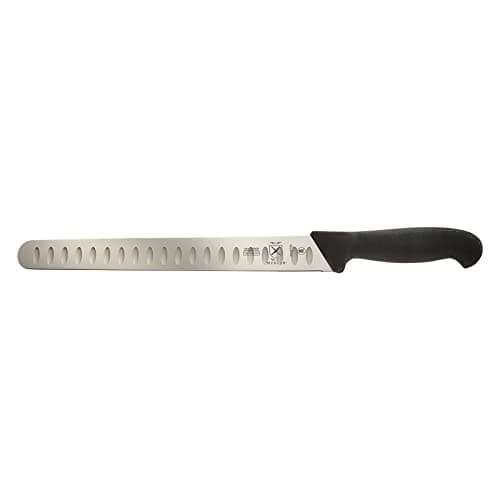
Mercer Culinary BPX 11" Granton Edge Slicer (M13721)

11 in / 27.9 cmGranton edge15° per sideHRC 57–58NSF
8.0/10

An 11-inch granton slicer with a published 15° edge at HRC 57–58, for roughly what a decent roasting pan costs. Nothing else on this page gives you this much carving knife for this little money.

Slicing
8
Edge quality
8
Handling
7
Build
7
Value
10

Pros

  • Mercer publishes both the numbers that matter here — 15° per side at HRC 57–58 — which neither the Victorinox nor the WÜSTHOF Gourmet set will tell you
  • Eleven inches is the length that actually carves a turkey or a brisket in one draw instead of three sawing passes
  • Ice-hardened German stainless at HRC 57–58 sits in the sweet spot: harder than the Swiss and German stamped blades here, still soft enough to bring back on a 1000-grit stone in minutes
  • Stamped and taper-ground means a thin, light blade with no bolster in the way when you sharpen it heel to tip

Cons

  • A commercial-line knife with a plain nylon handle — this is the least handsome object on the page and it will never be a gift
  • Stamped, so there is no heft behind the heel; if you like a knife that feels substantial, the forged Genesis or the WÜSTHOF will suit you better
  • Mercer publishes no weight for this SKU, so that figure is absent here rather than estimated
  • No fork, no sheath, no box — you are buying a blade and nothing else

Don't buy this if…

…the knife is going to sit out on a rack or arrive as a present. This is a working slicer from a professional line, and it looks like one. If the object matters as much as the cut, the WÜSTHOF Classic is the knife you actually want.

$36.86View on Amazon

Price as of October 17, 2026. Prices change — Amazon's is the one that counts.

#ad · we may earn a commission from this link to Mercer Culinary BPX 11" Granton Edge Slicer (M13721)

02
Mercer Culinary Mercer Culinary Genesis 10" Granton Edge Carving Knife (M21030)

A forged carving knife under $100

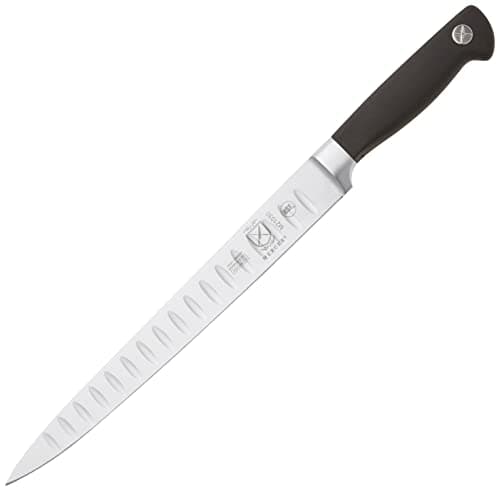
Mercer Culinary Genesis 10" Granton Edge Carving Knife (M21030)

10 in / 25.4 cmGranton edge15° per sideHRC 56 ±1Forged
7.8/10

A genuinely forged, full-tang carving knife with a published 15° edge, at a stamped-knife price. The pick if you want a carver that feels like a real knife in the hand.

Slicing
7
Edge quality
7
Handling
8
Build
8
Value
9

Pros

  • Forged with a full tang and a bolster at a price most makers reserve for stamped blades — the same bargain the Genesis chef's knife has been for years
  • Published 15° per side at HRC 56 ±1, so you know exactly what angle to match on the stone
  • The Santoprene handle stays grippy with hot fat on your fingers, which is the condition a carving knife is actually used in
  • Ten inches suits a normal roast, a leg of lamb or a supermarket turkey without feeling unwieldy on a home board

Cons

  • Ten inches runs out on a whole brisket or a big bird — the Victorinox and the BPX both reach further
  • HRC 56 is the softest steel on this page, so it needs honing more often than the WÜSTHOF or the Shun
  • The bolster adds weight at the heel and gets in the way of sharpening the last inch of edge
  • Mercer publishes no weight or country of manufacture for this SKU, so neither appears here

Don't buy this if…

…you carve big cuts — packer brisket, whole bone-in ham, a 20-pound turkey. Ten inches means extra passes and extra passes mean a ragged cut face. Buy the 11-inch BPX or the 12-inch Victorinox instead.

$49.19View on Amazon

Price as of October 17, 2026. Prices change — Amazon's is the one that counts.

#ad · we may earn a commission from this link to Mercer Culinary Genesis 10" Granton Edge Carving Knife (M21030)

03
WÜSTHOF WÜSTHOF Classic 9" Hollow Edge Carving Knife

A forged carver to hand down

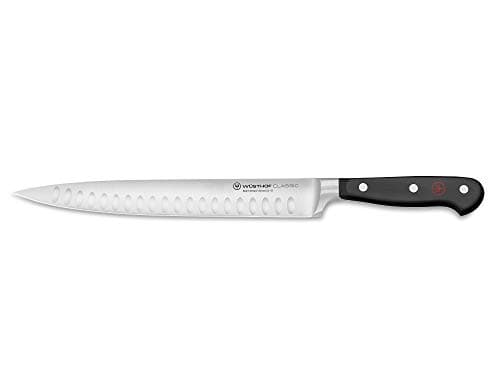
WÜSTHOF Classic 9" Hollow Edge Carving Knife

9 in / 23 cmHollow edge14° per sideHRC 58Full bolster
7.2/10

Forged in Solingen in a 40-step process, tempered to HRC 58 and ground to 14° per side. The heirloom carver, and the heaviest knife here by a wide margin.

Slicing
8
Edge quality
8
Handling
7
Build
10
Value
3

Pros

  • A published 14° per side — the keenest factory angle on this page — at HRC 58, which is a genuinely good combination of sharp and durable
  • Forged from a single blank with a full tang and a full bolster; dealer weight is about 0.57 lb, and it feels every ounce of it in a good way
  • The hollow edge releases wet slices of ham and roast beef better than the plain-faced Gourmet knife does
  • Solingen build with a limited lifetime warranty — this is the knife on the page most likely to outlive its owner

Cons

  • Costs around four times the Mercer BPX for a blade two inches shorter
  • The full bolster runs to the heel, so you cannot sharpen the last inch of edge without grinding the bolster back
  • At roughly 0.57 lb over a 9-inch blade it is the heaviest carver here, and weight is not an advantage when you are drawing through a roast
  • WÜSTHOF does not publish a total weight on the product page, so the figure above is a dealer's

Don't buy this if…

…you want the longest reach for the money. This is a 9-inch knife at a premium price; if the job is a brisket or a 20-pound bird, the Victorinox gives you three more inches for half the outlay.

$170.00View on Amazon

Price as of October 17, 2026. Prices change — Amazon's is the one that counts.

#ad · we may earn a commission from this link to WÜSTHOF Classic 9" Hollow Edge Carving Knife

04
Victorinox Victorinox Fibrox Pro 12" Granton Edge Slicing Knife

Big roasts, whole birds and brisket

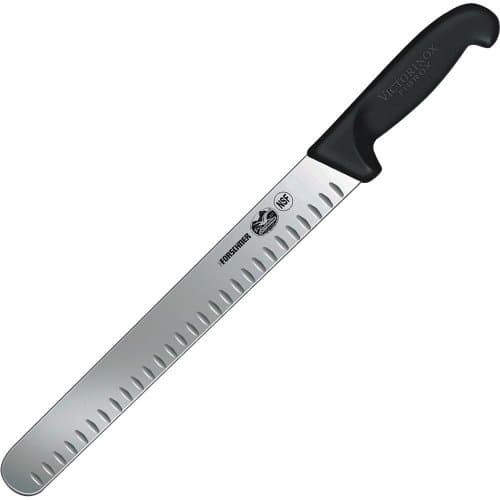
Victorinox Fibrox Pro 12" Granton Edge Slicing Knife

11.8 in / 30 cmGranton edge~6.2 ozRounded tipSwiss made
7.6/10

The long, wide, feather-light slicer that lives on catering benches and carving stations. If you carve big cuts, this is the blade that does it in one draw.

Slicing
9
Edge quality
7
Handling
9
Build
8
Value
5

Pros

  • Nearly 12 inches of blade at about 6.2 ounces — the longest and by some distance the lightest knife here, which is exactly what you want dragging through a roast
  • A wide blade with a rounded tip: more surface to guide the cut, and nothing sharp pointing at the hand steadying the bird
  • The textured Fibrox handle is the best grip on this page with hot fat on your fingers, and it is NSF-certified for a reason
  • Swiss made with a lifetime warranty, and soft enough that a few passes on a stone restore it completely

Cons

  • Victorinox publishes neither a steel grade nor a Rockwell figure for it, so two spec cells here are blank rather than guessed
  • Costs more than double the Mercer BPX for a stamped blade that is not obviously better at the job
  • Soft steel: it takes a lovely edge and does not hold it as long as the Shun or the WÜSTHOF
  • A rounded tip means it cannot do the tip work of separating a leg or following a bone — you still need a boning knife for that

Don't buy this if…

…you only ever carve a chicken or a small roast. Twelve inches on a home cutting board is more knife than the job needs, and the 10-inch Genesis costs far less and handles better at that size.

$86.99View on Amazon

Price as of October 17, 2026. Prices change — Amazon's is the one that counts.

#ad · we may earn a commission from this link to Victorinox Fibrox Pro 12" Granton Edge Slicing Knife

Which one your cooking actually needs

  • Mostly roast chicken and the holiday turkey: a carving knife. You need the point to separate a thigh from a carcass and to work along a breastbone, and 9–10 inches is plenty of blade. How to carve a turkey is the method.
  • Brisket, ham, pork loin, roast beef, salmon: a slicer, and the longer the better. A 12-inch granton blade takes a whole brisket slice in one draw, which is the difference between a clean face and a shredded one.
  • Both, occasionally, and you want one knife: an 11-inch granton slicer. It still works around a bird's joints, just less elegantly, and the extra reach is not something a carver can fake.
  • Neither, often: be honest about this. If you carve a roast twice a year, a well-honed 8-inch chef's knife will get it done — see chef knife vs carving knife and how many kitchen knives do you need.

The blades people confuse these with

Three neighbors are worth separating out:

  • A bread knife is also long and thin, but serrated. The serrations saw through crust and would tear a protein cut face — chef knife vs bread knife and what a bread knife is used for.
  • A boning or fillet knife is short and flexible, for separating meat from bone and skin from fish. The opposite tool — flex is a feature there and a flaw in a carver. Boning knife vs fillet knife.
  • A sujihiki or yanagiba is the Japanese slicer family — long, very thin, very hard steel, and the yanagiba is single-bevel. Superb at the job and far less forgiving; single bevel vs double bevel explains why.

Keeping either one sharp

Long blades reward sharpening more than any other knife shape, because drag accumulates over the length of the draw — a slightly dull 12-inch slicer feels much worse than a slightly dull paring knife. Both of these sharpen like any other double-bevel Western blade: how to sharpen a chef's knife is the method, except that a long straight edge means less rocking and more overlapping sections. Hone before carving, not after, with a rod at least as long as the blade — which for a 12-inch slicer means a 12-inch rod from best honing steels.

The granton scallops need no special treatment; sharpen the edge normally and leave the flutes alone. And store a long thin blade where the edge is protected — a 12-inch slicer loose in a drawer is the fastest way to chip one. Best knife storage has the options, and how to store knives in a drawer covers the cheap fix.

How we picked

We do not run a test kitchen

We compiled each product's published specifications — steel, hardness, edge geometry, weight — normalized them into the matrix above, and scored each one against a published rubric. The scores are judgments from those specs and the value math — they are not measurements we took, because we do not have a test kitchen and we're not going to pretend we do. Units we claim to have tested: 0.

Questions

Frequently asked

What is the difference between a carving knife and a slicing knife?

Length, tip and blade face. A carving knife is 8–10 inches with a pointed tip, for working around bone and joints. A slicing knife is 11–14 inches, usually with a rounded tip and a granton (fluted) face, for drawing one clean slice off a large cut like a brisket or ham.

Can you use a carving knife to slice brisket?

You can, but not well. A 9-inch blade is shorter than a brisket is wide, so you have to saw in overlapping strokes, which leaves a ragged face. A 12-inch slicer takes the same slice in one draw.

Do I need both a carving knife and a slicer?

Most home kitchens do not. If you cook large cuts, buy an 11-inch granton slicer and let it carve birds too. Buy both only if you carve bone-in roasts often enough to want a pointed tip dedicated to the job.

What does a granton edge do on a slicing knife?

The scallops create small air pockets that break the suction between a wet cut face and the blade, so slices release instead of sticking. It genuinely helps on ham, brisket and roast beef, and does little on dry food. It has no effect on sharpness.

Is a slicing knife the same as a bread knife?

No. Both are long and thin, but a bread knife is serrated so it can saw through crust. Serrations tear a protein cut face, which is why a slicer is plain-edged.

Keep reading

Receipts

Sources

We do not run a test kitchen, and we do not pretend to. Specs are the manufacturer's published figures, attributed as such; where we could not verify something, we say so on the page rather than quietly leaving it out. Read our full method.