VG-10 holds an edge noticeably longer; X50CrMoV15 survives abuse and is far easier to sharpen. If one knife has to do everything in a shared kitchen, buy X50CrMoV15. If you sharpen your own knives and cook mostly vegetables and boneless protein, buy VG-10. These are the two default steels in the category: VG-10 is the Japanese stainless that put Tojiro, Miyabi and a dozen other makers on Western counters, and X50CrMoV15 is the German stainless in a Wüsthof Classic, a Zwilling, a Mercer Genesis and a Victorinox Fibrox alike.
The headline difference is carbon. VG-10 carries roughly 1% carbon and is hardened to about HRC 60–61. X50CrMoV15 carries about 0.5% — the "50" in the name is the carbon figure in hundredths of a percent — and is hardened to about HRC 55–58. More carbon means more hard carbides, which means an edge that resists wear. It also means a steel that is less tough, and toughness is what stops an edge chipping.
The two steels, side by side
| Property | VG-10 | X50CrMoV15 |
|---|
| Origin / typical use | Takefu Special Steel, Japan — Japanese kitchen knives | German stainless standard — Solingen and budget forged knives |
| Carbon (nominal) | ~1.0% | ~0.5% |
| Chromium | ~15% — stainless | ~15% — stainless |
| Other notable additions | Cobalt, molybdenum, vanadium | Molybdenum, vanadium |
| Typical hardness as sold | ~HRC 60–61 | ~HRC 55–58 |
| Typical factory edge | ~15° per side | 14–20° per side |
| Edge retention | Long | Short |
| Failure mode | Chips | Rolls |
| Ease of sharpening | Slower; wants a water stone | Fast; comes back on almost anything |
| Corrosion resistance | Good (both are ~15% chromium) | Good |
Both are stainlessat roughly the same chromium level, so neither is a rust risk the way carbon steel is — that comparison is carbon vs stainless steel knives. Figures above are standard published compositions and the makers' own Rockwell claims, not measurements we took.
What to look for when you are choosing between them
- Who else uses the knife. A rolled edge is a ten-second fix on a honing rod. A chip needs a coarse stone and real metal removal. If the knife will be used by someone who scrapes the board with the edge or reaches for it to cut through a squash, buy the steel that rolls.
- Whether you own a stone. VG-10 at HRC 60 asks for a water stone and a steady 15°. X50CrMoV15 comes back on a cheap stone, a guided system or even a pull-through without much drama.
- The grind, not just the steel. A thin VG-10 blade cuts better than a thick one at the same hardness, and a thin X50CrMoV15 blade out-cuts a thick VG-10 one. How much metal sits behind the edge decides how a knife feels more than the alloy does — blade geometry is the mechanism.
- Heat treat, which no label shows. The same X50CrMoV15 at HRC 58 (Wüsthof) and HRC 55 (a budget stamped knife) behaves differently. The alloy is the floor; the heat treatment is the knife. Knife hardness explained covers the scale.
The four knives below are the clearest examples of each steel in the registry, with live prices: one VG-10 core, one Japanese molybdenum-vanadium alternative, and two X50CrMoV15 knives at opposite ends of the price ladder.
The short answer
Quick picks
#ad · Live prices from the Amazon Product API, as of October 17, 2026. Where we have no verified live price we show none — we'd rather leave a gap than print a number that has rotted.
By the numbers
The specs, side by side
Every figure below is the manufacturer's published specification. Where a maker doesn't publish a value, the cell reads "—" rather than a number we made up.
In detail
The picks, in full
The best value in a Japanese knife
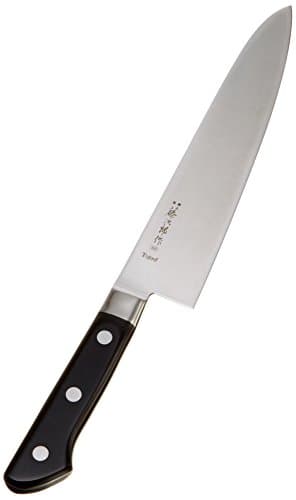
Tojiro DP Gyuto 210 mm Chef's Knife
8.3 in / 210 mmVG-10 core~HRC 60~15° edge3-layer clad
The cheapest honest way into a real VG-10 Japanese knife. It punches absurdly far above its price.
- Edge retention
- 8
- Out-of-box edge
- 8
- Handling
- 8
- Build
- 7
- Value
- 10
Pros
- +A genuine VG-10 cutting core at a price the German knives can't touch — this is the value story of the category
- +Harder than any German blade here, so it holds a keen edge far longer
- +Thin, flat-ish profile suits push-cutting and precise work
Cons
- −The Western handle is basic and a little blocky — you're paying for the steel, not the fit and finish
- −Harder steel chips if you twist it through bone or freeze; treat it with respect
- −Reactive-ish edge on the very hard core wants drying after acidic food
Don't buy this if…
…this is the only knife in a household that abuses knives. VG-10 rewards good habits and punishes bad ones — a Victorinox is the more forgiving choice for a shared kitchen.
The best overall, if budget allows
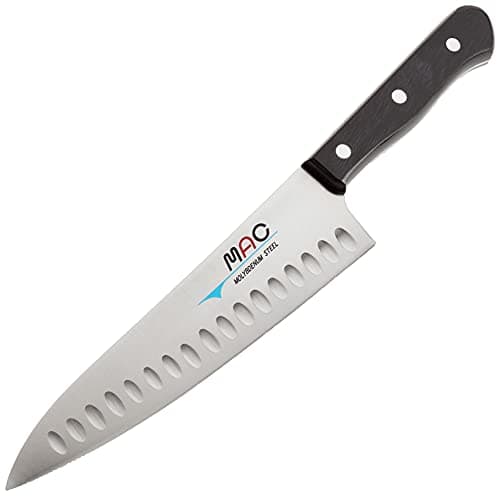
Mac Mth-80 Professional Hollow Edge 8" Chef's Knife
8 in / 20 cmMolybdenum-vanadium~HRC 59–61~15° edgeDimpled
The knife a lot of cooks quietly consider the best all-rounder made. Thin, sharp, and it stays that way.
- Edge retention
- 9
- Out-of-box edge
- 9
- Handling
- 9
- Build
- 8
- Value
- 7
Pros
- +The blade is unusually thin, so it falls through produce with almost no wedging
- +Harder Japanese-style steel than the German knives — holds its edge markedly longer
- +The dimples (granton edge) genuinely reduce sticking on starchy vegetables
- +Takes and holds a very acute edge
Cons
- −No full bolster; the pinch grip sits right at the blade — some find it exposed
- −Harder steel is a little less forgiving of lateral abuse than soft German steel
- −Costs several times a Victorinox and looks almost as plain
Don't buy this if…
…you're rough with your knives — you pry, twist, or hit bone. Harder, thinner steel chips where soft German steel just rolls. Buy the Wüsthof or the Victorinox and treat it like a hatchet if you must.
A do-everything German workhorse
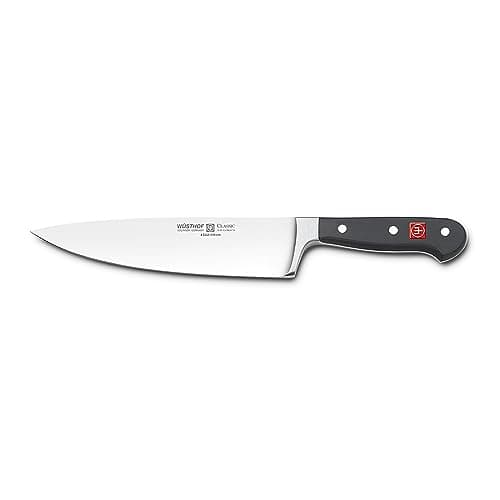
Wüsthof Classic 8" Chef's Knife
8 in / 20 cmX50CrMoV15~HRC 5814° per sideForged
The archetypal German chef knife. Heavy, tough, forgiving, and it will outlive you if you hone it.
- Edge retention
- 7
- Out-of-box edge
- 7
- Handling
- 7
- Build
- 9
- Value
- 7
Pros
- +Forged from a single billet with a full bolster and full tang — the reference for a durable German blade
- +Wüsthof's newer 14°-per-side edge is noticeably keener than the old 20° grind
- +Tough enough to shrug off the abuse a home cook actually inflicts
- +Triple-riveted POM handle is essentially indestructible
Cons
- −Heavy — a real workout over a long prep session
- −The full bolster eventually blocks the heel and complicates sharpening the whole edge
- −Full retail price is high; it's frequently the knife people overpay for
Don't buy this if…
…you want a light, nimble knife or you have smaller hands. This is a heavy German blade by design — the MAC or Tojiro will feel far more agile.
A forged knife on a budget
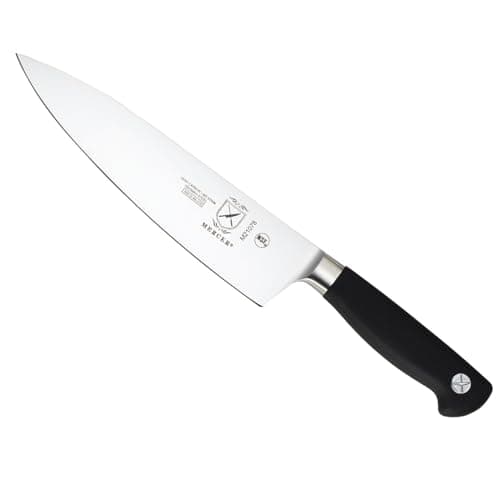
Mercer Culinary Genesis 8" Chef's Knife
8 in / 20 cmX50CrMoV15~HRC 56ForgedSantoprene handle
A forged, full-bolster German knife at a stamped-knife price. The value pick if you want heft.
- Edge retention
- 6
- Out-of-box edge
- 7
- Handling
- 8
- Build
- 8
- Value
- 9
Pros
- +Genuinely forged with a full tang — heft and balance closer to a Wüsthof than to its price tag
- +Short bolster leaves the whole edge usable and makes it easier to sharpen heel-to-tip
- +Grippy, ergonomic Santoprene handle that survives a commercial kitchen
Cons
- −Same soft German steel as the Victorinox, so edge retention is only average
- −Heavier than a stamped blade — a plus for some hands, a minus for others
Don't buy this if…
…you want the lightest possible knife. This is a deliberately hefty German-style blade; if you like a nimble Japanese feel, the Tojiro is the better call at a similar price.
Reading past the marketing names
Steel names are a minefield of branding, so a few translations:
- "High-carbon German stainless" almost always means X50CrMoV15 or something close to it. Nearly every kitchen knife on earth is high-carbon stainless; the phrase tells you very little.
- VG-MAX is Kai's proprietary evolution of VG-10, used in Shun's Classic line at ~HRC 60–61. It behaves like VG-10 for every practical purpose discussed here.
- FC61 is Miyabi's fine-carbide stainless at ~HRC 60 — another high-carbon Japanese steel in the same behavioral family.
- "Damascus" is cladding, not the cutting steel. A 68-layer Damascus knife has a VG-10 or VG-MAX core doing all the work; the layers are soft stainless and decoration. Damascus steel knives explained unpicks it, and that is why cladding counts never appear in our spec matrices.
- "Molybdenum-vanadium" — MAC's phrasing — is a Japanese high-carbon stainless hardened to ~HRC 59–61. Same family of behavior as VG-10 at a lower price.
The useful habit is to ignore the name and look for three published numbers: the steel designation, a Rockwell figure, and an edge angle per side. A maker who publishes all three is willing to be measured against them. How to tell if a knife is good quality is the full checklist, and the knife steel guide covers every alloy on this site.
Sharpening each one
VG-10: ~15° per side, 1000-grit water stone to set the edge, 6000 to finish, ceramic rod rather than a cut-steel one between sharpenings. It takes longer to raise a burr than German steel does, and it rewards the patience with an edge that lasts. Stones for Japanese knives is the shortlist.
X50CrMoV15: ~20° per side is a sensible everyday angle even on a knife ground at 14°, because the wider edge is harder to roll on soft steel. It comes up fast on a 1000-grit stone — this is the steel to learn freehand sharpening on, which is exactly why a Victorinox Fibrox Pro leads easiest knives to sharpen. Hone it before most sessions with a fine steel rod from best honing steels.
The answer most kitchens land on
Own both. A hard VG-10-class knife for slicing and precision prep, and a cheap tough X50CrMoV15 blade for bone, squash, frozen edges and anything a guest might pick up. Two knives bought that way cost less than one premium blade and remove the only real risk of owning hard steel — which is the same conclusion Japanese vs German knives reaches from the other direction, and the setup professional kitchens settled on decades ago.
If you only want one, and you want it to be in the right steel: read best chef knives, which ranks both families against each other, and are Japanese knives worth it for the honest case on both sides.
How we picked
We do not run a test kitchen
We compiled each product's published specifications — steel, hardness, edge geometry, weight — normalized them into the matrix above, and scored each one against a published rubric. The scores are judgments from those specs and the value math — they are not measurements we took, because we do not have a test kitchen and we're not going to pretend we do. Units we claim to have tested: 0.
Questions
Frequently asked
Is VG-10 better than X50CrMoV15?+
For edge retention, yes — VG-10 carries about twice the carbon and is hardened to ~HRC 60–61 against X50CrMoV15's ~HRC 55–58. For toughness, ease of sharpening and surviving a careless kitchen, X50CrMoV15 is better. Neither is better overall; they fail differently.
What does X50CrMoV15 mean?+
It is a German steel designation: X marks a high-alloy steel, 50 is the carbon content in hundredths of a percent (~0.5%), and CrMoV lists chromium, molybdenum and vanadium, with 15 being the approximate chromium percentage — which is what makes it stainless.
Does VG-10 rust?+
It is stainless at roughly 15% chromium, the same as X50CrMoV15, so it resists rust well. Neither is immune: leave either wet overnight, or in a dishwasher, and you can get spotting. Rinse and dry after use.
Is VG-MAX the same as VG-10?+
Not identical, but closely related. VG-MAX is Kai's proprietary development of VG-10 used in Shun's Classic line at ~HRC 60–61. In how it sharpens and how it fails, treat it as VG-10.
Which steel is easier to sharpen?+
X50CrMoV15, clearly. Softer steel abrades faster, so a burr forms in fewer strokes and comes up on almost any stone. VG-10 takes longer to sharpen and holds the result longer.
Receipts
Sources
We do not run a test kitchen, and we do not pretend to. Specs are the manufacturer's published figures, attributed as such; where we could not verify something, we say so on the page rather than quietly leaving it out. Read our full method.