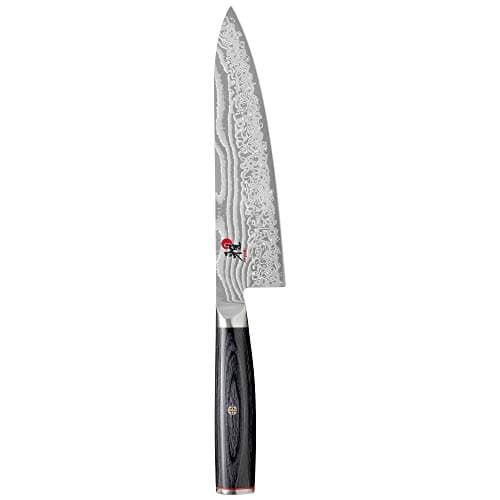
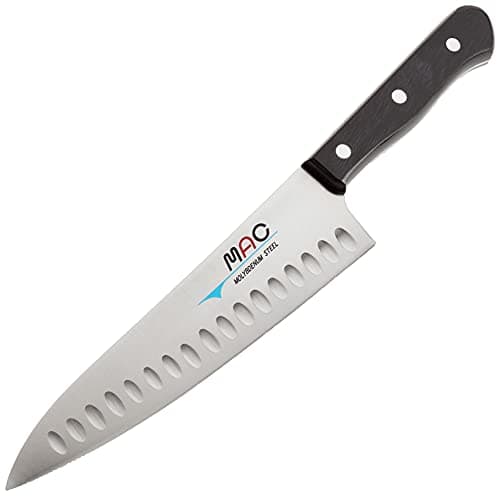
Buy the MAC MTH-80. The Miyabi Kaizen II is the better object and the sharper edge out of the box, and the MAC is the better knife to actually own. Both are Japanese, both run molybdenum-vanadium-class stainless in the HRC 59–61 band, and both are ground far thinner than any German knife at the same price. The MAC costs substantially less, weighs ~6.5 oz against the Miyabi's ~7.9 oz, and sits at ~15° per side — an angle you can maintain freehand without a jig. The Miyabi's hand-honed Honbazuke bevel at ~9.5–12° is genuinely keener and genuinely more fragile, and the first time you sharpen it you will not reproduce it.
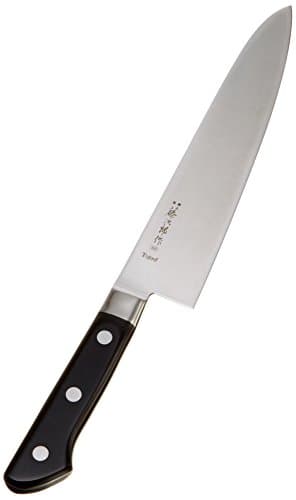
If your budget is below both, the third knife in the table — the Tojiro DP gyuto, a real VG-10 core at ~HRC 60 for a fraction of either — is the honest answer, and we say so on best Japanese chef knives too.
The specs, side by side
| Spec | MAC MTH-80 | Miyabi Kaizen II 8" |
|---|
| Steel | Molybdenum-vanadium high-carbon | FC61 fine-carbide stainless |
| Hardness (maker-stated) | ~HRC 59–61 | ~HRC 60 |
| Edge angle | ~15° per side | ~9.5–12° per side (Honbazuke) |
| Construction | Thin stamped blade, Pakkawood handle | Forged, Micarta handle |
| Blade face | Hollow-edge (dimpled) granton | Plain forged flat |
| Weight | ~6.5 oz (184 g) | ~7.9 oz (224 g) |
| Handle shape | Symmetric Pakkawood | Symmetric Micarta |
Both handles are symmetric, which matters: neither of these is a right-handed D-shape, so left-handed cooks are not paying a penalty here the way they are with a Shun Classic. See best chef knives for left-handed cooks.
Why the hardness numbers are a wash and the angle is not
~HRC 59–61 and ~HRC 60 are the same band. Nothing in edge retention separates these two knives meaningfully, which is the first surprise when people compare them expecting the price to buy longevity. What the price buys is the bevel: Miyabi grinds a three-step hand-finished edge down to roughly 10°, and MAC grinds a machine bevel at roughly 15°.
A 10° edge enters food with less resistance. It also has less steel behind the apex to support it, so it is the most chip-prone geometry in this registry. At 15° the MAC gives up a sliver of that glide and gets back an edge that tolerates a board, a shared kitchen and an imperfect stroke. Knife sharpening angle runs the full math on what each degree costs and buys.
The practical difference: resharpening
This is the part that decides it. Every knife is a factory edge for about a month and your own edge for the rest of its life. You can hold ~15° per side freehand on a 1000-grit stone with a little practice — how to sharpen a chef's knife is the method. You cannot hold 10° freehand, and if you sharpen the Miyabi at 15° like a normal knife — which is what most owners end up doing — you have paid the Honbazuke premium for one month of it.
So the honest framing is: the Miyabi is worth its price if you own a guided system or a very steady hand and you intend to preserve that bevel. Otherwise the two knives converge on the same edge within a year, and one of them cost a lot less. Guided vs freehand sharpening is the deciding read.
The dimples, honestly
The MAC's hollow-edge granton face is marketed as food release. It helps a little on wet starchy slices and it does nothing on an onion. It is not a reason to buy or avoid the knife — what is a granton edge is the unexcited version. What actually makes the MAC cut is that the blade is thin behind the edge, which is the spec no maker advertises and the one that decides how a knife feels; blade geometry is the mechanism.
Where each one wins
- MAC MTH-80 — buy this one. Lightest of the three, thinnest grind for the money, ~15° you can maintain, symmetric handle, and the quiet default among cooks who buy with their own money. The catch: MAC publishes less than Zwilling does, the stamped blade and plain Pakkawood look like nothing, and the dimples are a matter of taste.
- Miyabi Kaizen II — buy if you will protect the bevel. The keenest factory edge here and a properly forged, better-finished object. The catch: ~10° chips, it is the heaviest of the three, and it needs a careful owner, a ceramic rod and a water stone.
- Tojiro DP gyuto — buy if the budget says so. A real VG-10 core at ~HRC 60, three-layer clad, ~15° per side, 210 mm, for far less than either. The catch: bare-bones fit and finish, and VG-10 punishes bad habits the same way.
Whichever you pick, pair it with something tough for bone, squash and guests. Two knives — one hard and thin, one cheap and forgiving — is the setup nearly every kitchen we would point at actually runs, and it costs less than one premium blade. How many kitchen knives do you need makes that case properly.