Skip to content
Bevel & Bone

HUB 01 · Chef Knives

Miyabi vs Wüsthof

Rival Solingen houses, opposite philosophies. One is the keenest factory edge you can buy; the other is a knife you hand to your grandchildren. Here is which one belongs in your kitchen.

By Stephen V.Updated How we choose
#ad

We earn a commission when you buy through our Amazon links, at no extra cost to you. It never changes a ranking, and we say so when the cheaper knife is the better buy. How this works.

Buy the Wüsthof Classic 8" unless you already sharpen on a stone — then buy the Miyabi Kaizen II. That is the whole decision. The Wüsthof is X50CrMoV15 forged in Solingen to ~HRC 58 behind a stated 14° per side: heavy, tough, forgiving, and it rolls instead of chipping when someone in your house hits a chicken bone with it. The Miyabi is FC61 fine-carbide stainless at ~HRC 60 ground by hand to a dramatic ~9.5–12° per side — the keenest edge in this entire registry, and the least tolerant of a careless owner. Neither is better. They are built for different cooks.

If you want the short version of why those two numbers matter: hardness buys edge retention and costs you toughness, and bevel angle buys cutting ease and costs you edge stability. Wüsthof spends its budget on toughness; Miyabi spends it on the edge. Everything below is that one trade, worked out in detail. The third knife in the table — the MAC MTH-80— is there because a lot of people asking this question actually want the middle: ~HRC 59–61 behind ~15°, for noticeably less than either.

The specs, side by side

SpecMiyabi Kaizen II 8"Wüsthof Classic 8"
SteelFC61 fine-carbide stainlessX50CrMoV15 stainless
Hardness (maker-stated)~HRC 60~HRC 58
Edge angle~9.5–12° per side (hand-honed Honbazuke)14° per side (Precision Edge Technology)
ConstructionForged, Micarta handle, no bolsterForged, full tang, full bolster, triple-riveted
Weight~7.9 oz (224 g)~9.0 oz (255 g)
Handle shapeSymmetric Micarta — works in either handSymmetric POM — works in either hand
Made inSeki, JapanSolingen, Germany

Those are published figures, not measurements we took — we do not run a test kitchen and the rubric page says exactly that.

The short answer

Quick picks

#ad · Live prices from the Amazon Product API, as of October 17, 2026. Where we have no verified live price we show none — we'd rather leave a gap than print a number that has rotted.

By the numbers

The specs, side by side

Every figure below is the manufacturer's published specification. Where a maker doesn't publish a value, the cell reads "—" rather than a number we made up.

Knife / ToolBladeSteelHardnessEdgeConstructionWeight
Miyabi Kaizen II 8" Chef's Knife8 in (20 cm)FC61 fine-carbide stainless~HRC 60~9.5–12° per side (Honbazuke)Forged, Micarta handle~7.9 oz (224 g)
Mac Mth-80 Professional Hollow Edge 8" Chef's Knife8 in (20 cm)Molybdenum-vanadium high-carbon~HRC 59–61~15° per sideThin stamped blade, Pakkawood handle~6.5 oz (184 g)
Wüsthof Classic 8" Chef's Knife8 in (20 cm)X50CrMoV15 stainless~HRC 5814° per side (Precision Edge Technology)Forged, full tang, full bolster~9.0 oz (255 g)

In detail

The picks, in full

01
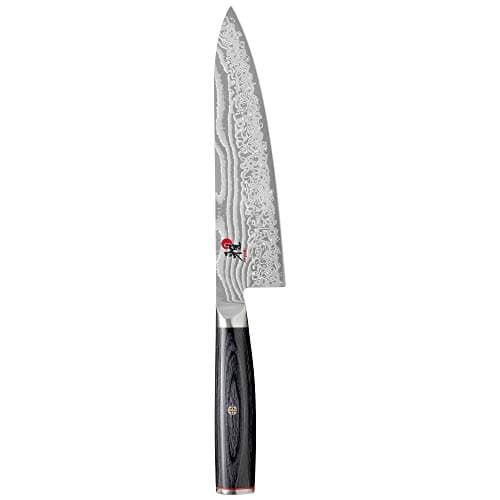
Miyabi Miyabi Kaizen II 8" Chef's Knife

The keenest factory edge here

Miyabi Kaizen II 8" Chef's Knife

8 in / 20 cmFC61 steel~HRC 60~9.5–12° edgeHonbazuke
8.4/10

Zwilling's Japanese line: a very hard, very acute edge with a hand-finished Honbazuke bevel.

Edge retention
9
Out-of-box edge
10
Handling
8
Build
9
Value
6

Pros

  • The hand-honed three-step Honbazuke edge is one of the most acute factory edges you can buy
  • Hard FC61 steel keeps that edge far longer than any German knife
  • Beautifully finished — this is a knife you look forward to using

Cons

  • A very acute, hard edge is the most chip-prone geometry in this roundup
  • Expensive, and the returns are diminishing versus a Tojiro if you don't sharpen well

Don't buy this if…

…you can't yet sharpen a Japanese edge on a stone. A 10° edge this hard needs correct maintenance; without it you'll chip it and won't be able to fix it. Start on the Tojiro or Victorinox.

$169.95View on Amazon

Price as of October 17, 2026. Prices change — Amazon's is the one that counts.

#ad · we may earn a commission from this link to Miyabi Kaizen II 8" Chef's Knife

02
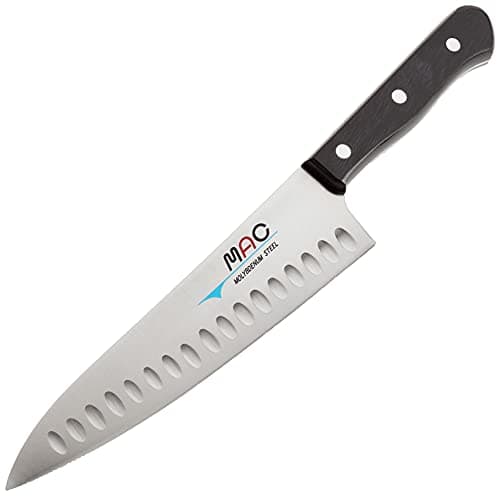
Mac Mac Mth-80 Professional Hollow Edge 8" Chef's Knife

The best overall, if budget allows

Mac Mth-80 Professional Hollow Edge 8" Chef's Knife

8 in / 20 cmMolybdenum-vanadium~HRC 59–61~15° edgeDimpled
8.4/10

The knife a lot of cooks quietly consider the best all-rounder made. Thin, sharp, and it stays that way.

Edge retention
9
Out-of-box edge
9
Handling
9
Build
8
Value
7

Pros

  • The blade is unusually thin, so it falls through produce with almost no wedging
  • Harder Japanese-style steel than the German knives — holds its edge markedly longer
  • The dimples (granton edge) genuinely reduce sticking on starchy vegetables
  • Takes and holds a very acute edge

Cons

  • No full bolster; the pinch grip sits right at the blade — some find it exposed
  • Harder steel is a little less forgiving of lateral abuse than soft German steel
  • Costs several times a Victorinox and looks almost as plain

Don't buy this if…

…you're rough with your knives — you pry, twist, or hit bone. Harder, thinner steel chips where soft German steel just rolls. Buy the Wüsthof or the Victorinox and treat it like a hatchet if you must.

$119.95View on Amazon

Price as of October 17, 2026. Prices change — Amazon's is the one that counts.

#ad · we may earn a commission from this link to Mac Mth-80 Professional Hollow Edge 8" Chef's Knife

03
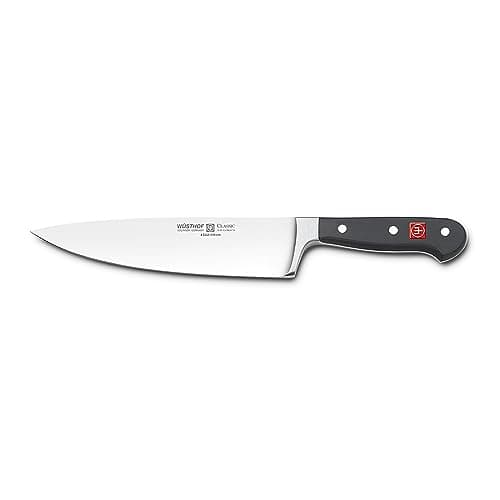
Wüsthof Wüsthof Classic 8" Chef's Knife

A do-everything German workhorse

Wüsthof Classic 8" Chef's Knife

8 in / 20 cmX50CrMoV15~HRC 5814° per sideForged
7.4/10

The archetypal German chef knife. Heavy, tough, forgiving, and it will outlive you if you hone it.

Edge retention
7
Out-of-box edge
7
Handling
7
Build
9
Value
7

Pros

  • Forged from a single billet with a full bolster and full tang — the reference for a durable German blade
  • Wüsthof's newer 14°-per-side edge is noticeably keener than the old 20° grind
  • Tough enough to shrug off the abuse a home cook actually inflicts
  • Triple-riveted POM handle is essentially indestructible

Cons

  • Heavy — a real workout over a long prep session
  • The full bolster eventually blocks the heel and complicates sharpening the whole edge
  • Full retail price is high; it's frequently the knife people overpay for

Don't buy this if…

…you want a light, nimble knife or you have smaller hands. This is a heavy German blade by design — the MAC or Tojiro will feel far more agile.

$170.00View on Amazon

Price as of October 17, 2026. Prices change — Amazon's is the one that counts.

#ad · we may earn a commission from this link to Wüsthof Classic 8" Chef's Knife

Two degrees of hardness is a bigger difference than it reads

HRC 58 to HRC 60 looks like a rounding error on a page. In the hand it is the difference between a knife that rolls its edge and a knife that chips it. A softer German blade deforms under a lateral load — the edge folds over, you straighten it on a honing rod in ten seconds, and nothing is lost. A harder Japanese blade does not fold; past its elastic limit it breaks, and a chipped edge needs a coarse stone and real metal removal to fix. That is the entire reason professional kitchens full of shared knives run soft steel, which why restaurant cooks use cheap knives goes into. Knife hardness explained covers the scale itself.

The flip side is real too. At ~HRC 60 behind a sub-12° bevel, the Miyabi stays sharp through far more cutting than the Wüsthof will, and it enters food with less force. If you prep a lot of vegetables, you will feel it on the first onion. The cost is that you own a knife with rules.

The bolster is the sharpening story

The Wüsthof Classic has a full bolster: the forged collar runs all the way down to the heel. It adds heft and a finger guard, and it blocks the last half-inch of edge from ever touching a stone, so over years of sharpening the heel develops a recurve. It is a known annoyance rather than a defect, and the fix is a sharpener willing to work the heel on a stone edge. The Miyabi is bolsterless — the whole edge is reachable heel to tip. If this specific thing bothers you and you still want German, the Zwilling Pro's curved bolster solves it; Wüsthof vs Zwilling is that comparison on its own.

Weight, and why a gram count decides this for some people

The Wüsthof is ~9.0 oz; the Miyabi ~7.9 oz; the MAC ~6.5 oz. An ounce does not sound like anything until you have broken down twenty pounds of squash. German cooks will tell you the mass does the work for you on hard produce — true, and it is also the reason people with smaller hands or any joint pain reach for the lighter blade. If weight is the deciding factor rather than steel, best lightweight chef knives and best kitchen knives for arthritis rank on exactly that axis.

What maintenance each one actually demands

  • Wüsthof Classic: hone before most sessions on a fine steel rod, sharpen on a 1000-grit stone a couple of times a year, keep it off the dishwasher rack. Forgiving of a dull stretch; it still cuts when neglected. ~20° is a fine everyday angle for it even though the factory grind is 14°.
  • Miyabi Kaizen II: hone on a ceramic rod, not a steel one, and sharpen at ~15° per side on a water stone rather than chasing the factory 12° freehand. Never bone, never frozen, never a glass board, never a drawer without an edge guard. If you will not do this, the Miyabi will be the most expensive dull knife you own — stones for Japanese knives is the shortlist.

Which to buy

  • Buy the Wüsthof if this is the household's main knife, if more than one person uses it, if it will meet bone or squash or frozen edges, or if you have no intention of learning a stone. It is the lower-risk purchase by a wide margin and it carries a lifetime warranty against defects.
  • Buy the Miyabi if you already sharpen, you cook mostly vegetables and boneless protein, and you want the keenest edge money buys. Buy it as a second knife beside something tough, not as a kitchen's only blade.
  • Buy the MAC MTH-80 if you want most of the Japanese cutting story — ~HRC 59–61, ~15° per side, a very thin grind — for meaningfully less money, and you can live with a plain-looking stamped blade and a dimpled granton face.

One more honest note: the single biggest upgrade available to anyone reading this is not the knife. A Wüsthof honed weekly out-cuts a Miyabi that has not seen a stone since it was unboxed, and it is not a close contest. Before you spend the difference, read sharpening vs honing and buy a stone from best knife sharpening kits. Then decide which of these two you want.
How we picked

We do not run a test kitchen

We compiled each product's published specifications — steel, hardness, edge geometry, weight — normalized them into the matrix above, and scored each one against a published rubric. The scores are judgments from those specs and the value math — they are not measurements we took, because we do not have a test kitchen and we're not going to pretend we do. Units we claim to have tested: 0.

Questions

Frequently asked

Is Miyabi better than Wüsthof?

Neither is better — they are built for different owners. The Miyabi Kaizen II holds a keener edge longer (FC61 at ~HRC 60 behind ~9.5–12° per side), and the Wüsthof Classic survives abuse better (X50CrMoV15 at ~HRC 58 behind 14°). If one knife has to do everything in a shared kitchen, buy the Wüsthof.

Are Miyabi and Wüsthof the same company?

No. Miyabi is owned by Zwilling J.A. Henckels, which is Wüsthof's direct Solingen rival rather than its parent. So the two knives come from competing German houses — Miyabi's blades are made in Seki, Japan under Zwilling ownership.

Can you sharpen a Miyabi at home?

Yes, on a water stone. Do not try to reproduce the factory Honbazuke bevel freehand — set ~15° per side on a 1000-grit stone and finish on 6000. A carbide pull-through sharpener will destroy the edge geometry you paid for.

Does the Wüsthof full bolster matter?

It matters over years. The full bolster blocks the heel of the edge from reaching a flat stone, so the heel sharpens less than the rest of the blade and slowly develops a recurve. Zwilling's Pro line solves it with a curved bolster if that bothers you.

Which one is better for a beginner?

The Wüsthof, comfortably — and a Victorinox Fibrox Pro before either, if you are learning to sharpen. Hard thin steel punishes the mistakes beginners actually make: lateral pressure, scraping food off the board with the edge, and dishwashers.

Keep reading

Receipts

Sources

We do not run a test kitchen, and we do not pretend to. Specs are the manufacturer's published figures, attributed as such; where we could not verify something, we say so on the page rather than quietly leaving it out. Read our full method.