Skip to content
Bevel & Bone

HUB 02 · Sharpening

Combination Honing Steels Explained

A combination rod promises two tools in one shaft. Here is what each surface really does, when the idea works, and the simpler setup we would buy instead.

By Stephen V.Updated How we choose
#ad

We earn a commission when you buy through our Amazon links, at no extra cost to you. It never changes a ranking, and we say so when the cheaper knife is the better buy. How this works.

A combination honing steel is one rod carrying two different surfaces — typically a coarse-cut or diamond-coated section for light metal removal and a fine-cut or ceramic section for realigning the edge. The verdict: for a kitchen, buy a plain fine-cut steel rod and, if you own hard Japanese knives, a 1200-grit ceramic rod alongside it. We do not stock a combination rod, and this page says why rather than inventing one to sell you.

The reason the idea sounds good is that honing and sharpening feel like the same motion, so a tool that does both seems efficient. They are not the same job. Honing straightens an edge that has rolled over; sharpening removes steel to create a new apex. Sharpening vs honing is the full distinction and it is worth reading first, because almost every bad honing-rod purchase comes from confusing the two.

What each surface on a rod actually is

  • Fine-cut steel (the classic hone). Shallow longitudinal grooves machined into a hardened steel rod — Victorinox calls its grade a "fine cut (#5)". It bends a rolled edge back straight and removes almost no metal. This is the correct everyday tool for a German or Swiss knife and the one you should use before most cooking sessions.
  • Standard or coarse-cut steel. Deeper grooves, more bite. It realigns faster and scratches the bevel more. On soft steel it is tolerable; on a hard thin Japanese edge it is destructive.
  • Ceramic. A fired ceramic rod with a published grit — Mercer states 1200 grit. It is genuinely abrasive, so it lightly refreshes an edge rather than only straightening it, and it is gentler on hard steel than any cut-steel rod. Ceramic vs steel honing rod is that choice on its own.
  • Diamond-coated. Industrial diamond bonded to a rod. This is not a hone at all — it is a sharpening tool in a hone's shape, and it removes real metal every pass. Used daily it will eat a knife.

Why combining them on one shaft usually goes wrong

Three practical problems, in the order they bite:

  1. You cannot see which surface you are on. Honing is a fast, half-attention motion done with a wet hand before service. A rod with a coarse band and a fine band invites you to run eight passes on the wrong one, which over a year is measurable metal gone from the blade.
  2. The usable length halves. A honing rod needs to be longer than the blade — a 10-inch rod suits an 8-inch chef's knife with room to spare. Split a 10-inch rod into two 5-inch zones and neither zone can take a full-length stroke, so you end up honing in sections and producing an uneven edge.
  3. The coarse half answers a question a stone answers better. If an edge needs metal removed, it needs a stone and a controlled angle, not a freehand pass on a rod at whatever angle your wrist found. A whetstone does that job properly and does not pretend to be two tools.

There is one case where the concept is genuinely useful, and it is not a kitchen: field and butchery work, where carrying a second tool is the cost you are trying to avoid. In a kitchen with a drawer, the second tool is free.

What to look for instead

Four specs decide a honing rod, and only four:

  • Length. Longer than your longest blade. A 10-inch rod covers an 8-inch chef's knife; a 12-inch rod covers a slicer or a carving knife too. This is the spec people get wrong most often — a 9-inch rod on an 8-inch knife leaves you no margin at the tip.
  • Surface. Fine cut for everyday honing. Ceramic if your knives are Japanese and hard. Skip coarse and skip diamond unless you specifically want a sharpening tool.
  • Guard and grip. A real finger guard between handle and rod, and a handle that holds in a wet hand. You are swinging a steel bar past your knuckles; this is not a cosmetic spec.
  • Profile. Round is forgiving and the default. Oval presents more surface per pass and is slightly faster. Neither is wrong.

The three rods below are what we would buy against those four criteria — one classic fine-cut steel, one 1200-grit ceramic for hard knives, and one lifetime-grade German rod. Prices are live and date-stamped.

The short answer

Quick picks

#ad · Live prices from the Amazon Product API, as of October 17, 2026. Where we have no verified live price we show none — we'd rather leave a gap than print a number that has rotted.

By the numbers

The specs, side by side

Every figure below is the manufacturer's published specification. Where a maker doesn't publish a value, the cell reads "—" rather than a number we made up.

Knife / ToolTypeLengthSurfaceHandle
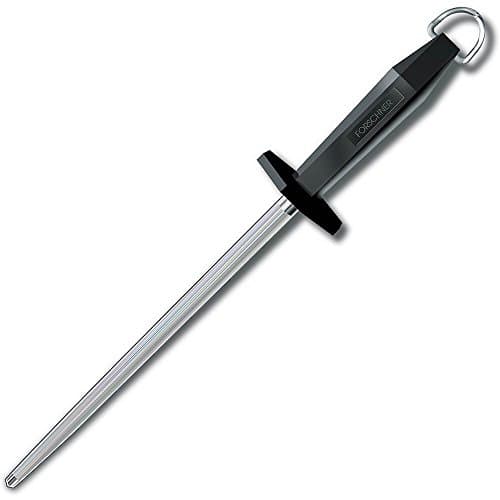
Victorinox 10" Fine Cut Honing Steel (40581)Fine-cut steel rod (round, 7/16 in diameter)10 in (25 cm) rodFine cut (#5)Black polyamide with finger guard and hanging ring
Mercer Culinary 12" Ceramic Honing RodCeramic rod12 in rod (19.1 in overall)Fine, 1200 gritErgonomic nylon with hand guard
Wüsthof 10" Sharpening SteelFine-cut steel rod10 in (26 cm) rodFine cutTriple-riveted POM

In detail

The picks, in full

01
Victorinox Victorinox 10" Fine Cut Honing Steel (40581)

The default honing steel

Victorinox 10" Fine Cut Honing Steel (40581)

Steel rod10 inFine cutPolyamide handleMagnetic tip
8.4/10

A no-nonsense fine-cut steel from the people who make the default chef's knife. Cheap and correct.

Realignment
8
Build
8
Ease of use
9
Versatility
7
Value
10

Pros

  • Fine cut realigns a rolled edge without stripping metal — exactly what a hone should do
  • 10 inches is long enough for an 8-inch chef's knife with room to spare
  • A finger guard between handle and rod, plus a hanging ring — a plain working-kitchen tool

Cons

  • A honing steel maintains an edge; it does not sharpen a dull one (people forget this constantly)
  • Steel rods won't touch very hard Japanese blades the way a ceramic rod will

Don't buy this if…

…your knives are hard Japanese steel (HRC 60+). A traditional steel rod barely bites on them — a fine ceramic rod is the right hone for hard blades.

$42.10View on Amazon

Price as of October 17, 2026. Prices change — Amazon's is the one that counts.

#ad · we may earn a commission from this link to Victorinox 10" Fine Cut Honing Steel (40581)

02
Mercer Culinary Mercer Culinary 12" Ceramic Honing Rod

Honing hard Japanese blades

Mercer Culinary 12" Ceramic Honing Rod

Ceramic rod12 in1200 gritNylon handleHand guard
8.0/10

The hone for hard Japanese knives. A fine ceramic rod actually bites where a steel rod slides off.

Realignment
8
Build
8
Ease of use
9
Versatility
9
Value
6

Pros

  • Mercer publishes a 1200-grit ceramic surface — abrasive enough to lightly refresh a hard edge, not just realign it
  • 12-inch rod suits long chef's and slicing knives
  • Nylon handle with a full hand guard and non-slip grip — the safest rod here to use with wet hands

Cons

  • The priciest rod in this roundup by some way, for a job a cheap steel rod does on soft German knives
  • Ceramic is brittle — drop it and it can crack or chip
  • Hand wash only; Mercer says don't put it in the dishwasher or leave it soaking

Don't buy this if…

…your knives are soft German steel and you already hone daily with a steel rod. The ceramic's advantage only shows up on hard blades; on soft steel a plain steel rod is fine — and a quarter of the price.

$68.69View on Amazon

Price as of October 17, 2026. Prices change — Amazon's is the one that counts.

#ad · we may earn a commission from this link to Mercer Culinary 12" Ceramic Honing Rod

03
Wüsthof Wüsthof 10" Sharpening Steel

Matching a German knife set

Wüsthof 10" Sharpening Steel

Steel rod10 inFine cutPOM handleMade in Germany
8.0/10

The steel that matches the classic German knife. Well-made, well-balanced, and it'll last forever.

Realignment
8
Build
9
Ease of use
9
Versatility
7
Value
7

Pros

  • Beautifully balanced and built like the Wüsthof knives it's meant to accompany
  • Fine cut is gentle on an edge — daily honing without eating your blade
  • A genuine lifetime tool

Cons

  • You pay a German-brand premium for what a Victorinox rod does equally well
  • Same limitation as any steel rod: it won't bite on very hard blades

Don't buy this if…

…you just want the function. The Victorinox steel hones just as well for less; buy the Wüsthof if you want the matching set on your counter.

$65.00View on Amazon

Price as of October 17, 2026. Prices change — Amazon's is the one that counts.

#ad · we may earn a commission from this link to Wüsthof 10" Sharpening Steel

The two-rod setup, and why it costs less than you think

If you own a mix of German and Japanese knives — which most kitchens do, and Japanese vs German knives explains why that mix is the right answer — the honest replacement for a combination rod is two cheap single-purpose rods: a fine-cut steel for the German blades and a ceramic for the Japanese ones. Together they often cost less than one marketed combination rod, each one is unambiguous in the hand, and each is full-length.

How often, and the actual motion

Hone a soft German knife before most cooking sessions and a hard Japanese knife every few sessions at most. Five or six light alternating passes per side is plenty — honing is not a workout, and twenty hard passes do damage rather than extra good. How to hone a knife has the stroke, the angle and the common mistakes, and how often should you sharpen a knife sets the schedule for the real sharpening that a rod cannot do.

When a rod stops working

A hone straightens an edge; it cannot rebuild one. If honing no longer restores the bite, the apex is gone and the knife needs a stone — that is the signal, not a reason to hone harder. How to tell if a knife is sharp is the paper test, and honing steel vs whetstone draws the line between the two tools. If an edge is chipped rather than dull, no rod of any description will help; how to fix a chipped knife edge is the repair.


How we picked

We do not run a test kitchen

We compiled each product's published specifications — steel, hardness, edge geometry, weight — normalized them into the matrix above, and scored each one against a published rubric. The scores are judgments from those specs and the value math — they are not measurements we took, because we do not have a test kitchen and we're not going to pretend we do. Units we claim to have tested: 0.

Questions

Frequently asked

What is a combination honing steel?

A single rod carrying two different surfaces along its length — usually a coarse-cut or diamond-coated section that removes a little metal and a fine-cut or ceramic section that realigns the edge. The idea is one tool for both jobs.

Are combination honing steels any good?

For kitchen use, rarely. You cannot easily tell which surface you are on mid-stroke, each zone is too short for a full-length pass on an 8-inch blade, and the coarse half does a job a whetstone does far better. Two single-surface rods are clearer and usually cheaper.

What length honing steel do I need?

Longer than your longest blade. A 10-inch rod suits an 8-inch chef's knife; go to 12 inches if you also hone a slicer or carving knife. Never shorter than the blade — you will run out of rod at the tip.

Should I use a steel or a ceramic rod?

Fine-cut steel for soft German and Swiss knives; ceramic for hard Japanese knives at ~HRC 60 and above, because it is less likely to chip a thin, hard edge and lightly refreshes it rather than only bending it straight.

Does honing sharpen a knife?

A cut-steel rod does not — it straightens a rolled edge and removes almost no metal. A ceramic or diamond rod is abrasive and does remove a little, which makes a ceramic rod a mild sharpener and a diamond rod a real one.

Keep reading

Receipts

Sources

We do not run a test kitchen, and we do not pretend to. Specs are the manufacturer's published figures, attributed as such; where we could not verify something, we say so on the page rather than quietly leaving it out. Read our full method.