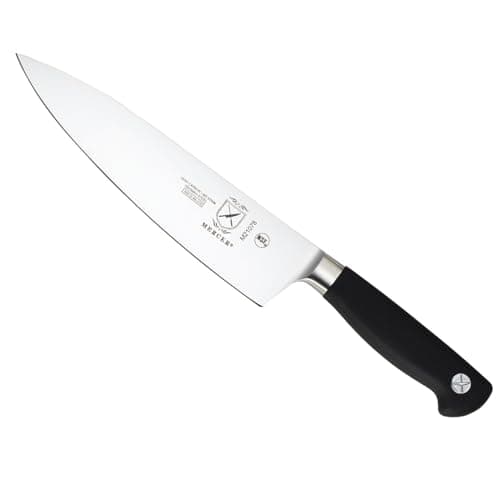
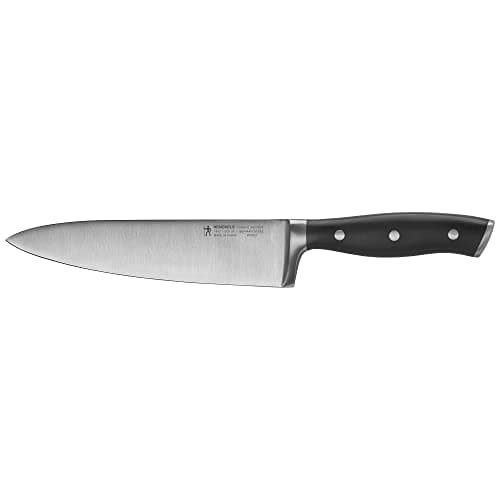
Buy the Mercer Genesis if you intend to sharpen the knife yourself; buy the Henckels Forged Accent if you want the more finished object and a narrower factory edge. Both are forged German stainless with a full tang, both sit in the X50CrMoV15 class, and both weigh ~8.5 oz. The Henckels is ~HRC 57 behind a ~15° edge with a full bolster. The Mercer is ~HRC 56 behind a ~20° edge with a short bolster that leaves the heel of the edge reachable on a stone, plus an NSF certification and a Santoprene handle built for wet commercial hands.
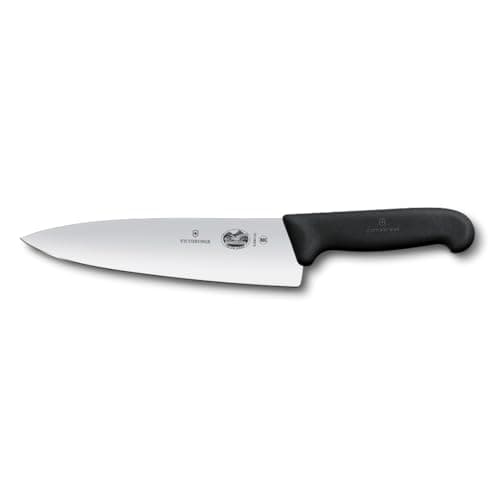
The third knife is the honest control: a stamped Victorinox Fibrox Pro costs less than either and out-cuts both out of the box. If forged construction is not actually what you want, that is the knife.
The specs, side by side
| Spec | Henckels Forged Accent 8" | Mercer Genesis 8" |
|---|
| Steel | German stainless (X50CrMoV15 class) | X50CrMoV15 German stainless |
| Hardness (maker-stated) | ~HRC 57 | ~HRC 56 |
| Edge angle | ~15° per side | ~20° per side |
| Construction | Forged, full tang, full bolster | Forged, full tang, short bolster |
| Handle | Triple-riveted polymer | Santoprene — grips wet |
| Weight | ~8.5 oz (241 g) | ~8.5 oz (241 g) |
| Certification | — | NSF-certified |
First: check which Henckels you are looking at
"Henckels" is two brands wearing one surname. Zwilling J.A. Henckels (the two-figure twins logo) is the premium Solingen line. J.A. Henckels International (the single figure) is the value line, largely made outside Solingen. The Forged Accent is the honest middle of that second family: genuinely forged, full tang, German stainless at ~HRC 57, cheaper than a Zwilling Pro. Neither brand is a scam; the confusion is the problem, because people pay premium attention to a budget knife. Zwilling vs Henckels untangles it properly.
The bolster decides this for most buyers
A full bolster runs the forged collar all the way down past the heel. It adds mass, gives you a finger guard, and physically prevents the last half-inch of the edge from touching a flat stone. Sharpen a full-bolster knife for years and the heel sharpens less than the rest, which is how a recurve develops.
Mercer's short bolster stops above the heel, so the whole edge reaches the stone. It is the single most practical difference between these two knives and the reason the Mercer is the one on culinary-school tool lists, where students are taught to sharpen on day one. Knife bolster explained covers the mechanics, and how to sharpen a chef's knife shows the stroke the bolster gets in the way of.
One HRC point and five degrees
~HRC 57 versus ~HRC 56 is inside the noise — you will not feel it. The angles are more interesting: ~15° on the Henckels against ~20° on the Mercer. On paper the Henckels enters food more easily. In practice both are soft enough that you will re-establish your own angle within a year of owning either, and 20° on ~HRC 56 steel is the more robust pairing for a knife that meets squash and chicken bone. Knife sharpening angle explains why wider is not worse on soft steel.
Handles: polished rivets or a wet grip
The Henckels' triple-riveted polymer handle looks like a traditional German knife and feels more expensive. Mercer's Santoprene is a textured thermoplastic that holds in a wet, greasy hand — the same reasoning behind Victorinox's Fibrox. If the knife lives in a busy kitchen, grip beats looks. If it lives on a magnetic strip in a quiet one, take the looks. Knife handle materials explained goes through all of them.
Which to buy
- Mercer Genesis — buy this if you will sharpen it, if it will be used hard or by several people, or if you want NSF certification and a grip that works wet. It is the better working knife and the better value, and it leads best chef knives for culinary school. The catch: utilitarian finish and a wider factory edge.
- Henckels Forged Accent — buy this if you want the more finished German object with a finger guard and a narrower factory edge, and you are happy to have a sharpener work the heel for you. The catch: the full bolster, and the brand-name confusion above.
- Victorinox Fibrox Pro — buy this if, after reading the two above, "forged" turns out not to be what you actually wanted. It cuts as well, weighs two ounces less, costs less and sharpens faster.
All three are soft-steel German-style knives, which means all three want a honing rod on the counter rather than in a drawer. Pick one from best honing steels and use it before most sessions; that habit matters more than which of these three you bought.