Nearly every "best kitchen knives" list is really a list of chef's knives, or a list of blocks. This one is neither. The question a real buyer is asking is which knives do I actually need, and what is the best one for each job— so that is what this page answers, one pick per job, in the order worth buying them.
The short version: a chef's knife, a paring knife and a serrated bread knife do roughly 95% of the cutting in a home kitchen. All three can be bought, excellently, for less than the price of one mid-range Japanese knife. Everything after that is a specialist that earns its drawer space only if you do the thing it is for.
The criteria: how we chose, and what we refused to weigh
A cross-category page needs honest rules, because the specs that decide a chef's knife are not the specs that decide a bread knife.
- Fitness for one job, not versatility. Each pick had to be the best answer to a specific task. A knife that is second-best at three jobs loses to one that is first at its own.
- Published specs only. Every figure in the table is a manufacturer-published claim. Where a maker does not publish a value, the cell reads "—" rather than a number we guessed. That is also why this page runs four spec columns instead of the usual six: hardness, weight and handle material are not published consistently across seven blade families, and a matrix with invented cells is worse than a shorter one.
- Value weighted hard. In several of these categories the cheap knife genuinely wins, and we say so rather than reaching for a premium pick to make the list look expensive. Three of the seven picks below cost less than a restaurant main.
- Sharpenable at home. A knife you cannot maintain is a knife that is excellent for a year and mediocre forever after. Soft-to-medium steels that come back on an ordinary stone were preferred where the job did not demand hardness.
- What we deliberately did not weigh: looks, sets and brand. Nothing here was chosen to match anything else. If visual coherence matters to you, that is a legitimate preference and best chef knife sets is the page for it — but a matching block costs more and gives you knives nobody uses.
Why three knives, and why not a block of fifteen
This is the single most useful thing on the page, so it goes before the picks.
A knife block is priced as a bundle and built around the slots, not around cooking. A fifteen-piece set typically contains eight steak knives, a pair of shears, a honing rod, and four or five knives of which you will use two. You are paying for the block and the filler, and the per-knife quality is lower than if you had bought three knives separately for the same money. Knife set vs open stock runs the arithmetic, and how many kitchen knives do you need is the honest count.
The three jobs that genuinely need separate tools are bulk work on a board(a chef's knife: length, weight, a belly to rock), close work in the hand (a paring knife: short, light, pointed), and cutting through a hard crust into a soft interior (a serrated bread knife: teeth that bite rather than compress). No single blade does all three, and no fourth job is as unavoidable as those.
Spend what you save on a stone. A sharp inexpensive knife out-cuts a dull expensive one every single time, which is the finding this whole site keeps arriving at — best sharpening stones is the shortlist and the beginner stones is where to start.
The three that matter
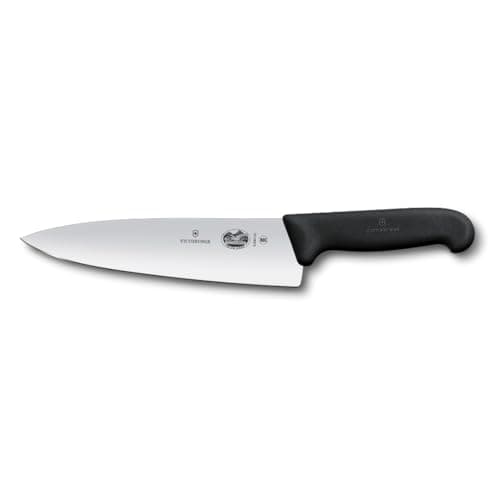
1. The chef's knife — Victorinox Fibrox Pro 8". Published at X50CrMoV15 stainless, ~HRC 55–56, a ~20° edge, stamped with a full-length tang, ~6.6 oz, Swiss made and NSF-certified. It arrives genuinely sharp, the textured Fibrox handle grips with wet hands, and the soft-ish steel is the easiest in this lineup to learn to sharpen on — which matters more over ten years than the edge retention it gives up. It is the default answer to "what is a good first chef's knife" for a reason. Honest cons: you will hone it often and sharpen it more frequently than a hard Japanese blade; the stamped blade lacks the heft and bolster some cooks want; and nothing about it is beautiful. Our full Fibrox Pro review has the detail.
If you want to spend more on this slot, do it here and only here. The chef's knife is the one place in the kitchen where a premium blade earns its money, because it does the most cutting and the most demanding cutting. The MAC MTH-80 is our overall number one on best chef knives— thinner, harder at ~HRC 59–61, ground near 15° — and the Tojiro DP is the value route into real Japanese steel. Best chef knives under $100 covers the middle ground.
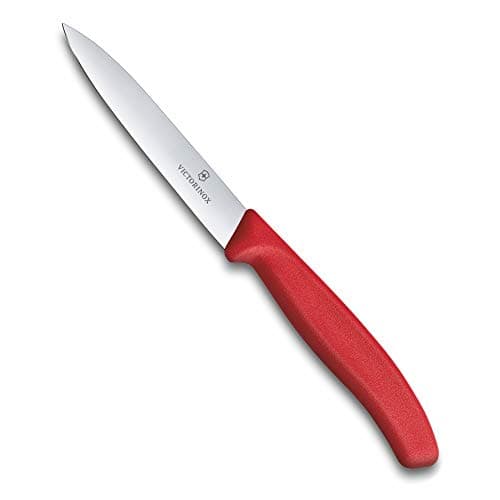
2. The paring knife — Victorinox Swiss Classic 4". Victorinox publishes a 3.9 in blade, 8.3 in overall and a weight of 1 oz, with a polypropylene handle, a straight edge and a pointed tip, Swiss made, dishwasher safe, under a lifetime warranty. This is the category where expensive steel stops paying for itself: paring cuts are short and shallow, so edge retention and blade thinness barely signify, while weight and wet grip decide everything. It is also cheap enough to own two, which matters because paring knives get lost. Honest cons: plain stamped blade and plastic handle, nothing substantial about it; the soft steel dulls sooner than a hard blade (though it sharpens back in moments); Victorinox publishes no steel grade or Rockwell figure for this model; and the thin tip snaps if you lever with it. Our full Victorinox paring knife review covers the blade-shape choice and the dishwasher question.
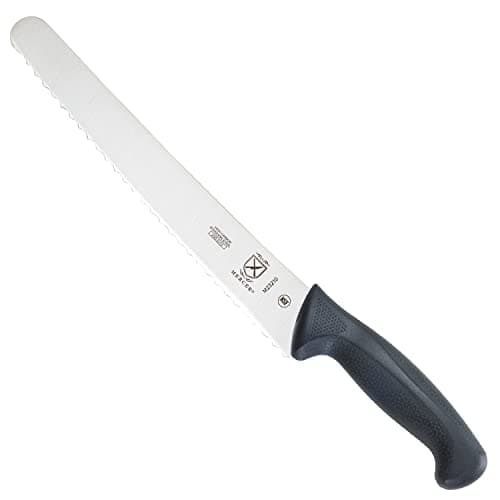
3. The bread knife — Mercer Culinary Millennia 10". A 10 in blade in high-carbon Japanese stainless with a wide wavy serration, stamped one-piece, with a Santoprene handle. The wide wave is the spec that matters: broad, shallow scallops saw through a hard crust without compressing the crumb underneath, where narrow pointed serrations tear it. Ten inches gives you enough length to cross a sourdough loaf in one stroke, which is what stops you sawing. Honest cons: a serrated edge is effectively not home-sharpenable without specialist kit, so this is a consumable on a long timescale rather than a lifetime knife; the stamped blade and molded handle are purely functional; and Mercer publishes no hardness figure for it. See best bread knives and do you need a bread knife.
Those three. If you buy nothing else, you are equipped for essentially everything a home kitchen does, and you have spent less than one mid-range Japanese chef's knife costs.
The four worth adding, in order
Each of these is a specialist. Buy it if you do the thing, and skip it cheerfully if you do not — an unused knife is not a bargain at any price.
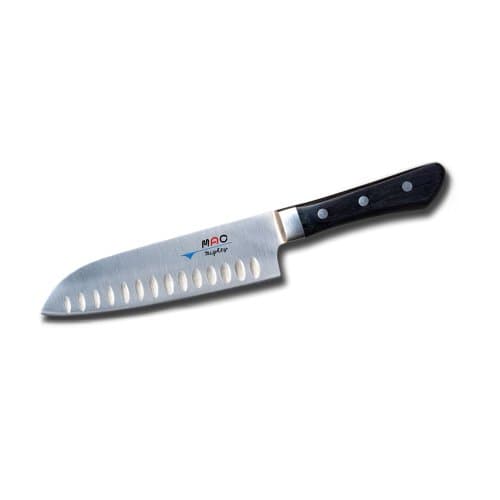
4. The vegetable knife — Mac Professional 6.5" Santoku (MSK-65). Published as high-carbon molybdenum-vanadium at ~HRC 59–61, ground to ~15° per side with a hollow dimpled edge, a thin blade with a bolster and a Pakkawood handle. Buy this if most of your prep is vegetables. A santoku's flatter profile suits push-cutting and chopping rather than rocking, the 6.5 in length is more maneuverable than 8 in on a crowded board, and the dimples genuinely reduce the suction that makes wet potato and cucumber slices cling to the blade. Honest cons:the blunt sheepsfoot tip will not pierce or core, and 6.5 in is not enough blade to break down a squash or a chicken; hard thin steel chips if you twist it or hit bone; the smooth Pakkawood handle is less secure wet than a textured polymer one; and it costs several times the Victorinox chef's knife above it. Full MSK-65 review, and santoku vs nakiri if you are weighing the flatter, taller alternative.
5. The utility knife — Mercer Culinary Millennia 6". A 6 in straight edge at ~15° per side in high-carbon Japanese stainless at ~HRC 53–54, stamped one-piece. This is the sandwich knife, the cheese knife, the one-tomato knife — the blade for the jobs too big for a paring knife and too small to justify washing the chef's knife. It is the most-used knife in a lot of kitchens and almost never the one people buy. Honest cons:it is genuinely redundant if you are disciplined about using the two knives you already own; ~HRC 53–54 is the softest steel on this page and needs frequent honing; and it is the definition of a plain working tool. Best utility knives and paring knife vs utility knife settle whether you need both.
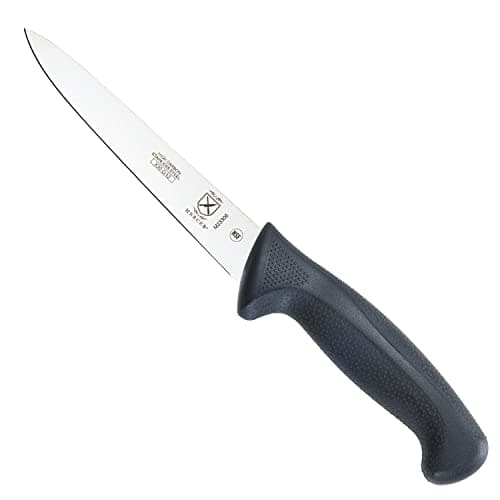
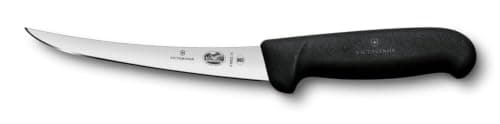
6. The boning knife — Victorinox Fibrox Pro 6" Curved, Semi-Stiff. A 6 in curved blade in X50CrMoV15, graded semi-stiff, stamped with a Fibrox Pro TPE handle at ~3.4 oz, Swiss made and NSF-certified. Buy this if you break down chicken, trim your own roasts or fillet fish. Flex grade is the whole category: semi-stiff is the right compromise, firm enough to drive along a bone and flexible enough to follow a curve, where a fully stiff blade fights you on poultry and a fully flexible one wanders on a shoulder. Honest cons: Victorinox publishes no edge angle for it, so that cell is blank; a specialist you will not touch if you buy meat already butchered; and the narrow blade demands respect, as it goes through a finger as readily as a joint. Best boning knives and boning knife vs fillet knife.
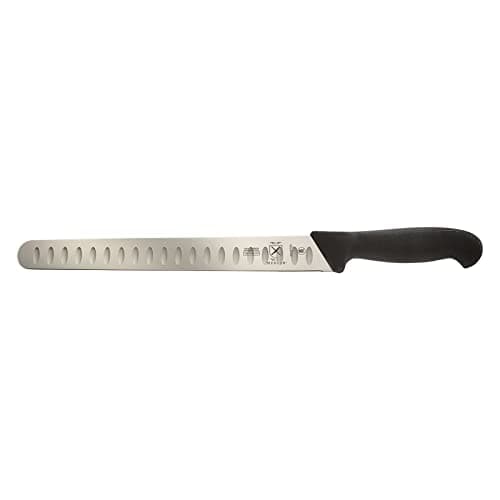
7. The slicer — Mercer Culinary BPX 11" Granton Edge (M13721). An 11 in blade in ice-hardened high-carbon German stainless at HRC 57–58, ground to 15° per side with a Granton (hollow-ground) edge, stamped and taper-ground, NSF-certified. Buy this if you cook roasts, brisket or a holiday turkey. The length lets you cross a large joint in one pull rather than sawing, and the Granton scallops break the suction that makes thin slices of meat stick and tear. Honest cons: an 11 in blade is awkward to store and useless for anything but slicing; it is a few-times-a-year knife in most homes; and the Granton edge does nothing at all on dry or fibrous food, so do not buy it expecting a general upgrade. Best carving knives, what is a Granton edge and how to carve a turkey.
What we left off, and why
Steak knives. A table purchase rather than a prep one, bought as a set and chosen on whether you want straight or serrated edges. Genuinely worth owning, just not part of a working lineup — best steak knives is the separate ranking.
A cleaver. Two different tools share the name: a thin, tall Chinese chef's knife you slice with, and a heavy Western chopper you split bone with. Both are specialists, and most people who think they want one want a nakiri instead. Best cleavers if you genuinely do.
A second chef's knife in a different length. A 6 in chef's knife is a real preference for smaller hands and a 10 in one is a real preference for volume cooking, but neither is an addition to a lineup — they are substitutions. Chef knife sizes explained covers the choice.
Shears, a honing rod and a block. Shears are genuinely useful and are not a knife. A honing rod is maintenance rather than cutting, and it is the accessory we would buy before any of picks 4 to 7 — best honing steels. A block is furniture; a magnetic strip or an in-drawer tray protects edges for less money and less counter space, per best knife storage.
The order to buy in, on a real budget
Start with the chef's knife and a stone. Those two purchases together change your cooking more than any other combination at any price. A good chef's knife kept sharp is the whole game.
Add the paring knife next — it is the cheapest item here and the second-most-used.
Then the bread knife, if you buy bread with a crust. If you buy sliced bread, skip it and come back when you do not.
Then a honing rod, which keeps all three sharp between sharpenings and costs less than any knife on this page.
Only then the specialists, and only the ones matching what you actually cook. If you cannot name the last three times you would have used a boning knife, you do not need a boning knife.
Upgrade, do not accumulate. When you outgrow the Victorinox chef's knife — which happens to people who cook a lot, and never happens to plenty of excellent cooks — replace it rather than adding to it. Best chef knives for the money is the upgrade path, and are expensive chef knives worth it is the honest answer to whether you should.
German or Japanese, if you are choosing a direction
Two of these picks are Swiss, three are German-style and two are Japanese, which is deliberate rather than indecisive: the right steel depends on the job.
Softer European steel (X50CrMoV15 at ~HRC 55–58, ground near 20°) rolls instead of chipping, tolerates abuse, and comes back to sharp in minutes on any stone. It is the right choice for a shared kitchen, for a boning knife that meets bone, and for anyone who has not sharpened a knife before.
Harder Japanese steel (HRC 60 and up, ground near 15° or below) holds a keener edge for far longer and cuts more cleanly through dense produce — and chips rather than rolls when mistreated, and needs a stone rather than a pull-through. Japanese vs German knives is the full comparison and are Japanese knives worth it is the buying decision.
The practical rule: put the hard steel where the precision matters (the chef's knife, the vegetable knife) and the soft steel where toughness and replaceability matter (paring, boning, bread). That is exactly the pattern above.
Keeping them sharp, which decides everything
A lineup of seven dull knives is worse than three sharp ones, and a knife spends most of its life somewhere between the two.
Hone weekly, sharpen a few times a year. Honing realigns an edge that has rolled over and removes almost no metal; sharpening cuts a new edge and removes steel permanently. Sharpening vs honing is the distinction most people have backwards, and how often should you sharpen a knife gives the realistic interval.
Match the tool to the steel. A grooved steel rod works on the European blades here and barely bites the Mac at ~HRC 60, which wants a fine ceramic rod instead — ceramic vs steel honing rod. Serrated bread knives take neither. A lineup like this one is also the single best case for a selectable-angle electric — the Chef'sChoice 1520 has separate 15° and 20° stages precisely so a mixed drawer does not have to be forced onto one angle.
Use a board that is kinder than the knife. Wood or soft plastic. Glass, stone and ceramic destroy edges faster than cutting does — wood vs plastic cutting board.
Keep almost all of them out of the dishwasher. The one defensible exception on this page is the Victorinox paring knife, which Victorinox itself lists as dishwasher safe. Everything else, hand wash and dry — can you put knives in the dishwasher and knife care and storage.
The verdict
Buy the Victorinox Fibrox Pro 8" chef's knife, the Victorinox Swiss Classic 4" paring knife and the Mercer Millennia 10" bread knife, and a stone to keep them sharp. That is a complete, genuinely good kitchen for less than the price of one premium Japanese chef's knife, and it will out-cut a fifteen-piece block at twice the money.
Add the Mac MSK-65 santoku if most of your prep is vegetables, the Mercer utility knife if you make a lot of sandwiches, the Victorinox boning knife if you break down your own meat, and the Mercer BPX slicer if you carve roasts. Add none of them if you do none of those things, and spend the money on better ingredients instead. If you would rather upgrade than expand, put every spare dollar into the chef's knife slot — it is the only one where premium reliably outperforms cheap.