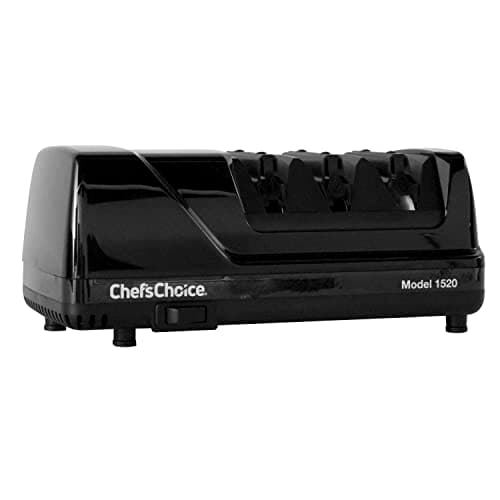
Almost every electric knife sharpener has one angle built into it, and that angle decides which of your knives it is allowed to touch. The Chef'sChoice 1520 is the exception we rank: it has a separate 15° stage and a separate 20° stage, both running 100% diamond abrasives, plus a third flexible stropping stagethat polishes whichever edge you just cut. Chef'sChoice publishes it as a three-stage machine, measures it at 9.5 × 4 × 4 in, states no honing oil or water is needed, and backs it with a three-year limited warranty. It is engineered and assembled in the USA.
That angle choice is genuinely useful and genuinely dangerous, and this review spends most of its length on why. An electric sharpener is a motor with abrasive discs: it does what you point it at, quickly and permanently. Point the 15° stage at a Wüsthof and you have just started reprofiling a German knife whether you meant to or not.
What Chef'sChoice publishes
The 1520 is current, in production, and sold by Chef'sChoice directly as the AngleSelect Professional Electric Knife Sharpener (item 0115200). The published specification:
- Stage 1: 100% diamond abrasives, sharpens the edge of 15° Asian-style knives.
- Stage 2: 100% diamond abrasives, sharpens the edge of 20° American and European-style knives.
- Stage 3: a flexible stropping and polishing disc that finishes both15° and 20° edges.
- Angle guidance: built-in spring-loaded precision angle guides hold the blade against the disc.
- Lubricant: none — no honing oil and no water.
- Dimensions: 9.5 × 4 × 4 in.
- Warranty: three-year limited.
- Origin: engineered and assembled in the USA.
Chef'sChoice lists the machine as suitable for American, European and Asian household knives, fine-edge and serrated blades, santoku, traditional single-bevel Japanese knives including thicker deba, and sports and pocket knives. Serrated capability is a real point of difference here — most electrics in this category do not claim it, and a serrated bread knife is otherwise the one blade in the kitchen you cannot maintain at home without specialist kit. How to sharpen a serrated knife covers the manual alternative.
One listing discrepancy worth knowing about. Chef'sChoice's own documentation and its dealers describe the 1520 as a three-stage machine, with stage three being the stropping disc. Amazon's title for this listing reads "2-Stage," and Amazon has stripped the model number out of the title on every Chef'sChoice product in this family. Buy on the specification — AngleSelect, 15° and 20°, diamond abrasives, serrated capable — and check the stage count on the listing in front of you before you order, because Chef'sChoice also sells genuinely two-stage machines that look similar and cost less.
The angle choice: what it buys and what it costs
This is the reason to pay more for the 1520 than for a single-angle electric, so it deserves a straight description.
Why two angles exist at all. German and Swiss kitchen knives are ground to roughly 20° per side because their steel is softer — a Victorinox Fibrox runs around HRC 55–56 and a Wüsthof Classic around HRC 58 — and a more obtuse edge is what keeps softer steel from rolling. Japanese knives run harder, often HRC 60 and up, and are ground nearer 15° or below, because hard steel can support a thinner apex. Knife sharpening angle is the full explanation and knife hardness explained is why hardness decides it.
What the 1520 does with that. It lets each knife keep the geometry it was designed around. A mixed drawer — a German chef's knife, a Swiss paring knife, a Japanese santoku — can go through the same machine without any of them being forced onto a single angle. Every other electric we rank makes you choose one angle for the whole kitchen, and the better-known Trizor XV deliberately converts everything to 15°.
What it costs you. The machine has no idea which knife you are holding. Feeding a 20° German blade into stage 1 does not fail safely — it begins grinding a new, thinner bevel, and since the 1520 removes metal with diamond at speed, you will not get very far before the change is permanent. The selectable angle is only an advantage if you actually know which of your knives is which. If you cannot say with confidence what angle your knives are ground to, the selectable machine is a liability rather than a feature, and a single-angle one removes the decision.
There is a legitimate exception, and Chef'sChoice documents it: the 1520 can deliberately converta 20° knife to a 15° edge, using stage 2 to cut a small intermediate bevel behind the 15° facet before stage 3 polishes the final microbevel. That is a real feature, not a side effect — but it is a one-way door. Once a German knife has been taken to 15°, going back means removing a lot more steel.
Why the stropping stage matters more than it sounds
Stage 3 is the part that separates this machine from the cheap end of the category, and it is the least discussed.
Any abrasive that cuts an edge also leaves a burr — a thin curl of displaced steel along the apex. A knife with a burr still on it feels impressively sharp for about a week and then goes abruptly dull, because what you were cutting with was a fold of metal that bends over and breaks off. How to remove a burr is the problem in detail. A flexible stropping disc is how a machine deals with it: the disc conforms slightly to the blade and polishes the apex rather than cutting a new one.
Chef'sChoice also puts a manual dressing lever on the back of the machine. The stropping discs glaze over with grease, food residue and steel dust in use, and the lever cleans and reshapes them. It is a small mechanical detail that tells you the discs are a wear part the maker expects you to maintain rather than a sealed component that quietly stops working.
Against the sharpeners we rank around it
Against the Chef'sChoice Trizor XV. Same brand, opposite philosophy. The Trizor XV has a fixed 15° edge and is designed to convert your whole kitchen to it, including German knives. It is the better buy if you are happy to standardize — one angle, no decision, and a 15° edge does cut better than a 20° one. The 1520 is the better buy if you have Japanese knives you want left alone and German knives you want kept German. If you would rather not think about angles at all, buy the Trizor and let it decide.
Against the Work Sharp Culinary E2. The E2 is the gentlest electric we rank: flexible abrasive discs, a fixed 20° guide and a 90-second timer, built specifically so you cannot over-grind. It removes less metal than the 1520 and costs less. What it will not do is sharpen at 15°, and it is a 20° machine for a 20° kitchen. Best electric knife sharpeners ranks the whole field.
Against a guided system. The Work Sharp Precision Adjust and the Lansky clamp the blade and set the angle mechanically, so they also solve the angle problem — much more slowly, with far less metal removed, and for less money. Guided vs freehand sharpening and best sharpening systems cover that route. If what you want is control rather than speed, a clamped system is the honest answer.
Against a whetstone. The real comparison, and the one this site keeps arriving at. A stone removes a fraction of the metal, puts a finer edge on the knife, costs a fraction of the price, and will not wreck anything in five seconds. It also takes practice and about fifteen minutes. Whetstone vs electric sharpener is the full argument. The honest case for an electric is not that it produces a better edge — it does not — but that a machine which gets used beats a stone that does not.
Living with it
Identify every knife before it goes near the machine. This is the whole discipline. Soft German or Swiss blade, 20°, stage 2. Hard Japanese blade, 15°, stage 1. If you do not know, find out before you switch it on, not after. Japanese vs German knives is the quickest way to tell which camp a knife is in.
Alternate sides, and use almost no pressure. Chef'sChoice is explicit: alternate strokes through the left and right slots of each stage so both sides of the edge are cut evenly, and use only enough downward force to keep the blade in contact with the disc. The spring guides do the angle work; leaning on the knife just removes more steel. The documented exception is a true single-bevel Japanese knife, which is ground on one face only — single bevel vs double bevel explains why that one is different.
Use it rarely. This is the part that gets lost. An electric sharpener is for when a knife is actually dull, which for a home cook is a few times a year. Between those sessions, a honing rod realigns the edge without removing anything — sharpening vs honing is the distinction, and how often should you sharpen a knife sets the realistic interval. Every pass through a diamond stage is steel you never get back; a knife run through an electric monthly has a measurably shorter life than one honed weekly and sharpened twice a year.
Dress the stropping discs when they glaze. Use the lever on the back. It takes a second and it is the difference between a stage-3 finish that works and one that just spins.
Expect a counter tenant, not a drawer tool. At 9.5 × 4 × 4 in this is a small appliance. It needs an outlet and a home, and if that home ends up being the back of a cupboard it will not get used — which defeats the only real argument for owning one.
Who should not buy it
Anyone whose knives are all German. You are paying a premium for an angle you will never select. A fixed 20° machine does that single job for meaningfully less, and the Work Sharp E2 removes less metal doing it.
Anyone who cannot identify their knives' angles. Said again because it is the way this machine causes damage. Selectable angles are a feature for someone who knows which is which and a hazard for someone guessing.
Anyone with expensive thin Japanese knives. A hard, acute blade ground at 10–12° is not a 15° knife, and running one through a 15° stage reprofiles it. A Miyabi Koya or a Shun Classicbelongs on a water stone, not in a motor — best sharpening stones for Japanese knives is the right shortlist for those.
Anyone who wants the finest possible edge. Diamond at machine speed plus a stropping disc gives a very good working edge. It does not give the polished, push-cutting apex a 6000-grit water stone does, and no electric does.
Anyone who would enjoy learning the stone. If the 15-minute version appeals at all, buy a 1000/6000 stone instead and keep the difference. The machine is for people who have concluded, honestly, that they will never do that.
The verdict
The 1520 is the electric sharpener to buy if your kitchen genuinely holds both 15° and 20° knives and you want each of them kept the way it was ground. Separate diamond stages for each angle, a flexible stropping stage that finishes both, serrated capability that most of the category does not claim, a dressing lever for the discs, US assembly and three years of warranty add up to the most capable machine in our electric ranking.
Buy the Trizor XV instead if you would rather standardize the whole kitchen on 15° and never think about it again. Buy a fixed 20° machine instead if every knife you own is German or Swiss. Buy a clamped guided system instead if you want the angle held mechanically but the metal removal kept low. Buy a whetstone instead if you are willing to learn — it is the better edge and the cheaper answer, and it always will be.
Honest limitations: it is the most expensive machine in our electric ranking and it is still a motor that removes metal; the selectable angle is only a benefit to someone who knows their knives, and actively dangerous to someone who does not; converting a 20° edge to 15° is a one-way decision; the stropping discs are a wear part you have to dress; it is too aggressive for very hard, very thin Japanese blades; it takes real counter space; and Amazon's listing title for it says "2-Stage" where Chef'sChoice documents three, so verify before ordering.
Where it sits on our lists: best electric knife sharpeners and best knife sharpening kits.