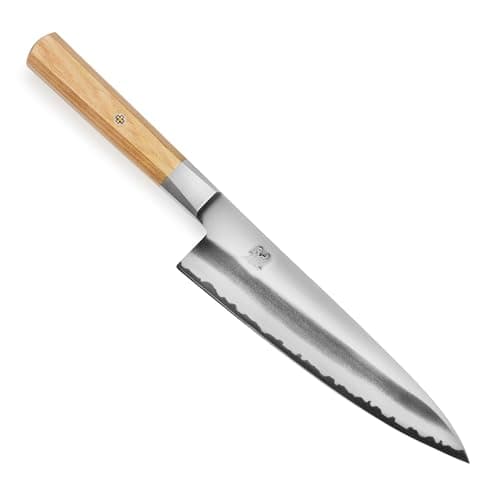
The Koya is the cheapest knife that is genuinely a Miyabi. It is not a trimmed-down version of the line with softer steel or a machine edge — Zwilling publishes FC61 fine carbide stainless at 61 HRC, hand-honed through the three-step Honbazuke process to a 9.5–12° per side edge, which is the same steel family, the same hardness class and the same edge treatment that sits on Miyabi knives costing considerably more. What you give up to get there is fit and finish, not performance.
That is the appeal, and it is also the warning. A 61 HRC blade ground to under 12° per side is the most chip-prone geometry the site ranks. This review is mostly about whether you are the person that geometry suits — and about one piece of model-naming confusion that is worth five minutes before you click buy.
What Zwilling publishes
Miyabi is a Zwilling brand, and Zwilling's own product page for item 33971-203— listed as "MIYABI KOYA 4000FCv2 8-inch, Gyutoh, beige" — is unusually complete for this category. Every figure below is theirs.
- Steel: FC61 fine carbide stainless steel.
- Hardness: 61 Rockwell.
- Edge: 9.5–12° per side, hand-honed Honbazuke, finished "Razor Edge Extra Smooth" (PVA).
- Blade: 200 mm / 7.87 in.
- Handle: octagonal beige Pakkawood, 13.5 cm long and 1.9 cm wide, over a concealed tang.
- Weight: 0.174 kg / 0.38 lb — about 6.1 oz.
- Origin: handcrafted in Seki, Japan.
Three of those numbers do the real work. 61 HRCis hard by any standard — a Victorinox Fibrox runs around HRC 55–56 and a Wüsthof Classic around HRC 58, so this blade holds a keen edge several times longer than either, and knife hardness explained covers what the scale actually buys you. 9.5–12° per sideis acute even for a Japanese knife, where 15° is the common grind and a German blade sits nearer 20°. And 174 gis light — lighter than the Tojiro DP (~210 g), lighter than the Shun Sora (~188 g), and considerably lighter than Miyabi's own Kaizen II (~224 g).
A note on what Zwilling calls FC61: it is the same fine-carbide stainless used across the 4000FC family, and the "fine carbide" description is the point. A fine, evenly distributed carbide structure is what lets a steel be taken to a very acute apex without the edge crumbling at the micron scale, which is why this geometry is possible at all. The honest caveat is that Zwilling does not publish a full alloy breakdown, so FC61 is a proprietary designation rather than a composition you can look up and compare the way you can with VG10 or X50CrMoV15.
The Koh / Koya problem — check the item number
This is the practical thing to get right, and it is the reason the review spends a section on it.
Zwilling's US site has historically listed a Koh8-inch chef's knife (item 33951-203), while the Canadian and UK stores list the Koya 4000FCv2 (item 33971-203). The published specs are the same on both: FC61, 61 HRC, Honbazuke, octagonal Pakkawood, concealed tang, Seki. Zwilling itself uses both names across overlapping pages in the same 4000FC family, so the two are best treated as naming generations of one range rather than two different knives.
What that means for you. Buy on the specification, not the name. If a listing says FC61, 61 HRC, Honbazuke and an octagonal handle, it is this knife whichever word is on the box. If a listing is vague about any of those, treat it as a different product until it is confirmed — Miyabi's range runs from this up through 5000FCD, Birchwood and Mizu lines, and the steel and handle change as you go.
The wa handle: what the octagon changes
The Koya has a wahandle — a Japanese-pattern handle, octagonal in cross-section, mounted over a concealed tang, with no bolster and no Western-style riveted scales. If you have only ever held German or Western-Japanese knives, this is the biggest single difference in the knife, bigger than the steel.
What it does well. An octagon has flats, and flats tell your fingers which way the blade is facing without you having to look. It encourages the pinch grip almost by itself, because the most comfortable place to hold it is forward, near the blade — how to hold a chef knife covers the grip this handle wants. The handle is also slim at 1.9 cm, so it suits smaller hands better than a chunky Western handle, and it is symmetrical, which means it does not favor one hand over the other the way a D-shaped handle does.
What it costs you. Balance moves forward. With no bolster and a light concealed tang, the weight sits over the blade rather than at your hand, which reads as nimble to someone used to Japanese knives and as front-heavy to someone used to a Wüsthof. It is also wood with no riveted construction holding it together, so it genuinely cannot go in a dishwasher — see can you put knives in the dishwasher. And Pakkawood is resin-impregnated and far more stable than plain wood, but it is still a glued laminate over a tang rather than a full-tang sandwich, which is a real durability difference from a forged German knife. What is a full tang knife sets out what that construction does and does not matter for.
Koya versus Kaizen II: the Miyabi decision
Within Miyabi, the comparison that matters is the Koya against the Kaizen II, because they share the steel and differ in everything else.
Same: FC61 steel, the Honbazuke hand-honed edge, the 9.5–12° grind, Seki manufacture.
Different: the Kaizen II is forged with a Western handle in Micarta and weighs around 224 g — roughly 50 g more knife, with the balance back at the hand and a conventional grip. The Koya is a concealed-tang wa knife at 174 g. Price favors the Koya clearly; Zwilling positions it as the entry point to the brand.
Which to buy. If you want a Japanese knife that feels Japanese, the Koya, and the money saved is real. If you want Miyabi steel in a knife that handles like the German blades you already own, pay the difference for the Kaizen II. Neither is more or less sharp than the other out of the box; you are buying a handle and a balance point.
Koya versus the knives most people actually compare it to
The Koya sits in an awkward and interesting spot: it costs noticeably more than the value Japanese knives and noticeably less than the premium ones.
Against the Tojiro DP gyuto. The Tojiro is a VG-10 core at ~HRC 60, three-layer clad, ground nearer 15°, 210 mm, ~210 g, with a plain Western handle — and it costs substantially less. On pure cutting it is close. What the Koya buys is the hand-honed edge, the lighter weight, the wa handle and Zwilling's service behind it. If your priority is the most cutting performance per dollar, the Tojiro remains the site's value answer and it is not a close contest.
Against the MAC MTH-80. The MAC is ~HRC 59–61, ground near 15°, with a dimpled blade and a Pakkawood Western handle at ~184 g. It is the more forgiving knife and the more versatile one — a 15° edge survives a careless moment that a 10° edge does not. The Koya is sharper on arrival and thinner at the apex.
Against the Shun Sora. The Sora is the cheaper way into a hard Japanese edge, at 16° per side and with a grippy polymer handle, and its composite construction is deliberately chip-tolerant. Where the Koya wins is material honesty: it is one hard steel with a wood handle, not a premium edge brazed to an ordinary upper.
The pattern is consistent. The Koya is the keenest and the most delicate of the group; best Japanese chef knives for beginners ranks all of them for a first-time buyer, and the Koya sits last in that ranking on purpose — not because it cuts worse, but because it asks the most of its owner.
Living with a 61 HRC blade at 10 degrees
Hard, thin steel does not roll the way soft steel does. It chips. That single sentence is the whole ownership manual, and everything below follows from it.
Boards. Wood or soft plastic only. Glass, stone, ceramic and bamboo-with-hard-resin boards will take microscopic pieces out of this edge, and you will see it as dull patches that honing cannot fix. Wood vs plastic cutting board covers the choice.
No twisting, no bone, no frozen food. A knife at this hardness is a slicing and chopping tool. Use a heavier blade for joints and squash rind — best knives for cutting meat has the right tools for that work.
Hone with ceramic, not a grooved steel. A traditional ribbed steel rod barely bites at HRC 60 and above, and the impact of each pass is a small risk to a 10° apex. A fine ceramic rod is the correct tool here; ceramic vs steel honing rod explains why, and our ceramic rod review covers the one we rank first.
Sharpen on a stone, at the factory angle. Do not let a pull-through sharpener near this knife; the carbide wheels in one are ground for ~20° German edges and will reprofile and tear a Japanese apex. A 1000/6000 water stone, held at the angle it came with, is the right maintenance — how to use a whetstone is the technique and best sharpening stones for Japanese knives is the shortlist. At ~10° you are working a very narrow bevel, so light pressure and patience matter more than usual. A diamond plate will cut this steel faster than a water stone will, but note that a DuoSharptops out at 600 grit and a Sharpal at 1000–1200, none of which is a finishing grit for an edge this acute — use diamond to set the bevel and a fine water stone to finish it.
Dry it. FC61 is stainless and resists rust well for a hard steel, but "stainless" is a resistance rating, not immunity, and the handle is wood over a concealed tang. Hand wash, dry immediately, store on a strip or in a guard. Knife care and storage has the routine.
Who should not buy it
Anyone who has not sharpened a knife on a stone. This is the clearest exclusion on the page. A 9.5–12° edge at 61 HRC will outlast a German knife by months and then need real maintenance, and the first thing that happens to an unmaintained Japanese edge is a chip you cannot hone out. Buy a Tojiro, learn the stone, come back.
Anyone sharing a busy kitchen. A knife that other people will grab for a frozen bagel or scrape across a granite counter is the wrong place for this geometry. Housemates, teenagers and Thanksgiving guests are a real engineering constraint.
Anyone who wants one knife for everything. A gyutoh this thin and this hard is a prep knife, not a universal tool. If you are buying one knife, buy a tougher one — best chef knives is the broader ranking.
Anyone who wants the heft of a bolster. There is no bolster and no full tang here. If the reassuring weight of a forged German knife is what you like about knives, this will feel insubstantial and you will not enjoy it, however sharp it is.
The verdict
The Koya does exactly one thing, and does it honestly: it puts Miyabi's real steel and real hand-honed edge into the cheapest package Zwilling makes. FC61 at 61 HRC, a 9.5–12° Honbazuke bevel, 174 g, an octagonal wa handle, made in Seki. Nothing about the performance is a compromise; the compromises are all in the fittings — a concealed tang instead of a full one, Pakkawood instead of Micarta or birch, and a plainer finish than the lines above it.
Buy it if you already know you are careful with knives, you want your first wa-handled Japanese blade, and you own or will own a water stone. Buy the Tojiro DP instead if value per cut is the brief. Buy the MAC MTH-80 or the Shun Sora instead if you want a hard Japanese edge with more margin for error. Buy the Kaizen II instead if you want Miyabi steel in a Western-handled, heavier knife.
Honest limitations, stated plainly: the most chip-prone geometry we rank; a concealed tang rather than a full one; FC61 is a proprietary designation with no published composition; the Koh/Koya naming across Zwilling's own regional stores is genuinely confusing and you should confirm the item number before you buy; and it is mainly an Amazon and dealer item in the US rather than a core Zwilling US listing.
Where it sits on our lists: best Japanese chef knives for beginners, best Japanese chef knives and Miyabi vs Shun.