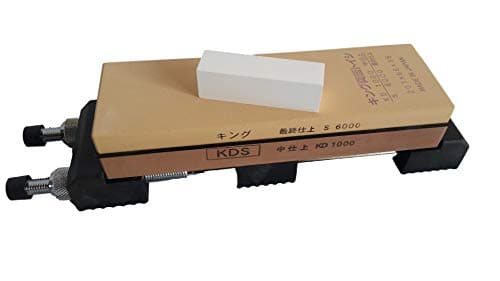
If you ask a room of people who sharpen freehand what they learned on, more of them will say "a King" than anything else. The King KDS 1000/6000 is a soft Japanese combination water stone that costs about the same as a takeout dinner, and it is the stone we hand almost every first-timer in our best sharpening stones ranking. It is not the hardest, the fastest, or the lowest-maintenance stone you can buy. It is the best teacher, and for a first stone that is the only thing that matters.
What the spec sheet tells you
It is a combination water stone with a 1000-grit face on one side and a 6000-grit face on the other, roughly 185 x 63 mm, and it ships in a plastic holder. Two numbers do all the work. 1000 grit is the sharpening grit — coarse enough to grind a new edge in a reasonable time, fine enough to leave a genuinely sharp working edge. 6000 gritis a finishing grit — it removes almost no metal and instead polishes the edge the 1000 side set, taking it from "sharp" to "slides through a tomato under its own weight." For the overwhelming majority of home cooks, that pairing is the whole job: you do not need a five-stone progression to keep kitchen knives keen. The full logic of why is in our grit and angle guide.
Why soft and forgiving is exactly what a beginner wants
The King's defining trait is a soft binder — the clay that holds the abrasive together is comparatively loose. That has one big upside and one big downside, and the upside is the whole reason to buy it. As you sharpen, a soft stone sheds a little fresh abrasive into a gray slurry, so it keeps cutting instead of glazing over, and it gives you an unusual amount of tactile feedback — you can feel the edge bite the stone, feel when the angle is right, and feel the burr form under your fingertips. That feedback is what teaches the skill. A hard diamond plate or a dense ceramic stone cuts faster and stays flatter, but it is a quieter, more clinical surface to learn on. The King talks back, and beginners learn faster for it — which is why we point people here before the how-to-sharpen walkthrough rather than at a fancier stone.
The two chores it asks of you
Here is the honest cost of that soft, friendly surface, because every soft water stone charges it. First, the King is a soaker: you drop it in water for five to ten minutes, until the bubbles stop, before you sharpen. It is not splash-and-go, so it is a poor choice if you want to grab a stone for a thirty-second touch-up and put it away — a hard splash-and-go ceramic suits that better. Second, and more importantly, a soft stone dishes — it hollows out in the middle where the blade rides, and a dished stone physically cannot grind a straight edge. So you have to flatten it periodically with a flattening plate or a coarse diamond stone. On a combination stone the two faces wear at different rates (the 1000 side does more work), so flattening matters a little more, not less. Neither chore is hard, but if you refuse to do them the King will quietly stop giving you a good edge and you will blame the stone.
How it feels in use
Soak it, set it in its holder on a damp towel so it will not slide, and start on the 1000 side. You hold a consistent angle— about 15 to 20 degrees per side for most Western kitchen knives — and grind until a fine burr forms along the whole edge, then work the other side until it flips. Flip the stone to 6000, lighten your pressure, and take that burr off with a few finishing passes and, if you like, a strop. The King's slurry makes each of those stages legible: you can see the metal come off and feel the edge change. The step-by-step, with photos of the burr you are feeling for, is in how to use a whetstone. It works on soft German stainless and harder Japanese steel alike — though on very hard, wear-resistant modern steels a diamond plate will cut faster and the soft King will dish quicker.
1000 or 6000: how to use each side
Almost all of your time lives on the 1000 side. That grit does the actual sharpening — it grinds a fresh edge and raises the burr that tells you you have reached the apex along the whole blade. The 6000 side is a finisher: a handful of light passes to polish the edge the 1000 grit set and to knock the burr off, nothing more. A common beginner mistake is spending too long on the 6000 chasing a mirror finish — it removes almost no metal, so if the knife is not already sharp off the 1000 side, more 6000 will not rescue it; go back to 1000. For everyday kitchen maintenance you rarely need anything coarser than 1000. Reach for a coarse 220–400 grit only to grind out a chip or reset a badly neglected edge, then come back to the King to sharpen and finish. If your knife will not take an edge at all, the cause is usually technique, not grit — here is what to check.
King KDS, KW65 or the Sharp Pebble?
The KDS is the smallest and cheapest of the classic King combinations, which is exactly why it is the one we hand to first-timers. If you want the same forgiving King feel with a bigger face and a steadier rubber base, the King KW65 is a small step up — it tops our beginner list for that reason. If you would rather a combination that ships with an angle guide and a weighted holder so you have everything in the box on day one, the Sharp Pebble 1000/6000 is the one we point most people to. All three are soft soakers that dish and need flattening, so you are really choosing on size, base and what comes in the box — not on the edge they produce, which is much the same forgiving King-style feel.
Who it's for — and who should skip it
Buy the King if this is your first stone and you actually want to learn to sharpen. It is cheap enough that you will not baby it, forgiving enough that a wobbly early angle still produces a sharp edge, and communicative enough that you improve every time you use it. It is the stone we recommend to the same person we send to a soft, cheap beginner knife — the two are the whole starter kit. Skip it if you want a stone you never have to soak or flatten (a hard ceramic or a diamond plateis the low-maintenance answer), if you mainly sharpen very hard powder-steel blades, or if you already know you prefer splash-and-go. It is a learner's stone and a lifelong stone, but it is not a no-maintenance one.
Value
The King is the cheapest honest way into freehand sharpening, and freehand sharpening is the single highest-leverage purchase in a kitchen: a sharp $45 knife out-cuts a dull $190 one every day of the week. For roughly the price of a takeout dinner you get both grits you need to set and finish an edge, plus the most forgiving surface on which to learn the skill. Its close cousin, the King KW65, adds a bigger face and a rubber base for a little more; the diamond and ceramic alternatives cost more and ask less maintenance. But nothing teaches for less. If you are going to own one stone and learn to use it, the King KDS is still the default answer — just remember it only sharpens. Between sharpenings, keep the edge aligned with a honing steel, and understand why in sharpening vs honing.